Key Takeaways
1. Modern Thought's Flawed Authority
What I wish to question are not the methods of science, but the methods of a kind of argument that claims the authority of science or highly specialized knowledge, that assumes a protective coloration that allows it to pass for science yet does not practice the self-discipline or self-criticism for which science is distinguished.
Questioning legitimacy. A significant body of contemporary literature, often termed "parascientific," purports to speak with scientific authority on human nature and the mind. However, this work frequently lacks the rigorous self-discipline and critical evaluation characteristic of true scientific inquiry. It often adopts a "protective coloration" to appear scientific, while its underlying arguments are polemical and predetermined.
Predetermined conclusions. These writers, including sociologists, evolutionary psychologists, and philosophers, often start with a favored conclusion and then recruit whatever rationalization supports it. Their arguments are not harmonious with one another, except in their shared outcome: that positivism correctly excludes anything science cannot verify or falsify. This approach leads to systematically reductionist conceptual vocabularies, particularly concerning human nature.
Limited scope. The narrow terms these authors deem appropriate for discussing human origins and nature inevitably yield a very limited conception of humanity. This excludes vast observations and speculations offered throughout history by thinkers outside their "closed circle" of modern thought. Such a restricted view prevents a comprehensive understanding of our species.
2. The Dismissal of Inwardness
I propose that the core assumption that remains unchallenged and unquestioned through all the variations within the diverse traditions of ‘‘modern’’ thought is that the experience and testimony of the individual mind is to be explained away, excluded from consideration when any rational account is made of the nature of human being and of being altogether.
Excluding subjective experience. A fundamental, yet often unexamined, assumption in modern thought is the systematic exclusion of the individual mind's experience and testimony from any rational account of human nature. This dismissal extends to the "felt life of the mind," which is deemed irrelevant or subordinate to reductionist explanations. This approach impoverishes our understanding of what it means to be human.
Consequences for understanding. By marginalizing individual subjectivity, these theories fail to acknowledge the mind as the solitary, perceiving, and interpreting locus of all experience. This oversight is critical because the mind's unique perspective is central to human life, language, and culture. No philosophy or cognitive science should be allowed to evade this fundamental fact.
A motive or a consequence? The diverse schools of modern thought, despite their incompatibilities, converge on this shared impulse to nullify individual experience. This suggests that the exclusion of inwardness might be as much a driving motive as it is a consequence of their rigorous, yet narrow, theoretical frameworks. This suppression of subjective testimony has profound implications for how we understand ourselves.
3. The "Threshold" Illusion
A model that shapes contemporary writing across any number of fields is the crossing of the threshold. It asserts that the world of thought, recently or in an identifiable moment in the near past, has undergone epochal change.
Epochal change narrative. Many contemporary writers operate under the "threshold" myth, claiming that modern thought has crossed a definitive boundary, leaving behind past errors for a new, enlightened understanding. This narrative often assumes pervasive error in previous thought and its survivals, asserting a prerogative to characterize the past and establish new terms for discourse.
Uncritical dismissal of history. This triumphalist posture often leads to a condescending view of history and traditional wisdom, frequently misrepresenting earlier states of knowledge or failing to inquire into them. For example, the idea that ancient flood narratives were a "startling modern discovery" overlooks centuries of scholarship that acknowledged such parallels. This selective engagement with history serves to bolster the claim of radical departure.
The "modern" as immutable. The belief that we have entered an era of "modern thought" implies a one-way door, where major illusions have been dispelled for good. This perspective often treats insights from figures like Darwin, Marx, and Freud as ahistorical, immutable truths, making criticism seem like nostalgia or skepticism. This creates a rigid intellectual landscape resistant to re-evaluation.
4. Altruism's "Strange History"
No theory contemporary with us or influential among us would suggest that humankind is characterized by an ‘‘inherent tendency to universal love.’’
The problem for reductionism. Altruism, defined as selfless devotion to others, poses a significant challenge to parascientific theories, particularly neo-Darwinism, which typically assume self-interest as the primary driver of behavior. Since altruism seemingly confers benefit at a cost to oneself, it appears to contradict the evolutionary imperative of genetic survival.
Redefining altruism. To reconcile this anomaly, theorists often redefine altruism as a form of disguised self-interest.
- "Soft-core" altruism: Expects reciprocation from society or benefits for close relatives.
- Manipulation: Informative speech is seen as a means to manipulate others for personal gain, such as sexual payoff.
- Genetic selfishness: Hamilton's rule (r * b > c) suggests altruism towards kin is driven by the gene's "selfish" interest in its own propagation.
Denying genuine motivation. This reductionist approach dismisses the possibility of genuine selfless motivation, attributing apparent altruism to "lying, pretense, deceit, and self-deceit." It implies that our conscious experience of generosity is an illusion, a mere mechanism by which our genes or memes manipulate us for their own purposes. This perspective impoverishes the understanding of human compassion and conscience.
5. Freud's Contextualized Theories
Rereading Freud, I have come to the conclusion that his essays, and therefore very central features of his thought, most notably the murder of the primal father with all its consequences, were meant to confute theories of race and nation that were becoming increasingly predominant as he wrote.
A counter-narrative to racial nationalism. Freud's metapsychological essays, particularly his theory of the primal parricide and its consequences, can be understood as a direct, albeit implicit, challenge to the racial and nationalist ideologies prevalent in early 20th-century Europe. In a climate of intense anti-Semitism and theories of ethnic purity, Freud offered a universal anthropology that transcended these divisive categories.
Universalizing anxiety. Instead of attributing European malaise to "foreign elements" or "deracination," Freud posited that human anxiety and discontent were inevitable, phylogenetic consequences of civilization itself, stemming from a universal primal act. This narrative, while unsentimental, effectively erased racial and national differences as essential determinants of human character.
Morality's origins. Freud's emphasis on the Oedipal crime and its internalization as conscience provided an alternative origin for morality, distinct from Nietzsche's cultural genealogy. By placing the source of moral behavior in a primordial, universal event, Freud argued that morals were not historically contingent or subject to "transvaluation" by specific groups, thereby countering anti-Semitic claims about Jewish influence on European values.
6. The Mind as a Shielded Self
This little entity, ‘‘threatened by the enormous energies at work in the external world,’’ forms a ‘‘crust’’ to defend itself against, in e√ect, experience.
A defensive consciousness. Freud's biological origins theory, particularly in Beyond the Pleasure Principle, portrays consciousness as fundamentally defensive. He suggests that the nervous system, originating from the outermost surface of an organism, forms a "protective shield" against the overwhelming energies of the external world. This "crust" limits the reception of stimuli, making existence tolerable.
Rationing awareness. In this model, the world itself is an intolerable threat, and awareness is strictly rationed by the selectivity of the senses. This contrasts sharply with Romantic or traditional philosophical views that propose intuitive contact with profound reality as possible and normative. Freud's "oceanic feeling" is dismissed as infantile or pathological, further emphasizing the mind's isolation.
A besieged being. Freud's conception of consciousness is one of a being constantly besieged and beleaguered, not by Darwinian nature's vital energies, but by the undifferentiated barrage of cosmic stimuli. This model suggests that authenticity, truth, or meaning cannot be directly imparted by the external world, as the mind's primary function is self-preservation through limited engagement.
7. The Enduring Dualism
The supposedly immaterial soul, we now know, can be bisected with a knife, altered by chemicals,’’ and so on. By identifying the soul with the mind, the mind with the brain, and noting the brain’s vulnerability as a physical object, he feels he has debunked a conception of the soul that only those who find the word meaningless would ever have entertained.
Perpetuating the dichotomy. Despite claiming to reject the mind-body dichotomy, many modern reductionist arguments inadvertently perpetuate it. By disparaging the physical (e.g., calling the brain a "lump of meat") while simultaneously asserting that the mind is merely the brain's activity, they maintain a qualitative divide. This approach fails to acknowledge the inherent brilliance and complexity of the physical body itself.
The "ghost in the machine" fallacy. Arguments that "debunk" the soul or mind by pointing to the brain's physical vulnerability often attack a straw man. If the mind is indeed the activity of the brain, then the brain is capable of astonishing things that have been given names like "mind," "soul," and "spirit." To dismiss these terms based on the brain's physicality is to misunderstand the profound capabilities of complex biological matter.
Ignoring quantum reality. The old distinction between materiality and nonmateriality is increasingly untenable in light of modern physics. Phenomena like quantum entanglement, where changes occur instantaneously across vast distances, challenge our conventional understanding of physical causality. To confidently oppose the "physical" to a "nonphysical" mind, without acknowledging the uncanny properties of matter, is to cling to an outdated positivist dogma.
8. Humanity's Unsolved Mystery
The great di√erence between parascientific thought on one hand and religion and traditional philosophy on the other is perhaps encapsulated in that word ‘‘solve,’’ assuming the use of the word is not simply a casual imprecision.
Beyond "solvable" problems. Parascientific thought often frames understanding as "solving" mysteries, implying a finite, conquerable knowledge, much like Auguste Comte's vision of science. However, the human mind's complexity, its capacity for profound questions, and its unique cultural expressions are not problems to be simply "solved" or reduced to simple formulae.
The "imponderables" of existence. Even proponents of reductionism acknowledge "imponderables" like consciousness, self, free will, and morality, which humankind has pondered endlessly. To dismiss these as insoluble, or beyond the mind's cognitive equipment, is to prematurely close off inquiry. Every real question, even if insoluble, is fruitful, as demonstrated by the history of human thought.
An open question. The human mind, the most complex object known, continuously imposes itself on reality, shaping history, art, science, and philosophy. What we are, and what the mind is, must therefore remain an open question, evolving as we respond to new circumstances. To reduce humanity to an "optimized ape" or a "pipeline to the truth" is to deny the terrible and glorious mystery of our nature.
9. Science's True Nature
And it is also an illustration of the fact that science does not foreclose possibility, including discoveries that overturn very fundamental assumptions, and that it is not a final statement about reality but a highly fruitful mode of inquiry into it.
Inquiry vs. dogma. True science is a dynamic, self-correcting mode of inquiry that consistently exceeds expectations and overturns fundamental assumptions. It does not foreclose possibility but embraces discoveries that challenge existing paradigms, such as the accelerating expansion of the universe. This contrasts sharply with "parascientific" thought, which often uses scientific language to assert fixed conclusions and close questions.
Challenging fixed assumptions. The discovery of dark matter and dark energy, for instance, demonstrates that reality consistently exceeds scientific expectations, and that even tried and rational assumptions can encourage false expectations. Genuine science adapts to solid data, even if it means revising venerable natural laws. This openness is a hallmark of scientific brilliance.
The polemical reflex. The tendency in "parascientific" literature to exclude phenomena that don't fit its models, or to scold them for their "atavistic persistence," is a reflex of a polemical impulse. This impulse, rooted in positivism's historical opposition to religion, seeks to assert scientific authority by limiting the scope of what is considered relevant or real, rather than expanding understanding.
10. The Richness of Human Testimony
History and civilization are an authoritative record the mind has left, is leaving, and will leave, and objectivity deserving the name would take this record as a starting point.
The mind's enduring record. The most compelling proof of the mind's existence and complexity lies in the entirety of human history and civilization, including art, science, and philosophy. These are not mere "ruses" or "concealments" of a primitive nature, but profound expressions of human exceptionalism and the mind's unique capabilities.
Beyond reductionist data. Objectivity, truly deserving of the name, would begin by acknowledging this overwhelmingly rich "reef of collective experience" and individual introspection. To exclude these data, as reductionist schools often do, is to ignore the very phenomena that define human nature. The mind's continuous self-expression in new terms provides an endless source of insight.
The burden of complexity. The human brain, the most complex object known, and all associated phenomena are central to understanding the mind. To simplify or limit this complexity to fit reductionist models is to deny the profound mystery we embody. The "gifts" of human experience, perception, and thought are too rich to be excluded from any comprehensive account of what we are.
Review Summary
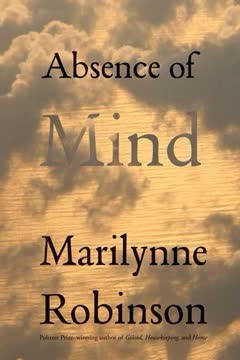
Reviews of Absence of Mind are mixed, averaging 3.8/5. Admirers praise Robinson's elegant prose and sharp critique of "parascientific" thinkers like Dawkins, Dennett, and Pinker, applauding her defense of subjective human experience and inner life against reductive materialism. Critics find her arguments meandering, overly allusive, and occasionally self-contradictory, noting she sometimes targets outdated ideas while projecting onto science the rigidity she associates with religion. The Freud chapter divides readers sharply. Most agree the writing is exceptional, even when the philosophical reasoning feels incomplete or insufficiently rigorous.