
Plot Summary
Coffee with the Enemy
Belfast, early 1970s. The Troubles have carved the city into Protestant and Catholic territories walled off by barbed wire and suspicion. Sadie Jackson,1 a sharp-tongued Protestant girl of sixteen, spots Kevin McCoy2 in a crowd — the dark, restless Catholic boy she once fought and then befriended three summers ago. Over coffee and hamburgers, their old banter returns as if the years hadn't passed.
At the bus stop, Linda Mullet8 — Sadie's1 neighbor — recognizes Kevin's2 unmistakably Catholic name and hurries off. Sadie1 doesn't care. She and Kevin2 ride to Cave Hill, where the city lies peaceful below them and he touches her fair hair. Both sense they are embarking on something dangerous, but neither has ever been inclined to retreat from danger.
Brandy and a Hidden Rifle
Linda8 wastes no time. Visiting the Jacksons under pretense of seeing Sadie's brother Tommy,5 she drops Kevin's2 name like a grenade into the kitchen. Mrs Jackson9 grips the table and requires brandy. Mr Jackson10 forbids Sadie1 from seeing Kevin.2 Sadie1 threatens to leave home — she's nearly seventeen, and no one can drag her back. Tommy5 tries to mediate but fails.
Across the barricades, Kevin2 faces a different pressure. Brian Rafferty,6 his childhood friend, leads him upstairs and reveals a rifle and ammunition hidden under his bed — Provisional IRA weaponry. Brian6 wants Kevin2 to hide it in the scrapyard where Kevin2 works. Kevin2 refuses and calls him a fool. Brian6 points the rifle down the stairs at Kevin's2 retreating back and laughs softly.
Rain, Rage, and a First Kiss
Saturday in Bangor. They swim in the freezing outdoor pool at Pickie, picnic on the rocks, and compete at the shooting gallery where Kevin2 proves unnervingly accurate.
But on Ballyholme sands, Sadie1 needles him about confession and the power of priests; he retaliates by mocking Protestants for worshipping a dead Dutchman on a white horse. She accuses Catholics of wanting to outnumber them. He calls her afraid. He storms off across the darkening sand. Rain begins — first drizzle, then solid sheets.
Kevin2 returns to find her still crouching in the downpour, stubborn and soaked. He hauls her to a shelter and calls her a stupid twit. His mouth softens. He kisses her. They hold each other while rain hammers the roof, and miss the last bus without caring.
Fathers and Gunfire
Uncle Albert,11 Kevin's2 irrepressible uncle, rescues them from the roadside in his sputtering wreck of a car — which promptly overheats and dies. They walk the remaining miles through a Belfast crackling with violence: a burning shop, armoured cars, rioting.
At three in the morning, Sadie's father10 and Linda's father Mr Mullet12 stand blocking the street alongside Tommy.5 Mr Mullet calls Kevin2 a coward and a sneaking Catholic; Kevin2 seizes the older man by the shoulders, towers over him, but holds back. Tommy5 spots two more men approaching and talks everyone into retreating.
Kevin2 zigzags home alone through streets alive with gunfire. A burst from a machine gun sends him flat on the pavement — across the road, a civilian lies dead. Near home, Brian Rafferty6 intercepts him, grinning. Uncle Albert11 had cheerfully mentioned Sadie's1 name.
Three Against One
Walking home from a midnight parting with Sadie,1 Kevin2 is jumped by three attackers outside the scrapyard. He recognizes Brian Rafferty's6 voice and laugh before the boots find his ribs. Mr Kelly,14 the scrapyard owner, discovers Kevin2 unconscious and calls an ambulance — three stitches close the gash in his head.
When Kevin's sister Brede3 learns the reason for the beating, she does something remarkable: she navigates alone into Protestant territory, past the King Billy murals and hostile graffiti, to find Sadie.1
But Sadie1 has already been sacked from her hat-department job — a colleague learned she was dating a Catholic. Brede3 delivers the news of Kevin's2 injuries and pleads with her to stop seeing him before more blood is shed. Sadie1 listens — because it's Brede3 asking, not because she agrees.
Twinkle Blake's White Gate
Kevin2 drags himself to the riverpath for their evening meeting, bandaged and half-fainting, refusing to let Sadie1 think he stood her up. A retired teacher walking his dog finds him slumped against a tree — Mr Blake,4 once nicknamed Twinkle for his bright blue eyes, who taught Sadie1 geography years ago.
Sadie1 arrives at a sprint. Mr Blake4 drives them to his suburban house and calls his doctor friend. Sadie1 tells Kevin2 this must be their last meeting, but Mr Blake4 invites them for Friday supper — and something shifts.
When a petrol bomb kills the shopkeeper on Sadie's1 street, Sadie1 seeks Mr Blake4 for comfort. He offers her morning work; afternoons, she babysits for his neighbor Moira Henderson,13 a Catholic painter married to a Protestant. A fragile new world takes root around the white gate.
Kate Kelly's Lie
Kevin2 rejects Kate Kelly,7 the scrapyard owner's daughter, who has long considered them a couple. She runs home crying — and begins spending time with Brian Rafferty.6 When the army searches the neighborhood and finds nothing at the Raffertys', Kevin2 suspects Brian6 has moved his arsenal.
He is right: the rifle surfaces in Kelly's14 scrapyard, and Kate7 tells soldiers she witnessed Kevin2 carry it in. Armed men bang on the McCoys' door at night. Kevin2 is taken for questioning while his father blusters and Uncle Albert11 suggests escape over the back wall.
Before dawn, Brede3 runs to the police station and quietly reveals that Kate7 has a personal grudge — Kevin2 rejected her. The officer, already skeptical, releases Kevin.2 But Mr Kelly14 fires him from the scrapyard, believing his daughter over his worker.
Blood and Loosened Bolts
Kevin2 waits in an alley at dawn and beats Brian Rafferty6 with bare fists — payback for the beatings, the framing, every cowardice. He arrives at Mr Blake's4 with blood on his shirt that isn't his own, confessing that standing over Brian's6 crumpled body, the triumph curdled into nausea.
Mr Blake4 listens, puffs his pipe, and says nothing judgmental. What he does not mention are the anonymous threatening letters arriving each morning, which he burns in the grate without telling anyone. Days later, on a country drive together, the car lurches violently — a front wheel spins free across the road.
Police discover every nut on every wheel had been methodically loosened. Sadie1 thinks of a Protestant boy who'd recently threatened her. Kevin2 thinks of Brian's6 unnamed accomplices. Mr Blake4 thinks of the letters. None of them speaks.
The Twelfth at Bangor
Kevin2 stops calling Sadie1 to protect her, and the days curdle into weeks. He collects the dole, walks rubble-strewn streets, watches his mother worry about the new baby. Sadie1 sits in her bedroom writing letters to Kevin2 and tearing them up.
Someone paints TRAITOR on the Jacksons' gable wall; Tommy5 and Sadie1 scrub it off, and it reappears. The Twelfth of July arrives — bonfires, Orange parades, drums. Her family goes out. Alone in the deserted street, Sadie1 catches a bus to Bangor on impulse.
She finds Kevin2 leaning against the sea wall, watching the rain. He had a feeling she might come. Over coffee he tells her he's unemployed and may have to leave Belfast entirely. The sparkle dies in her eyes. They agree to resume careful meetings at Mr Blake's.
Ashes at the White Gate
Moira Henderson's13 husband Mike16 drives to the Jacksons' house before seven in the morning. When Sadie1 opens the door and reads his face, she already knows. Mr Blake4 is dead — a petrol bomb hurled through his window in the night. The house burned in minutes. He never got out. Sadie1 collapses at the kitchen table, weeping, insisting it's her fault.
At the funeral, Kevin2 walks behind the coffin with his face drained of color. Afterwards at Moira's,13 he says he could kill whoever did it, then catches himself — he doesn't want their blood on his hands. On Cave Hill, where they once watched the city lie peaceful below them, he tells Sadie1 he's leaving next week. Not running away, he says. Just refusing to stay where kindness is a death sentence.
The White, Waiting Ship
Kevin2 packs his suit, takes sandwiches and a thermos from his mother, and pockets a five-pound note his father presses into his hand. He walks down the street with Brede3 at his side, waves to the younger children, passes Mrs Rafferty at her door. At the scrapyard gate, Kate Kelly7 tries to apologize — Brian6 forced her to lie, she admits. Kevin2 barely hears her.
It is all behind him now. At the Liverpool ferry shed, the funnels loom through dock-smell of sea and oil. And there stands Sadie1 — not to see him off, but holding a ticket. She's coming with him. He drops his suitcase and lifts her off the ground, spinning her breathless with laughter. Hand in hand, they walk across the shed toward the white ship.
Analysis
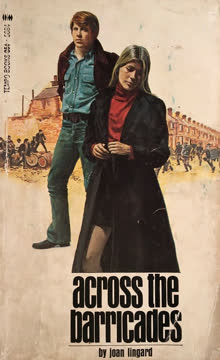
Across the Barricades interrogates a question political analysis typically renders abstract: what does sectarian division cost at the level of daily human experience? Joan Lingard's answer is granular and domestic. The cost is measured in bus routes not taken, streets not walked down, a boy beaten outside a scrapyard for kissing the wrong girl. The novel refuses to treat the Troubles as backdrop; it demonstrates how political conflict colonizes the most intimate spaces — kitchen tables, bedrooms, shop counters, bus stops.
The book's most sophisticated move is its treatment of complicity. No character is a straightforward villain. Brian Rafferty6 begins as Kevin's2 friend before ideology calcifies into vendetta. Kate Kelly7 acts from romantic humiliation rather than political conviction. Even Mrs Mullet's12 relentless gossip operates within a logic of community self-protection. Lingard reveals how ordinary social mechanisms — gossip, family loyalty, neighborhood surveillance — become instruments of enforcement in a divided society. The street is simultaneously home and panopticon.
Mr Blake4 functions as the novel's moral center precisely because he exists outside both communities' gravitational pull. His suburban villa is an island of individual conscience in a city organized by collective identity. That this island proves unsustainable constitutes the book's darkest argument: goodness positioned between opposed tribalisms becomes the primary target of both.
Crucially, the novel offers no resolution through reconciliation. Sadie1 and Kevin2 do not bridge their communities; they flee them. Their departure is simultaneously an act of courage and an admission that some social structures cannot be reformed from within by individual love — they can only be survived by leaving. This is a profoundly unsentimental conclusion for a young adult novel, one that grants the story lasting honesty. The white ship at the dock is not a symbol of triumph but of exile freely chosen — the only freedom available when both sides of a barricade agree that you no longer belong on either.
Review Summary
Across the Barricades is a beloved young adult novel set during The Troubles in Northern Ireland. Readers appreciate its portrayal of forbidden love between Catholic Kevin and Protestant Sadie amidst sectarian violence. Many found it engaging, authentic, and impactful, praising the characters and historical context. Some criticized the writing style as simplistic or flat. Overall, reviewers felt it effectively introduced the complex issues of the time to young readers, though opinions on its quality varied. The book remains memorable for many who read it in school.
People Also Read
Characters
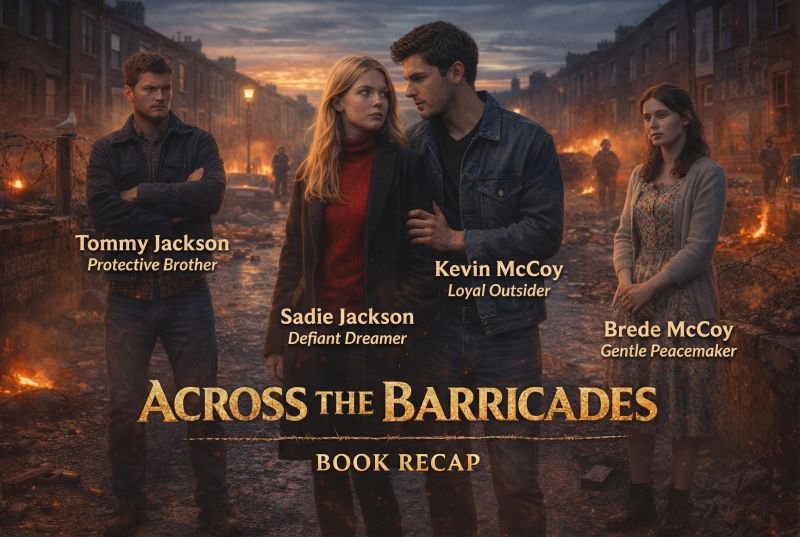
Sadie Jackson
Defiant Protestant girlProtestant. Sixteen, going on seventeen. Fair-haired, sharp-tongued, fearless to the point of recklessness. Sadie is constitutionally incapable of submission—to her mother's9 nagging, Linda Mullet's8 gossip, or anyone's decrees about whom she should love. Beneath her defiance lives a girl hungry for something more authentic than the narrow streets she was born into. She mocks hat-department customers, quits jobs on principle, and tells authority figures exactly what she thinks. Yet her stubbornness is more than rebellion—it's a moral compass pointing toward honesty, even when honesty costs her. With Kevin2, she finds someone whose restlessness matches her own, and the match illuminates how confined her world has been. Her psychological signature is a refusal to perform compliance, rooted in the conviction that cowardice often disguises itself as common sense.
Kevin McCoy
Restless Catholic boyCatholic. Nearly eighteen. Dark, strong from years of lifting scrap, perpetually restless within the few streets that constitute his world. Kevin carries the tension of a young man who believes in Ireland's cause intellectually but recoils from its cost in human flesh. Brian Rafferty's6 rifle disgusts him; his own fists, when circumstances demand them, leave him nauseated. He is torn between the instinct to fight and the knowledge that fighting solves nothing. With Sadie1, he discovers joy that has no political dimension—swimming in freezing water, throwing stones at waves—and it sharpens his awareness of how little joy his streets contain. His defining struggle is against the gravitational pull of sectarian violence, which seeks to recruit every young Catholic man whether he volunteers or not.
Brede McCoy
Kevin's devoted sisterKevin's2 younger sister, a nursery nurse with soft brown eyes and quiet moral authority. Brede is the McCoy family's conscience: she challenges Brian Rafferty's6 war games, navigates Protestant territory alone to warn Sadie1, and defends Kevin2 at the police station before dawn. She carries her family's domestic burdens—cooking, mending, minding babies—without complaint, yet her gentleness conceals a will as firm as her brother's. She worries not from weakness but because she understands consequences better than anyone around her.
Mr Blake
Retired teacher, their shelterSadie's1 retired geography teacher, a widower with bright blue eyes and the nickname Twinkle. He lives alone with his dog Jack in a quiet suburban house where the Troubles feel distant. He offers Sadie1 and Kevin2 what no one else can: a neutral space where a Protestant girl and a Catholic boy are simply two young people having supper. Principled, gentle, and stubbornly decent, he refuses to let fear dictate his choices. His loneliness is eased by their company, and he quietly stakes his own safety on the belief that individual kindness matters more than collective tribal loyalty.
Tommy Jackson
Sadie's peacemaking brotherSadie's1 older brother, an apprentice welder. Tommy is the family peacemaker who defuses confrontations between his father10 and sister, restrains hotheaded neighbors, and navigates between loyalty and conscience. He once refused to march in the Orange parade after Brede3 nearly died in a sectarian fight. Steady, decent, and conflict-averse—effective as a mediator but unable to change anything larger than the next five minutes.
Brian Rafferty
Kevin's radicalized former friendKevin's2 childhood friend, now gravitating toward the Provisional IRA. Tall, broad-shouldered like his brawling father Pat, Brian hides weaponry and recruits neighborhood boys for the paramilitary cause. When Kevin2 refuses to join and begins dating a Protestant, Brian's ideology hardens into personal vendetta. He represents the transformation of neighborhood loyalty into organized sectarian violence, the boy next door who becomes the enforcer.
Kate Kelly
Jealous scrapyard owner's daughterBrede's3 friend and the scrapyard owner's daughter. Kate is infatuated with Kevin2, interpreting his polite tolerance as an exclusive relationship. She lavishes time on her appearance—false eyelashes, painted nails—and clings with increasing desperation. When rejected, her wounded pride becomes her most dangerous quality, driving her into alliance with Brian Rafferty6 against the boy who spurned her.
Linda Mullet
Neighborhood gossip, Tommy's girlSadie's1 neighbor and Tommy's5 girlfriend. Linda's defining act is gossip deployed as moral duty—she reveals Kevin's2 identity to the Jacksons with calculated innocence, claiming the information slipped out. She mirrors her mother's12 surveillance culture, using information as social currency. Her rivalry with Sadie1 is rooted in envy of Sadie's1 fearlessness and resentment that Tommy5 admires his sister more than his girlfriend.
Mrs Jackson
Sadie's anxious motherSadie's1 mother. Perpetually in hair rollers, perpetually anxious. Her world is the kitchen, the television, and the street's opinion. She loves Sadie1 fiercely but cannot begin to fathom her.
Mr Jackson
Sadie's Orange Lodge fatherSadie's1 father, a lifelong Orange Lodge member. Usually mild-tempered, but his daughter's relationship with a Catholic boy triggers protective fury he barely contains. Loyal to his lodge, bewildered by his daughter.
Uncle Albert
Kevin's lovably unreliable uncleKevin's2 uncle. Irrepressibly cheerful, father of eleven, never worked a day if he could avoid it. Devoted to an ancient car that barely runs, his loose tongue accidentally exposes Kevin's2 secret to the wrong people.
Mrs Mullet
Street surveillance in spiky heelsLinda's8 mother. The street's self-appointed information network, permanently stationed at her doorstep in spiky heels, trading gossip with the persistence and authority of a newsreader.
Moira Henderson
Catholic painter, mixed marriageA Catholic painter married to a Protestant, living near Mr Blake4. Her mixed marriage represents the possibility—and fragility—of cross-sectarian love among the middle class.
Mr Kelly
Scrapyard owner, Kate's fatherKate's7 father, the scrapyard owner who employs Kevin2. A small, strong, good-humored man caught between loyalty to his best worker and belief in his daughter.
Steve
Tommy's Lodge-joining friendTommy's5 friend, newly enlisted in the Orange Lodge. He pressures Tommy5 to join and physically intimidates Sadie1 for associating with a Catholic.
Mike Henderson
Moira's Protestant husbandMoira's13 husband, a Protestant married to a Catholic. He delivers the worst news of the story and represents the quiet courage of those who cross the sectarian line through marriage.
Plot Devices
The Barricades and Barbed Wire
Physical map of divisionThe barbed-wire barricades strung across Belfast streets dictate every movement Sadie1 and Kevin2 make. They determine which routes are safe, where Kevin2 risks being identified, and where Sadie's1 territory ends. The barricades function as both literal obstacle and central image: Sadie1 and Kevin2 cannot walk together through either neighborhood, so they must always meet in neutral ground or outside the city entirely. When Sadie1 stands at the barricades longing to reach Kevin2 on the other side, the wire crystallizes the story's central problem—a physical manifestation of social, religious, and political divisions separating two people who live streets apart. The barricades shape not just the plot's geography but its emotional logic: love requires detour, secrecy, and constant vigilance.
Mr Blake's House
Neutral sanctuary for loversThe quiet suburban villa with its white gate, laburnum tree, and rose garden is the only place in Belfast where Sadie1 and Kevin2 can exist as a couple without fear. Mr Blake's4 house operates as a third space—neither Protestant nor Catholic, removed from both communities' surveillance. It is where Kevin2 recovers from his injuries, where Sadie1 discovers satisfaction in domestic work, and where they share evenings without looking over their shoulders. Sadie1 works there mornings; Kevin2 visits when he can. The house embodies the novel's argument that individual kindness can create pockets of normalcy within systemic violence. But its very existence as a cross-community refuge also makes it a target for those who enforce the sectarian order.
Brian's Rifle
Escalation catalystThe gun hidden under Brian Rafferty's6 bed introduces lethal stakes into what has been a story of fistfights and gossip. It represents the threshold between childhood sectarian scuffles and adult paramilitary violence. Brian6 first attempts to make Kevin2 complicit by pressuring him to hide the weapon in the scrapyard; when Kevin2 refuses, the rifle becomes an instrument for framing him. Its journey—from bedroom to scrapyard to army evidence—traces the mechanics of how violence ensnares the unwilling: not through ideology alone, but through proximity, betrayal, and a spurned girl's7 testimony. The device links Brian's6 radicalization, Kate's7 jealousy, and Kevin's2 vulnerability into a single chain of causation that costs Kevin2 his livelihood.
The Anonymous Letters
Foreshadowing hidden threatFour mornings in a row, threatening letters arrive at Mr Blake's house. He burns each one without telling Sadie1 or Kevin2, protecting them from anxiety while unwittingly shielding his attackers from scrutiny. The letters represent the invisible machinery of sectarian intimidation—anonymous, untraceable, deniable. They reveal Mr Blake's4 character: he would rather absorb danger alone than burden the young people he is helping. The letters function as dramatic irony, visible to the reader only after additional violence occurs, creating retroactive dread. They also raise the unanswered question of who sent them—Protestant extremists targeting a man who harbors a Catholic, Catholic hardliners punishing Kevin's2 Protestant connection, or some combination of both.
Uncle Albert's Car
Comic catalyst and plot driverThe ancient, backfiring vehicle serves multiple narrative purposes. Its breakdowns strand characters in revealing situations—the midnight walk through rioting Belfast that forces the confrontation with Sadie's father10. Uncle Albert's11 cheerful mention of Sadie1 to Brian Rafferty6 inadvertently exposes Kevin's2 secret to his most dangerous former friend. Later, the car ferries Kevin's2 parents to the countryside, leaving him responsible for the household. The car's unreliability provides necessary comedy in a dark story while being genuinely functional: in a city of checkpoints and barricades, mobility matters, and this vehicle provides just enough to move the plot forward while reliably failing at the worst possible moments.
FAQ
Synopsis & Basic Details
What is Across the Barricades about?
- Divided Belfast, Young Love: The novel centers on Sadie Jackson, a Protestant, and Kevin McCoy, a Catholic, who rekindle a childhood friendship amidst the violent backdrop of 1970s Belfast.
- Forbidden Love Theme: Their relationship faces opposition from their families and communities due to the deep-seated sectarian divisions.
- Seeking Peace and Escape: The story explores their struggle to maintain their bond and find a future together, ultimately leading them to consider leaving Belfast to escape the conflict.
Why should I read Across the Barricades?
- Insightful Social Commentary: The book offers a nuanced portrayal of the Troubles in Northern Ireland, exploring the impact of political and religious conflict on ordinary people.
- Compelling Character-Driven Narrative: Readers will be invested in Sadie and Kevin's relationship and their personal struggles against societal pressures.
- Themes of Hope and Resilience: Despite the grim setting, the novel emphasizes the power of love, friendship, and the possibility of finding hope amidst despair.
What is the background of Across the Barricades?
- The Troubles in Northern Ireland: The novel is set against the backdrop of the Troubles, a period of intense political and sectarian conflict in Northern Ireland that began in the late 1960s and lasted until the Good Friday Agreement in 1998.
- Religious and Political Divisions: The conflict was primarily between the Protestant/Unionist community, who wanted Northern Ireland to remain part of the United Kingdom, and the Catholic/Nationalist community, who wanted Northern Ireland to unite with the Republic of Ireland.
- Social and Economic Factors: The Troubles were also fueled by social and economic inequalities, with Catholics often facing discrimination in employment, housing, and education.
What are the most memorable quotes in Across the Barricades?
- "You never let them get you down, do you?": Kevin admires Sadie's resilience and defiance against societal pressures, highlighting her strong character.
- "There's an awful lot of things nobody should do these days.": Kevin acknowledges the restrictions and impossibilities imposed by the Troubles, reflecting the pervasive sense of constraint.
- "There's enough blood, Sadie, without any more getting shed.": Brede's plea to Sadie underscores the tragic consequences of sectarian conflict and the desire for peace.
What writing style, narrative choices, and literary techniques does Joan Lingard use?
- Realistic Dialogue and Setting: Lingard employs authentic dialogue and vivid descriptions of Belfast to create a realistic and immersive reading experience.
- Third-Person Limited Perspective: The narrative primarily follows Sadie and Kevin's perspectives, allowing readers to empathize with their experiences and understand their motivations.
- Symbolism and Foreshadowing: Lingard uses recurring motifs, such as the barricades and the murals, to symbolize the divisions in society and foreshadow future events.
Hidden Details & Subtle Connections
What are some minor details that add significant meaning?
- King Billy Mural's Defacement: Kevin's past act of defacing the King Billy mural foreshadows his continued defiance of Protestant traditions and societal expectations.
- Mrs. McConkey's Shop: The shop's destruction symbolizes the loss of innocence and community cohesion due to the escalating violence.
- Uncle Albert's Car: The unreliability of Uncle Albert's car mirrors the precariousness of life and the constant threat of disruption in their society.
What are some subtle foreshadowing and callbacks?
- Early Mentions of Violence: Casual mentions of bombings and shootings in early chapters foreshadow the tragic events that will later impact Sadie and Kevin's lives directly.
- Brede's Hospitalization: The reference to Brede's past injury during a sectarian clash foreshadows the potential for violence and the dangers of their relationship.
- King Billy Mural: The mural is a recurring symbol of division, and its presence in Sadie's street foreshadows the challenges and opposition she will face.
What are some unexpected character connections?
- Mr. Blake and Sadie's Shared History: The revelation that Mr. Blake was Sadie's former teacher adds depth to their relationship and highlights his genuine concern for her well-being.
- Moira Henderson's Mixed Marriage: Moira's marriage to a Protestant provides a contrasting example to Sadie and Kevin's relationship, suggesting the possibility of harmony despite religious differences.
- Kate and Brian's Alliance: The growing connection between Kate and Brian, two characters initially linked to Kevin, creates a sense of unease and foreshadows potential betrayal.
Who are the most significant supporting characters?
- Brede McCoy: Kevin's Confidante: Brede serves as a voice of reason and compassion, offering Kevin support and understanding while also cautioning him about the dangers of his relationship with Sadie.
- Mr. Blake: The Benevolent Mentor: Mr. Blake provides Sadie and Kevin with a safe haven and offers them guidance and encouragement, representing a beacon of hope and tolerance.
- Tommy Jackson: The Conflicted Brother: Tommy's internal conflict between loyalty to his family and his past friendship with Kevin highlights the complexities of navigating sectarian divisions.
Psychological, Emotional, & Relational Analysis
What are some unspoken motivations of the characters?
- Sadie's Rebellious Spirit: Beyond her feelings for Kevin, Sadie is driven by a desire to challenge societal norms and assert her independence, even if it means facing opposition.
- Kevin's Search for Identity: Kevin's involvement in republican activities and his relationship with Sadie stem from a deeper search for identity and belonging in a divided society.
- Mr. Jackson's Fear of Change: Mr. Jackson's resistance to Sadie's relationship is rooted in a fear of change and a desire to preserve the traditions and values of his community.
What psychological complexities do the characters exhibit?
- Sadie's Internal Conflict: Sadie struggles with the tension between her love for Kevin and the disapproval of her family and community, leading to feelings of guilt and isolation.
- Kevin's Guilt and Responsibility: Kevin feels responsible for the violence and conflict that surround him, leading to a sense of guilt and a desire to escape the cycle of hatred.
- Mr. Blake's Quiet Despair: Beneath his cheerful exterior, Mr. Blake harbors a sense of loneliness and despair stemming from the loss of his wife and the senseless violence in his community.
What are the major emotional turning points?
- The Beating of Kevin: The brutal attack on Kevin forces Sadie to confront the real dangers of their relationship and question whether it is worth the risk.
- Mr. Blake's Death: Mr. Blake's tragic loss serves as a catalyst for Sadie and Kevin's decision to leave Belfast and seek a new beginning.
- Kevin's Loss of Employment: Kevin's unjust dismissal from his job highlights the pervasive discrimination and prejudice in their society, fueling his desire to escape.
How do relationship dynamics evolve?
- Sadie and Kevin's Growing Intimacy: Their relationship deepens as they face increasing opposition, strengthening their bond and solidifying their commitment to one another.
- Tommy and Sadie's Shifting Allegiance: Tommy's initial support for Sadie's friendship with Kevin gradually erodes as societal pressures mount, leading to tension and conflict between the siblings.
- Mr. and Mrs. Jackson's Conflicted Parenting: Mr. and Mrs. Jackson's differing approaches to parenting Sadie reflect the broader societal divisions and the challenges of raising children in a conflict zone.
Interpretation & Debate
Which parts of the story remain ambiguous or open-ended?
- The Identity of Mr. Blake's Killer: The novel does not explicitly reveal who was responsible for Mr. Blake's death, leaving the reader to speculate about the motives and perpetrators.
- The Future of Sadie and Kevin's Relationship: While the novel ends with Sadie and Kevin embarking on a new journey together, the long-term prospects of their relationship remain uncertain.
- The Possibility of Reconciliation in Belfast: The novel offers a glimmer of hope for a better future, but it also acknowledges the deep-seated divisions and the challenges of achieving lasting peace in Belfast.
What are some debatable, controversial scenes or moments in Across the Barricades?
- Kevin's Beating of Brian Rafferty: Some readers may question whether Kevin's violent response to Brian's betrayal was justified, given the novel's overall message of peace and reconciliation.
- Sadie's Initial Attraction to Kevin: Some readers may find it difficult to reconcile Sadie's initial attraction to Kevin with the deep-seated prejudices and stereotypes that exist in her community.
- The Ending's Optimism: Some readers may view the ending as overly optimistic, given the grim realities of the Troubles and the challenges that Sadie and Kevin will likely face in their new life.
Across the Barricades Ending Explained: How It Ends & What It Means
- Escape from Sectarianism: Sadie and Kevin's decision to leave Belfast symbolizes a rejection of the sectarian violence and hatred that have defined their lives.
- Hope for a Shared Future: Their journey together represents a leap of faith and a commitment to building a future based on love, understanding, and mutual respect.
- Ambiguity of Long-Term Success: While the ending offers a sense of hope, it also acknowledges the challenges that Sadie and Kevin will likely face in their new life, leaving the reader to speculate about their long-term prospects.
Download PDF
Download EPUB
.epub digital book format is ideal for reading ebooks on phones, tablets, and e-readers.








































