


Key Takeaways
Adolescence is your brain's second and final window of deep plasticity
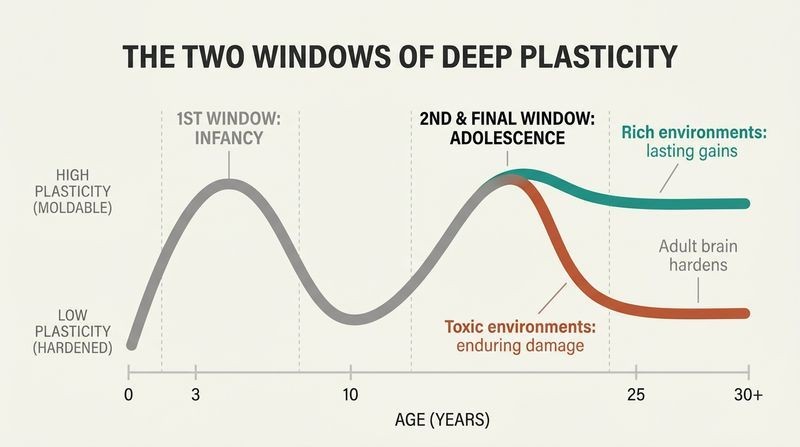
The forgotten sensitive period. Everyone knows the first three years of life reshape the brain. Steinberg's core argument is that adolescence, roughly ages ten to twenty-five, is a second era of heightened neuroplasticity, the brain's capacity to be molded by experience. The word plastic comes from the Greek plassein, to mold, like clay before it hardens.
Plasticity cuts both ways. Rich, challenging environments produce lasting gains, but toxic ones (stress, drugs, trauma) inflict enduring damage precisely because the brain is so malleable. Evidence includes the reminiscence bump (we recall mundane teenage moments in vivid detail), the fact that most serious psychiatric disorders first appear by fourteen, and animal studies showing adolescent brains are permanently altered by early drug exposure in ways adult brains are not.
What's striking is how this reframes adolescence from a problem to be survived into an opportunity to be seized. The claim aligns with broader neuroscience on experience-dependent plasticity, though critics rightly note that popular neuroscience often overreaches. Steinberg concedes the direct human evidence that adolescence rivals infancy is still accumulating rather than settled. The metaphor of open windows letting in both ocean breezes and mosquitoes captures the asymmetry well. A useful parallel: Carol Dweck's work on mindset suggests malleability beliefs themselves shape outcomes, hinting that simply teaching teens their brains are still forming could be intervention enough.
Teens have a sensitive gas pedal and weak brakes
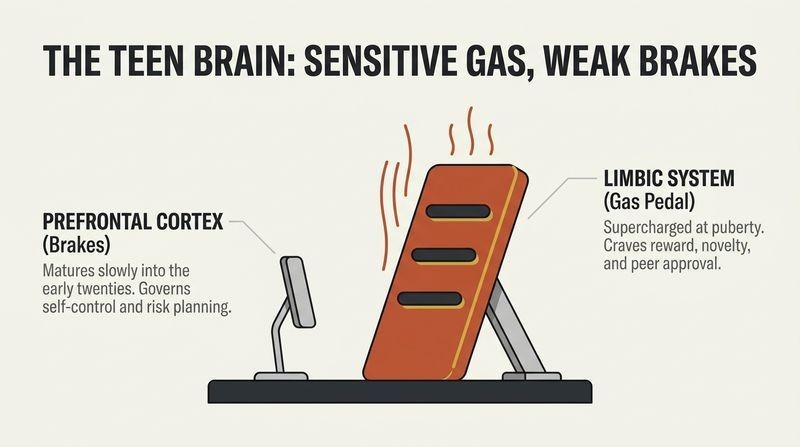
Two systems maturing on different clocks. The limbic system, which generates emotion and craves reward, gets supercharged at puberty. The prefrontal cortex, the brain's CEO governing self-control and planning, matures slowly into the early twenties. This creates a years-long imbalance: powerful accelerator, underdeveloped brakes.
Why smart kids do dumb things. By sixteen, teenagers reason as well as adults and know the risks. The problem is not ignorance. Dopamine receptors surge at puberty, making rewards feel more intense (first kisses, favorite songs, sugar all hit harder). The story of Danny, an honors student who caused a fatal crash while frantically texting his girlfriend, illustrates the point. He knew better. His still-immature brain simply could not restrain an emotionally aroused impulse in the moment.
This dual-systems model has become one of the most influential ideas in developmental psychology and has reshaped juvenile justice. Its strength is explanatory power: it dissolves the paradox of intelligent teens making catastrophic choices. A nuance worth raising is that the model can slide into determinism, seeming to excuse all behavior as neural fate. Steinberg guards against this by insisting environments, not just biology, drive outcomes. The framing also echoes Daniel Kahneman's fast-and-slow thinking, though here the imbalance is developmental rather than universal, a temporary mismatch that resolves with maturation rather than a permanent feature of human cognition.
Adolescence has tripled in length in 150 years
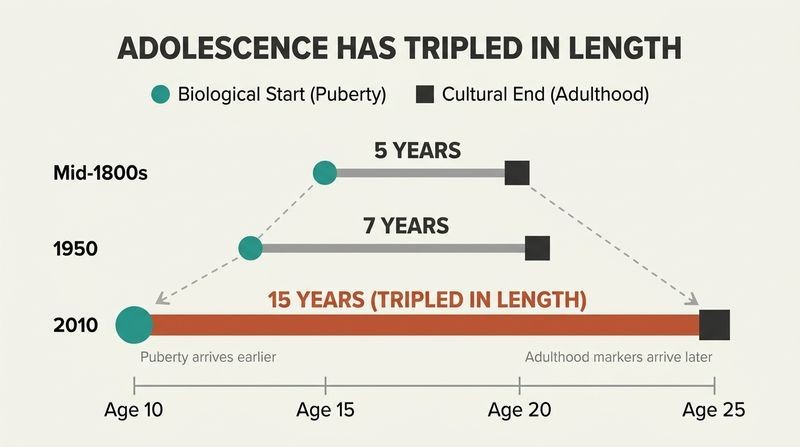
Biology at the start, culture at the end. Adolescence begins with puberty and ends with the social markers of adulthood. Using menarche (first menstruation) and marriage as trackable bookends, Steinberg shows adolescence lasted about five years in the mid-1800s, seven years in 1950, and roughly fifteen years by 2010. Puberty keeps arriving earlier while marriage, careers, and financial independence keep arriving later.
Both ends are moving. Girls now show first breast development around age nine or ten; some inner-city second graders are already menstruating. Meanwhile, at twenty-five, today's young adults are twice as likely to be students and half as likely to be married as their parents were. The result: the gas-pedal-versus-brakes mismatch now stretches across a far longer, riskier stretch of life.
The two-sided elongation is the book's most underappreciated demographic insight. What's compelling is the causal split: earlier puberty is genuinely worrying, while delayed adulthood is often beneficial, a distinction popular commentary collapses into generic hand-wringing about lazy millennials. Steinberg's data-driven pushback against the arrested-development narrative is refreshing. One limitation: using marriage as the endpoint marker carries cultural baggage and may distort comparisons across eras with radically different marriage norms. Still, the convergence of multiple independent measures (schooling, employment, household formation) strengthens the case that the transition itself, not just one metric, has genuinely stretched.
Obesity and screens are pushing puberty dangerously early
Puberty starts in the brain, not the body. A chemical called kisspeptin triggers the hormonal cascade. It is stimulated by leptin (produced by fat cells) and suppressed by melatonin (produced in darkness). So more body fat and more artificial light both accelerate puberty. Today's children are heavier and bathed in screen light late at night, effectively signaling their brains that it is time to mature.
Early puberty carries real costs. Other drivers include endocrine-disrupting chemicals in plastics and cosmetics, premature birth, and family stress. Early-maturing girls face elevated risk of depression, eating disorders, and sexual abuse; menarche at twelve or earlier raises breast cancer risk by 50 percent versus sixteen. Parents can delay puberty by limiting sugar, ensuring sleep, cutting screen time, and reducing exposure to hormone-disrupting products.
The mechanistic clarity here is valuable: rather than vaguely blaming modern life, Steinberg identifies specific, actionable levers. The leptin-melatonin-kisspeptin pathway gives parents concrete targets. What deserves scrutiny is the causal weight assigned to each factor; the endocrine-disruptor literature remains contested, and correlation-versus-causation problems abound in observational puberty research. The evolutionary logic (store enough fat, sense abundant food, begin reproducing) is elegant and consistent with life-history theory in biology. The unsettling implication, that we may soon need to teach preschool teachers about adolescent development, is not hyperbole given documented cases of seven-year-olds showing sexual development.
Peers make teens reckless by making everything feel better
It is not peer pressure, it is peer presence. In driving-game experiments, adolescents ran more yellow lights and crashed more when friends merely watched, even when friends could not speak. Adults drove identically alone or observed. The mere presence of peers lights up the adolescent reward center, and the more it activates, the more risks they take.
Friends are a dopamine hit. During adolescence, being around peers activates the same reward circuitry as drugs, sex, and money. This even holds in mice, which drink more alcohol near cage-mates only during adolescence. The practical lesson flips conventional wisdom: the danger zone is not Saturday night but unsupervised weekday afternoons. Steinberg advises minimizing unstructured, unsupervised group time and notes teen passengers more than quadruple crash risk.
This is among the book's most original empirical contributions and it quietly demolishes the moralistic peer-pressure narrative. Reframing peers as an ambient reward amplifier rather than active coercers changes the intervention: you cannot lecture teens out of it, but you can structure their environments. The mouse experiments are a clever bridge, isolating biology from human social meaning. A connection worth drawing: behavioral economics shows adults too are swayed by social context (restaurants, casinos), so the difference is one of degree tied to reward sensitivity, not kind. The military and workplace applications (mixing ages in teams) show the finding's reach beyond parenting.
Self-regulation predicts success more than IQ or wealth
The single most important capacity. Across studies of privileged and destitute teens alike, those scoring high on self-regulation get better grades, more friends, and fewer problems. The famous marshmallow test (wait fifteen minutes, get two treats instead of one) tracked four-year-olds into middle age: delayers had higher test scores, better stress coping, and healthier weights decades later, with brain scans showing more effective self-control circuitry.
Only 25 percent of school performance is intelligence. The rest is largely motivational: determination, grit, and the willingness to persevere through tedium. Steinberg contrasts Lucy, a brilliant graduate student who never finished anything, with an investment firm's best analysts who simply dug deeper and worked harder. Crucially, self-control is far less genetically fixed than intelligence and stays malleable throughout adolescence.
Steinberg makes self-regulation the linchpin connecting brain science, parenting, schooling, and inequality, a genuinely integrative move. The marshmallow test is invoked confidently, though readers should know later large-scale replications found its predictive power shrinks substantially once family background is controlled, suggesting environment drives both the marshmallow behavior and later outcomes. This does not undermine Steinberg's deeper point, since he explicitly argues self-regulation is environmentally shaped and teachable. His distinction between skills (acquired via instruction) and capacities (nurtured over time) is philosophically sharp and explains why you cannot lecture grit into a child the way you teach fractions.
Be warm, be firm, be supportive: the authoritative formula
Three ingredients, all required. Steinberg's evidence-based prescription for raising self-regulating children has three parts:
1. Warmth: affection, praise, involvement, so children feel safe enough to venture out.
2. Firmness: clear, explained, consistently enforced expectations, because we learn self-control by first being externally controlled.
3. Support: scaffolding, giving slightly more autonomy than a child has handled before.
Style beats intensity. Authoritative parents (warm plus firm plus supportive) produce more confident, self-reliant, drug-resistant teens than autocratic parents (cold and controlling, the tiger-mother model) or permissive parents (warm but lenient). Autocratic parenting wins obedience but breeds fragility; permissive parenting breeds susceptibility to peers. Praise effort, not innate ability. Punish by naming the act, its impact, an alternative, and expressing confidence the child will do better.
The warmth-firmness combination is the crux, and decades of cross-cultural research support it, including findings that Asian American children fare better with authoritative than autocratic parenting, directly challenging the tiger-mother mystique. The scaffolding concept, borrowed from Vygotsky's zone of proximal development, elegantly frames autonomy as something dialed up incrementally rather than granted all at once. One tension: Steinberg treats authoritative parenting as near-universally optimal, yet some research suggests strict parenting may be adaptive in genuinely dangerous neighborhoods where the cost of a mistake is severe. The effort-versus-ability praise distinction connects directly to Dweck's growth-mindset research.
American high schools fail because teens are bored, not underfunded
The problem is the students, not the buildings. U.S. elementary students rank near the top internationally, middle schoolers in the middle, but high schoolers near the bottom, and their scores have not improved in forty years. Yet the U.S. spends more per student than almost anyone, teacher qualifications match elementary schools, and class sizes are average. Nearly every reform (charters, vouchers, Teach for America) has failed to move the needle.
High school is a country club. American teens rank highest in social engagement but merely average in academic engagement. The real gap is cultural: high-achieving countries demand more work and more self-control at younger ages. The immigrant paradox proves it, as children of recent immigrants outperform peers of the same ethnicity in the same schools with the same teachers, purely because of home expectations.
Steinberg's willingness to locate the failure in student engagement and home culture rather than school inputs is bracing and politically inconvenient. The international comparison is his strongest weapon: if U.S. schools were structurally broken, elementary performance would not be world-class. The immigrant paradox is a near-natural experiment that isolates culture from institutions. A caveat: this framing risks underplaying documented resource inequities between wealthy and poor districts, and the boredom data, while real, could reflect curriculum design as much as student culture. His proposed fix, building noncognitive skills through meditation, exercise, and social-emotional learning, is promising but he candidly notes the evidence base remains thin and easily oversold.
Longer adolescence widens the gap between rich and poor
A new form of inequality. The elongation of adolescence has been a windfall for the affluent and a trap for the poor. Wealthy kids enter adolescence with stronger self-control, get parenting and schools that build it further, then stay in stimulating environments (college, apprenticeships) that keep the plasticity window open longer, accumulating what Steinberg calls neurobiological capital.
The poor get squeezed at both ends. Poor children hit puberty earlier (more obesity, more father absence, more chemical exposure, more stress), which harms self-control, and they exit adolescence earlier into routinized adult roles, closing the plasticity window sooner. Steinberg's study of 1,350 juvenile offenders found that failure to develop mature self-control was one of the only consistent predictors of who kept committing crimes, like Robert, whose impulse control actually worsened through his twenties.
This chapter is the book's most sociologically ambitious, extending Bourdieu's forms of capital into neuroscience. The concept of neurobiological capital, advantage compounding through prolonged, enriched plasticity, is genuinely novel and unsettling. It suggests inequality is now inscribed in brain development itself, not just bank accounts. What strengthens the argument is its refusal of easy blame: Steinberg names four rules for avoiding poverty (finish school, delay childbearing, obey the law, avoid idleness) while insisting these are hardest precisely for those with the least self-regulatory scaffolding. The critique it invites: if plasticity favors the privileged, targeted adolescent interventions become a justice imperative, not merely an efficiency gain.
Change teens' surroundings, not their nature, to curb risk
Stop lecturing, start engineering. Because risk-taking is hardwired and evolutionarily rooted, education campaigns mostly fail. Steinberg mocks a New York subway campaign that assumed a sixteen-year-old mid-hookup would pause over a toddler's future educational attainment. Adolescents already know the risks; information does not reach them when they are emotionally aroused.
What actually works is contextual. Effective policies change the environment rather than the adolescent:
1. Graduated driver licensing (limiting teen passengers) cut crashes far more than driver education.
2. Raising cigarette prices, not health class, drove the drop in teen smoking (a pack went from 63 cents in 1980 to seven dollars).
3. Enforcing alcohol sales laws and school-based condom access reduce harm.
Meanwhile DARE, abstinence education, and driver training show little to no measured effect despite over a billion dollars spent annually.
This is behavioral public policy at its sharpest, and it converges with the nudge movement in economics: when you cannot easily change preferences, change the choice architecture. Steinberg's demolition of information-based prevention is well-supported and should embarrass the many programs still funded on the opposite premise. The cigarette-price example is particularly persuasive because price is a clean, measurable lever. A fair challenge: contextual controls can feel paternalistic and may simply displace risk rather than eliminate it (teens crossing state lines for alcohol). But the core insight, that fighting adolescent biology with pamphlets is a losing battle against endocrinology, is both humbling and liberating for exhausted parents and educators.
Adolescents are less guilty, not innocent, and courts now agree
Immaturity mitigates culpability. Steinberg helped bring brain science into three landmark Supreme Court cases that abolished the juvenile death penalty (Roper, 2005), banned life without parole for non-homicide juveniles (Graham, 2010), and ended mandatory juvenile life sentences (Miller, 2012). The argument: a still-developing brain makes teens more impulsive and peer-influenced, hence less blameworthy, though not blameless.
One age does not fit all decisions. Steinberg distinguishes cold cognition (unhurried, consultative choices like voting or abortion, where sixteen-year-olds reason like adults) from hot cognition (emotionally charged, time-pressured, peer-laden situations like crime or drunk driving, where maturity arrives later). This resolves the apparent hypocrisy of granting abortion rights at sixteen while opposing adult criminal treatment. He argues for raising the driving age to eighteen and treating juveniles as juveniles.
The cold-versus-hot cognition framework is the intellectual key that unlocks the seemingly contradictory legal positions, and it is a genuine contribution to jurisprudence. What's notable is Steinberg's candor about science as a political instrument: he quips that policymakers use research like drunks use lampposts, for support rather than illumination. This honesty strengthens rather than weakens his authority. The documented racial bias, where Black adolescents are judged more adult-like than white peers for identical crimes, is a powerful argument against case-by-case maturity assessments and for bright-line chronological rules. The false-confession vulnerability of teens adds urgency to interrogation-reform proposals.
Analysis
Age of Opportunity is a thesis-driven synthesis of developmental neuroscience, aimed at parents, educators, and policymakers, built on Steinberg's forty years of research including studies of tens of thousands of young people. Its central move is a reframe: adolescence is not a disease to endure but a second critical period of brain plasticity, a last best chance to shape a life. This inverts the deficit model that has governed how societies treat teenagers.
The book's intellectual architecture is unusually coherent. A single mechanism (a limbic reward system that ignites at puberty years before the prefrontal cortex matures) explains risk-taking, peer effects, mental-illness onset, and the vivid reminiscence bump. A single capacity (self-regulation) links parenting, schooling, criminal justice, and inequality. This parsimony is both the book's strength and a risk, since monocausal frameworks can flatten complexity, and Steinberg occasionally leans harder on self-control than the evidence fully bears.
Where the book is most valuable is its counterintuitive, policy-relevant claims: that information-based prevention fails, that delayed adulthood benefits the privileged, that early puberty is a poverty phenomenon, and that changing environments beats changing minds. These are actionable and well-evidenced, drawing on natural experiments (the immigrant paradox, cigarette pricing, graduated licensing) rather than mere correlation.
The book's weaknesses are honest ones Steinberg mostly acknowledges: the direct human evidence that adolescence rivals infancy in plasticity is still emerging, brain-training interventions remain unproven at scale, and the marshmallow test he cites prominently has faced replication trouble tied to socioeconomic confounds. His authoritative-parenting prescription, though robustly supported, is presented as near-universal despite contexts where stricter parenting may be adaptive.
Read alongside Kahneman, Dweck, Thaler's nudge theory, and Bourdieu, the book emerges as a bridge between neuroscience and social policy. Its enduring contribution is moral as much as scientific: if adolescence is a window of opportunity, squandering it, especially for the disadvantaged, becomes a matter of justice.
Review Summary
Age of Opportunity receives mostly positive reviews for its insights into adolescent brain development and behavior. Readers appreciate Steinberg's research-based approach and practical advice for parents and educators. Many find it eye-opening and useful for understanding teenagers. The book is praised for its clear explanations of neuroscience and strategies to support adolescent development. Some criticize repetitiveness or disagree with certain points, but overall, reviewers recommend it for anyone working with or parenting teens. The book's focus on self-regulation and the importance of the adolescent period resonates with many readers.
Glossary
Neuroplasticity (developmental vs. adult)
Brain's capacity to be reshapedThe brain's ability to change through experience. Developmental plasticity, dominant in early childhood and adolescence, involves building and pruning neural structure itself, producing lasting change. Adult plasticity involves only minor tweaks to existing circuits. Steinberg's thesis is that adolescence is a second heightened plasticity period, making the teen brain both especially teachable and especially vulnerable to harm.
Reminiscence bump
Vivid memories from ages ten to twenty-fiveThe well-documented tendency to recall events from ages ten to twenty-five far more than other life periods. Steinberg argues it occurs not because more momentous events happen then, but because the adolescent brain, chemically primed by dopamine and heightened emotion, encodes even mundane experiences unusually deeply, evidence of the period's special sensitivity.
Gas pedal and brakes (dual-systems model)
Reward system outpaces self-controlSteinberg's metaphor for adolescent brain development. Puberty supercharges the limbic reward system (the gas pedal) years before the prefrontal cortex, which governs self-control (the brakes), fully matures in the early twenties. The prolonged mismatch explains why intelligent, well-informed teens take dangerous risks, especially when emotionally aroused.
Kisspeptin
Brain chemical triggering pubertyA brain chemical that initiates puberty by signaling the ovaries or testicles to produce sex hormones. It is stimulated by leptin (produced by fat cells) and suppressed by melatonin (produced in darkness), which is why childhood obesity and artificial light exposure both accelerate the onset of puberty.
Peer effect
Peers amplify reward sensitivitySteinberg's finding that the mere presence of peers, not active peer pressure, makes adolescents take more risks. Being around age-mates activates the adolescent reward circuitry, making all rewards feel more compelling. Demonstrated in driving-game experiments and even in mice, it explains why teens behave more recklessly in groups than alone.
Authoritative parenting
Warm, firm, and supportiveA parenting style high in warmth, firmness, and support for autonomy, distinguished from autocratic (cold and controlling) and permissive (warm but lenient) styles. Extensive cross-cultural research links it to greater self-reliance, self-control, academic success, and psychological health in adolescents.
Scaffolding
Gradually increasing a child's autonomyA supportive technique in which parents or teachers give a child slightly more responsibility or challenge than they have previously handled, enough to grow but not to overwhelm. As competence increases, support is withdrawn. Based on Vygotsky's zone of proximal development, it gradually transfers control from external sources to the child's own self-regulation.
Cold cognition vs. hot cognition
Calm versus emotionally aroused decisionsSteinberg's legal-developmental distinction. Cold cognition covers unhurried, consultative decisions (voting, medical consent) where sixteen-year-olds reason as maturely as adults. Hot cognition covers emotionally charged, time-pressured, peer-influenced situations (crime, drunk driving) where mature judgment does not arrive until eighteen or later. The distinction justifies different legal age thresholds for different rights.
Immigrant paradox
Immigrant children outperform established peersThe finding that children of recently immigrated families achieve more in school than same-ethnicity peers whose families have lived in the U.S. longer, despite attending the same schools with the same teachers. Steinberg cites it as proof that American high-school underachievement stems from home culture and expectations, not from school quality.
Neurobiological capital
Advantage from prolonged, enriched plasticitySteinberg's coined term for the developmental advantage gained by spending a prolonged adolescence in stimulating environments that keep the brain's plasticity window open longer. Affluent youth accumulate it through college and enriching experiences, while poorer youth, entering adult routines earlier, lose it, widening inequality at a neurological level.
Metaplasticity
Plasticity that begets more plasticityThe discovery that learning during a plastic period not only changes targeted circuits but enhances the brain's capacity for future change in neighboring circuits. It suggests that exposing adolescents to novelty and challenge keeps the plasticity window open longer, and helps explain why intelligent, engaged people enjoy extended sensitive periods.
FAQ
What is Age of Opportunity: Lessons from the New Science of Adolescence by Laurence Steinberg about?
- Redefining adolescence: The book explores adolescence as a unique, extended period of brain plasticity and development, spanning roughly ages 10 to 25.
- Scientific foundation: Steinberg synthesizes neuroscience, psychology, sociology, and law to explain how adolescent brain changes shape behavior, risk-taking, and learning.
- Societal implications: The author argues for a radical rethinking of how society raises, educates, and supports adolescents, emphasizing both the opportunities and vulnerabilities of this life stage.
Why should I read Age of Opportunity by Laurence Steinberg?
- New perspective on teens: The book debunks myths about teenage irrationality, showing adolescence as a period of opportunity for growth, not just risk.
- Practical guidance: Steinberg provides actionable advice for parents, educators, and policymakers to better support adolescent development.
- Broader impact: Readers gain insight into how adolescent brain science affects education, mental health, legal policy, and social inequality.
What are the key takeaways from Age of Opportunity by Laurence Steinberg?
- Adolescence is extended: The period now lasts from early puberty to the mid-twenties, requiring new approaches from families and institutions.
- Brain plasticity is central: Adolescents’ brains are highly malleable, making this a critical window for positive influence and intervention.
- Self-regulation is crucial: Developing self-control during adolescence predicts lifelong success and well-being.
- Parenting and environment matter: Warm, firm, and supportive parenting, along with safe, structured environments, are essential for healthy adolescent development.
How has adolescence changed over time according to Age of Opportunity?
- Longer duration: Adolescence has more than doubled in length over the past century, now spanning about 15 years.
- Earlier puberty: Children are entering puberty at younger ages due to factors like obesity and environmental changes.
- Delayed adulthood: Young people are taking longer to achieve social and economic independence, creating a mismatch between biological maturity and adult responsibilities.
What does Laurence Steinberg reveal about adolescent brain development in Age of Opportunity?
- Second window of plasticity: Adolescence is a sensitive period for brain development, especially in the prefrontal cortex (self-control) and limbic system (reward/emotion).
- Imbalance in brain systems: The reward system matures earlier than the self-regulation system, leading to increased risk-taking and impulsivity.
- Environmental influence: Experiences during adolescence—positive or negative—have a profound impact on brain wiring and future outcomes.
Why do adolescents take more risks, according to Age of Opportunity by Laurence Steinberg?
- Heightened reward sensitivity: Increased dopamine activity makes pleasurable experiences more intense, motivating risk-taking.
- Immature self-regulation: The prefrontal cortex, responsible for impulse control, matures slowly, creating a gap between strong impulses and weak brakes.
- Peer influence: The presence of peers amplifies reward sensitivity, making risky behaviors more appealing in social contexts.
How does Laurence Steinberg define and explain self-regulation in adolescence in Age of Opportunity?
- Definition: Self-regulation is the ability to control thoughts, emotions, and behaviors, especially delaying gratification and resisting impulses.
- Developmental trajectory: It develops gradually from childhood through the mid-twenties, with adolescence being a critical period due to brain plasticity.
- Predictor of success: Strong self-regulation is linked to better academic achievement, mental health, and social competence, and lower risk behaviors.
What parenting styles does Laurence Steinberg discuss in Age of Opportunity, and which is most effective?
- Three main styles: Autocratic (high control, low warmth), permissive (high warmth, low control), and authoritative (high warmth and control).
- Authoritative parenting benefits: This style, combining warmth, firmness, and support, best fosters autonomy, self-regulation, and psychological well-being.
- Drawbacks of other styles: Autocratic parenting can harm self-esteem and persistence, while permissive parenting may lead to misbehavior and poor academic motivation.
How can parents support adolescent development according to Age of Opportunity by Laurence Steinberg?
- Warmth, firmness, support: Effective parenting blends affection, clear rules, and scaffolding of autonomy to foster competence and confidence.
- Gradual autonomy: Parents should gradually give adolescents more decision-making power as self-regulation improves, while maintaining appropriate limits.
- Avoid harshness: Consistent, fair discipline supports self-control, while harsh or inconsistent discipline undermines it.
What challenges do American high schools face, and what does Age of Opportunity recommend for improvement?
- Low academic engagement: U.S. high school students often show low motivation and high boredom, with schools functioning more as social clubs than learning environments.
- Ineffective reforms: Common reforms like charter schools and increased testing have not significantly improved outcomes.
- Focus on noncognitive skills: Schools should prioritize developing self-regulation, perseverance, and social-emotional skills alongside academics.
How can schools and society help adolescents develop self-regulation and noncognitive skills, according to Age of Opportunity?
- Social and emotional learning: Implement sequenced, active, focused, and explicit (SAFE) SEL programs to teach emotion regulation and stress management.
- Diverse training methods: Use working memory exercises, mindfulness, physical activity, and strategy training to build executive function.
- Challenging, supportive environments: Provide scaffolded, demanding tasks and supportive relationships to foster growth and engagement.
What legal and policy implications does Laurence Steinberg draw from adolescent brain science in Age of Opportunity?
- Reduced culpability: Adolescents’ immature brains justify different treatment in the justice system, such as banning the juvenile death penalty and focusing on rehabilitation.
- Age boundaries: Legal ages for activities like driving, drinking, and voting should reflect differences in brain maturity and decision-making contexts.
- Policy recommendations: Raise driving ages, enforce substance restrictions, and maintain a separate juvenile justice system to protect and support adolescent development.
Download PDF
Download EPUB
.epub digital book format is ideal for reading ebooks on phones, tablets, and e-readers.








































