Key Takeaways
1. Native Peoples' Deep Connection to Land is the Foundation of Their Existence.
We are a part of everything that is beneath us, above us, and around us. Our past is our present, our present is our future, and our future is seven generations past and present.
Intrinsic connection. Native American teachings emphasize an intrinsic relationship with all living and non-living elements—animals, fish, trees, rocks—as relatives. This deep connection is honored through ceremony, song, and story, forming the bedrock of their cultures and ensuring the preservation of their families and traditions. The obliteration of these "older relatives" by industrial forces represents an immense loss to Native families and cultures, compelling ongoing struggles for preservation and recovery.
Biodiversity link. Wherever Indigenous peoples remain, there is a corresponding enclave of biodiversity. This direct relationship highlights how Native stewardship has historically protected ecosystems. Examples include:
- Salmon rivers in the Northwest, home to distinct peoples.
- Florida panthers surviving in the presence of traditional Seminoles.
- Remaining prairie grasses on reservation lands.
- Half of all U.S. reservation lands still forested, much of it old-growth.
Unquantifiable value. This profound connection means that the value of their homeland, land, trees, and future cannot be quantified or sold. For centuries, Native people have asserted that their way of life is not for sale, a truth that clashes with government and industry attempts to assign monetary compensation for stolen lands and livelihoods. This fundamental difference in perspective underlies many of their ongoing struggles.
2. Native Lands Bear the Brunt of Industrial Environmental Destruction.
Most Indigenous governments are over 22 years behind the states in environmental infrastructure development.
Targeted for waste. Native America, comprising only 4% of U.S. land, is disproportionately targeted for environmental hazards. This includes:
- 16 proposed nuclear waste dumps.
- Over 100 proposals for toxic waste dumps in Indian communities.
- 77 sacred sites disturbed or desecrated by resource extraction.
Specific examples. The consequences are severe and widespread. Western Shoshone land in Nevada has endured over 1,000 atomic explosions, making them "the most bombed nation on earth." Dine (Navajo) land suffers from over 1,000 slag piles and tailings from abandoned uranium mines, leading to a cancer rate 17 times the national average for some teenagers. Akwesasne Mohawk territory is downstream from major industrial polluters, resulting in PCB contamination of their water, soil, and even mothers' milk.
Systemic injustice. This targeting is exacerbated by systemic environmental injustice, where federal agencies like the EPA consistently fail to fund tribes equitably compared to states for environmental infrastructure. This lack of support leaves Native communities vulnerable, forcing them to fight powerful corporations and government entities with meager resources, often for decades.
3. Colonialism's Legacy Continues Through Land Appropriation and Economic Exploitation.
We have, and have had for centuries, our own culture, our own customs, our own government, our own language, and our own way of life, which is different from the government, the culture, the customs, the language, and the way of life of the White Man.
Historical land grabs. From the 1800s, U.S. expansionism systematically dispossessed Native peoples of their lands. Treaties were signed and then violated, leading to massive land cessions and the creation of reservations. The Homestead Act and General Allotment Act further fragmented and reduced Native landholdings, often opening "surplus" lands to non-Indian settlement.
Economic exploitation. This land appropriation was often driven by resource extraction. Anishinaabeg lands were targeted for iron, copper, and vast white pine forests, fueling major lumber companies like Weyerhauser. The BIA, acting as "trustee," often signed leases on behalf of tribes for coal, oil, and uranium at grossly undervalued rates, squandering tribal assets. The Hudson Bay Company created economic serfdom among the Innu through unfair fur trade practices.
Cultural disruption. Beyond economic loss, colonialism actively sought to disrupt Native ways of life. The forced relocation of the Innu to Davis Inlet, the decimation of buffalo herds to "settle the vexed Indian question," and the privatization of Hawaiian lands were all deliberate strategies to dismantle self-sufficient Indigenous societies and foster dependency on the colonizing power.
4. Native Communities Lead Resilient Grassroots Resistance Against Environmental Injustice.
We are the ones who stand up to the land eaters, the tree eaters, the destroyers and culture eaters.
Grassroots power. Despite being underfunded and often working out of homes, Native grassroots organizations are winning hard-fought victories. These groups, like Native Americans for a Clean Environment or DineCARE, coalesce into national networks such as the Indigenous Environmental Network, providing technical and political support to protect land, biodiversity, and communities. Their commitment stems from a deep, spiritual connection to the land.
Diverse tactics. Native resistance employs a multifaceted approach, combining legal challenges, direct action, and cultural preservation. The Innu of Nitassinan have repeatedly occupied runways to protest NATO low-level flight training, leading to court rulings affirming their land rights. The Northern Cheyenne successfully fought AMAX Coal Company, voiding leases and redesignating their reservation to Class-One air quality. Mohawk women, through the Mothers' Milk Project, used scientific research to expose PCB contamination and demand corporate accountability from General Motors.
Unwavering tenacity. These struggles often span decades and generations, demonstrating unwavering tenacity. From the Seminoles' refusal to accept land settlements to the White Earth Land Recovery Project's efforts to restore forests and traditional seed stocks, Native communities continue to fight for future generations. Their actions challenge the notion that economic development must come at the cost of environmental and cultural destruction.
5. The Destruction of Ecosystems Directly Undermines Native Cultures and Well-being.
There is a direct link in our community between the loss of biodiversity—the loss of animal and plant life—and the loss of the material and cultural wealth of the White Earth people.
Cultural erosion. The obliteration of natural resources directly erodes Native cultures. For the Anishinaabeg, clearcutting destroyed their forest culture, impacting medicinal plants, food sources, and traditional crafts like birch-bark basketry and canoe-making. The loss of traditional foods, like fish for the Mohawks or caribou for the Innu, forces communities to abandon ancestral diets and practices, leading to a profound sense of cultural displacement.
Ethnostress and health. This environmental degradation creates "ethnostress"—the daily burden of dealing with poverty, racism, and the constant assault on Native identity and land.
- Grassy Narrows Ojibwe suffered mercury poisoning, leading to the collapse of commercial fishing, over 80% unemployment, and a rise in alcoholism.
- The Lakota of Pine Ridge experience high rates of alcoholism, suicide, and accidental death, linked to unresolved grief from historical trauma and the loss of the buffalo economy.
- Hawaiians face ethnocide and genocide, with high rates of homelessness, incarceration, and poor health outcomes due to land loss and cultural commodification.
Spiritual impact. The spiritual dimension of the natural environment is deeply intertwined with Native well-being. When sacred sites are desecrated, animals are killed without reverence, or traditional ceremonies are disrupted, it inflicts spiritual wounds. The Innu believe that disrespecting animal masters leads to punishment, while the Lakota see the buffalo slaughter as a war on their psyche and soul. Healing, therefore, must be multi-dimensional, addressing both physical and spiritual health through cultural restoration.
6. Traditional Knowledge and Self-Determination Offer a Path to Healing and Sustainable Futures.
The way of life of the red people is like a clay cup, and the way of life of the white man is like a Styrofoam cup... It takes a lot of work to keep that clay cup intact.
Reclaiming identity. Native communities are actively reclaiming their traditional knowledge and asserting self-determination as a path to healing. This involves restoring languages, ceremonies, and governance structures that were suppressed by colonialism. The Akwesasne Freedom School, for example, immerses children in Mohawk language and the "Thanksgiving Address" to ensure future generations have "something significant to say."
Sustainable practices. Traditional practices often embody sustainable living. The Innu's hunting economy works with the land, maintaining a delicate balance between the animal and human worlds. The Menominee reservation in Wisconsin demonstrates successful sustainable forest management, harvesting timber for 140 years while increasing sawtimber volume. The White Earth Land Recovery Project focuses on restoring traditional farming, seed stocks, and maple sugarbush, alongside land recovery.
Holistic healing. Healing is viewed holistically, encompassing the individual, community, and environment. Katsi Cook's midwifery work strengthens social bonds, while the Braveheart Project Learning Circle on the Yankton reservation restores traditional women's societies and their relationship with the buffalo. These efforts emphasize that true healing comes from aligning with ancestral instructions and the Creator's laws, fostering a "good life" (Minobimaatisiiwin) that ensures continuous rebirth and balance.
7. The Buffalo's Return Symbolizes the Healing of Land, People, and Spirit.
The buffalo were made for the prairie, and the prairie for the buffalo.
Ecological restoration. The return of the buffalo is central to restoring the Great Plains ecosystem. Buffalo, as "prairie makers," co-evolved with the prairie, their grazing patterns and hardiness maintaining biodiversity. In contrast, cattle culture has devastated the prairie, leading to:
- Massive loss of plant and animal species.
- Soil erosion and desertification.
- Depletion of the Ogallala Aquifer.
Spiritual and cultural revival. For buffalo peoples like the Lakota, the buffalo are "older brothers" and "Tatanka, He Who Owns Us." Their decimation was a spiritual and ethnic death. Restoration efforts, such as the Oglala buffalo herd and the Seventh Generation Buffalo Cooperative, are seen as bringing back collective mental and spiritual health. The birth of a white buffalo calf, "Miracle," symbolizes a new era of restoration and hope.
Resistance and vision. Native activists like Rosalie Little Thunder physically interpose themselves between buffalo and state guns, protesting the slaughter of Yellowstone herds. Their vision extends beyond stopping the killing to establishing "buffalo commons"—vast, contiguous land areas where buffalo can roam freely, healing the land and the people. This movement challenges the unsustainable cattle industry and offers a culturally appropriate model for land stewardship.
8. Hawai'i's Militarization and Tourism Threaten Its Indigenous Land and Culture.
This is not America, this is a colony. The sugar and pineapple plantations were the first wave of colonialism. The military and finally tourism are the next waves of colonialism.
Militarization's toll. Hawai'i has been profoundly militarized, serving as the center of the U.S. military's Pacific Command (PACOM). Over 100 military installations occupy 6.3% of the state's land, leading to:
- 31 federal hazardous waste sites, more than any other U.S. state.
- Release of radioactive liquid waste into Pearl Harbor.
- Storage of approximately 3,000 nuclear weapons on Oahu.
- Accidental bombings and shellings of islands and beaches.
Tourism's impact. Tourism, while a major economic driver, is viewed as the latest wave of colonialism, commodifying Hawaiian culture and land. Tourists outnumber Native Hawaiians 30 to 1, driving up living costs and providing low-paying jobs. The industry fuels "development" that destroys fragile ecosystems:
- Dredging of fishponds for resorts.
- Diversion of water from agricultural areas to golf courses.
- Hawai'i is the "endangered species capital" of the nation.
Cultural commodification. The commodification of Hawaiian culture means that traditional practices like the Hula are performed for tourists, leading to a "haole interpretation of culture." This cultural deformation, coupled with land loss and poor socio-economic indicators for Native Hawaiians (high homelessness, incarceration, low life expectancy), highlights the ongoing ethnocide and genocide. Despite these challenges, Native Hawaiian groups like KaLahui are actively working to rebuild their nation, assert sovereignty, and restore their sacred relationship with the 'aina (land).
9. Alternative Energy and Local Self-Reliance are Key to Native Sovereignty and a Balanced Future.
No stable, sustainable community can... exist without a secure, sustainable supply of energy at a steady price, and the only way that both security and price stability can be guaranteed is by having energy sources within community boundaries and under community control.
Energy colonialism. Native lands hold vast energy resources (uranium, coal, oil, gas), yet Native communities often remain impoverished and without electricity. Corporations extract these resources, paying minimal compensation and leaving behind massive environmental damage. This "energy colonialism" perpetuates dependency and prevents long-term economic development, as seen with the Navajo Nation, which produced immense energy but had 85% of households without electricity in 1975.
Hopi model of self-sufficiency. The Hopi nation offers a powerful model of energy self-reliance. Many Hopi villages resist utility power lines, fearing loss of land rights and cultural disruption. The Hopi Foundation's NativeSUN project installs photovoltaic solar panels on homes, promoting self-sufficiency and conservation. This initiative, led by solar electricians like Debby Tewa, demonstrates how communities can control their energy future through:
- Local production.
- Revolving loan programs.
- Emphasis on conservation.
Potential for renewable energy. Native communities, particularly in the Great Plains, possess immense potential for renewable energy sources like wind and solar. If these alternatives received subsidies comparable to fossil fuel and nuclear industries, they could become highly cost-effective. The Intertribal Council On Utility Policy (ICOUP) is working to inform tribal governments about energy protection and infrastructure, recognizing that "one form of life affects every other form of life" and that a balanced future requires a shift away from destructive energy sources.
10. The "Seventh Generation" Principle Demands a Transformation of Human Laws to Align with Natural Laws.
The challenge at the cusp of the millennium is to transform human laws to match natural laws, not vice versa. And to correspondingly transform wasteful production and voracious consumption.
Natural law vs. human law. Indigenous teachings, like the Iroquois "Seventh Generation" principle, emphasize considering the long-term impact of decisions on future generations. This contrasts sharply with industrial society's short-term focus and legal systems, which have increasingly prioritized corporate profits over the "common good." The violence of the times, marked by collapsing ecosystems and species extinction, has "outstripped the law," highlighting the urgent need for legal transformation.
Constitutional reform. The U.S. Constitution, originally intended to secure liberty for "ourselves, and our posterity," has been reinterpreted to grant corporations immense privileges, including "eminent domain" and protection under the Bill of Rights. This corporate personhood allows for "private injury and personal damage" in pursuit of "progressive improvements." The Seventh Generation Amendment proposes to curb these corporate rights and protect citizens' rights to clean air, water, and sunlight for all generations.
Closing the circle. The ultimate goal is to move from a society based on conquest to one steeped in survival, transforming linear industrial production into a cyclical system where resources are reused or not used at all, and waste is minimized. This requires a technological, cultural, and legal shift, guided by Indigenous worldviews that emphasize interconnectedness and the understanding that "economic development cannot subsist on a deteriorating resource base." The choice between technology and spiritualism, as described in Anishinaabeg prophecies, is a collective and individual decision for a better future.
Review Summary
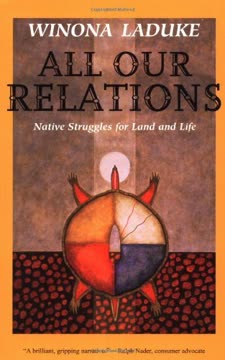
All Our Relations by Winona LaDuke receives widespread praise for its unflinching documentation of environmental injustices faced by Indigenous communities across North America. Readers consistently commend its well-researched, episodic structure covering diverse tribal nations, and its ability to challenge comfortable perspectives while balancing distressing realities with inspiring stories of resistance. The most common critique is its 1999 publication date, leaving readers wanting updated information. Many consider it essential, even urgent reading, noting with frustration that many of the injustices chronicled remain unresolved decades later.