Key Takeaways
1. The Permanent Political Class: A Self-Serving Oligarchy
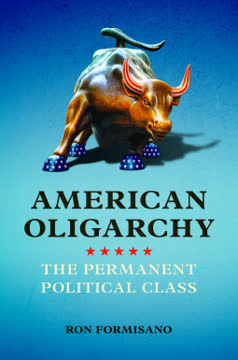
The "permanent political class" in the United States functions at times as an abstract scapegoat; this book describes many of the ways it acts as a plutocratic oligarchy and contributes not only to the creation of extreme economic inequality, but the creation of an aristocracy of inherited wealth.
Entrenched elites. The American political class, a self-perpetuating and self-aggrandizing group, extends beyond Washington D.C. to encompass regional and state elites across various institutions. This class drives economic and political inequality through policies favoring corporations and the wealthy, and by its own self-dealing behavior. It has become increasingly untouchable, rarely held accountable for transgressions against the public interest.
Broad definition. This influential class includes:
- Members of Congress and other politicians
- Lobbyists, consultants, and appointed bureaucrats
- Pollsters and celebrity journalists
- Behind-the-scenes billionaires
- Highly compensated university presidents and nonprofit executives
Living like millionaires. Many members of Congress, over half of whom are millionaires, leverage their positions to enrich themselves and their families. Even those not millionaires enjoy perks like reserved airport parking, luxury car allowances, first-class travel, exclusive gyms, and special healthcare services, enabling a millionaire lifestyle at public expense. This affluence often disconnects them from ordinary Americans, despite populist rhetoric.
2. The "Gift Economy" and Legalized Bribery
The "gift economy" is "so sophisticated that even the people inside it feel it is a culture of goodwill and not the auctioning off of the public welfare."
Beyond explicit bribes. While overt bribery is rare, the political class operates within a "gift economy" where exchanges between lobbyists, corporations, and representatives are subtly masked. This system, often perceived as a culture of goodwill, effectively enables quid pro quo arrangements without the "smoking gun" of documented bribes. The Supreme Court's narrow definition of corruption, focusing only on explicit exchanges, fails to grasp this reality.
Influence, not just access. Campaign contributions, often funneled through Political Action Committees (PACs) and Super PACs, buy more than just "access" to politicians; they directly influence votes and policy outcomes. Former lobbyist Jack Abramoff, who went to jail for extreme overcharging, admitted, "All of it is bribery, every bit of it." This system renders the participation of ordinary citizens meaningless, creating modern "rotten boroughs" where money dictates outcomes.
Systemic corruption. Public perception aligns with this reality, with close to 80% of Americans believing corruption is widespread in government. Studies confirm that state governments, like Washington D.C., exhibit significant "legal corruption" where political favors are exchanged for campaign contributions. This systemic issue benefits the few at the expense of the many, undermining democracy and harming economic growth.
3. The Revolving Door: Monetizing Public Service
Politicians can't fully monetize their plutocratic networks until they retire.
A path to riches. The transition from public office to lucrative positions in lobbying or finance is a well-trodden path in Washington. Over half of members leaving Congress now move into lobbying, a significant increase from 3% in 1970. This "revolving door" allows former officials to leverage their influence, connections, and knowledge of government workings for immense personal gain.
"Shadow lobbyists." The 1995 Lobbying and Disclosure Act, with its vague definition of lobbying, is easily circumvented. Many former officials, like Senator Tom Daschle, avoid registering as lobbyists by calling themselves "consultants" or "policy advisors," continuing to influence policy while earning millions. This practice makes it difficult to track their activities and income, further obscuring the true scale of influence peddling.
Wall Street's gilded entryway. The most lucrative revolving door exists between government and Wall Street. Bank executives receive generous compensation packages when they leave for "public service," a practice questioned by unions as a "backdoor way to pay off" officials. Former regulators often become lawyer-lobbyists, hired by banks to attack and roll back regulations they once helped create, demonstrating a deep-seated conflict of interest.
4. Nepotism: The Core of Privilege and Entitlement
The rampant nepotism of the political class fuels the galloping socioeconomic inequality of the twenty-first century that shows no signs of abating.
"Me and mine" ethos. The practice of promoting one's offspring, relatives, and friends into lucrative positions is deeply ingrained in the political class. This "take care of their own" mentality is brazenly and routinely practiced, giving "nephews" plum jobs and a place at the head of the line. This favoritism undermines any claim to meritocracy and exacerbates socioeconomic inequality.
Pervasive examples:
- Congressional offices: Members like Alcee Hastings paid his girlfriend a top staffer salary, and Maxine Waters paid her daughter and grandson hundreds of thousands.
- Administrations: The George W. Bush administration was described as "a family matter," with numerous relatives of high-ranking officials holding key posts. The Obama administration also saw loyal associates and media figures' spouses/children in influential roles.
- Media and entertainment: Chelsea Clinton's high-paying NBC News job, despite minimal journalistic experience, exemplifies "media legacies" where famous names secure privileged positions.
Eroding meritocracy. This "naked, unabashed favoritism" creates an "illusion of meritocracy," where inherited privilege, not talent, dictates opportunity. It reinforces a caste system, blocking social mobility and fostering a sense of entitlement among the beneficiaries. This practice contributes to public distrust in institutions and a narrow, out-of-touch elite.
5. Faux Populism: Rhetoric vs. Reality
Almost every politician in modern America pretends to be a populist; indeed, it's a general rule that the more slavishly a politician supports the interests of wealthy individuals and big corporations, the folksier his manner.
The "folks" facade. Politicians frequently adopt populist rhetoric, using terms like "folks" to project an image of being "one of us" and caring for "everyday Americans." This rhetorical "softener" aims to connect with voters while often masking deep ties to wealthy donors and corporate interests. The more a politician serves the elite, the more they tend to embrace a folksy manner.
Lifestyle contradictions. Many "faux populists" exhibit lifestyles that starkly contradict their public image. New Jersey Governor Chris Christie, despite his "straight-talking" persona, enjoyed luxury travel on private planes funded by billionaires and spent lavishly on personal expenses using state funds. His rhetoric against public employee pensions contrasted sharply with his administration's financial decisions benefiting Wall Street friends.
Campaign vs. governance. Candidates often campaign on populist themes, denouncing "special interests" and promising to fight for the middle class. However, once in office, their actions frequently align with corporate and wealthy donors. President Obama, for example, while using populist rhetoric, appointed economic advisors favored by Wall Street and pursued trade agreements opposed by unions, illustrating the gap between campaign poetry and governing prose.
6. The Shadow Branches: Lobbyists and Think Tanks
The corps of lobbyists in Washington and across the country now constitute a Fourth Estate, or a fourth unofficial branch of government as important in making policy as the three established by the constitution.
Lobbying's explosive growth. Lobbying has grown exponentially since the 1990s, with corporations and business associations spending billions annually to influence policy. This industry, far exceeding public interest groups in spending, has become a dominant force, often dictating policy outcomes. The rise of "shadow lobbyists" who avoid registration further obscures the true scale of this influence.
Think tanks as advocates. Washington's numerous think tanks, while often claiming independence, frequently serve as extensions of corporate power and partisan agendas. Many are funded by industries that benefit from their "research" and policy recommendations, often denying climate change or defending controversial products. Their "experts" move through a revolving door between government, corporations, and media, shaping public opinion and policy.
Blurred lines. The distinction between genuine research and advocacy is often blurred. Think tanks like the Heritage Foundation openly function as partisan arms, while others accept millions from foreign governments to promote specific agendas. This "philanthrocapitalism" allows billionaires and corporations to wage continuous campaigns, influencing policy through seemingly non-political giving and research, further entrenching the political class.
7. The Profitable World of Nonprofits: Exploiting Public Trust
The corporate sector has no monopoly on greed.
Scandals and distrust. The nonprofit sector, employing 10% of the U.S. workforce and receiving billions in donations and government grants, is frequently marred by scandals involving fraud, theft, and executive self-enrichment. High-profile cases, like the United Way's CEO diverting funds for personal use, erode public trust, which has steadily declined since 9/11 and Hurricane Katrina.
Corporate emulation. Boards of wealthy nonprofits increasingly emulate the corporate model of excessive compensation and lax oversight. Executives receive princely salaries, lavish perks (luxury cars, housing allowances, private school tuition), and generous bonuses, often unrelated to performance or mission fulfillment. This occurs even as many nonprofits reduce charity giving and services, or struggle with financial crises.
Taxpayer burden. Many nonprofits, particularly hospitals and universities, enjoy tax-exempt status while providing insufficient community benefits. Some nonprofit hospitals aggressively sue low-income patients for unpaid bills, garnish wages, and even jail debtors. Meanwhile, they spend millions on executive compensation and lobbying, effectively shifting the burden onto taxpayers and the most vulnerable.
8. The Unpunished: Immunity for Financial Criminals
The justice system not only sucks at punishing financial criminals, it has actually evolved into a highly effective mechanism for protecting financial criminals.
"Too big to jail." Despite egregious financial crimes that led to the 2008 economic meltdown, high-level executives from major financial institutions have largely escaped prosecution and jail time. This contrasts sharply with the aftermath of the 1980s savings and loan crisis, which saw thousands of convictions for far smaller offenses. The perception of "one justice system for the rich and powerful and another for everyone else" is widespread.
Deferred prosecution agreements. The Justice Department increasingly uses deferred-prosecution and nonprosecution agreements, allowing companies to avoid criminal charges by paying fines and promising reforms. These deals, often involving billions in fines, effectively turn prosecutors into regulators, a role they are not trained for. This approach, driven by concerns about "collateral consequences" to the economy, has shielded banks like HSBC, which laundered money for drug cartels and rogue nations, from full accountability.
The "Rotten Heart of Finance." Scandals like the LIBOR manipulation, where major banks conspired to fix interest rates for decades, have been labeled "the crime of the century." Yet, even when banks plead guilty to felony charges, their executives face no jail time. This ongoing immunity, coupled with finance's oversized share of the economy and its influence over government, perpetuates a "culture of greed and shortsightedness" that damages the entire economy.
9. Tax Havens and Dynasty Trusts: Fueling Inherited Wealth
These trusts, according to Madoff, 'operate largely outside public view, like spores in a horror movie, [and] are poised to fundamentally transform the face of the United States by creating a new aristocracy made up of individuals who have access to large amounts of untaxed wealth to meet their every need and desire while being immune to the claims of creditors.'
Hidden trillions. Billions, if not trillions, of dollars in wealth are hidden in offshore tax havens, costing the U.S. government significant tax revenue. The "Panama Papers" leak revealed just a fraction of this global industry, exposing how wealthy individuals and criminals use shell companies to conceal assets and avoid taxes. The U.S. itself acts as a major tax haven, with states like Delaware, Wyoming, and Nevada facilitating the creation of anonymous shell companies.
Legal loopholes. The U.S. tax code contains numerous loopholes that enable legal tax avoidance by multinational corporations and billionaires. Corporations shift profits to tax-friendly countries, while the super-rich benefit from low federal rates on capital gains and dividends. The estate tax, which few wealthy estates fully pay, is also under constant threat of repeal, further subsidizing the accumulation of inherited wealth.
Perpetual privilege. "Dynasty trusts" allow wealthy families to transfer vast amounts of money and assets to succeeding generations in perpetuity, largely outside public view and immune to creditors. The abolition of perpetuity rules in many states, driven by bankers seeking investments, has created a "marketing bonanza" for trust companies. These mechanisms solidify a new aristocracy of wealth, exacerbating inequality and undermining the principle of equal opportunity.
10. A Microcosm of Corruption: Kentucky's Political Economy
Kentucky's status as a poor state endures because it contains the poorest region in the nation: thirty Appalachian counties in eastern Kentucky where geography, the decline of coal mining, and loss of manufacturing and other jobs have combined to create persistent poverty.
Poverty amidst plenty. Kentucky consistently ranks among the poorest and unhealthiest states, with high rates of child poverty, food insecurity, and low wages. Despite this, its political class and corporate interests thrive. The state's tax system, riddled with exemptions for businesses and the wealthy, underfunds education and public services, while legislators enjoy "super" pensions and superior healthcare.
"Prince of Pork." Congressman Hal Rogers, representing one of the nation's poorest districts for decades, has channeled hundreds of millions in federal funds into his region. However, this largesse often benefits a network of politically connected nonprofits, commercial enterprises, family, and friends, rather than significantly alleviating widespread poverty or improving the district's dire health and economic indicators. Examples include:
- $17,000 drip pans for helicopters from a donor's company
- Millions for conservation groups where his daughter worked
- Paving roads near his own commercial properties
Culture of dependence and corruption. Eastern Kentucky's deep-seated poverty is intertwined with a culture of dependence and political corruption. Local officials wield immense power through control over scarce jobs and welfare, leading to vote buying and the manipulation of disability systems. The Eric C. Conn disability fraud scandal, involving a lawyer, bribed doctors, and complicit judges, exemplifies how the political class exploits the vulnerable for personal gain, with little accountability.
11. The Opioid Epidemic: A Political Class Complicity
Profiteering from drug abuse is woven into every fabric of government and society, from billionaire CEOs to small online distributors, to doctors and pharmacists, respectable and rogue, to myriad forms of criminal activity, from top to bottom.
Targeting vulnerable regions. The opioid epidemic, particularly in Appalachian states like Kentucky and West Virginia, was not accidental. Purdue Pharma, the manufacturer of OxyContin, aggressively marketed the drug, claiming it was less addictive, and targeted primary care physicians in rural, low-income areas. This strategy, driven by profit, led to an explosion of addiction and overdose deaths.
Political influence and minimal penalties. Despite the devastating impact, Purdue Pharma faced minimal consequences. Its lawyers, including prominent political class members like Rudolph Giuliani and Eric Holder, negotiated settlements that allowed the company to pay relatively small fines without admitting wrongdoing, preventing the full exposure of its criminal activities. This demonstrated the pharmaceutical industry's "stranglehold" on Congress and regulatory agencies.
Systemic enablement. The epidemic is sustained by a complex web of complicity:
- Manufacturers: Aggressive marketing and delayed modification of abuse-resistant drugs.
- Wholesalers: Shipped hundreds of millions of pills into small communities, ignoring warnings and fighting investigators.
- Regulators: The FDA, DEA, and other agencies are riddled with conflicts of interest, with officials often moving to high-paying jobs in the industries they once oversaw.
- Lobbying: Big Pharma spends vast sums to oppose laws that would limit opioid availability, often through front groups.
12. The Populist Backlash: A Response to Alienation
The millions of Sanders's supporters, and many of Clinton's and Trump's, appear to have had their fill of the self-dealing, immunities, and fraudulence of the political class.
Widespread distrust. Decades of self-serving behavior, corruption, and the widening gap between the rich and everyone else have led to profound public cynicism and alienation from government. Trust in government, business leaders, and even charities has plummeted, with large majorities believing the economic system is rigged and politicians care more about winning than doing what's right.
The 2016 "Populist Tsunami." The 2016 presidential election saw an unprecedented surge of populist anger, with voters rejecting established politicians. Bernie Sanders's campaign, focusing on economic inequality and attacking Wall Street, resonated deeply with young voters and the economically insecure. Donald Trump's "reactionary, white nationalist populism" also tapped into widespread frustration, particularly among those who felt left behind by globalization and trade deals.
A call for change. While the specific solutions proposed by populist movements vary, the underlying sentiment is a demand for fairness, opportunity, and accountability from a government perceived as serving only the elite. The "vanishing center" and declining civic culture highlight a yearning for leaders who genuinely represent the common good, rather than perpetuating a system of privilege and self-enrichment.








































