
Plot Summary
Prologue
Two centuries before the story begins, Lady Rydainn carries her infant son Zevander2 to a blazing vein of sablefyre — a divine black flame forged in Aethyria's molten core. The corrupt mage Cadavros9 has struck a deal with her husband: protection from enemies in exchange for their sons' bodies.
Branimir,7 the eldest, already bears grotesque bark-like skin and blackened veins from the same ritual performed weeks earlier. Cadavros9 tears Zevander2 from his mother's arms, shoves a fistful of black ember into the baby's mouth, then hurls him into the flaming fissure.
Against all possibility, the infant survives — marked with burning eyes and a jagged scar across his cheek. His brother7 reads the ancient words seared into the baby's skin: a binding that declares whatever has been stolen can never be restored.
The Lorn at the Archway
Maevyth,1 nineteen and shunned since infancy as the lorn — a baby found abandoned near The Eating Woods of Foxglove Parish with ravens and a black rose — stands at the bone archway clutching her adoptive father's death notice.
Without him, she faces forced marriage or a tongueless life serving the church. In fury, she writes blasphemy on the letter, which blows into the forest and returns bearing different words in her handwriting, equating god with death. Reaching for it, she slashes her forearm on a protruding bone.
Her blood sizzles against the ivory, the forest shimmers with a translucent sheen, and a child's voice whispers her name. A blast of darkness knocks her flat. She finds a silver-eyed raven impaled on the archway, mercy-kills it, and buries it beneath a winterberry bush.
Six Stones, One Curse
In immortal Aethyria, Zevander Rydainn2 — Lord of Eidolon castle, cursed bearer of sablefyre, and one of King Sagaerin's12 secret assassins — delivers a bloodstone to the disgraced mage Dolion.5 For years, Zevander2 has hunted descendants of the six founding bloodlines, turning their blood to stone through forbidden magic.
The stones will power the septomir, an ancient weapon Dolion5 claims can break the sablefyre curse that is slowly transforming Zevander2 into a creature like his brother Branimir.7 But six stones are insufficient.
Dolion's5 foresight reveals the seventh lies in Mortasia — the mortal world beyond the Umbravale ward, a place deemed a diseased wasteland. He hands Zevander2 a passage spell and the coordinates: a bedroom window facing a bone archway. The target is mortal. It should be simple.
Moros's Mermaids
Agatha,15 Maevyth's1 step-grandmother, sells her to Mr. Moros6 — a wealthy mine owner three times her age — and plans to sell Aleysia4 to a Vonkovyan soldier. Maevyth1 resigns herself to the arrangement, reasoning a married woman could claim guardianship of her sister.4
That logic dissolves in Moros's6 cellar. Behind glass tanks, two Lyverian sisters swim with their legs stitched together, tubes feeding them air — his handmade mermaids. Deeper in, a former military captain has been mutated into a flesh-eating monster after consuming white stones Moros6 discovered near Sawtooth Mountain.
He treats women as collectible specimens, taming what he calls the wild, and warns Maevyth1 that unruly women are broken or destroyed. Then he escorts her upstairs to watch her sister's4 banishment.
The Flame Refuses
Zevander2 crosses the Umbravale into Mortasia, kills three boundary guards, and enters Maevyth's1 cottage. He finds her sleeping, her scent — sweet oranges — dizzying him with unexpected desire. He channels sablefyre to boil her blood to stone, as he has done to hundreds before.
The flame enters her body and rebounds. It attacks him. His own scorpion stings his arm. Each subsequent attempt produces scorching pain in his veins instead of hers. His power, which has never failed or hesitated, simply refuses.
Standing over her with a blade to her throat, his hands tremble. She opens her pale gray eyes and catches the glow of his burning irises. He vanishes into black smoke, furious at a failure he cannot explain — and a face he cannot stop seeing.
Through the Barrier Alone
Aleysia's4 pregnancy by Uncle Riftyn is exposed. The parish drags her toward the forest for banishment, and Maevyth1 attacks the guards with a stolen torch. The crowd brands her a witch. When she flings out her hands, a pile of ancient bones erupts from her palms — her first glyph, manifested by rage.
Both sisters sprint into The Eating Woods, where the wrathavor creature catches Moros,6 swallows him whole, then shapeshifts to wear his face. It flays Uncle Riftyn alive. Maevyth1 finds the Umbravale archway and leaps through its shimmering barrier.
She turns to pull Aleysia4 after her, but the wall has hardened to impenetrable glass. The Moros-creature seizes Aleysia4 by the throat. Maevyth1 pounds and screams, but cannot break through. Her sister4 vanishes into the dark.
Rescue at Bonesguard
Imperial Guards on the Aethyrian side capture Maevyth.1 Instead of delivering her to the king,12 they take her to Bonesguard prison, planning to let violent criminals assault her for entertainment. A prisoner is thrown into her cell. She bluffs about poisonous mortal blood and slashes him with a confiscated knife.
Before the guards intervene, an impossibly massive scorpion fills the doorway, its metallic stinger punching through the prisoner's chest and disemboweling the guards. Maevyth1 blacks out. She wakes draped across a horse, an enormous cloaked figure behind her.
He guides them through a treacherous bog, kills a fanged toad-beast with one invisible thrust of his sword, and warns that mortals make delicious snacks. She recognizes his burning gold-and-orange eyes — the stranger from her bedroom. He tells her his name. Zevander.2
The Corvikae Daughter
Maevyth1 wakes in a dungeon cell furnished with silk sheets. Rykaia3 — Zevander's2 silver-haired, two-hundred-year-old sister — brings food, apple slices, and dry wit. Dolion,5 a six-hundred-year-old Elvynira mage imprisoned voluntarily in the next cell, reveals why she was brought here: she is Corvikae, the last descendant of an extinct mortal tribe who worshipped the death goddess Morsana.
Powerful mages want her blood turned to stone for an ancient weapon. He tests her bloodline by applying vivicantem to her nape — a glowing death sigil surfaces.
He gives her a bone-spined puzzle book sealed by Corvikae magic. She pricks her finger on its surface, and the blood navigates a tiny maze, unlocking animated illustrations of raven warriors, feathered dragons called Corvugons, and a battle between mortals and golden-armored invaders.
The Flame She Commands
Zevander2 trains Maevyth1 in combat and glyphs — Aeryz for wind, Propulszir for mental shielding. Each earned glyph scars her palm permanently. When he teaches staff-spinning, he channels sablefyre through their joined hands to levitate the weapon. The flame does not burn her. It ribbons through her veins in warm, erotic waves that leave her shaking.
She pulls more and more power into herself — enough to incinerate any other being — while the staff spins midair. He breaks contact, shaken. No one has ever siphoned his flame with such hunger. Dolion5 privately records the new glyph appearing on her palm and warns Maevyth:1 this ability to commandeer another's power would terrify the magehood. If discovered, they would surely destroy her for it.
The Beast in the Cellar
A spider from beneath Branimir's7 trapdoor lures Maevyth1 with a mirror and key. She drops into his cell and finds herself face-to-face with Zevander's2 older brother — bark-skinned, horned, surrounded by thousands of arachnids. He begs her to sing.
She does, trembling, and the grotesque creature lays his head in her lap and weeps while spiders retreat to the walls. Rykaia3 sounds the alarm. Zevander2 hauls Maevyth1 out, furious — but what he saw through the mirror haunts him: his brother7 at peace for the first time in centuries.
He agrees to escort Maevyth1 nightly so she can feed Branimir7 raw meat and sing to him. Through these visits, he watches the impossible — a mortal girl offering tenderness to the monster everyone else abandoned — and something cracks in his chest.
The Kiss He Forbids
In his study, Zevander2 tests the sablefyre channeling again. Maevyth1 places her hand against his palm and closes her eyes. She confesses it feels like chaos — and arousal. The flame pours into her in escalating waves until she begs him not to stop.
He breaks contact, sweat-drenched and trembling, and demands to know what she is. Before she can answer, he clamps his hand around her nape and crushes his lips to hers. She tastes toffee and embers.
His kiss is commanding, punishing, intoxicating — then he wrenches himself away as though scorched by something worse than flame. He tells her they can never do this again and orders her to leave. For the following week, he avoids training sessions, avoids meals, avoids her — while she tortures him simply by existing.
The Whistle Calls
Maevyth1 solves the puzzle book's music-box mechanism and discovers a silver whistle inside. When she blows it, silence follows — then the sky darkens.
Hundreds of ravens swarm the castle, parting for an eight-meter-tall Corvugon that perches on her balcony: Raivox, the creature she hatched from a mysterious egg back in Foxglove, now fully grown with a horn and wingspan wider than a cottage. His silver crescent markings confirm his identity.
Days later, when fyredrakes chase Maevyth1 and Rykaia3 across Eidolon's grounds after a failed attempt to cleave home, Raivox descends and roars silver flame over the beasts, scattering them. He is bonded to her through the whistle, fiercely protective — a living relic of the Corvikae that scholars had dismissed as myth.
Dancing with the Scorpion
Rykaia3 disguises Maevyth1 with scent-masking potion and a jeweled cicada mask, then smuggles her into Princess Calisza's13 Becoming Ceremony at Costelwick Castle.
In a ballroom glittering with candles and half-naked acrobats, Maevyth1 dances the Lunasier waltz with Zevander2 — palm to palm, circling, dipping — while he whispers that her dress is a torment and she is incapable of blending. Afterward, he interrogates the mage Anatolis, whom Maevyth1 recognized as a scribe from Foxglove Parish, and learns that Cadavros9 is alive in Mortasia, that a vein of sablefyre exists there, and that the Magestroli have been secretly crossing the Umbravale.
Before Anatolis can name who orchestrates it all, a binding spell liquefies his organs, and Nilivir villagers storm the outer walls chanting Cadavros's9 name.
Fire from Her Lips
In the chaos, Melantha11 — the Magelord's new apprentice — seizes Maevyth1 and delivers her to an underground ritual chamber. Robed mages chain her to an altar and shove sablefyre into her mouth, intending to boil her blood to stone.
Maevyth1 plunges into caligorya — the dark mindspace — where the death goddess Morsana instructs her to command the flame. She opens her eyes. Black fire erupts from her lips, destroying the Magelord's eyeballs and incinerating two other mages to ash. A ring of sablefyre blazes around the room, trapping everyone.
Rykaia3 and Dolion5 cleave through the altar stone to reach her, and the three escape down corridors. Melantha11 intercepts them, offering to return Maevyth1 to her sister4 through a portal that shows Aleysia4 pacing alive in the forest.
The Betrayer's Door
Elsewhere in the undercroft, Zevander2 overhears General Loyce14 — his former Solassion enslaver — conspiring with the Imperial Guard captain to steal the bloodstones by capturing Rykaia.3 He discovers that Prince Dorjan's13 life is soulbound to Cadavros:9 killing the ancient mage would kill the prince and unleash a plague-amulet over all of Nyxteros.
Then Dolion5 confesses what he has known since before sending Zevander2 to Mortasia — Maevyth1 is Zevander's2 fated mate, the reason his flame refused to kill her.
Forced to choose between protecting his sister3 and pursuing the woman bound to his soul, Zevander2 sends Rykaia3 to the Elvynira island of Calyxar with Dolion5 and the bloodstones. Then he follows Maevyth1 through the portal. Months have passed in Mortasia, and the spider plague has consumed the village.
The Eating Woods' Revenge
Maevyth1 enters her abandoned cottage and is ambushed by Uncle Felix — half his face melted smooth, spider-legs erupting from his spine. He pins her and tears at her clothes. She drives an embalming needle into his ear, then lashes out with the bone whip glyph — Osflagulle — which shatters every bone in his body with one crack.
Agatha15 crawls from a corpse drawer, mutated and hissing, spewing hundreds of black spiders from her mouth and eye sockets after Maevyth1 severs her head. The swarm covers Maevyth's1 body.
She cannot scream. Zevander2 materializes behind her, suspends the spiders in midair with telekinetic force, and incinerates them alongside the entire cottage in a torrent of black flame. She collapses into his arms, begging to go home to Eidolon.
A Millennium of Waiting
They shelter at The Crone Witch's8 cottage, whose real name is Elowen.8 She is no village herbalist but a Nilivir — a powerless Aethyrian — who lived with the Corvikae tribe nearly a thousand years ago.
When Solassions massacred the tribe and hurled them into the Crussurian Trench, the priestess gave Elowen8 the last rose of the death goddess and told her to flee to the mortal world — to wait for a child who would avenge their people. For centuries she watched.
Then Cadavros9 crossed over, banished but alive, harboring the spirit of Pestilios, God of Disease. When a baby appeared at the archway surrounded by ravens, Elowen8 placed her on a doorstep with a black rose and masked her silver eyes with a spell. Only death, she says, will restore them.
Hands Pressed, Chains Broken
Sharing a narrow bed in Elowen's8 cottage, Maevyth1 and Zevander2 finally yield to weeks of tension. He pleasures her with devastating expertise, floating her with telekinetic magic while she explores the cruel piercings forced on him during a century of Solassion enslavement.
He tells her he craves her more than breath but cannot trust himself. That night, Cadavros9 seizes his mind — trapping Zevander2 in abyssal binding, a caligorya prison where the ancient mage tortures him with memories of sexual abuse and demands fealty.
Maevyth1 wakes to find him convulsing, eyes pitch-black, skin scorching. She presses her palms to his, channels the sablefyre into herself, and holds on until his eyes clear. He gasps awake. She promises to grab the rope with both hands and never let go.
Under the Floorboards
Elowen8 ventures into the woods for herbs and returns infected — her face swelling shut, teeth lengthening. She attacks Maevyth,1 who seizes her throat. A new glyph manifests: death itself. Maevyth's1 fingertips turn onyx, and the old woman disintegrates to black dust.
Freed from the cloaking spell, Maevyth's1 eyes shine fully silver. Mutated creatures surround the cottage but cannot breach Elowen's8 protective ward. Zevander2 wakes, holds her through the night as monsters pace outside, and accepts Dolion's5 revelation — she is his fated mate.
He vows to take her to Calyxar, to safety. As they prepare to leave, Maevyth1 notices a loose floorboard shifting beneath her feet. She kneels, pulls the hatch open, and lowers a lamp into the crawl space. There, curled beneath the witch's cottage, alive, lies Aleysia.4
Analysis
Anathema constructs its central romance as a negotiation between two bodies that have been treated as property. Maevyth's1 worth in Mortasia is measured in marriage price and reproductive capacity; in Aethyria, it shifts to her blood's alchemical value. The novel argues that neither framework constitutes being seen. Zevander's2 body carries the same dual exploitation — weaponized by the king12 for assassination, previously commodified by the Bellatryx for sexual entertainment. Their intimacy becomes radical precisely because it is the first context in which either character's body is touched for its own sake rather than extracted from.
The sablefyre curse operates as a metaphor for inherited trauma that threatens to consume its bearer. Branimir7 represents the endpoint Zevander2 fears — complete psychological dissolution — while Maevyth's1 ability to channel the flame without destruction suggests that trauma can be shared rather than borne alone. The flame's refusal to kill her literalizes the psychological truth that vulnerability disarms aggression more effectively than force.
The novel's treatment of religion is deliberately destabilizing. Foxglove Parish's Red God demands obedience through banishment and mutilation, while Aethyria's gods are indifferent cosmic forces inhabiting mortal bodies. Both systems exploit believers. Maevyth's1 arc from suppressed heretic to wielder of a death goddess's power reframes blasphemy as self-actualization.
The Corvikae genocide mirrors colonial narratives of indigenous displacement — a thriving culture erased, its history falsified, its descendants scattered. That Maevyth1 unknowingly carries this heritage in a world that branded her cursed for it creates a pointed commentary on how communities construct scapegoats from the very people they have wronged. Her journey from lorn to Corvikae daughter is not transformation but recognition — the world finally seeing what was always there.
Review Summary
Anathema receives mixed reviews, with many praising its dark gothic atmosphere, unique magic system, and slow-burn romance. Readers appreciate the complex world-building and character development, particularly for the main characters Zevander and Maevyth. Some find the pacing slow, especially in the beginning, and note that the romance takes a backseat to the fantasy elements. The book's length and intricate plot leave some readers confused, while others are captivated. Many eagerly anticipate the sequel, despite criticisms of the cliffhanger ending.
People Also Read
Characters
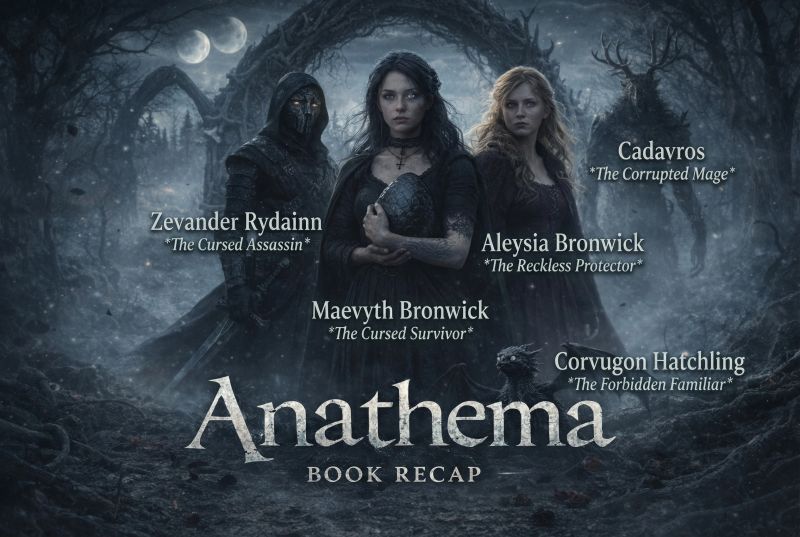
Maevyth
Mortal foundling, last CorvikaeAbandoned as an infant at the edge of a cursed forest with a black rose on her chest, Maevyth grew up branded the lorn—a living omen blamed for famine and misfortune. Beneath her forced piety and black dresses hides a sharp-tongued defiance born of lifelong rejection. She copes by deflecting with wit and caring for the marginalized: feeding homeless widows, burying birds, protecting her sister4. Her attachment style is anxious—she grips loved ones fiercely because loss defined her before memory did. The discovery that she carries Corvikae blood and can command sablefyre reframes her cursed identity as a gift. Her deepest fear is aloneness, which fuels her refusal to abandon Aleysia4 and her growing dependence on Zevander2, whose darkness mirrors the parts of herself she was taught to suppress.
Zevander
Cursed assassin, Lord of EidolonForged in sablefyre as an infant, enslaved by Solassions for a century, then conscripted as King Sagaerin's12 deadliest assassin, Zevander operates under a calcified emotional armor reinforced by genuine danger. His trauma manifests as hypervigilance, sensory acuity, and an aggressive avoidance of intimacy—traits weaponized by his training but rooted in childhood abuse. He carries tremendous guilt over his inability to protect his mother, his father's execution, his brother's7 deterioration, and his sister's3 suffering. The scorpion sigil reflects his psychology: lethal defense mechanisms that activate before conscious thought. He fears losing control to the curse consuming him, and the idea that someone might love the monster he's becoming terrifies him more than any enemy. His protectiveness borders on possessiveness—a trauma response masquerading as devotion.
Rykaia
Empathic sister, pain absorberZevander's2 younger sister possesses the ability to absorb pain and emotions from others—a gift that became a curse after she was forced to hold her mother's hand during a Solassion assault, feeling every violation as her own. This trauma drove her to years of tonic abuse and brothel escapism, numbing herself against memories she cannot erase. Her effervescent humor and recklessness serve as deflection from a depression she refuses to name. She recognizes in Maevyth1 a kindred spirit—someone else defined by others' cruelty—and clings to the friendship with an intensity that reveals how profoundly lonely her existence at Eidolon has been. Her apparent impulsiveness masks a strategic intelligence; she manipulates situations to bring her brother2 and Maevyth1 together.
Aleysia
Maevyth's reckless, beloved sisterMaevyth's1 golden-haired step-sister is everything her adoptive community values—beautiful, spirited, legitimate—yet she stands fiercely alongside the outcast sibling. Her recklessness masks a deep fear of powerlessness inherited from growing up in Agatha's15 household. She pursues forbidden love with Uncle Riftyn partly from genuine affection, partly from a compulsive need to defy authority. Her disappearance after the Banishing becomes the gravitational center of Maevyth's1 motivation, pulling her across worlds.
Dolion
Disgraced mage with foresightA six-hundred-year-old Elvynira scholar expelled from the Magestroli for his apocalyptic ravings, Dolion carries the burden of visions he cannot prevent. His foresight shows him catastrophes in vivid detail, driving him to desperate measures including collecting forbidden bloodstones. Brilliance and cowardice coexist in him—he designs grand solutions but cannot face their moral costs directly. His relationship with truth is transactional: he reveals precisely as much as serves his current purpose, making him simultaneously indispensable and untrustworthy.
Mr. Moros
Wealthy suitor, secret collectorA mine owner whose respectable facade masks obsessive cruelty. He collects living women the way others collect taxidermy—capturing, modifying, and displaying them. His discovery of white stones near Sawtooth Mountain connects the mortal and immortal worlds' economies of power. He represents the intersection of wealth, entitlement, and dehumanization that Maevyth's1 society enables through patriarchal betrothal customs.
Branimir
Zevander's mutated elder brotherThe first Rydainn son subjected to the Emberforge ritual, Branimir suffered catastrophic physical and mental deterioration—bark-like skin, horns, an army of spiders that share his consciousness. Locked beneath Eidolon by his own request, he exists in a twilight between humanity and monstrosity. He remains gentle enough to weep at a song yet violent enough to consume soldiers alive. He represents Zevander's2 most intimate fear: the future that awaits him if the curse cannot be broken.
Elowen
The Crone Witch of FoxgloveThe feared hermit living beside The Eating Woods is far older and more complex than any villager suspects. Elowen possesses knowledge spanning centuries and cultures, communicating in cryptic riddles that protect secrets too dangerous for direct speech. She found baby Maevyth1 at the archway and has watched over her from a distance ever since—a self-appointed guardian whose guilt over past transgressions shapes her relationship with duty and redemption.
Cadavros
Ancient mage, cosmic vesselOnce the king's12 highest Magelord, Cadavros mastered sablefyre and performed the Emberforge ritual on the Rydainn brothers. Banished to Mortasia rather than executed, he exists as the wrathavor—a creature of bark and horn that feeds on mortal flesh to sustain itself. He represents the convergence of mortal ambition and divine malevolence, possessing intelligence enough to manipulate both worlds and patience measured in centuries.
Allura
Bone scribe, Corvikae scholarAn Elvynira academic who can read the history embedded in bones through touch. Allura brings scholarly rigor and warmth to Maevyth's1 education, translating ancient myths into tangible heritage. Her uncle's discredited research on Corvugon fossils is vindicated by Maevyth's1 existence. She represents the intellectual bridge between Maevyth's1 mysterious powers and their historical context.
Melantha
Ambitious Magelord apprenticeThe newly appointed apprentice to the Magelord, Melantha possesses unsettling skill in aura-reading and mental probing. She survived Solassion imprisonment herself, which gives her a manipulative understanding of power dynamics. Her true loyalties and motivations remain deliberately opaque—she operates with a strategic patience that makes her equally plausible as ally or antagonist.
King Sagaerin
Nyxteros's secretive monarchA paranoid ruler who hoards vivicantem while his people starve. He freed Zevander2 from the Solassions and fashioned him into a weapon, rewarding loyalty with resources while concealing devastating secrets about Cadavros9 and the plague-amulet bound to his son13.
Prince Dorjan
King's progressive, vulnerable heirSagaerin's12 son secretly loves men and openly despises his father's greed. His life is unknowingly tethered to ancient magic, making him both politically vital and existentially fragile. He treats Zevander2 as a genuine friend rather than a servant.
General Loyce
Zevander's Solassion tormentorThe Solassion general who enslaved adolescent Zevander2 and subjected him to years of sexual abuse. She represents the weaponization of desire and the long shadow of childhood trauma. Her reappearance destabilizes Zevander's2 hard-won composure.
Agatha
Maevyth's cruel step-grandmotherThe calculating matriarch who squandered her husband's winery fortune, then monetized death through a mortuary and poison trade. She sells both granddaughters without hesitation, viewing them as assets to liquidate.
Plot Devices
Sablefyre
Divine flame, curse, and weaponSablefyre is a black flame forged in Aethyria's molten core, capable of turning bodies to ash in seconds. Forced into Zevander2 as an infant through the Emberforge ritual, it destroyed his natural bloodline magic and threatens to transform him into a creature like Branimir7. It serves simultaneously as his greatest weapon—powering his scorpion sigil and assassination abilities—and his deepest curse. The flame's refusal to harm Maevyth1 becomes the central mystery of their bond. When she channels it, it flows willingly, almost eagerly, establishing that sablefyre recognizes something in her blood that overrides Zevander's2 commands. The mages who capture Maevyth1 also use sablefyre in their ritual, inadvertently giving her the ability to breathe it offensively.
The Umbravale
Ward dividing two worldsAn imperceptible barrier between Aethyria and Mortasia, created centuries ago by the septomir using the blood of seven founding races. It appears as a shimmering, liquid wall within bone archways in the forest. Only descendants of those seven bloodlines can pass through freely; others require a specific cantafel spell. The ward prevents mortals from entering Aethyria and Aethyrians from contaminating themselves with mortal disease. Maevyth's1 ability to cross confirms her Corvikae heritage. The Umbravale functions as both prison and protection—it kept Cadavros9 contained for centuries, but once a vein of sablefyre is discovered in Mortasia, its integrity becomes the last defense against a trans-dimensional plague.
Bloodstones and the Septomir
Forbidden weapon of seven bloodsBloodstones are crystallized remains of a person's blood, created through demutomancy—an outlawed practice of altering blood with sablefyre. Seven stones, one from each founding bloodline, are required to power the septomir, an ancient scepter capable of creating or shattering the Umbravale. Dolion5 enlists Zevander2 to collect six stones by killing bloodline descendants, promising the completed weapon can break his curse. The seventh stone requires Corvikae blood—Maevyth's1. The stones' existence drives political conspiracies: the Magestroli wants them to strengthen the ward, while the Solassions and rogue factions want them for power. Their location becomes leverage throughout the story.
The Corvikae Puzzle Book
Heritage grimoire and keyA bone-spined, feather-covered book sealed by Corvikae magic that only Maevyth1 can open. Each page contains a mechanical puzzle fused with enchantment—solving one unlocks the next chapter of Corvikae history through animated illustrations that move at her touch. The book reveals the tribe's origin, their war against golden-armored Solassions, the death goddess Morsana, and the Corvugon raptors. Within its mechanisms hide practical objects: a music-box, a black rose of Morsana, and a silver whistle that summons Raivox. It functions as both a heritage education and an arsenal of tools specific to Maevyth's1 bloodline, each puzzle training her to think in the symbolic logic her glyphs require.
Raivox the Corvugon
Bonded protector-beast from mythHatched from a black-and-silver scaled egg that appeared where Maevyth1 buried the mercy-killed raven, Raivox begins as a palm-sized creature with a beak, horns, and carnivorous instincts. He grows at an extraordinary rate, eventually becoming an eight-meter-tall feathered dragon with silver-flame breath and crescent moon markings. Bonded to Maevyth1 through blood—she cut herself on the same bone archway where the egg appeared—he responds to a silver whistle found in the puzzle book. Corvugons were believed extinct alongside the Corvikae people. Raivox's existence proves the mythology is real and gives Maevyth1 a fiercely loyal protector capable of intimidating even Eidolon's fyredrakes.
FAQ
Synopsis & Basic Details
What is Anathema about?
- Faustian bargain for protection: Lady Rydainn sacrifices her infant son Zevander to the mage Cadavros in exchange for protection from the Solassions, marking him with sablefyre and setting him on a dark path.
- Cursed orphan near Eating Woods: In the present, Maevyth, an orphan shunned by her village for being found near the cursed Eating Woods, faces a bleak future after her adoptive father's death.
- Forbidden powers and a new world: Maevyth discovers her own mysterious powers and is thrust into a world beyond the Eating Woods, where she is hunted for her blood and must learn to survive.
Why should I read Anathema?
- Intriguing gothic fantasy world: The novel offers a richly detailed and atmospheric world filled with dark magic, ancient lore, and dangerous creatures.
- Complex characters with compelling arcs: Maevyth and Zevander are compelling protagonists grappling with their pasts, their powers, and their growing connection.
- Exploration of dark themes: Anathema delves into themes of power, sacrifice, redemption, and the struggle against societal prejudice.
What is the background of Anathema?
- Aethyria and Mortasia: The story is set in a world divided into Aethyria, a land of magic and immortals, and Mortasia, a mortal realm believed to be a barren wasteland.
- Vonkovyan society and the Red God: The dominant culture is Vonkovyan, ruled by fanatical Sacred Men who enforce worship of the Red God and banish heretics to the Eating Woods.
- Ancient races and blood magic: Aethyria is populated by various races with unique bloodline magic, including Lunasier, Solassions, and Zephromyte, each with their own powers and histories.
What are the most memorable quotes in Anathema?
- "Il captris nith reviris.": This Primyrian phrase, meaning "What is taken will never return," is embedded in a marking on Zevander's chest, foreshadowing the irreversible nature of his curse and the sacrifices made in the story.
- "God is Death.": This phrase, initially written by Maevyth out of resentment, becomes a recurring motif, reflecting the dark and oppressive religious atmosphere of Foxglove Parish and the sacrifices demanded by the Red God.
- "You are mine, moon witch. For all eternity and whatever lies beyond it.": Zevander's possessive declaration to Maevyth highlights the intense and potentially dangerous connection between them, hinting at the power dynamics and emotional stakes of their relationship.
What writing style, narrative choices, and literary techniques does Keri Lake use?
- Atmospheric and descriptive prose: Lake creates a vivid and immersive world through detailed descriptions of the environment, characters, and magical elements.
- Dual POV with shifting perspectives: The story is primarily told from the perspectives of Maevyth and Zevander, allowing readers to experience the events from different angles and understand their internal struggles.
- Foreshadowing and symbolism: Lake uses subtle foreshadowing and recurring symbols, such as the black rose and the silver-eyed raven, to hint at future events and deepen the thematic resonance of the story.
Hidden Details & Subtle Connections
What are some minor details that add significant meaning?
- The Black Rose: The black rose found with Maevyth as an infant is a symbol of Morsana, the goddess of death, hinting at her connection to the Corvikae and her potential role in the events to come.
- The Silver in the Raven's Eyes: The silver hue in the raven's eyes that Maevyth finds dead foreshadows the duoculos condition that Maevyth develops, and the connection to the Lunasier bloodline.
- The Weavers: The herbal sachets used to ward off bad dreams are a subtle reminder of the characters' vulnerability to the dark forces at play and their attempts to find solace and protection.
What are some subtle foreshadowing and callbacks?
- The prisoner's words: The prisoner's words "God is Death" foreshadows the reveal of the Red God's true nature and the sacrifices demanded by the Vonkovyan faith.
- The cut on Maevyth's arm: The cut Maevyth receives near the archway foreshadows her connection to the Eating Woods and the magical changes she will undergo.
- The five stars and moon: The five stars and moon symbol on the prisoner's hand is a callback to the Aethyrian Gods and the old ways, hinting at a deeper history and a potential challenge to the dominant religion.
What are some unexpected character connections?
- The Crone Witch and Maevyth: The Crone Witch's knowledge of Maevyth's past and her warnings about the forest suggest a deeper connection between them, hinting at a shared understanding of the supernatural forces at play.
- Uncle Riftyn and Aleysia: The inappropriate relationship between Aleysia and Uncle Riftyn adds a layer of complexity to the family dynamics and foreshadows potential betrayal and conflict.
- Dolion and Cadavros: Dolion's fear of Cadavros and his knowledge of sablefyre suggest a past connection between them, hinting at a shared history and a potential link to the dark magic that plagues Aethyria.
Who are the most significant supporting characters?
- Lolla: As the housekeeper and confidante, Lolla provides Maevyth with a source of support and guidance, offering a glimpse into the lives of those who are marginalized in Vonkovyan society.
- Uncle Felix: The resident mortician, Uncle Felix's knowledge of death and the human body adds a macabre element to the story, and his actions raise questions about his true nature and his potential involvement in sinister events.
- Agatha: As Maevyth's step-grandmother, Agatha represents the oppressive forces of Vonkovyan society and the prejudice against those who are deemed different or cursed.
Psychological, Emotional, & Relational Analysis
What are some unspoken motivations of the characters?
- Maevyth's desire for acceptance: Despite her outward defiance, Maevyth longs for acceptance and connection, as evidenced by her attempts to help others and her vulnerability in her relationship with Zevander.
- Zevander's fear of losing control: Zevander's gruff exterior and his reliance on control mask a deep-seated fear of losing himself to the sablefyre and becoming a monster like his brother.
- Aleysia's need for validation: Aleysia's reckless behavior and her pursuit of pleasure stem from a need for validation and a desire to escape the constraints of Vonkovyan society.
What psychological complexities do the characters exhibit?
- Maevyth's survivor's guilt: Maevyth grapples with survivor's guilt, questioning why she was spared while others suffered, and struggling to reconcile her desire for happiness with the weight of her past.
- Zevander's self-loathing: Zevander's internal conflict is fueled by self-loathing and a belief that he is inherently evil, making it difficult for him to accept love and connection.
- Aleysia's denial and escapism: Aleysia exhibits denial and escapism as coping mechanisms, using pleasure and recklessness to avoid confronting the pain and trauma in her life.
What are the major emotional turning points?
- Maevyth's discovery of her powers: The realization that she possesses magical abilities marks a turning point for Maevyth, empowering her to take control of her destiny and challenge the forces that seek to control her.
- Zevander's failure to kill Maevyth: Zevander's inability to carry out his mission to kill Maevyth forces him to confront his own humanity and question his loyalty to the king.
- Aleysia's banishment: Aleysia's banishment serves as a catalyst for Maevyth's actions, driving her to seek a way to save her sister and challenge the oppressive forces of Vonkovyan society.
How do relationship dynamics evolve?
- Maevyth and Zevander: Their relationship evolves from animosity and distrust to a complex bond of attraction, respect, and shared purpose, as they learn to rely on each other and confront their inner demons.
- Maevyth and Aleysia: Their sisterly bond is tested by the challenges they face, but their loyalty and love for each other remain a constant source of strength.
- Maevyth and Dolion: Their relationship evolves from a student-mentor dynamic to a partnership, as they work together to unravel the mysteries of Aethyria and challenge the forces that threaten their world.
Interpretation & Debate
Which parts of the story remain ambiguous or open-ended?
- The nature of the Red God: The true nature of the Red God and the validity of the Vonkovyan faith remain ambiguous, leaving readers to question the morality of the characters' actions and the power structures that govern their world.
- The extent of Cadavros's influence: The extent of Cadavros's influence and his potential return remain uncertain, leaving readers to speculate about the future of Aethyria and the challenges that lie ahead.
- The true nature of the Corvikae: The true nature of the Corvikae and their connection to the death goddess Morsana remain shrouded in mystery, leaving readers to wonder about their role in the unfolding events and the potential for their return.
What are some debatable, controversial scenes or moments in Anathema?
- The sacrifice of Zevander: Lady Rydainn's decision to offer her infant son to Cadavros is a morally complex and debatable moment, raising questions about the lengths to which people will go to protect their families.
- The treatment of Nilivir and spindlings: The treatment of Nilivir and spindlings in Vonkovyan society is a controversial topic, highlighting the prejudice and discrimination that exist in Aethyria.
- The relationship between Aleysia and Uncle Riftyn: The inappropriate relationship between Aleysia and Uncle Riftyn raises ethical questions and challenges the reader's perception of family dynamics and power imbalances.
Anathema Ending Explained: How It Ends & What It Means
- Maevyth and Aleysia are separated: Maevyth is tricked into returning to Mortasia, while Aleysia is left behind in Aethyria, highlighting the challenges of crossing between worlds and the sacrifices required for survival.
- Zevander is left with a choice: Zevander is left with the choice of pursuing Maevyth or remaining in Aethyria to protect his sister, forcing him to confront his priorities and his loyalties.
- The battle against Cadavros is far from over: The discovery that Cadavros is still a threat and that a new power is rising in Aethyria sets the stage for a larger conflict, leaving readers to wonder about the fate of both worlds and the role that Maevyth and Zevander will play in the final battle.
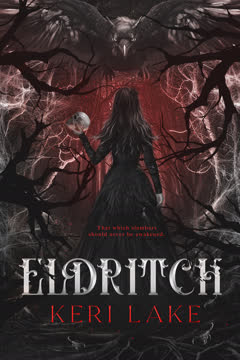
The Eating Woods Series
About the Author
Other books by Keri Lake
Download PDF
Download EPUB
.epub digital book format is ideal for reading ebooks on phones, tablets, and e-readers.








































