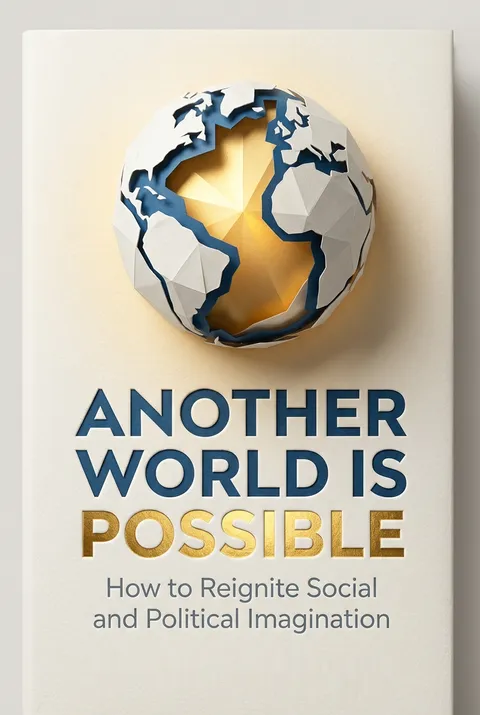
Key Takeaways
1. The World Suffers from a Pervasive "Imaginary Crisis"
We can more easily imagine the end of the world than a better future.
Pervasive pessimism. Humanity is gripped by a profound pessimism, where dark visions of apocalypse overshadow hopes for a better tomorrow. This "imaginary crisis" means horizons have shrunk, and institutions once fueling shared imagination now recycle old ideas, leaving public discourse stagnant. This pervasive gloom risks becoming a self-fulfilling prophecy, paralyzing action.
Stunted creativity. Research suggests a decline in creativity, particularly among younger generations, despite technological advancements. This is attributed to:
- Rigid, exam-focused education
- Social media echo chambers
- Increased "burden of knowledge" in research
This leads to a shift from innovation to recycling, with few truly novel ideas emerging in politics, arts, or social thought.
Imbalance in imagination. There's a striking gulf between vibrant technological imagination (AI, synthetic biology, space colonization) and a stunted social imagination. Silicon Valley, for instance, excels in tech but struggles with social thought, leading to pathologies like widespread homelessness alongside immense investment in virtual reality. This "materiality bias" prioritizes visible tech over invisible social structures, exacerbating societal problems.
2. Imagination is a Fundamental Human Capacity for Shaping Reality
the ultimate, hidden truth of the world is that it is something that we make and could just as easily make differently.
Everyday fictions. Much of daily life relies on shared fictions—like private property, marriage, or money—which are products of human imagination. These "necessary fictions" provide maps for day-to-day life, and recognizing their constructed nature is the first step toward reimagining and redesigning our social world. This capacity allows us to see things not just as they are, but as they could be.
Possibility perception. Imagination enables "possibility perception," the ability to look at existing social arrangements—schools, workplaces, democracy—and envision their potential transformations. This involves:
- Questioning the present's claim to be natural
- Constructing plausible alternatives, balancing limits with transcendence
This process not only shapes the future but also deepens our understanding of the present's malleability and our own freedom.
Empathy and consciousness. Our ability to imagine the future is deeply linked to our capacity for empathy, allowing us to grasp the lives and feelings of others. Expanding empathic imagination helps us understand how our lives are shaped by luck and context, fostering a more inclusive and tolerant society. This "progress in consciousness" is essential for any meaningful societal advancement, moving beyond illusions and attachments.
3. History Reveals How Imagination, from Utopias to Lifestyles, Drives Change
A map of the world that does not include utopia is not worth even glancing at, for it leaves out the one country at which Humanity is always landing.
Utopias as thought experiments. From Plato's Republic to More's Utopia and Bellamy's Looking Backward, descriptive utopias have served as powerful thought experiments. While rarely blueprints, they clear people's heads, showing the world's plasticity and acclimatizing us to other possibilities, even if they are often too complete or insular to be directly implemented. The act of "utopifying" itself is healthy and essential.
Generative ideas and new lifestyles. More impactful than complete utopias are simple, generative ideas that spawn many others, like:
- Human rights
- Universal suffrage
- Permaculture
- Nudge theory
Equally transformative are new lifestyles or sensibilities, such as veganism or hacker culture, which influence through habits and ethos, creating new ways of living that spread organically.
Organizations and neotopias. Imagination also materializes through new organizations, like Michael Young's Consumers Association or Muhammad Yunus's Grameen Bank, which embed ideas in scalable structures. Even more concretely, "neotopias"—real places built to exemplify new ideas, like Robert Owen's New Lanark or Ebenezer Howard's garden cities—persuade by force of example, inspiring wider change.
4. Effective Imagination is "Thick," Dialectical, and Embraces Incompleteness
those that live, thrive and become meaningful to successive generations are the ones that leave them space to adapt, add and subtract (something always true of pieces of music and theatre, which have to be interpreted to live).
The power of incompleteness. The future is unknowable, making complete, coherent visions less useful than ideas that are fragmentary, suggestive, and partial. The most useful imagineers are explorers who map the future through trial and error, providing ideas and tools that others can adapt and evolve. Over-planned models rarely work; the best designs build in capacity for adaptation.
Thick vs. thin imagination. Influential ideas are "thick"—dense networks of complementary concepts, ethos, domain applications, and practical implementations. Thin imagination, by contrast, offers only vague ideas. Powerful movements, like Robert Owen's cooperative program or 19th-century Prussian militarism, operate effectively at all four levels, gathering meaning and becoming part of people's identities.
Dialectical thinking. The most powerful social imagination is dialectical, going both with and against the grain of powerful trends. It draws on frontier ideas while challenging them, grasping tensions and contradictions rather than wishing them away. This approach, unlike one-dimensional thinking, recognizes that each action creates its own dynamics and challenges, leading to more robust and adaptable solutions.
5. Re-energizing Imagination Requires Deliberate Tools and Collaborative Methods
Imagination is more important than knowledge. Knowledge is limited. Imagination encircles the world.
Universal grammars of creativity. Creativity can be learned and institutionalized using a "universal framework" that mirrors artistic practices. This involves applying transformations to existing activities or functions:
- Extension: Taking an aspect further (e.g., expanding market reach).
- Grafting: Applying an idea from one field to another (e.g., juries in democracy).
- Inversion: Reversing roles or norms (e.g., patients becoming doctors).
- Addition/Subtraction: Adding new elements or removing existing ones.
- Metaphor/Analogy: Seeing one thing and thinking of another.
- Randomness: Introducing surprise to dislodge conventional thought.
Collaborative exploration. Imagination flourishes in collaborative settings that encourage exploration and challenge old habits. Methods include:
- Psychodrama: Using theatre techniques like role reversal to gain visceral insights.
- Pattern languages: Identifying and recombining fundamental elements of design.
- Thought experiments: Unraveling the logic of new possibilities by relaxing or introducing constraints.
- Worldbuilding: Creating coherent fictional environments to explore future scenarios.
Institutions and meetings for imagination. Dedicated institutions like Finland's "Future Foundation" or Dubai's "Museum of the Future" provide spaces for free-thinking. Large-scale participatory methods, such as Christchurch's MMORPG for city rebuilding or Japan's "Future Design" citizens' assemblies, engage broad publics in imagining and shaping their collective future.
6. Translating Ideas into Action Demands Experimentation Across All Domains
Only a crisis—actual or perceived—produces real change. When that crisis occurs, the actions that are taken depend on the ideas that are lying around.
Crisis as catalyst. Crises, like the COVID-19 pandemic, force governments to consider previously unthinkable policies, confirming that "the politically impossible becomes the politically inevitable" when ideas are readily available. The task of creators is to keep options alive, ready for when conditions ripen.
Reimagining welfare. Welfare states, designed for 20th-century risks, need reimagining for 21st-century challenges like mental illness, precarious employment, and intensive elderly care. Experiments like Finland's universal basic income pilot show:
- Increased work and well-being for recipients
- A willingness to test radical ideas on a small scale
This approach can lead to diverse welfare models, such as targeted basic incomes or universal basic services.
Net zero and public spaces. Achieving net zero carbon emissions requires radical imagination across energy, transport, and lifestyles. This includes:
- Circular economies with reduced waste
- Carbon allowances and penalties
- Rethinking jobs for maintenance and repair
Similarly, public spaces like beaches or libraries can be reimagined for new functions, from educational hubs to community centers, or even as "15-minute cities" where essential services are hyper-local.
7. Imagination Springs from Deep Mental Roots, Milieus, and Material Conditions
Companions the creator seeks, not corpses, not herds and believers. Fellow creators, the creator seeks—those who write new values on new tablets.
Mental modules and collective unconscious. Social imagination feeds off innate mental modules—our intuitive physics, social heuristics, and moral predispositions—which form a "folk sociology." These, along with ideas circulating in a constantly mutating "collective unconscious," constrain and shape what can be collectively imagined, making ideas resonate when they echo shared hopes and fears.
Material base: time and money. Social imagination is a specialized activity that surges in particular places and times. It requires:
- Security: Freedom from immediate survival concerns.
- Free time: To conceive, design, and describe imaginative options.
- Resources: Access to literacy, libraries, and funding.
Historically, visionaries often relied on private wealth or patrons, and today, the uneven distribution of these resources leads to unequal capacities to dream and shape the future.
Milieus and the insider/outsider paradox. Ideas rarely flourish in isolation. A vibrant "milieu"—a surrounding network of comment, criticism, competition, and informed audience—is crucial. Cities, with their density and combinations, often serve as crucibles of imagination. The most influential imagineers often straddle insider and outsider status, combining elite connections with a critical distance from dominant currents.
8. Ideas Spread Through a Dynamic Interplay of "Push" and "Pull" Factors
The man who has no imagination has no wings.
Push theories: advocacy and charisma. Some ideas spread because they are actively "pushed" by advocates, evangelists, and charismatic leaders who believe in their transformative power. This "push power" can be seen in:
- William Blake's belief in "firm persuasion" moving mountains
- Corporate visions of driverless cars or smart cities
- The aesthetic program of Nazism
Evidence also plays a part, but the inherent appeal and philosophical ontology of ideas—their beauty, simplicity, and resonance with deeper notions of communion or justice—also influence their spread.
Pull theories: needs and demands. Ideas are also "pulled" by societal needs and demands. This includes:
- Profit motive: Firms adopting new ideas for economic gain.
- Electoral politics: Governments seeking ideas to win public support.
- Crises and wars: Forcing the adoption of new measures (e.g., rationing, vaccine development).
- Fear of disaster: Threats like climate change or species extinction create a strong pull for innovative solutions.
The Great Stink in London, for example, forced a radical rethink of public health and sewage systems.
How ideas keep flying. Ideas spread more easily when they:
- Travel in groups: "Thickened out" with complementary concepts and techniques.
- Complement older ideas: Grafting onto existing systems is easier than smashing them.
- Are embedded: Translated into routines, institutions, and jobs, becoming second nature.
The timing is crucial, as complementary technologies, institutions, or shared senses of need must be in place for ideas to take hold and scale.
9. Limits and Dangers: Navigating the Boundaries of the Possible
on a certain level, the nature of our nature is not to be particularly constrained by our nature.
Boundaries of the possible. While human social organization shows astonishing variety, there are limits to what can be done and thought. These include:
- Practical constraints: How to organize large settlements with food, water, energy.
- Path dependence: Societies get locked into past choices (e.g., oil-based economies, inherited tax systems).
- Human nature: While malleable, it's not infinitely flexible, with basic biological needs and needs for meaning.
- Ecological limits: Societies cannot defy the laws of physics or endlessly deplete natural resources.
Despite these, societies can reinvent themselves, and "Year zero" thinking is often brutal and inefficient.
Dangerous imagination. Imagination is ambiguous; utopia for one can be hell for another. It can amplify the worst of human nature, leading to:
- Totalitarianism: Creating "lying worlds" distant from reality, as with Nazism.
- Death cults: Movements like fascism or Daesh that glorify violence and death.
- Morally suspect ideas: Eugenics, which attracted brilliant minds but led to horrific policies.
Fertile imagination can also substitute for knowledge, spreading "bullshit" that is hard to refute.
Destruction and violence. The belief that blockages must be destroyed to make way for the new (e.g., Lenin's "can't make an omelette without breaking eggs") often leads to violence. While anger can motivate, violence tends to be pointless or habitual, becoming an end in itself. It crowds out imagination of a world beyond conflict, failing to offer the "transition" needed for future harmony.
10. Reimagining Government as a "Shared Brain" is Crucial for a Wiser Society
intelligence is knowing what to do when you don’t know what to do
Beyond cynicism. Governments are often seen as enemies of imagination, prone to bureaucracy and mistakes. However, they are central to societal progress, providing health, prosperity, and security. A stunted imagination of government leads to an odd distortion of its potential. The ideal is a state that is transparent, responsive, and humble, evolving from a coercive force to a partner and servant of society.
Government as a shared brain. A future government could function as a collective intelligence, sharing insights with society rather than hoarding power. This involves:
- Observation: Using diverse data (citizen feedback, sensors, satellites) organized as a commons.
- Models: Employing multiple, challenging models to make sense of complex phenomena, openly debated.
- Creation & Experimentation: Fostering innovation labs and continuous experimentation, learning from what works.
- Memory: Organizing institutional memory through evidence repositories and "What Works Centres."
- Empathy: Cultivating empathy in civil servants through frontline engagement.
- Judgment & Wisdom: Explicitly predicting outcomes, reflecting on results, and adapting.
Cultivating wisdom in society. A wiser society would embed these habits of looped learning and reflection at all levels. Wisdom is:
- Learned: Through practice, reflection, and testing arguments.
- Plural: Seeing things from many viewpoints, avoiding single-discipline traps.
- Diverse: Combining diverse, sophisticated, and integrated perspectives for superior problem-solving.
- Collective: Mobilizing group intelligence through crowdsourcing, citizen science, and AI-enhanced collaboration.
This "dark matter" of everyday wisdom—calm, balance, conflict resolution—reduces unnecessary harm and suffering.
11. Competing Political Imaginaries Battle for the Future's Narrative
Who controls the past controls the future: who controls the present controls the past.
Frontier politics. Marx believed the leading edge of the economy determines political futures. Today, this frontier includes high-end manufacturing and millions in software/data, whose daily tasks involve reprogramming and remaking the world. Their ideals, like the open-source movement, point to greater autonomy and control over algorithms and data, challenging corporate and state power.
Authoritarian nationalist technocracy. A powerful contender is techno-nationalism, exemplified by Xi Jinping's China. This imaginary fuses:
- National mission: A sense of unique history and destiny.
- Military prowess & industrial strength: Global leadership in science and technology.
- Authoritarian control: Internet as a governance tool, eliminating dissent.
- Ecological concern: Advocating renewables and circular economy.
This vision, rooted in ancient ideas like "tianxia," promises order and prosperity, appealing to many rulers globally.
Ecological imagination. This imaginary starts from the nightmare of climate change and species extinction, promising a reversal of industrialization. It envisions:
- Organic farming, vegetarianism, car-free cities, zero-waste economies.
- A return to community, equity, and spiritual reconnection with nature.
The challenge lies in reconciling human population needs with ecological limits, and moving beyond portraying humans as a "virus" to a more integrated view where humans are part of nature but also capable of advancing consciousness.
Social democracy's timidity. Traditional progressive parties often lack bold, future-oriented ideas, instead offering incremental tweaks or recycling old concepts like UBI or shorter workweeks. This "timid incrementalism" and "purity politics" hinder their ability to:
- Combine practical steps with long-term aspirations.
- Engage with new divides (e.g., between fast/slow, connected/less connected).
- Construct inclusive imaginaries for a zero-carbon economy that appeals to manual workers.
12. Cultivating a Creative Ecosystem is Essential to Become Authors of Our Future
How does a single person put a break in inevitability? Well, by finding others.
A creative ecosystem for social imagination. Just as art thrives in a supportive milieu, social imagination needs a broad and deep ecosystem. This requires:
- Resources: Funding, time, and training programs to spread creative methods.
- Physical places: "Imaginariums" or "museums of the future" to curate and promote ideas, allowing audiences to experience possible futures.
- Curators: New professionals skilled in making future options compelling and convincing.
This ecosystem must foster intensive feedback and connect supply with demand from political parties, governments, and NGOs.
Social sciences for the future. Social science must move beyond analyzing the past and present to embrace "exploratory social science." This new approach would:
- Design future societies: Combining creativity and rigor to propose potential designs for firms, welfare, cities, and governance.
- Use creative tools: Scenarios, fiction, simulations, and games to rigorously explore assumptions and patterns.
- Integrate disciplines: Work on challenge-based questions (e.g., ending homelessness in London) using diverse expertise.
Universities, as public spaces, can host imaginariums and become more immersed in their cities' future-shaping efforts.
Funding and political will. Philanthropy, despite its potential for risk-taking, often remains cautious and focused on narrow problem-solving. A shift is needed towards funding "sparks"—radical thought and action that challenges power structures. Political parties and leaders must also cultivate a hunger for imagination, moving beyond short-term electoral cycles to engage with long-term societal needs. Leaders like Antanas Mockus, who transformed Bogota's culture through imaginative acts, demonstrate the power of embodied imagination.
Review Summary
Another World Is Possible holds a strong overall rating of 4.5 out of 5 stars based on 18 reviews on Goodreads. While specific detailed reviews are limited in the available data, the book appears on Tobias Revell's recommended bookshelf, suggesting it has garnered attention and appreciation within certain intellectual circles. The high rating indicates readers have generally responded positively to the work's content and ideas about alternative futures and possibilities for social change.
People Also Read
Download PDF
Download EPUB
.epub digital book format is ideal for reading ebooks on phones, tablets, and e-readers.








































