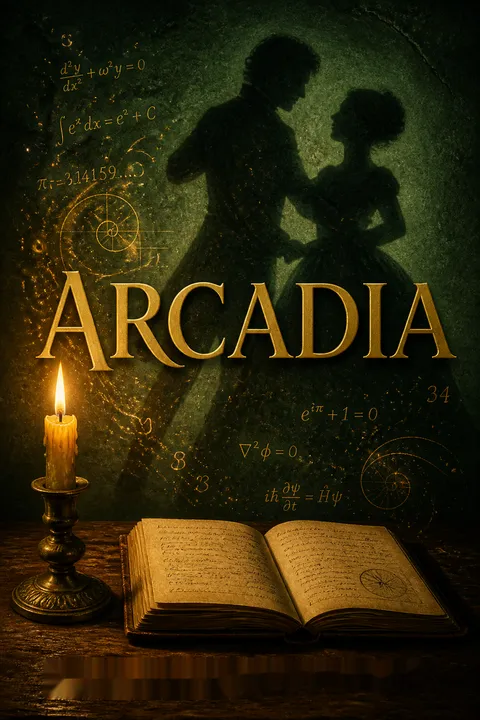

Plot Summary
Gardens of Order and Chaos
Sidley Park, an English country house in 1809, is in flux. Lady Croom struggles with her landscape architect, Noakes, as he transforms classical order into picturesque chaos, reflecting the tumult between Enlightenment rationality and Romantic spirit. The grounds are alive with change, embodying the clash of aesthetics and the search for meaning, with discussions of gardens echoing deeper questions about order and disorder in nature and human desire. These shifting landscapes will become a metaphorical backdrop for the emotional and intellectual tangles of residents past and present, as centuries later, scholars and descendants will try to untangle not only history but the hidden patterns beneath it all.
Lessons in Love and Logic
Thirteen-year-old Thomasina Coverly is precocious and insatiably curious, tutored by the witty and languid Septimus Hodge. Their lessons traverse algebra, forbidden knowledge, and carnal embrace—Thomasina's questions blend scientific rigor with a longing to understand the mysteries of adult passion. Septimus, amused and disarmed, offers strict truths about mathematics alongside evasions about love, until innocence is gradually replaced by insight. Their exchanges are playful but profound, foreshadowing discoveries that will echo far beyond their lifetimes, entwining matters of the heart and mind in ways neither fully anticipates.
Rumors Spread, Pistols Drawn
In the genteel chaos of the manor, rumors race: Mrs. Chater's indiscretion in the gazebo throws the household into confusion. Septimus, implicated in gossip, faces off with Ezra Chater, the aggrieved but comically earnest poet. Chater's sense of honor demands a duel. Comic misunderstandings escalate as literary rivalry and sexual jealousy collide, with the threat of violence hanging in the air. The episode reveals the era's codes of reputation and rivalry, but also hints at how personal failings and partial truths can shape the historical record—a motif that will reverberate into the present day.
Secrets in the Schoolroom
The schoolroom collects secrets like dust. Septimus juggles the advances of Mrs. Chater and Lady Croom's watchful eyes, all while guiding Thomasina's mathematical leaps. Her thoughts push beyond conventional wisdom; she is already glimpsing chaos within order, sensing that even the universe might rebel against tidy rules. Objects—letters, books, a tortoise—shift meaning from hand to hand, keeping knowledge (and scandal) alive for future researchers. Personal passions are masked behind formality, while intellectual passion makes the air crackle with potential.
An Apple Stirs Time
A simple apple becomes an emblem of intellectual temptation as Thomasina seeks to describe the world's shapes using mathematics. She wonders why equations fail to capture nature's complexity—why, for example, an apple leaf defies all formulas. Septimus and Thomasina's relationship deepens, filled with challenging questions and mutual respect, as the joys and dangers of knowledge itself are dramatized. The apple, like Eve's in Eden, beckons toward both the pleasures and perils of forbidden understanding, hinting at the eventual tragedy to come.
Entangled Pasts, Colliding Presents
Nearly two centuries later, present-day Sidley Park is a crucible of modern inquiry. Author Hannah Jarvis and academic Bernard Nightingale spar over half-glimpsed truths buried in household records. Modern descendants like Valentine and Chloë add their own emotional complications. As Hannah examines the hermit's life and Bernard chases scandalous connections between Byron and a vanished poet, their own rivalries and attractions mirror those of the past. The schoolroom becomes a palimpsest: layers of time, emotion, and intellect overlap, blurring the boundaries between observer and observed.
The Hermit and the Hermitage
Hannah's research into Sidley Park's mysterious hermit becomes a lens for larger themes. The hermit, once a learned man, retreated to the garden's built seclusion, leaving behind only indecipherable notations and rumors of genius-turned-madness. He is mythologized by later generations as emblematic of the Romantic mind—reason turned to chaos. His lonely cottage is both a physical and philosophical ruin, suggesting the fragility of intellect isolated from human contact, and the way even great minds can be misunderstood or lost.
Byron in the Margins
Lord Byron, briefly present at Sidley Park, haunts both eras—more myth than man. Letters, inscriptions, and the dogged efforts of Bernard shroud him in scandal. Did Byron seduce and kill Chater in a duel? The evidence is tantalizing but inconclusive. Like the hermit's mathematics, historical truth proves elusive: the facts, filtered through rumor and personal obsession, remain unresolved. Yet Byron's shadow catalyzes passions both amorous and professional, showing how celebrity and imagination can distort the search for knowledge.
Genius Lost, Genius Found
Thomasina's mathematical insights—anticipating chaos theory and the limits of determinism—go largely unrecognized and unfulfilled in her lifetime. Her lesson books, traversed and puzzled over by Valentine and Hannah, reveal breathtaking ideas about iterative equations and the unpredictable beauty of real nature. The tragedy is doubled: not only will she die young in a fire, but her work, eclipsing her male counterparts, will be both prescient and unread. Genius flickers in the margins, rescued only posthumously by chance and perseverance.
Chaos and the Dance of Numbers
Valentine, the present-day mathematician, elucidates what Thomasina grasped: that simple formulas, when fed back upon themselves, generate unspeakably complex patterns—fractals, turbulence, the structure of leaves. The universe is not smoothly predictable but, like history and the heart, erupts into disorder. This new mathematics, only accessible with computers, retroactively vindicates Thomasina's intuitions. The unpredictable and the predetermined coexist, and chaos, not order, is the true genius of nature—and of Sidley Park.
Scandal, Science, and the Search
Bernard's pursuit of a historical coup—proving Byron a murderer—collides with Hannah's measured skepticism and Valentine's scientific rigor. Passions and ambitions distort evidence; the past is rewritten to serve the needs of the present. The scientific versus Romantic worldviews clash in lively debate. The search itself—more than any conclusion—becomes the central human endeavor. The swirling energies of love, creativity, and scientific curiosity create meaning, despite the impossibility of final certainty.
Duels, Discovery, Departure
In 1809, accusations burst into the open: scandals are aired, and threatened duels dissipate into comic anti-climax. Byron and the Chaters depart amid farce and heartbreak, their traces confused by time. Septimus stays behind, a victim of public disgrace but also a steward of Thomasina's gifts. Relationships fracture and reassemble; knowledge is lost in fires and misunderstandings. The threads of the past momentarily fray, only to be rewoven—with crucial omissions—by those who survive.
The Heat of Irreversibility
Both Thomasina and Valentine, across centuries, glimpse the profound truth that certain processes—like the dispersal of heat or the mixing of jam into pudding—are irreversible. The second law of thermodynamics, an arrow of time, permeates both the physical universe and the fates of characters. Knowledge is always partial; broken windows, burned letters, and losses—scientific and emotional—cannot be unmade. Time itself, like scandal or love, only flows one direction.
Romantic Myths Unravel
Bernard's grand thesis begins to collapse: Chater's fate is prosaic rather than poetic, yet the passionate need for meaning endures. The reality of history is tangled, and as new evidence emerges, it transforms once-sensational stories into muted truths. The mythic arc is replaced by layers of ambiguity, the certainty of genius replaced by the contingent beauty of incomplete knowledge. Yet, as the legend dissolves, new depth and new appreciation emerge for those whom history almost forgot.
Truths Beyond the Archive
The characters, old and young, realize that closure is impossible—whether in science or personal longing. Life goes on across generations, answers remain partial, and the allure of the unknowable is both frustration and invitation. Hannah, Bernard, and Valentine each come to accept that their missions—whether literary, historical, or scientific—will never yield total certainty. Imperfect, they persevere, their questions an affirmation of the very act of seeking.
In the Light of Ashes
The schoolroom, now layered with century's worth of books, inventions, and detritus, becomes a silent witness to what endures and what perishes. Thomasina's death by fire seals her discoveries in obscurity, yet her work, and her love for Septimus, leave traces that the moderns belatedly attempt to bring to light. The estate's ruins, metaphoric and literal, signal both the destruction and transformation that time brings—leaving only what the future may be wise enough to recover.
Timelines Entwine at Midnight
As a modern fancy-dress party overlaps with an echo of a long-ago night, ghosts and descendants all seem to occupy the same enchanted space. The present is animate with the unresolved passions and unfinished discoveries of the past; the living perform dances, debates, and desires that closely resemble those of their forerunners. The air is thick with unspoken connections, missed chances, and the ambiguous comfort that knowledge, like love, is always a matter of faith as well as of fact.
Waltzing Into the Unknowable
As the house fills with music and revelry, Thomasina, on the eve of her death, finally dares—guided by Septimus—to waltz. Their connection culminates in a dance, innocent and sublime, as tragedy looms. In the waning light, mystical beauty and loss commingle; the modern researchers, guided by the fragments left behind, catch fleeting glimpses of their ancestors' truths. Reason and passion, science and art, order and chaos—these opposites waltz together, not toward resolution, but into the enduring, generative darkness of what can never be fully known.
Analysis
Arcadia is a dazzling meditation on the intersection of reason and desire, determinism and chaos, and the role of time in both erasing and preserving lives. Stoppard's layered structure—the intertwined timelines, the mirroring of past and present characters, the re-use of motifs—enacts his central theme: that knowledge, like passion, is always partial and entwined in disorder. The play warns against the comforts of closure and the arrogance of certainty (whether in love, history, or mathematics), arguing instead for the nobility of unending curiosity and acceptance of loss. Thomasina's pioneering insights are lost by accident and gender; Bernard's pet theories are undone by facts and ego; Hannah's skeptical rigor can only gesture at what is ultimately unknowable. Yet Stoppard insists that this incompleteness is not tragic, but beautiful: the pursuit of meaning—be it through equations, garden designs, or waltzes—creates islands of order in a sea of ashes. In its final, moving tableau, dancing lovers in candlelight dissolve the boundaries of time and genre: a celebration of the human compulsion to seek, love, and create, undeterred by the certainty that every answer is temporary, and every story unfinished.
Review Summary
Reviews of Arcadia are largely positive, with many praising Stoppard's intellectual ambition, wit, and structural ingenuity in weaving together two time periods within a single setting. Admirers celebrate its fusion of chaos theory, thermodynamics, romanticism, and human emotion, culminating in a deeply moving final waltz. Critics, however, find the characters insufferably self-impressed, the scientific treatment inaccurate or oversimplified, and the play overly elitist. Most agree it is best experienced as a performance rather than a read text, and nearly all acknowledge its extraordinary cleverness, even when divided on its emotional resonance.
People Also Read
Characters
Thomasina Coverly
Thomasina, only thirteen at the story's beginning, is dazzlingly bright, curious about mathematics, physics, and the mysteries of love and death. Her relationship with Septimus, part mentoring, part playful comradeship, is charged with affection and intellectual equality. Thomasina's genius is tragic: she anticipates revolutions in science lost on her contemporaries, and her ardor for learning is shadowed by a fatal curiosity—mirrored in her untimely death by fire before she can realize her full promise. Psychologically, she's the archetype of the thwarted visionary—innocent, passionate, and bursting beyond her era's boundaries. Her legacy survives in the work and wonder of those who come after her, glimpsing in her notebooks the chaos that shapes the world.
Septimus Hodge
Septimus is a young tutor, intellectually agile and sardonic, teaching Thomasina as much about life's ambiguities as about Latin or mathematics. Outwardly amused and rational, he is inwardly drawn to both reason and romance, his affections oscillating between the married Mrs. Chater, Lady Croom, and—chastely at first—his gifted pupil. His role as teacher is complicated by scandal and longing: both the world's folly and its beauty are clear to him. After Thomasina's death and his own disgrace, Septimus becomes the hermit of Sidley Park, his mind unraveling as he obsesses over fallen hopes—and yet, his presence echoes down the centuries in both legend and the landscape itself.
Hannah Jarvis
A contemporary historian and writer, Hannah is fiercely intelligent, reserved, and determined to find meaning amid fragmentary records. She scorns sentimentality, preferring hard evidence over grand romantic theories. Her investigation into the Sidley hermit and the garden's history intersects with her own emotional entanglements—especially with Bernard and the Coverly family. Hannah moves past illusions of certainty, accepting that history is written as much by error and accident as by achievement. Her reserved exterior masks a longing for human connection, ultimately shining through her growing sense of wonder at Thomasina's genius.
Bernard Nightingale
Bernard, an academic in the present, is charismatic, impulsive, and fervently competitive. Fixated on securing his scholarly reputation, he pursues a sensational theory that Byron killed Chater in a duel. Bernard's intellect is as unstable as his libido: he is both dazzling in debate and quick to project personal desires onto the past. His rivalry (and occasional flirtation) with Hannah reflects his fundamental need to be acknowledged. Repeatedly, his daring conclusions collide with inconvenient facts, but though he is often wrong, he embodies the Romantic ardor to wrest sense from chaos, for better and worse.
Valentine Coverly
Valentine is Sidley Park's present-day inhabitant—a scientist devoted to mathematical models of chaos theory and population dynamics. Patient, sometimes irritable, and quietly passionate, Valentine is the bridge between Thomasina's discoveries and modern science. He reveres the messy beauty of real data, understands the limits of predictability, and offers a counter to Bernard's focus on literary drama. His understated longing for Hannah and empathy for others underscore his role as an observer unwilling to impose certainty where none exists.
Lady Croom
Lady Croom dominates 1809 Sidley Park with her forceful will and sharp tongue. She is both a protector of tradition and a connoisseur of social maneuvering, managing scandals, servants, and sons with equal aplomb. Her interactions with Septimus, Thomasina, and the rest offer both comic relief and pointed commentary on the era's constraints, particularly for women. Emotionally intelligent but bound by decorum, she is nonetheless swept along by the passions and changes surrounding her, embodying the intersection of old order and new chaos.
Ezra Chater
Chater desperately seeks both literary acclaim and conjugal respect, swinging between wounded pride and foolish ambition. His tragicomic role is to become a pawn in the rivalries of greater minds, his posthumous record confused between minor poetry and botany. Chater's emotional naivety—his inability to see or resist manipulation—renders him both ridiculous and touching, a casualty of others' schemes and the indifference of history.
Mrs. Chater (Charity Chater)
Charity Chater is the object of multiple men's attentions, her actual feelings and agency drowned out by the projections and desires of others. Her liaisons—most notably with Septimus—catalyze the play's central scandal, and her legacy is further complicated by her later marriage and voyage abroad. She personifies the tendency of both history and gossip to reduce women to their romantic attributes, yet her actions inadvertently shape the destinies of nearly all the main players.
Richard Noakes
Noakes, the self-styled visionary gardener, personifies the transition from Enlightenment order to Romantic wildness in the landscape. His earnestness makes him a comic figure to the more cynical aristocrats, yet he is an engine of genuine, if sometimes destructive, innovation. His ambitions, both artistic and technological, foreshadow the coming age of steam and transformation—catalyzing the physical and metaphorical storms at Sidley Park.
Gus/Augustus Coverly
In the present, Gus is mute and seemingly simple, but intuitively drawn to the remnants and mysteries of the house, returning objects and making quiet, empathetic connections. In 1809, Augustus is a minor, mischievous figure. Gus's nonverbal presence becomes crucial: he is the living thread between centuries, and his small acts help restore what history has lost or overlooked, hinting at the importance of kindness and curiosity beyond words or theories.
Plot Devices
Time's Interleaving Structure
with the narrative shifting rapidly between 1809 and the present day. Events, motifs, and even props (such as books, the tortoise, the apple) physically and thematically overlap, revealing how lives and ideas are recursively interrelated. The juxtaposition imparts poignancy to lost potential, intensifies the suspense as discoveries are made—or missed—and renders the play itself a fractal, iterated system. This interweaving blurs clear distinctions between past and present, making every character both observer and observed.
Iteration and Chaos
The iterated equations in Thomasina's work, later confirmed by Valentine's computer, formally mirror the narrative's own recursive, self-referential storytelling. Patterns emerge from apparent disorder—historical details, emotional rivalries, and scientific ideas repeatedly cycle and reconfigure. The plot explicitly uses feedback, sensitive dependence, and the unpredictability of outcomes to shape both individual fates and the audience's understanding, making the play itself an exploration of chaos theory.
Foreshadowing and Irony
as Stoppard seeds discussions and props which reveal their true significance only much later. Tragic irony abounds: the audience is made party to knowledge withheld from characters (e.g., Thomasina's impending death, the misreading of evidence), intensifying both pathos and dark humor. Dialogue frequently foreshadows future revelations, while emotional and scientific truths are invariably entwined, making the play's discoveries all the more poignant when the limits of evidence are finally exposed.
Meta-Narrative and Self-Reference
The play questions the activity of historical research itself; Bernard's scholarly zeal becomes part of the dramatic action, critiqued and parodied by Hannah and Valentine. The act of searching for meaning—be it scientific, romantic, or biographical—becomes the subject. The audience is constantly reminded of interpretive error, the unreliability of records, and the inadequacy of reason to exhaust either love or the universe.
About the Author
Other books by Tom Stoppard
Download PDF
Download EPUB
.epub digital book format is ideal for reading ebooks on phones, tablets, and e-readers.








































