
Key Takeaways
1. Plants: Ingenious Architects of Life and Human History
Often beautiful, sometimes deadly, but constantly ingenious, plants are the sources of life and delight, myth and mayhem.
Foundational role. Plants are the fundamental architects of life on Earth, performing photosynthesis to convert basic substances like carbon dioxide, water, and nutrients into complex organic matter. This process forms the base of all food chains, sustaining every other creature, directly or indirectly. Without plants, the intricate web of life as we know it would collapse.
Ancient ties. Human civilization is deeply intertwined with the plant world, a relationship spanning millennia.
- Barley, domesticated over 10,000 years ago, enabled communities to settle and build cities.
- Nettle fibers were woven into textiles 2,800 years ago in Denmark.
- Papyrus was vital to ancient Egyptian civilization, providing materials for boats, ropes, and the very first paper.
These early uses highlight how plants were not just resources but catalysts for societal development.
Cultural imprints. Plants have left indelible marks on human history and culture, often revealing clues about our past. Nettle patches, for instance, indicate ancient human habitation due to their preference for phosphate-rich soil from fires and waste. From colossal temple columns carved as papyrus bundles to the symbolic use of plants in art and literature, their presence is a constant reminder of their profound influence.
2. The Dual Nature of Plants: Sustenance and Danger
Some have a troubling past, while others have ignited human creativity or enabled whole civilizations to flourish.
Nourishment and poison. Many plants offer vital sustenance, yet simultaneously harbor potent toxins. The tomato, a member of the Solanaceae family, provides edible fruit, but its leaves contain alkaloids and are best avoided. Similarly, while potato tubers are a global staple, their fruit and green parts are poisonous, containing glycoalkaloids that cause severe illness.
Medicinal marvels. Plants have served as humanity's pharmacy for millennia, offering remedies for a vast array of ailments.
- Liquorice has a 4,000-year history of treating coughs, colds, asthma, and indigestion.
- Wormwood, known for expelling intestinal parasites, also yielded artemisinin, a Nobel Prize-winning treatment for malaria.
- The Mexican yam provided diosgenin, a crucial precursor for the artificial manufacture of steroids, including anti-inflammatory drugs and the contraceptive pill.
Deadly allure. Some plants are deceptively beautiful or useful, masking deadly properties. The castor bean, despite being the source of ricin—one of the world's deadliest poisons—also yields castor oil, a reliable laxative with a 4,000-year medical history. Opium poppies, while providing the raw material for highly addictive drugs like morphine and heroin, were also among the few effective pain relievers known to ancient civilizations.
3. Evolution's Masterpieces: Remarkable Adaptations and Survival
There is so much to captivate us in the riotous, and often bizarre, plant world.
Ingenious survival. Plants exhibit extraordinary adaptations to thrive in diverse, often harsh, environments. The welwitschia of the Namib Desert, with its two ever-growing leaves, may absorb moisture directly from fog. The saguaro cactus, an icon of the Sonoran Desert, conserves water by closing its pores during the day and absorbing carbon dioxide at night, a specialized form of photosynthesis.
Pollination wizardry. Plants employ bizarre and complex strategies to ensure reproduction, often manipulating insects with remarkable precision.
- Dandelions use a tiny halo of spinning air, a vortex, to slow the descent of their seeds, allowing them to be wafted further.
- Sphagnum moss fires its microscopic spores skywards using compressed air, reaching astonishing heights relative to its size.
- The dead-horse arum mimics rotting flesh with overwhelming stench and appearance to attract blowflies for pollination, trapping them temporarily.
- Orchids, with their baroque shapes and scents, use deception, intricate traps, and even mimicry of female insects to ensure pollinators deliver pollen precisely.
Parasitic prowess. Some plants have evolved to live entirely off others, showcasing extreme forms of adaptation. Rafflesia, found in Borneo, is the world's most massive single flower, lacking roots, stems, or leaves, and living as microscopic filaments within a host vine. It emerges only to bloom, reeking of carrion to attract pollinators. The Western Australian Christmas Tree (Nuytsia) is the world's largest parasite, sending out roots to sever and siphon nutrients from its neighbors, even cutting buried telephone wires.
4. Cultural Tapestry: Plants Woven into Human Rituals and Identity
Most of the stories in this book reveal as much about people as they do about plants: the dumb cane, the opium poppy and the peacock flower with their poignant and troubling tales; the peculiar traditions involving kava, Spanish ‘moss’ and rhododendron; the extraordinary ways that men and women have taken to mandrakes, chocolate and even wormwood as aphrodisiacs; and let’s not forget the comedy pumpkin.
Sacred symbols. Plants are deeply embedded in human spirituality, folklore, and national identity. The lotus, India's National Flower, symbolizes purity, wealth, and enlightenment in Hinduism and Buddhism, often depicted as thrones for deities. The citron (etrog) is central to Jewish Sukkot celebrations, chosen for its symmetry and perfection.
Rituals and folklore. Many cultures have developed elaborate rituals and superstitions around plants.
- Kava is a sacred social drink in Vanuatu, consumed in ceremonies to connect with ancestral spirits and welcome distinguished visitors.
- Mandrake, with its disconcertingly human-like bifurcated roots, was associated with magic, aphrodisiacs, and even anaesthesia in ancient times, leading to bizarre harvesting rituals.
- Spanish moss, with its eerie drapes, is used to stuff hoodoo dolls, charms believed to ward off evil or bring good fortune, linking it to spiritual traditions of the West African diaspora.
Identity and celebration. Plants define cultural identity and mark significant events and festivals. Marigolds are known as "flor de muertos" (flower of the dead) in Mexico, adorning altars and graves for Día de Muertos, guiding souls home. The Japanese chrysanthemum is a national symbol, celebrated in autumn festivals with elaborate displays, representing rejuvenation and longevity.
5. The Global Exchange: Plants Shaping Economies and Empires
Commerce was persuasive, and by 1900 some 60,000 people across Scotland derived their livelihoods from the kelp industry, although coastal workers saw little of the landowners’ profits.
Commodities and trade. Plants have driven global trade and shaped economies for centuries, often leading to immense wealth and conflict. Saffron, the world's most expensive spice, was so valuable in 14th-century Europe that it led to piracy and fraud. Cocoa beans served as currency for the Aztec empire and later fueled the proliferation of European chocolate houses, becoming a symbol of luxury.
Colonial exploitation. The pursuit of valuable plant commodities often led to brutal exploitation and geopolitical struggles. The British Raj forced Indian farmers to cultivate indigo, leading to the Indigo Revolt of 1859. Sugar cane plantations in the Caribbean relied heavily on enslaved labor, dramatically lowering sugar prices in Europe but at an immense human cost.
Monopolies and innovation. Control over valuable plant resources sparked intense competition and technological innovation. The Dutch brutally maintained a nutmeg monopoly in the Spice Islands, imposing death penalties for illicit cultivation, until a French botanist smuggled seedlings to break their hold. Later, the invention of synthetic indigo based on petrochemicals collapsed India's natural dye trade, reversing historical fortunes.
6. Unseen Wonders: Microscopic Marvels and Hidden Processes
Magnification reveals a parallel universe of intricate structures, the stuff of acid dreams; solitary spaceships and implausibly geometric shapes, minute snakes and ladders and garlands of elaborate beads on infiniteeinal threads.
Microscopic powerhouses. Many vital plant processes and organisms operate at a scale invisible to the naked eye, yet have profound global impacts. Marine phytoplankton, microscopic single-celled organisms, collectively perform as much photosynthesis as all land plants combined, forming the fundamental base of the ocean's food chain and regulating global oxygen levels.
Intricate structures. Plants possess astonishing microscopic features that enable their survival and unique properties. Lotus leaves are studded with microscopic waxy papillae, creating a "lotus effect" that makes them self-cleaning and hydrophobic, allowing water droplets to roll off, carrying away dirt. Spanish moss leaves have minuscule scales that trap water and minerals from the humid air, allowing the epiphyte to absorb nutrients.
Hidden life cycles. Some plants have complex life stages that are rarely observed, adding to their mystique. Nori seaweed's mysterious life cycle, involving a microscopic pink sludge stage in seashells, was only understood in the 1940s, a discovery that revolutionized its cultivation in Japan. Ferns, too, have an inconspicuous heart-shaped prothallus stage that produces sperm, requiring a film of water for fertilization.
7. A Call to Action: Protecting Our Plant-Dependent Future
Our futures depend on these ecosystems and the relationships between them, but sadly, biodiversity is under threat from rampant human consumption, our agricultural practices and climate change.
Unsustainable practices. Modern human consumption and agricultural methods pose severe threats to global plant biodiversity and ecosystem resilience. Vast areas of tropical forest are cleared for oil palm and soybean monocultures, exacerbating climate change, destroying critical habitats, and displacing countless endangered animal and plant species.
Vulnerability of monocultures. Over-reliance on a few genetically uniform crops makes global food supplies dangerously vulnerable to pests and diseases. The Irish potato famine, caused by a blight spreading rapidly through genetically uniform potato crops, serves as a stark historical reminder. Today, the Cavendish banana faces a similar threat from a deadly fungal disease due to its cloned nature.
Solutions and hope. Diversifying our diets with forgotten crops like amaranth, which is drought-tolerant and nutritious, is crucial for food security and biodiversity. Reintroducing clover to enrich soil naturally, reducing meat consumption to lessen pressure on land, and protecting wild relatives of cultivated plants are vital steps. These actions, combined with discouraging non-food uses of crops like palm oil, can help mitigate environmental damage and secure a sustainable future.
Review Summary
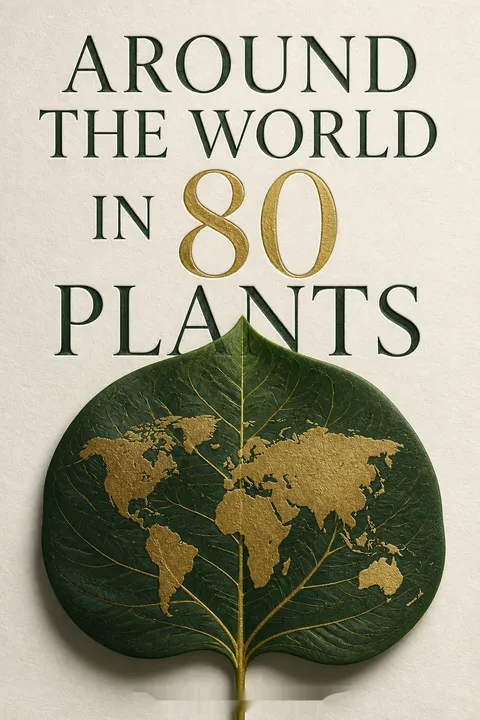
Most reviewers praise Around the World in 80 Plants for its stunning illustrations by Lucille Clerc and its engaging blend of botany, history, and culture. Many highlight its accessibility, recommending it to non-botanists and plant enthusiasts alike. Common positives include fascinating facts, beautiful production quality, and passionate writing. Some criticisms note loose geographical organization, with plants occasionally associated with regions where they aren't native. One professional botanist flagged scientific inaccuracies. Overall, readers find it an enjoyable, visually gorgeous book, ideal for gifting or leisurely dipping into.
People Also Read



Download PDF
Download EPUB
.epub digital book format is ideal for reading ebooks on phones, tablets, and e-readers.








































