


Key Takeaways
Neediness is the one trait that repels every woman alive
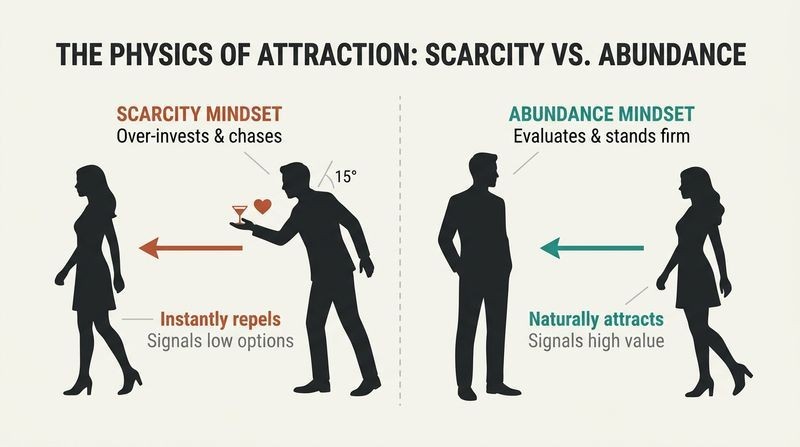
Neediness is the master sin. Dominic Mann argues you could have Brad Pitt's face, but the faintest whiff of neediness kills attraction instantly. Crucially, neediness is not just the obvious stalker behavior (checking her phone, 69 texts a day, jealous meltdowns). It leaks out in small acts: buying drinks for a stranger, bragging about your salary, asking 'where do you want to go?' on a date, apologizing for who you are.
It signals scarcity. The author frames neediness as over-investing emotion, time, and money while receiving little back. The man with no other options clings; the man with abundance does not. His blunt slogan: the fewer you chase, the more chase you. The fix is a mindset flip, from 'I hope she likes me' to 'let me decide if I like her.'
The kernel here aligns with attachment research: anxious attachment, marked by reassurance-seeking and fear of abandonment, predicts lower partner satisfaction, while a secure, non-clingy posture correlates with stronger bonds. Self-Determination Theory adds that autonomy is genuinely attractive because it signals a self-sustaining person. Where the book overreaches is treating all generosity as weakness. Decades of relationship science (Gottman) show that responsiveness and investment build lasting intimacy. The accurate insight is narrower than stated: desperation repels, but warmth offered from security does not.
What your actions secretly signal matters more than the actions themselves
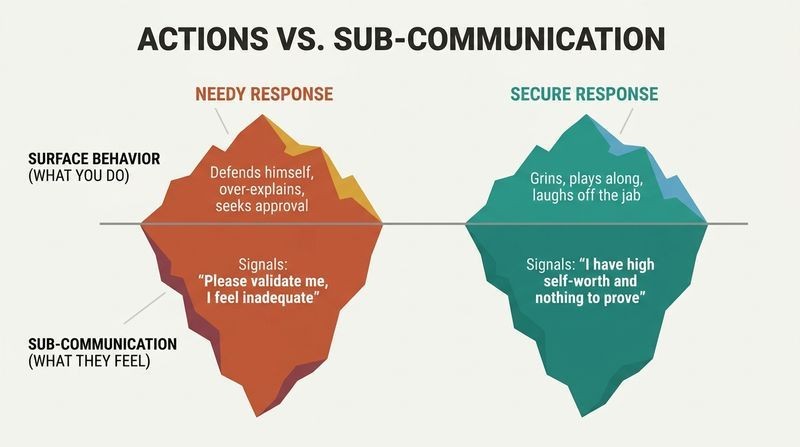
Decode the sub-communication. Mann's term sub-communication means the unspoken message your behavior broadcasts about your status and self-worth. Two men can do the identical thing with opposite effect. Buying a drink because you feel inferior reeks of inadequacy; teasing her playfully implies you have nothing to prove.
He maps three levels:
1. Needy: brags, sends essay-length texts, defers every decision to her.
2. Somewhat needy: defends himself when she pokes ('you seem like a player'), justifying anxiously.
3. Zero neediness: absorbs the same jab with a grin ('sounds like you've got an eye for talent').
The behavior is a surface; the meaning beneath is what registers. Women, he claims, smell the difference from a mile away.
The distinction between act and signal is genuinely sophisticated and echoes evolutionary signaling theory, where costly, hard-to-fake displays communicate underlying quality. A confident response to a tease is a cheap signal of abundance; anxious justification betrays scarcity. Erving Goffman's dramaturgy makes a similar point: we are always managing impressions. The weakness is the assumption that women operate as uniform lie-detectors decoding a single status hierarchy. Real attraction is idiosyncratic, shaped by values, humor, and shared meaning, not just dominance signaling.
Attraction is an involuntary instinct, not a logical decision
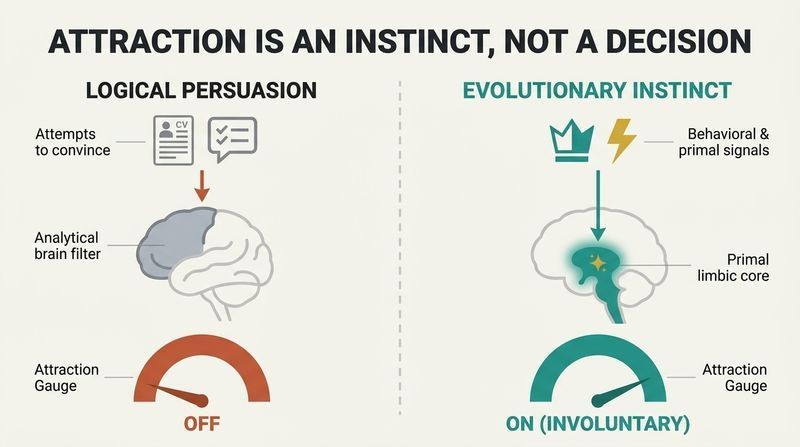
You cannot argue her into desire. Mann's central evolutionary claim: a Ferrari, six-pack, or resume won't generate attraction, because attraction was wired long before any of those existed. Men evolved to chase cues of fertility (youth, health); women evolved to prize a man's behavior, because a mate's strength and resourcefulness protected her and offspring through pregnancy and vulnerable infancy.
Hence the 'bad boy' puzzle. Confidence, indifference, and willingness to walk away sub-communicate options and dominance, the very traits that boosted reproductive odds in ancestral environments. He cites a 2013 Dark Triad study (Carter et al.) finding women rated men high in narcissism, Machiavellianism, and psychopathy as more attractive. His takeaway: stop selling reasons and start triggering instinct.
The Dark Triad finding is real but routinely overstated. Carter's effect was modest, measured on a written character vignette, and applies mainly to short-term mating; for long-term partners, women reliably prioritize kindness and stability. Evolutionary psychology also warns against the naturalistic fallacy: that a trait may have boosted ancestral fitness does not make it good or even currently optimal. Confidence and decisiveness are attractive, but the book conflates them with cruelty. The data supports the former, not the latter.
Become the man other women obviously want, and more will follow
Preselection is social proof for mating. Mann defines preselection as women observing that other attractive women desire you. The guy with a beauty on each arm is rated higher even when he is otherwise unremarkable. He cites lab studies where the same man is rated more attractive when shown beside or near a smiling woman, even an unrelated photo angled toward him.
Practical levers he lists:
1. Date several women rather than rushing into exclusivity.
2. Be photographed with attractive female friends.
3. Never reveal a low partner count; stay vague.
4. Cut behaviors that signal you rarely get attention (instant replies, over-liking posts).
The caveat: it only works with attractive women; associating with unappealing company backfires.
This maps to a documented phenomenon called mate choice copying, observed in guppies, birds, and humans (Waynforth, Place et al.). Females do use others' choices as a quality heuristic, especially under uncertainty. But human effects are small, context-dependent, and can reverse: studies show women sometimes derogate a rival's choice rather than copy it. The book's advice to manufacture preselection through deception (exaggerating counts, staging photos) trades a real, modest signal for a fragile illusion that collapses on contact with reality, and corrodes the authenticity that sustains actual relationships.
Build your life around a mission, not around chasing women
A Mission solves neediness automatically. Mann capitalizes Mission to stress its weight: a consuming purpose, a business, an art, an empire (he name-drops a young Steve Jobs building Apple, the rapper 50 Cent, Julius Caesar). When a man burns for a goal, the pickup tactics (don't reply instantly, don't pedestalize, stay scarce) stop being tricks and become natural byproducts of a busy, directed life.
The missionless man pedestalizes. With nothing else to fill his attention, he obsesses, texts constantly, and worships, which repels. The ambitious man, by contrast, treats a woman as an accessory to an exciting life rather than its center. 50 Cent's line, paraphrased: he has lost money chasing women, but never lost women chasing money.
Stripped of its swagger, this is durable advice supported by well-being research: people anchored in intrinsic purpose report higher life satisfaction and are less dependent on any single relationship for validation. Viktor Frankl argued meaning is the deepest human drive, and a purposeful person is simply more magnetic and resilient. The flaw is instrumental framing. Pursuing a mission solely to become attractive is self-undermining, because genuine absorption (and the attractiveness it produces) requires caring about the work itself. Reducing other people to 'accessories' also predicts shallow, brittle bonds.
Her investment in you, not yours in her, creates desire
Flip the investment equation. The common male error, Mann says, is believing lavish dates, gifts, and chauffeuring will earn affection. Instead it earns the friend zone, the role he mockingly calls Orbiter-in-Chief. The reason: your investment increases your attachment to her, but does nothing to her feelings, because her investment hasn't moved.
Attraction follows effort spent. When she invests time, energy, and emotion into you, her desire climbs to match it, a self-justification loop. The prescription: invest just enough to make her feel safe investing back, then let her do the chasing. He pairs this with 'emperor-like respect': the awe you feel for a mentor you would never dare boss around is the same circuitry that, in women, fuses with attraction.
There is real psychology here, though the book misnames it. Cognitive dissonance research (the Ben Franklin effect) shows that doing someone a favor increases liking, because we rationalize our effort as evidence we value the person. Effort justification (Aronson and Mills) makes us prize what we work for. So letting someone invest can deepen their commitment. But healthy relationships are reciprocal escalations of vulnerability, not zero-sum withholding. Strategically starving a partner of your investment to manufacture insecurity describes manipulation, and chronic imbalance breeds resentment, not the emperor's awe.
Two kinds of respect exist, and only one ignites attraction
Grandfather versus emperor. Mann splits female respect into two flavors. Grandfatherly respect is warm but sexless, the affection reserved for kind friends and the friend-zoned. Emperor-like respect is the awe, intimidation, and fascination one feels toward a powerful figure, and this, he argues, is the respect that fuses with sexual attraction in women.
Cultivate the dominant traits. To earn the emperor's standing rather than the grandfather's, he points back to the 'ambitious bad boy' cluster: confident, direct, decisive, indifferent, entitled, exciting, rebellious, masculine, mysterious, teasing, and a leader. The bonus claim is that developing these qualities also raises how much other men respect you, suggesting status is a single currency that both sexes read.
The friend-versus-lover divide tracks a real distinction psychologists draw between companionate affection and passionate desire, which can indeed feel categorically different. Esther Perel's work on eroticism supports a counterintuitive piece of this: too much closeness and predictability can dampen desire, while a degree of mystery and autonomy sustains it. Where the framing fails is the implication that warmth and desire are mutually exclusive. They coexist in lasting passionate relationships. And the long list of 'bad boy' adjectives blurs admirable confidence with menace and entitlement, conflating respect-worthy traits with red flags.
Flirt by playfully framing her as the one chasing you
Flirting must stay playful. Mann insists the defining quality of flirtation is play; the same line delivered seriously reads as creepy. He champions two techniques.
1. Push-pull: emotionally (or physically) pushing her away, then pulling her back, creating an addictive up-and-down ('you're too cute, get away from me,' plus a teasing shove). It manufactures emotional swings and signals you aren't throwing yourself at her feet.
2. Chase framing (credited to Chase Amante of Girls Chase): playfully accusing her of trying to seduce you. She mentions massages; you reply, 'trying to seduce me with free massages?' The premise is that you are the prize fending off her advances.
Both tactics aim to flip the dynamic so she works to win you.
Push-pull resembles intermittent reinforcement, the variable-reward schedule that makes slot machines and unpredictable texters so compulsively engaging; unpredictability spikes dopamine. Used lightly, this is just the well-documented appeal of banter and the tension that makes early romance exciting. The danger is dosage: deliberately engineering emotional rollercoasters in a partner is the same mechanism behind toxic, anxiety-inducing dynamics, where the 'high' is indistinguishable from distress. Chase framing works as witty role-play but curdles into arrogance if the underlying warmth and genuine interest are missing. The thin line is playfulness backed by real respect.
Escalate touch gradually, like slowly heating water around a frog
Always be escalating. Mann's blunt thesis for the bedroom: men must lead the physical progression, because attraction stalls and dies without it. Many men report a great connection and even multiple dates that go nowhere precisely because they never escalated touch.
Heat the water slowly. Drop a frog in boiling water and it leaps out; warm it gradually and it never notices. He applies this to physical contact: begin with a handshake or a touch on the forearm to punctuate a joke, progress to a hand on the lower back, then the thigh, then brushing hair from her face. Throughout, read her body language, does she lean in or stiffen, and dial back a notch if she tenses, then rebuild. For the kiss: lean in holding eye contact, glance at her lips, then go.
The escalation-with-feedback model has a legitimate core. Intimacy does build incrementally, and attentiveness to a partner's responses is the foundation of attunement. The crucial and underemphasized element is exactly that feedback loop, which is the practical definition of seeking ongoing, enthusiastic consent. Where the framing is troubling is the 'always be escalating' imperative, which can pressure a man to treat any pause as an obstacle to overcome rather than a genuine signal. The healthiest reading inverts the emphasis: escalation is permission to read and respect her actual responses, not a script to push through them.
Offer a face-saving excuse so intimacy can feel spontaneous
Feed the rationalization hamster. Mann's crudely named concept, the rationalization hamster, refers to a woman's internal need to not see herself (or be seen) as promiscuous. His solution is plausible deniability: never propose sex directly, but offer a pretext that lets the encounter feel like it 'just happened.' Invitations like 'come see my pool table,' 'let's grab a drink at my place,' or even a flimsy 'you have to see my rug' give her a cover story.
Read the hesitation. If she stalls outside her door with an excuse about an early morning, a light 'can I use your bathroom?' can bridge the moment. He frames a turned-away kiss as a minor 'shit test' to brush off casually rather than dwell on.
The social mechanism is real: sexual double standards still stigmatize women's desire more than men's, so face-saving framing reflects genuine cultural pressure. Anthropologists note such 'plausible deniability' rituals across courtship. But this is the book's most ethically hazardous territory. The line between easing social awkwardness and engineering compliance is precisely where consent lives. Reframing a refusal as a mere 'test' to ignore is dangerous advice; a turned head or stated reluctance is information to respect, not an obstacle. The defensible version of this insight is empathy for social stigma, never a workaround for an actual 'no.'
Analysis
This is a short, self-published seduction manual in the pickup-artist (PUA) tradition, structured in two halves: becoming attractive (mindset and identity) and executing (flirting and physical escalation). Its intellectual spine is pop evolutionary psychology, recruited to justify a single thesis: female attraction is an involuntary response to dominance, scarcity, and social proof, and can therefore be engineered by managing signals rather than offering substance.
Stripped of its deliberately crude packaging, the book contains a few psychologically defensible observations. Anxious, validation-seeking behavior genuinely does undermine attraction and relationship quality, a finding consistent with attachment theory and Self-Determination Theory. Purpose and autonomy are authentically magnetic. Effort-justification and the favor-induced liking documented by Aronson and the Ben Franklin effect lend partial support to the 'let her invest' claim. Mate choice copying and intermittent reinforcement are real mechanisms. The attunement-through-feedback model of physical escalation, read charitably, describes consent.
But the book systematically overreaches. It treats short-term, lab-vignette findings (the Dark Triad study, photo-rating preselection experiments) as universal laws, ignoring that effect sizes are small, context-bound to short-term mating, and reversed for long-term partner preferences where kindness and reliability dominate. It commits the naturalistic fallacy throughout, sliding from 'ancestrally advantageous' to 'good.' Most importantly, it repeatedly blurs admirable traits (confidence, decisiveness, ambition) with corrosive ones (cruelty, entitlement, manipulation), and its final chapters on 'plausible deniability' and brushing off rejection edge into advice that disregards consent.
The honest verdict: a reader can extract a handful of legitimate self-improvement principles, cultivate purpose, drop neediness, lead with confidence, while discarding the manipulative tactics and the reductive, often contemptuous model of women that frames them. The valuable 20 percent is essentially a confidence-and-purpose argument; the rest substitutes performance and deception for the reciprocity and authenticity that actual intimacy requires.
Review Summary
Unlock Her Legs receives positive reviews for its practical advice on attracting women. Readers praise the "scrambler technique" and report success in dating and relationships. The book is described as easy to read, with logical concepts and real-life examples. Reviewers appreciate the program's focus on building genuine connections and boosting confidence. Some highlight improved dating experiences and ability to create sexual tension. While most reviews are enthusiastic, one suggests simply being less invested in girls and more invested in oneself.
People Also Read

Glossary
Neediness
Over-investing while signaling scarcityMann's redefinition of the single most unattractive trait. It is not only obvious clinginess but any behavior, however subtle, that broadcasts emotional over-investment or perceived inadequacy: excessive favors, bragging, anxious justification, deferring all decisions. The unifying signal is that a man lacks other options and feels he must compensate to deserve the woman.
Sub-communication
Hidden message behind behaviorThe unspoken meaning an action conveys about a man's status, options, and self-worth. Mann argues identical behaviors carry opposite weight depending on whether they signal abundance and confidence or scarcity and inferiority. Attraction responds to the underlying signal, not the surface act.
Preselection
Being desired by other womenThe principle that women find a man more attractive when they observe other attractive women desiring him. Presented as social proof for mating, supported by lab studies where the same man rates higher when shown near a smiling woman. Related in academic literature to 'mate choice copying.'
Mission
All-consuming life purposeA capitalized term for a burning, central goal (a business, art, or empire) that a man pursues above all else, including women. Mann argues a real Mission automatically eliminates neediness and produces attractive traits as natural byproducts, since the man's attention and identity are anchored elsewhere.
Push-pull
Alternating distance and warmthA flirting technique of playfully pushing a woman away (teasing, a mock shove) and then pulling her back with implied interest, creating emotional swings. Mann claims it generates addictive tension and signals high value by showing the man is not throwing himself at her.
Chase framing
Acting as if pursuedA flirting method credited to Chase Amante of Girls Chase in which a man playfully frames the interaction as though the woman is trying to seduce him (for example, accusing her of using massages or staring to win him over). It positions the man as the prize being chased.
Rationalization hamster
Woman's need for face-saving justificationMann's crude metaphor for a woman's internal drive to avoid seeing herself as promiscuous. He advises 'feeding' it through plausible deniability: indirect invitations that let an encounter feel like it happened spontaneously rather than being explicitly chosen.
Grandfatherly vs. emperor-like respect
Two opposite types of respectMann's split between two forms of female respect. Grandfatherly respect is warm but sexless, reserved for friends and the friend-zoned. Emperor-like respect is awe-filled, intimidated fascination toward a powerful figure, which he claims fuses with sexual attraction in women.
About the Author


Download PDF
Download EPUB
.epub digital book format is ideal for reading ebooks on phones, tablets, and e-readers.








































