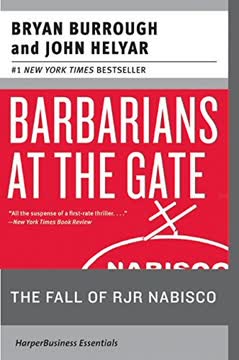
Key Takeaways
1. The CEO's Fatal Flaw: Hubris and Undervaluation
“It’s plain as the nose on your face that this company is wildly undervalued,” Johnson said.
Undervalued assets. F. Ross Johnson, CEO of RJR Nabisco, initiated the largest leveraged buyout in history primarily because he believed the market unfairly penalized the company's stock due to its tobacco operations. Despite strong performance in its food divisions like Nabisco and Del Monte, the stock languished, prompting Johnson to seek a drastic solution to "unlock shareholder value." This conviction, coupled with his restless nature, set the stage for the unprecedented corporate drama.
Personal ambition. Beyond shareholder value, Johnson harbored a deep-seated desire for action and personal enrichment. Having spent two decades climbing the corporate ladder, he was a "noncompany man" who thrived on constant change and big deals. The LBO offered a chance to cement his legacy, escape the perceived constraints of public ownership, and become "a billionaire," as one suitor promised.
Underestimated forces. Johnson's decision to take RJR Nabisco private was born from a mix of strategic frustration and personal ambition, but he profoundly underestimated the competitive forces and public scrutiny he would unleash. His initial confidence that the deal would be unopposed, or easily managed, proved to be a critical misjudgment that would define the ensuing battle.
2. The Peril of Perks: A Culture of Excess
“Spending money was always a joyful, joyous thing to Ross,” recalled William Blundell, a Canadian friend.
Lavish corporate lifestyle. Ross Johnson cultivated a corporate culture defined by extravagant perks and a "party animal" ethos, a stark contrast to the frugal traditions of RJ Reynolds. This included:
- A fleet of ten corporate jets (the "RJR Air Force"), including two $21 million G4s.
- Company-owned apartments and homes in Manhattan, Palm Beach, and Vail.
- Dozens of country club memberships and lavish golf tournaments.
- High salaries and generous expense accounts for favored executives.
Symbol of excess. While Johnson saw these perks as essential for morale and business networking, they became a potent symbol of corporate excess and detachment from the company's roots. The opulent spending, particularly on items like the "Taj Mahal of corporate hangars" and celebrity endorsements, fueled resentment among employees and the public, ultimately undermining Johnson's credibility.
Erosion of trust. This culture of indulgence, combined with Johnson's disdain for cost-cutting and detailed financial oversight, created an environment ripe for criticism. It suggested a CEO more interested in personal gratification than sound business management, a perception that would haunt him throughout the LBO battle and alienate key stakeholders.
3. The Management Buyout: A Double-Edged Sword
“The wolf is not at the door,” Johnson said. No corporate raider was forcing him to do this. “This is simply the option that I think is best for our shareholders."
Inherent conflict of interest. Johnson's decision to lead a management buyout (MBO) of RJR Nabisco, while framed as a benefit to shareholders, immediately created a profound conflict of interest. As CEO, he was obligated to maximize value for existing shareholders, yet as a bidder, his incentive was to acquire the company at the lowest possible price to maximize his own group's profits. This duality became a central ethical challenge for the board.
Unprecedented personal gain. The proposed management agreement, which promised Johnson's group an initial 8.5% equity stake (potentially rising to 20%) and significant control, was seen as extraordinarily lucrative. This potential for billions in personal wealth, without significant personal investment, drew intense criticism and fueled public perception of "greed."
Board's compromised position. The board's initial approval of Johnson's exploration of an LBO, and his role in selecting the "independent" special committee, placed them in a difficult position. They were tasked with evaluating an offer from the very CEO they oversaw, creating an appearance of impropriety that would be relentlessly exploited by competing bidders and the media.
4. The Barbarian's Discipline: KKR's Relentless Pursuit
“What Cohen didn’t know,” Kravis recalled months later, “was that we were charging right through the rice paddies, not stopping for anything and taking no prisoners.”
Strategic aggression. Henry Kravis and KKR, initially dismissed by Johnson, launched a surprise $90/share tender offer, seizing the initiative and forcing Johnson's hand. This aggressive move, made without management's cooperation, signaled KKR's determination to win, regardless of traditional LBO norms.
Financial prowess. KKR's strength lay in its unparalleled ability to raise massive amounts of capital and structure complex deals. With a $5.6 billion war chest and the backing of Drexel Burnham Lambert's junk bond network, KKR could deploy an unprecedented $45 billion in buying power, dwarfing most competitors.
Ruthless efficiency. Unlike Johnson, Kravis was a disciplined financial operator focused on maximizing investor returns through rigorous cost-cutting and asset sales. His team meticulously analyzed financial data, even when denied full access, to identify areas for efficiency and value creation, demonstrating a "charging through the rice paddies" mentality.
5. The Board's Burden: Navigating Greed and Scrutiny
“It is important,” Peter Atkins began, “that today be as clear and thoughtful as any day ever spent in a boardroom.”
Fiduciary duty vs. public image. The RJR Nabisco Special Committee, led by Charles Hugel, faced immense pressure to maximize shareholder value while navigating intense public and political scrutiny. They were caught between Johnson's self-serving bid and KKR's aggressive tactics, all under the glare of a media increasingly focused on "greed."
Legal and ethical tightrope. The board's advisers, particularly Peter Atkins of Skadden Arps, were acutely aware of the legal precedents set by previous LBOs and the risk of shareholder lawsuits. This compelled them to:
- Establish formal bidding guidelines and a "level playing field."
- Scrutinize management's compensation agreement.
- Consider alternative restructuring plans to ensure the best outcome for shareholders.
External pressures. The committee was bombarded with criticism from various stakeholders, including:
- Angry employees and retirees in Winston-Salem.
- Institutional investors concerned about LBO debt.
- Politicians threatening regulatory intervention.
This external pressure significantly influenced the board's decisions, pushing them towards a more transparent and competitive auction process.
6. The Junk Bond's Power: Fueling the Takeover Frenzy
“Today’s financial age has become a period of unbridled excess with accepted risk soaring out of proportion to possible reward,” Forstmann wrote.
Transformative financing. Drexel Burnham Lambert's high-yield "junk" bonds revolutionized the LBO industry by providing unprecedented access to capital for audacious takeovers. This "funny money," as critics called it, allowed smaller, less established bidders to challenge corporate giants, fundamentally altering Wall Street's power dynamics.
Forstmann's moral crusade. Theodore J. Forstmann, head of Forstmann Little & Co., vehemently opposed junk bonds, viewing them as a dangerous drug that corrupted the financial system and enabled irresponsible deals. His moral stance, articulated in a Wall Street Journal op-ed, positioned him as a "white knight" against the "junk-bond cartel" led by Michael Milken and Henry Kravis.
Risk and reward. While junk bonds fueled massive profits for LBO firms and their investors, they also introduced significant risk. Forstmann warned that the immense debt assumed by LBO companies, if unchecked, could trigger widespread bankruptcies and even a national economic crisis, likening the situation to "a herd of drunk drivers."
7. The Auction's Chaos: Egos, Leaks, and Misinformation
“All these guys,” says the chairman of one of Wall Street’s largest firms, “have three balls. Loyalties one, two, and three are to themselves."
Intense personal rivalries. The RJR Nabisco auction was less a rational financial process and more a gladiatorial contest driven by the colossal egos and shifting allegiances of Wall Street's top players. Personal friendships and long-standing rivalries often overshadowed objective business decisions, leading to:
- Public spats between Peter Cohen and Henry Kravis.
- Ted Forstmann's moralistic denunciations of Kravis.
- Internal conflicts within bidding groups over strategy and fees.
Strategic leaks and bluffs. Information control was paramount, yet leaks were rampant, often strategically placed to gain an advantage or sow discord. Johnson's management agreement, Kravis's bid details, and Forstmann's intentions all found their way to the press, creating a volatile environment of misinformation and suspicion.
The "deal heat" phenomenon. Investment bankers, driven by the prospect of massive fees and the prestige of the "deal of the century," often succumbed to "deal heat," pushing for higher bids and more aggressive tactics. This collective frenzy, fueled by adrenaline and the desire to win, sometimes led to irrational decisions and a disregard for long-term consequences.
8. The Cost of Overconfidence: Johnson's Strategic Blunders
“This is stupid as hell! This is asinine! If all the negotiations have broken down, what the hell use is there in making an offer?"
Misjudging Kravis. Johnson's initial dismissal of Henry Kravis as a serious competitor, based on a year-old meeting and a belief that Kravis wouldn't touch tobacco, proved to be a fatal error. He failed to anticipate KKR's aggressive entry and its willingness to bid without management.
Poorly structured agreement. The management group's initial agreement, granting Johnson's team an outsized equity stake and significant control, was a public relations disaster. Despite warnings from Jim Robinson and Steve Goldstone, Johnson's reluctance to renegotiate it early on made his group appear greedy and undermined their standing with the board.
Delayed and flawed counter-bids. Johnson's detachment from the bidding process, coupled with Shearson's overconfidence, led to a series of strategic missteps:
- A delayed counter-bid to KKR's initial $90 offer.
- A subsequent $92 "fuck you" bid that merely infuriated Kravis without securing a merger agreement.
- A final $112 bid that relied on "soft" securities without reset mechanisms, making its true value questionable to the board.
9. The Unseen Hand: Information Asymmetry in Battle
“This is useless,” he muttered to Josh Gotbaum, a Lazard Freres banker monitoring the interviews. “These guys aren’t saying anything.”
Kravis's information disadvantage. KKR faced a significant challenge in conducting due diligence without the cooperation of RJR Nabisco's management. Johnson's executives, loyal to their CEO, provided minimal information, forcing Kravis's team to rely on:
- Public filings and external analyses.
- Strategic leaks from disgruntled insiders like John Greeniaus.
- Their own financial modeling and assumptions, which proved to have significant "gaping holes."
The "Other Uses of Cash" mystery. A critical example of this information asymmetry was the "Other Uses of Cash" line item in RJR's projections, a $300-500 million annual figure that KKR's analysts couldn't decipher. This single unknown represented a billion-dollar swing in valuation, highlighting the risks of bidding blind.
Greeniaus's pivotal role. John Greeniaus, Nabisco's president, became an invaluable, albeit secret, source of information for KKR. His detailed insights into Nabisco's operations and potential cost savings allowed KKR to significantly refine its valuation and boost its bid, providing the "first chink in their armor."
10. The Public's Verdict: Greed at the Gate
“This spectacle is not just unseemly—it is dangerous,” it held. “It is precisely this sort of behavior that plays into the hands of those who want to shackle the free market with unnecessary regulation."
Media's moral outrage. The RJR Nabisco LBO became a national sensation, with media outlets like Time magazine portraying Ross Johnson as a symbol of corporate greed. Headlines like "A Game of Greed" and "King Henry" fueled public indignation, transforming a business transaction into a moral debate about the soul of American capitalism.
Political backlash. The controversy quickly spilled into the political arena, prompting calls for regulatory reform from figures like Senator Bob Dole and Federal Reserve Chairman Alan Greenspan. The involvement of state pension funds in "hostile" bids sparked political squabbles, highlighting the broader societal implications of unchecked LBO activity.
Erosion of trust. The spectacle of executives enriching themselves while employees faced job losses, combined with the bitter public feuding among bidders, eroded public trust in Wall Street. The LBO became a lightning rod for criticism, symbolizing a financial system perceived as prioritizing short-term profits and personal gain over long-term stability and community welfare.
Review Summary
Barbarians at the Gate receives mostly positive reviews for its detailed account of the RJR Nabisco leveraged buyout. Readers praise its engaging narrative style, thorough research, and insights into 1980s Wall Street culture. Some find it overly long and complex, with too many characters to follow. The book is lauded for exposing corporate greed and providing a fascinating look at high-stakes business deals. Many consider it a classic in finance literature, though a few critics find the subject matter dry or morally troubling.
FAQ
1. What is Barbarians at the Gate: The Fall of RJR Nabisco by Bryan Burrough and John Helyar about?
- Epic corporate takeover saga: The book chronicles the dramatic 1988 leveraged buyout (LBO) battle for RJR Nabisco, which became the largest and most complex corporate takeover in history at the time.
- Focus on key players: Central figures include Ross Johnson (RJR Nabisco’s CEO), Henry Kravis (KKR), and other Wall Street powerhouses, whose ambitions and rivalries drive the narrative.
- Insight into 1980s Wall Street: It provides a vivid portrait of the era’s financial culture, including the rise of junk bonds, aggressive deal-making, and the clash between old and new corporate values.
- Behind-the-scenes drama: The book reveals the personalities, negotiations, and high-stakes maneuvers that shaped the outcome and changed American business.
2. Why should I read Barbarians at the Gate by Bryan Burrough and John Helyar?
- Definitive account of LBO era: The authors conducted extensive interviews and research, making this the authoritative narrative on the RJR Nabisco takeover and 1980s corporate finance.
- Understanding high finance: The book demystifies leveraged buyouts, mergers, and Wall Street strategies, making complex financial concepts accessible and engaging.
- Human drama and ethics: It goes beyond numbers, exploring the egos, alliances, betrayals, and ethical dilemmas that define high-stakes corporate battles.
- Historical and cultural relevance: The story marks a turning point in Wall Street history, offering lessons that remain relevant for understanding modern business and finance.
3. Who are the main players in the RJR Nabisco takeover battle described in Barbarians at the Gate?
- Ross Johnson and management group: Johnson, the flamboyant CEO, leads a management buyout team backed by Shearson Lehman and Salomon Brothers, seeking to retain control and reap large rewards.
- Henry Kravis and KKR: Kravis and his firm, Kohlberg Kravis Roberts, are LBO pioneers who mount a hostile bid using junk bonds and aggressive tactics.
- Ted Forstmann and Forstmann Little: A rival LBO firm critical of junk bonds, advocating a more conservative approach but ultimately unable to compete financially.
- Investment bankers and advisers: Key figures from Shearson Lehman, Drexel Burnham, Lazard Freres, and First Boston play crucial roles in structuring, financing, and negotiating the bids.
4. What is a leveraged buyout (LBO) as explained in Barbarians at the Gate by Bryan Burrough?
- Definition and mechanics: An LBO is a financial transaction where a company is purchased primarily with borrowed money, using the company’s assets and future cash flows as collateral.
- Typical structure: About 60% of the purchase price comes from bank loans, 10% from the buyer’s own funds, and the rest from investors or junk bonds, with debt paid down over time.
- Management’s role: Executives often form a buyout group to take the company private, but ultimate control usually rests with the buyout firm, not management.
- Controversy and impact: LBOs are criticized for heavy debt burdens and potential layoffs, but proponents argue they force companies to become leaner and more efficient.
5. How did junk bonds influence the RJR Nabisco LBO and 1980s Wall Street, according to Barbarians at the Gate?
- Fuel for LBO growth: Junk bonds—high-yield, high-risk debt—enabled massive, fast-moving buyouts by providing quick access to large amounts of capital.
- Role of Michael Milken and Drexel Burnham: These Wall Street players were central to popularizing junk bonds, transforming the scale and speed of corporate takeovers.
- Controversy and criticism: Critics like Ted Forstmann called junk bonds “funny money,” blaming them for inflating deal prices and endangering companies with excessive debt.
- Impact on competition: Junk bonds allowed firms like KKR to outbid traditional buyers and pursue hostile takeovers, reshaping the balance of power in corporate America.
6. What was unique about Ross Johnson’s management agreement in the RJR Nabisco LBO, as described by Bryan Burrough?
- Unprecedented control and rewards: Johnson demanded veto power over the board and major decisions, and his management group was granted up to 20% of the company’s equity—potentially worth billions.
- Lifestyle protection: Johnson insisted on preserving perks like corporate jets and the Atlanta headquarters, resisting typical LBO cost-cutting.
- Public and board backlash: The agreement, once leaked, became a lightning rod for criticism, symbolizing executive greed and complicating negotiations.
- Negotiation complication: The pact’s terms made it difficult for other bidders to cooperate with management, stalling peace talks and fueling anti-LBO sentiment.
7. How did the culture clash between Reynolds Tobacco and Nabisco affect the merged company in Barbarians at the Gate?
- Contrasting corporate traditions: Reynolds was conservative and rooted in Winston-Salem, while Nabisco was more flamboyant and New York-based, leading to conflicting values and management styles.
- Tensions and alienation: Nabisco executives felt powerless under Reynolds’s bureaucracy, while Reynolds veterans resented Nabisco’s perks and lifestyle, resulting in internal conflicts and resignations.
- Symbolic product conflicts: Campaigns like Nabisco’s Fleischmann’s Margarine, which discouraged smoking, horrified tobacco executives and highlighted the cultural divide.
- Complicated integration: The cultural clash made strategic decision-making and company integration more difficult, contributing to instability.
8. What role did investment bankers and advisers play in the RJR Nabisco takeover, according to Barbarians at the Gate?
- Deal architects and influencers: Bankers from Shearson Lehman, Drexel Burnham, Lazard Freres, and others proposed, structured, and financed the LBO, bringing expertise and pressure to the process.
- Merchant banking evolution: Investment banks increasingly invested their own capital in deals, blurring lines between advisory roles and ownership.
- Inter-firm rivalries: Banks often competed against each other, sometimes representing opposing sides, adding complexity to the takeover battle.
- Financial innovation: Bankers introduced new concepts like limited partnerships, dual-stock structures, and leveraged financing, pushing the boundaries of corporate finance.
9. How did the RJR Nabisco board and special committee influence the LBO process in Barbarians at the Gate?
- Formation for fairness: A special committee of independent directors was created to evaluate buyout proposals and protect shareholder interests.
- Legal and fiduciary duties: The committee’s lawyers guided directors through complex legal responsibilities, especially regarding management’s conflicting interests.
- Active involvement: The board, led by Charlie Hugel, managed the auction process, set bidding guidelines, and worked on restructuring plans.
- Suspicions and conflicts: Tensions arose over the committee’s impartiality, especially given Johnson’s influence and the offering of equity stakes to directors.
10. What were the main bidding groups and strategies in the final RJR Nabisco auction, as detailed in Barbarians at the Gate?
- Management group led by Johnson: Backed by Shearson Lehman and Salomon Brothers, they raised their bid to $112 per share but faced skepticism due to the management agreement and public backlash.
- KKR’s disciplined approach: Henry Kravis’s team countered with $108, then $109, and finally $112 per share, offering better securities and reset provisions to reassure the board.
- First Boston’s innovative bid: The group, with Jay Pritzker, proposed a complex tax-deferral strategy using installment notes, but lacked solid financing and was ultimately dismissed.
- Board’s decision: The board favored KKR’s bid due to better terms, securities, and promises to shareholders and employees, leading to a unanimous vote for KKR.
11. What were the key financial instruments and innovations used in the RJR Nabisco bids, according to Bryan Burrough?
- Pay-in-kind (PIK) securities: These bonds allowed interest to be paid in additional bonds rather than cash, reducing immediate cash outflows and enabling higher bids.
- Reset provisions: KKR’s bid included mechanisms guaranteeing securities would trade at stated values, providing more certainty to the board and shareholders.
- Installment note loophole: First Boston’s bid used a tax-deferral strategy to increase bid value, but it carried political and legal risks and lacked reliable financing.
- Complex valuation: The use of PIKs, resets, and other securities required expert analysis, highlighting the financial engineering central to the deal.
12. What are the key takeaways and best quotes from Barbarians at the Gate by Bryan Burrough and John Helyar?
- Complexity of corporate takeovers: The RJR Nabisco saga shows that large buyouts involve intricate financial engineering, legal maneuvering, and personal ambitions.
- Power of personalities: The outcome hinged on the character, relationships, and decisions of a few key individuals, whose motivations were often personal as well as professional.
- Impact on stakeholders: The deal brought risks such as heavy debt, job losses, and conflicts of interest, raising ethical and economic questions that still resonate.
- Notable quotes: “Some genius invented the Oreo. We’re just living off the inheritance.” (Ross Johnson); “The casino society.” (Felix Rohatyn); “Mickey Mouse has just become Mighty Mouse!” (Jim Maher), each
About the Author
Download PDF
Download EPUB
.epub digital book format is ideal for reading ebooks on phones, tablets, and e-readers.








































