

Key Takeaways
Your birth date and hour form an eight-character code of your life
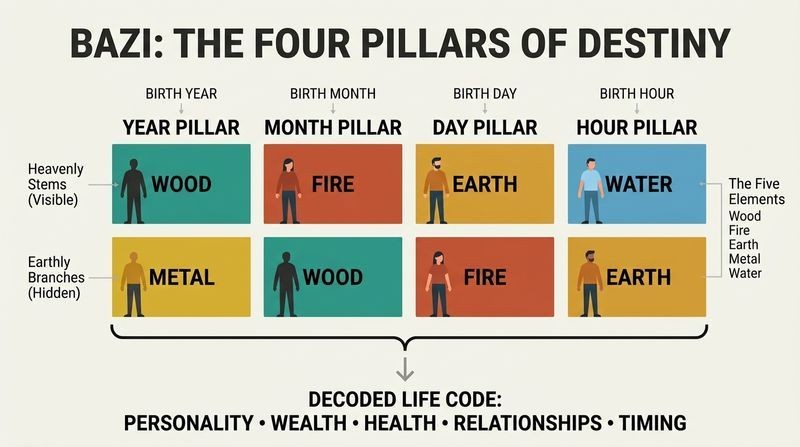
BaZi (pronounced "bah-zi," meaning "eight characters") converts your year, month, day, and hour of birth into four pairs of Chinese characters, called the Four Pillars of Destiny. Each pair sits as one pillar: a Heavenly Stem above, an Earthly Branch below. Together the eight characters express the Five Elements (Wood, Fire, Earth, Metal, Water) present at your birth.
Yap compares BaZi to DNA. To a layperson the characters mean nothing, but to someone with the key they reveal personality, wealth capacity, relationships, health, and timing. Grand Master Xu Zi Ping systematized the method during the Five Dynasty era (roughly AD 907 to 978). Yap stresses this is a structured observational science recorded over centuries, not the cartoon zodiac of "all Dragons are bold" that fills newspaper horoscopes.
What's compelling is the framing of astrology as an information-compression system rather than mysticism. The DNA analogy is apt in one respect and misleading in another: DNA is empirically decodable and falsifiable, while BaZi rests on correlational tradition never subjected to controlled testing. Still, the epistemology Yap invokes, science as accumulated observation like meteorology, echoes how pre-modern knowledge systems genuinely functioned. Readers from a Western analytic tradition can engage BaZi productively as a structured self-reflection framework, much like the Enneagram or Jungian typology, whose value lies less in cosmic truth than in giving language to patterns people already sense in themselves.
Destiny sets your ceiling; luck decides when you reach it
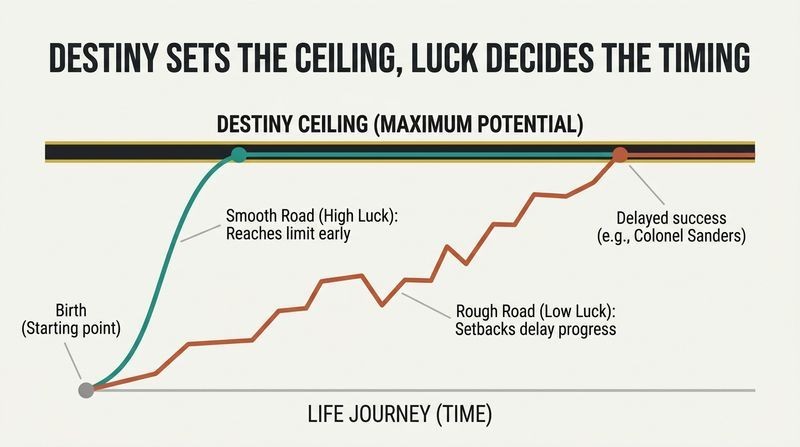
Yap draws a sharp line between two Chinese concepts. Ming (Destiny) is fixed at birth, like a map with fixed destinations. Yun (Fortune or Luck) is dynamic, like the quality of the roads on that map. When roads are smooth, you reach destinations quickly; when rough, the journey is full of obstacles. Together the Chinese speak of Ming Yun.
Destiny is capacity, not predetermined events. There is only one Bill Gates, one Warren Buffett, because destiny caps how far each person can go. Yet destiny is worked out through action: someone destined for wealth still must act to claim it. Yap cites figures who had the destiny but waited on luck: Colonel Sanders became famous in his sixties, and Abraham Lincoln lost repeatedly before the presidency. The saying he leans on: it is not the hand you are dealt but how you play it.
This is a sophisticated compatibilist position dressed in metaphysical clothing. Philosophers have long wrestled with the same tension between fate and agency, and Yap's resolution mirrors Stoic doctrine: some things are up to us, others are not, and wisdom lies in distinguishing them. The behavioral parallel is Carol Dweck's work on realistic self-assessment, though Yap pushes against the pure growth-mindset gospel that anyone can become anything. His claim that knowing your limits spares needless heartbreak is psychologically defensible, yet it risks becoming self-fulfilling: told you cannot, you may never try. The framework's honesty about inequality of outcomes is bracing and rare in self-help.
Heaven, Earth, and Man each control a third of your fate
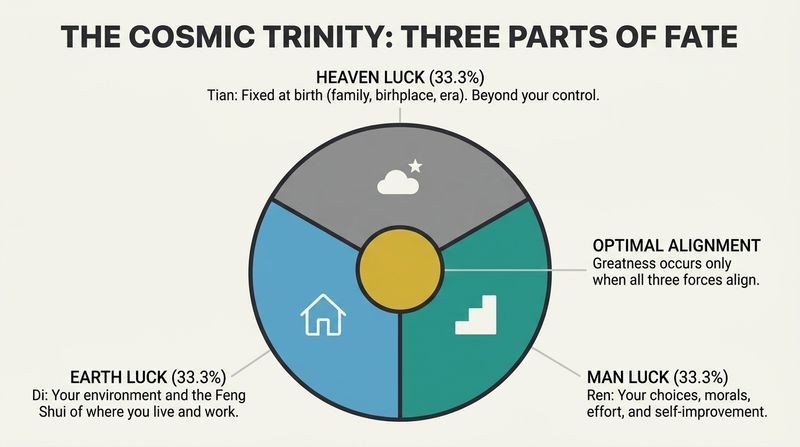
Ancient sages divided the universe into a Cosmic Trinity, with each force exerting roughly equal influence:
1. Heaven Luck (Tian): your destiny, fixed at birth, your family, birthplace, and era. Beyond your control.
2. Earth Luck (Di): your environment and the Feng Shui of where you live and work.
3. Man Luck (Ren): your choices, morals, effort, and self-improvement.
Yap argues this model is nearly airtight. Motivational gurus who claim mind-over-everything cannot will themselves into billionaire status; if positive thinking alone worked, coaches would top the Forbes list. Feng Shui masters know the secrets of Earth yet rarely become billionaires because Heaven Luck (the missing piece) is not theirs to command. Greatness happens only when all three forces align at their optimum points.
The one-third split is heuristic rather than measured, but the tripartite structure is genuinely useful as a diagnostic. It maps neatly onto modern social science: Heaven Luck resembles what economists call circumstances (birth lottery, documented by Raj Chetty's mobility research), Earth Luck resembles environmental and network effects, and Man Luck resembles agency and grit. The insight that no single lever explains success is more honest than most Western success literature, which overweights individual effort. The weakness is unfalsifiability: any outcome can be retrofitted to whichever third was supposedly decisive, making the model excellent for post-hoc storytelling but poor for prediction.
Treat BaZi as diagnosis and Feng Shui as the prescription
Yap's professional maxim: Feng Shui is the prescription, BaZi is the diagnosis. Just as a doctor must diagnose before prescribing, a practitioner reads a person's BaZi to understand their capacity and problems before applying environmental remedies. Feng Shui cannot manufacture wealth; it only magnifies existing capacity. If capacity is large, Feng Shui yields more; if small, little.
He illustrates with a wealthy client whose home received a powerful "Water Dragon" wealth-enhancing formula. The result was disaster: the client was already going through strong wealth luck, and the extra boost threw his life out of balance, triggering his children to fight over the inheritance while he was still healthy. The Chinese saying: too much wealth deteriorates the health. Prescribing wealth to someone who cannot absorb it is like giving penicillin to someone allergic to it.
The diagnosis-before-prescription discipline is the single most transferable idea here, applicable far beyond metaphysics. It rebukes the one-size-fits-all thinking that plagues wellness, finance, and management advice. The inheritance-war anecdote is a striking argument against the assumption that more of a good thing is always better, an intuition supported by research on hedonic adaptation and the diminishing, sometimes negative, returns of wealth on wellbeing beyond a threshold. The framing also quietly reframes Feng Shui away from its commercialized get-rich reputation, which Yap explicitly laments. The critical caveat: without any falsifiable diagnostic standard, the doctor analogy borrows medicine's credibility without medicine's accountability.
Everything in your chart reduces to five elements seeking balance
The backbone of BaZi is Wu Xing, better translated as five phases or transformations than five elements. The five interact through three cycles:
1. Productive: Water grows Wood, Wood feeds Fire, Fire makes Earth (ash), Earth yields Metal, Metal condenses Water.
2. Controlling: Water douses Fire, Fire melts Metal, Metal cuts Wood, Wood holds Earth, Earth dams Water.
3. Weakening: producing something depletes the producer, as childbirth drains the mother.
Each element also maps to a virtue: Water to wisdom, Wood to benevolence, Fire to elegance and passion, Earth to trustworthiness, Metal to decisiveness and justice. A good chart has harmonious flow of Qi and balance across all five. Crucially, Yap hammers one rule repeatedly: judge quality, not quantity. Having many of an element does not mean strength, and equal numbers do not mean balance.
The three-cycle system is genuinely elegant systems thinking, anticipating modern ideas of feedback loops, homeostasis, and network dynamics centuries early. The controlling and weakening cycles in particular resemble ecological predator-prey and resource-depletion models. The element-to-virtue mapping parallels humoral theory in Greek and Ayurvedic medicine, suggesting a deep human tendency to organize personality into a small number of interacting types. The quality-over-quantity discipline is the intellectually serious part: it forces holistic, contextual reading rather than mechanical counting, which is also what separates expert clinical judgment from checklist thinking in real medicine. The vulnerability remains that "quality" is subjective enough to rescue any interpretation from disconfirmation.
Your Day Master and birth season reveal if you run strong or weak
The Day Master is the Heavenly Stem of your Day Pillar, your self element and the reference point for the entire chart. Everything is read relative to it. To assess whether your Day Master is strong or weak, you look first at the Earthly Branch of your Month Pillar, which tells you the season of birth.
Season governs elemental strength: Wood is prosperous in Spring, Fire in Summer, Metal in Autumn, Water in Winter. A Wood person born in Spring is timely and strong; the same Wood born in Summer is weakened because roaring Fire consumes it. Yap uses vivid imagery throughout: Jia Wood is a towering redwood, Yi Wood is grass and vines, Bing Fire is the sun, Ding Fire is a candle, Ren Water is the ocean, Gui Water is mist. Thinking pictorially, he insists, is how you actually read a chart.
Anchoring all analysis to a single reference point (the Day Master) is smart design, giving the system coherence and preventing arbitrary readings. The seasonal logic is where BaZi is most defensibly naturalistic: it encodes the real observation that context determines whether a trait is an asset or liability, the same insight behind gene-environment interaction and situational leadership theory. The pictorial method is pedagogically brilliant, exploiting the brain's superior memory for imagery over abstraction, a principle documented in dual-coding theory. One tension: the seasons are declared symbolic, not climatic, so a Malaysian born in tropical December is still "Winter," which severs the naturalistic anchor and returns the system to pure convention.
Find your favourable element to know when good luck arrives
The Favourable Element is whichever element restores balance to your chart. The logic flips on Day Master strength:
1. A strong Day Master favours elements that drain or check it: the element it controls (Wealth), the one that controls it (Influence), or the one it produces (Output).
2. A weak Day Master favours elements that reinforce it: the same element (Companion) or the one that produces it (Resource).
Once you know your Favourable Element, you scan your Luck Pillars, the ten-year cycles drawn from your chart, to see when that element appears. Yap's example: a Wood person born in high Summer is weakened by Fire, so Water becomes favourable. When Water years arrive, life flows smoothly; when Fire years arrive, expect obstacles. This single skill, Yap says, is the whole goal of a beginner: know whether you are in good or bad luck, and when it shifts.
This is the operational heart of the system and the most falsifiable claim: it makes dated predictions. That is admirable in principle, though the predictions are couched in language elastic enough ("obstacles," "smoother") to survive most outcomes, the same Barnum-effect vulnerability that makes horoscopes feel accurate. Still, the underlying counsel is sound and echoes stoic and agricultural wisdom: recognize seasons, plant and harvest accordingly, do not force growth in winter. The concept of matching action to timing has real analogues in market cycle investing and in circadian and energy-management research. The practical honesty of reducing the beginner goal to one question is good pedagogy.
Read every chart through five life factors, never by counting
Each element in your chart plays one of five roles relative to your Day Master, the Five Factors:
1. Wealth: what your Day Master controls. Represents money and, for a man, his wife.
2. Output: what your Day Master produces. Creativity, expression, persuasion, talent.
3. Influence: what controls your Day Master. Authority, status, self-discipline, and for a woman, her husband.
4. Resource: what produces your Day Master. Knowledge, learning, support, mother.
5. Companion: the same element. Friends, siblings, rivals, self-confidence.
None is inherently good or bad; value depends on whether it is favourable. Yap warns against beginner error: counting elements. A chart drowning in Wealth elements may belong to a bank teller surrounded by money that is not his. Too many Companions can mean loneliness, not friendship. The saying returns: too much wealth deteriorates the health, because excess Wealth weakens the Day Master trying to control it.
The Five Factors function as a projective personality grid, and the striking move is making relationships relational: your spouse, boss, and children are not fixed people but roles defined by elemental dynamics. This resonates with family-systems therapy, which reads individuals as nodes in a web rather than isolated units. The gendered mappings (wife as Wealth, husband as Influence) are frankly archaic, rooted in a thousand-year-old property view of marriage, which Yap acknowledges with some discomfort. Modern readers can extract the structural insight while discarding the sexist encoding. The anti-counting discipline again mirrors expert cognition: novices tally features, experts read configurations, a pattern documented across chess, radiology, and clinical diagnosis.
Guard your Spouse Palace and watch for the Six Clashes
For relationships, Yap offers two beginner tools. The Peach Blossom Star is an Earthly Branch, keyed to your Day Master's branch, that signals charisma and attractiveness; politicians and performers often have it. But too many Peach Blossoms destabilize a marriage. The Spouse Palace is the Earthly Branch directly beneath your Day Master, which Yap calls the Untouchable Palace. A favourable element there means an easy marriage; an unfavourable one means you must work harder.
The danger sign is a clash. The Six Clashes are six pairs of Earthly Branches that oppose and remove each other. When a Luck Pillar or annual year clashes your Spouse Palace, expect a turbulent relationship period. When it clashes your Wealth branch, Yap estimates a 65 to 75 percent chance of financial loss. His divorced-lady example stacked multiple red flags: a clash in the Spouse Palace, an unfavourable Husband element, and all four branches as Peach Blossoms.
The Spouse Palace concept usefully externalizes relationship difficulty as something diagnosable rather than shameful, which can lower defensiveness in counseling, a real therapeutic benefit regardless of causal validity. Yap's advice when a clash looms is disarmingly mundane: tolerate more, attend counseling, consider temporary distance. That pragmatism reveals the framework functioning as a scheduling and expectation-setting device rather than fatalism. The 65 to 75 percent figure is the boldest quantified claim in the book and the most testable, though no data source is offered. The deeper wisdom, that forewarning of a rough patch helps couples weather it rather than bolt, aligns with research showing that normalizing marital difficulty predicts resilience.
BaZi is a weather forecast, not fortune telling, and action is the cure
Yap's closing thesis: BaZi does not tell fortunes, it forecasts conditions so you can act. Knowing rain is coming, you carry an umbrella. Knowing a hard luck cycle approaches, you lie low; knowing a good one nears, you go aggressive. The cure is never a trinket but a decision. Since the Five Factors translate into human actions, you remedy an imbalance by acting through the right factor. A chart burdened by excess Wealth is helped by Companions, so the advice becomes practical: take a business partner or work with a sibling to share and control the wealth.
He adds crisis and health uses. Your unfavourable element often marks your bodily weak spot (Earth to stomach, Metal to lungs, Fire to heart). His own example: during a phase dominated by a strong Influence element, a press interview was twisted into making him sound arrogant, exactly the miscommunication trouble that element predicts. Forewarned, he could have brought his secretary or chosen words carefully.
Reframing divination as forecasting is the book's most defensible philosophical move, shifting BaZi from claims about fixed futures to probabilistic preparation, closer to actuarial risk management than crystal-ball gazing. "Action is the cure" rescues the entire system from fatalism and makes it behaviorally activating rather than passive, a meaningful distinction, since research on locus of control shows that frameworks fostering agency improve outcomes while fatalistic ones worsen them. The health mappings are the least supportable element, veering toward correspondences with no physiological basis. The strongest reading of Yap: whether or not the metaphysics holds, a practice that prompts people to anticipate difficulty, set expectations, and act deliberately confers real advantages through entirely ordinary psychological mechanisms.
Analysis
The Destiny Code is a beginner's manual disguised as a philosophy book, and its ambitions are dual: teach the mechanics of plotting a BaZi chart, and rehabilitate an ancient practice from its association with superstition and commercialized Feng Shui. Yap, a Malaysian master trainer who studied in Hong Kong, writes to fill a genuine gap: rigorous BaZi texts existed only in archaic Chinese, written by masters for masters. His achievement is pedagogical translation, both linguistic (coining an English "BaZi Language") and cognitive (the relentless pictorial method that turns abstract elements into redwoods, candles, and oceans).
Intellectually, the book is most interesting as a systems-thinking artifact. The Five Elements with their productive, controlling, and weakening cycles constitute a pre-modern model of feedback, homeostasis, and context-dependence that anticipates concepts in ecology, cybernetics, and situational psychology. The insistence on balance over accumulation, and on quality over quantity, is a genuinely counter-cultural message in a self-help market obsessed with maximization.
The epistemological problem is unavoidable and Yap half-acknowledges it: BaZi is presented as observational science yet is never falsifiable, its predictions elastic enough to absorb any outcome, its "quality" judgments subjective enough to rescue any reading. The DNA and meteorology analogies borrow scientific credibility the method has not earned by scientific means.
Yet judged as a decision framework rather than a truth claim, the book has real value. Its compatibilist stance (destiny as ceiling, action as expression), its diagnosis-before-prescription discipline, its reframing of divination as forecasting, and its insistence that action is the only cure all foster agency, deliberation, and realistic expectation-setting. These are the same mechanisms that make any structured reflective practice useful. The gendered marriage encodings are dated. But the underlying counsel, know your season and act accordingly, is durable wisdom in unfamiliar dress.
Review Summary
Bazi - The Destiny Code receives mixed reviews, with an overall positive rating. Many readers find it helpful for understanding basic BaZi concepts, praising its accessibility and practical approach. Some appreciate its connection to Feng Shui and its potential for personal growth. However, a few critics note gaps in information for novices and a lack of metaphysical depth. Despite these criticisms, the book is generally recommended for beginners interested in Chinese astrology and destiny charting, with many readers finding value in Joey Yap's teachings.
People Also Read

FAQ
What's "BaZi - The Destiny Code" about?
- Introduction to BaZi: "BaZi - The Destiny Code" by Joey Yap introduces readers to the ancient Chinese science of BaZi, also known as the Four Pillars of Destiny. It explains how one's birth data can reveal personality traits, hidden talents, and life potential.
- Decoding Destiny: The book guides readers on how to plot and interpret their own Destiny Charts, providing insights into their life path and potential challenges.
- Practical Application: It emphasizes the practical application of BaZi in everyday life, helping individuals make informed decisions based on their Destiny Code.
- Comprehensive Guide: The book serves as a comprehensive guide for beginners, laying the foundation for more advanced BaZi studies.
Why should I read "BaZi - The Destiny Code"?
- Self-Understanding: The book offers a unique perspective on understanding oneself better through the lens of BaZi, revealing personal strengths and weaknesses.
- Life Planning: It provides tools for life planning, helping readers align their actions with their inherent potential and life cycles.
- Cultural Insight: Readers gain insight into Chinese metaphysical sciences, enriching their knowledge of cultural practices and beliefs.
- Practical Benefits: By understanding their Destiny Code, readers can improve various aspects of their lives, including relationships, career, and health.
What are the key takeaways of "BaZi - The Destiny Code"?
- Balance is Key: The book emphasizes the importance of balance in one's BaZi chart, highlighting how equilibrium among elements leads to a smoother life path.
- Dynamic Luck Cycles: It explains how luck cycles influence life events and how to navigate them for optimal outcomes.
- Five Factors: Readers learn about the Five Factors—Wealth, Output, Influence, Resource, and Companion—and their significance in a BaZi chart.
- Action-Oriented: The book encourages taking informed actions based on BaZi analysis to enhance life quality and achieve personal goals.
How does Joey Yap explain the concept of Destiny in "BaZi - The Destiny Code"?
- Fixed and Dynamic: Destiny is portrayed as a combination of fixed elements (Heaven Luck) and dynamic cycles (Luck Cycles) that influence life events.
- Heaven, Earth, Man: The book introduces the Cosmic Trinity—Heaven Luck, Earth Luck, and Man Luck—as interdependent forces shaping one's life.
- Potential and Capacity: Destiny is about understanding one's potential and capacity, guiding individuals to make the most of their inherent abilities.
- Not Fatalistic: While Destiny sets certain parameters, the book emphasizes that individuals have the power to influence their life path through informed actions.
What are the Five Factors in BaZi, according to "BaZi - The Destiny Code"?
- Wealth Element: Represents direct and indirect income, as well as a man's wife in traditional BaZi interpretation.
- Output Element: Indicates creativity, intelligence, and the ability to express oneself effectively.
- Influence Element: Relates to authority, charisma, and for women, it represents the husband.
- Resource Element: Denotes learning ability, wisdom, and support from family or superiors.
- Companion Element: Reflects self-esteem, will-power, and relationships with friends and siblings.
How can I find my Favourable Element in "BaZi - The Destiny Code"?
- Day Master Strength: Determine the strength of your Day Master by identifying the season of your birth month.
- Elemental Balance: Assess which elements are needed to balance your BaZi chart, focusing on those that strengthen or support your Day Master.
- Five Elements Cycle: Use the Five Elements Cycle to identify which elements are productive, controlling, or weakening for your Day Master.
- Practical Application: Apply this knowledge to navigate your Luck Cycles and make informed decisions in life.
What is the significance of the Day Master in BaZi?
- Central Reference Point: The Day Master is the central reference point in a BaZi chart, representing the individual.
- Determines Elemental Relationships: It determines the relationships between the Five Factors and the elements in the chart.
- Influences Analysis: The strength and condition of the Day Master influence the analysis of the entire BaZi chart.
- Guides Life Decisions: Understanding the Day Master helps guide life decisions, aligning actions with personal strengths and weaknesses.
How does "BaZi - The Destiny Code" address relationship and marriage luck?
- Peach Blossom Stars: The book introduces Peach Blossom Stars as indicators of attractiveness and relationship potential.
- Spouse Palace: It explains how the Spouse Palace in a BaZi chart represents one's relationship with their spouse.
- Influence and Wealth Elements: For women, the Influence Element represents the husband, while for men, the Wealth Element represents the wife.
- Clashes and Combinations: The book discusses how clashes and combinations in the Spouse Palace can affect marriage luck.
What are the best quotes from "BaZi - The Destiny Code" and what do they mean?
- "Balance is the key": This quote emphasizes the importance of achieving equilibrium in one's BaZi chart for a harmonious life.
- "Destiny is not fate": It highlights the distinction between predetermined life paths and the ability to influence one's future through informed actions.
- "Heaven, Earth, Man": This phrase encapsulates the Cosmic Trinity, illustrating the interplay of different forces in shaping one's life.
- "Action is the cure": It underscores the book's focus on taking proactive steps to address challenges and improve life circumstances.
How does Joey Yap suggest using BaZi for career choices in "BaZi - The Destiny Code"?
- Favourable Elements: Identify your Favourable Elements and align your career choices with industries related to these elements.
- Avoid Unfavourable Elements: Steer clear of career fields associated with your Unfavourable Elements to minimize challenges and dissatisfaction.
- Elemental Associations: The book provides a guide to associating each of the Five Elements with specific industries and career paths.
- Maximize Potential: By choosing a career aligned with your BaZi, you can maximize your potential and achieve greater success and fulfillment.
How can "BaZi - The Destiny Code" help with health and wellness?
- Unfavourable Elements: Identify your Unfavourable Elements to understand potential health risks and areas of concern.
- Elemental Associations: The book associates each element with specific body parts and health issues, providing insights into potential ailments.
- Preventive Measures: Use BaZi analysis to take preventive measures and seek early treatment for potential health problems.
- Holistic Approach: The book encourages a holistic approach to health, integrating BaZi insights with lifestyle choices for overall well-being.
What is the role of Luck Cycles in "BaZi - The Destiny Code"?
- Dynamic Aspect: Luck Cycles represent the dynamic aspect of a BaZi chart, influencing life events and opportunities.
- Timing and Action: They help determine the right timing for taking action, aligning efforts with favorable periods.
- Navigating Challenges: Understanding Luck Cycles allows individuals to navigate challenges and capitalize on opportunities.
- Life Planning: The book emphasizes using Luck Cycles for life planning, ensuring actions are in harmony with one's Destiny Code.
Download PDF
Download EPUB
.epub digital book format is ideal for reading ebooks on phones, tablets, and e-readers.








































