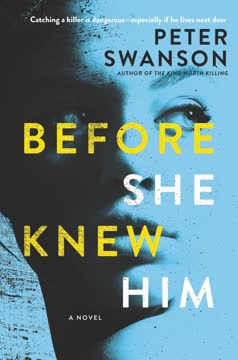
Plot Summary
Suburban Strangers, Hidden Darkness
Hen and Lloyd, new to their suburban neighborhood, attend a block party and meet Matthew and Mira Dolamore—the only other childless couple on the street. First impressions mask true natures, as neighbors exchange pleasantries and mild curiosity. But Hen—an artist managing her bipolar disorder—senses an unsettling undercurrent. In the Dolamores' home, the group's forced intimacy and small talk set a mood of pleasant normalcy, yet a chance glimpse of a fencing trophy in Matthew's office chills Hen. Subtle but tangible, an invisible thread binds Hen to secrets long buried beneath the surface. The glossy veneer of suburbia cracks, exposing the slow shiver of suspense and the hint that deeper, darker connections lurk just out of sight.
Obsessions and Old Wounds
As Hen's fixation with the trophy grows, her mind returns to the unsolved murder of Dustin Miller—once a local case that turned into her past obsession during a bipolar episode. Her history of manic suspicion haunts her; she was once hospitalized after a college incident involving paranoid accusations and violence. Now, Hen's resurfacing compulsion is laced with rational fear: the fencing trophy's inscription and Matthew's school align disturbingly with the cold case details. Past and present coalesce in the mind of a woman both attuned to danger and haunted by her own reliability. Is it illness, intuition, or something in between? The boundary blurs for Hen, propelling her on a perilous investigation.
The Trophy on the Mantel
Meanwhile, Matthew, quietly unsettled by Hen's reaction to his trophy, contemplates his "souvenirs": objects tied to old, secret acts of violence. He hides them, grieving their loss even as he recognizes the risk of exposure. Hen, desperate for proof and accountability, contemplates surveillance and break-ins, unable to trust herself to leave the mystery alone. Memories of earlier, obsessive spirals are juxtaposed with a rational quest for the truth—her mind oscillating between reason and premonition. For both, the trophy symbolizes not just guilt but identity. Their stories, each scarred by the past, begin to encircle each other in an uneasy psychological dance.
Masked Motives Revealed
Hen's efforts to access the Dolamores' home allow her to confirm that the troubling trophy has vanished. It's clear: Matthew is aware he's been seen. Paranoia becomes mutual—a parallel hunt, both unsure of the other's knowledge or next move. Over shared dinners and daily routines, both conceal growing tensions from their partners. Matthew's internal monologue gives chilling clarity to his intricate justifications, as he recounts—almost fondly—the murder of Dustin, motivated less by madness than a perverse sense of justice. The game of masks deepens, as two troubled minds edge closer to direct confrontation.
The Watchers Next Door
Hen's obsession with Matthew intensifies; she shadows his movements, tries to read signs in the ordinary. Simultaneously, Matthew surveils potential new targets: men he deems deserving of punishment, reflecting on old violence and the trauma inherited from his father and brother. He stalks Michelle's boyfriend Scott, convinced of Scott's infidelity. Hen, in her own car, tails Matthew on late-night drives, seeing in her neighbor a dangerous pattern mirroring mysteries from her own past. As their lives orbit each other, the line separating pursuer from pursued dissolves, and each watches the other ever more closely, uncertain where danger truly lies.
Connections: Foxes and Lambs
Both Hen and Matthew have been shaped by powerlessness—Hen by mental illness and past paranoia, Matthew by a family legacy of abuse. Their interior lives reflect on gendered violence, trust, marriage, and self-doubt: Hen questions her own sanity and marriage; Matthew clings to his rationalizations of vigilantism. The neighborhood's tranquility becomes mere camouflage for predation. When the police are involved—thanks to Hen's anonymous tip—Matthew's evasive calm and plausible explanations reinforce his untouchable status. Both begin to recognize the nature of their bond: two damaged witnesses, attracted and repelled by the other's recognition, complicit in the cycle of hiding and seeking.
Stalkers, Secrets, and Songs
Matthew's stalking of Scott intensifies, culminating in a music gig at the Owl's Head Tavern. Hen, sensing something imminent, follows, and becomes a silent observer of Matthew's methods—just as Matthew observes Scott's infidelity firsthand. Their stalking forms a mirror, each following but never quite confronting the other. Secrets multiply; Hen's relationship with Lloyd strains under the weight of her secrecy. Both stalkers are isolated, carrying knowledge and fear—each both witness and potential victim, each forced to see how easily obsession can tip into action under cover of night.
Dangerous Games at Midnight
When Hen follows Matthew on a nocturnal pursuit, she witnesses the setup for murder—Scott's violent death at Matthew's hands in a dark parking lot, with Hen an accidental, speechless eyewitness. Their eyes finally meet. The shared secret is traumatic, leaving Hen both empowered with knowledge and trapped by her reputation: her mental health history undermines her credibility with the police and her own husband. The themes of bearing witness and the cost of truth come to the fore, as darkness in suburbia finally erupts into overt violence.
Tipping Off the Police
Hen reports what she saw, but her past accusations and bipolar diagnosis render her unreliable in the eyes of the police—and to Lloyd, who moves from protective to doubtful. Matthew, armed with Hen's history, leverages her instability as a shield, manipulating the narrative. The police confrontations produce only ambiguity, not answers: without unambiguous evidence, the murders go unsolved, the killer untouched, and the witness branded unreliable. The terrible cost of stigma is made palpable; the system repeatedly underestimates violence when it is observed by the "unstable."
Paths Cross, Fates Entwine
Loyalties fracture and marriages buckle under the stress of secret-keeping and suspicion. Matthew's brother Richard, warped by their shared childhood abuse, enters the narrative—another wolf in sheep's clothing, another watcher who threatens to tip violence into full catastrophe. The maze of surveillance, stalking, and disguised intent becomes too crowded for peace. Both main couples, their facades pierced, must reckon with betrayals—sexual, moral, and existential. Hen is left exposed, isolated, and doubted; Matthew feels seen, exposed, and exhilarated by his own notoriety.
Anonymous Accusations
The narrative demonstrates how clever killers can weaponize public perceptions. Matthew manipulates his alibi through Mira's loyalty, the neighborhood's trust, and the police's bias—just as Hen's past is used to silence her. This battle of dueling narratives erupts into restraining orders and legal maneuvers, both threatening and empty. Simultaneously, Richard's escalating instability—his resentment at being left behind, his envy of Matthew, and his own gendered violence—raises the stakes. Amidst legal drama, chaos simmers behind closed doors.
Reckonings at the Bar
The heart of darkness is unmasked in the public anonymity of a bar, where Hen and Matthew finally talk openly. What follows is a chilling negotiation: a confession not to the authorities, but to the only person who will listen. Matthew attempts to justify his vigilantism and evoke sympathy, while Hen tries to psychoanalyze him out of his compulsion. They simultaneously recognize and defy the intimacy of shared knowledge; their mutual dependency is as dangerous as any crime they discuss. The abnormality of their trust forms the book's emotional core, exposing the ambiguity of both morality and madness.
Broken Homes, Broken Hearts
Hen discovers Lloyd's long-term affair with Joanna, confirming Matthew's earlier insinuations. Joanna, too, has been lied to by Lloyd about the supposed end of his marriage. This revelation leaves Hen emotionally adrift, her trust shattered on all sides. Parallels between romantic betrayal and neighborly violence deepen the novel's themes, as both emotional and physical dangers emerge from those closest to us. Hen's clarity about her own mind now contrasts with the chaos around her; she finds herself less broken than those who seem perfectly "normal".
The Madness Next Door
The story shifts to Richard's point of view, revealing him as a dangerous, sexually frustrated predator. He has always lived in the shadow of Matthew and their father, both fascinated and repelled by the violence and control of his childhood home. Richard's pathology is less organized than Matthew's, driven by envy and resentment. His feelings of entitlement and grievance coalesce into acts of stalking and, ultimately, murder. The lines between him and Matthew blur, as both are driven by compulsion and trauma—alter egos that each fear and despise in the other. When the narrative returns to Matthew, guilt, paranoia, and a warped sense of kinship drive him toward catastrophic choices.
Brothers Born of Blood
The brothers' entwined legacies climax: Matthew's calculated killings—justified in his mind as protection, punishment, or mercy—are offset by Richard's random violence. Both are propelled by the carnage of their upbringing, but Richard lacks Matthew's "moral" code. After Richard's murder of Michelle, Matthew confronts the limits of his own justifications and must choose: protect his brother or save himself—and, possibly, Hen. Loyalty, shame, and mutual resentment spiral, as fate closes in on both men, with Hen caught in the crossfire.
Confessions Without Consequence
Hen is driven to desperate measures, agreeing to secret meetings with Matthew in the hope of stopping his spree through understanding alone. Their conversations expose their psychological wounds and the limitations of talk as medicine for violence. Meanwhile, Lloyd—buoyed by new belief in his wife—confronts Matthew and is left humiliated, his bravado crumbled alongside his body. The police, at last attentive, are too late and too skeptical: proof remains elusive even as bodies accumulate, and the story barrels toward its nightmarish conclusion.
Confrontation and Catastrophe
Lloyd's attempts to redeem their marriage and protect Hen unravel; in seeking evidence inside Matthew's house, he is caught and killed in a moment of brutality. Hen, finally seeking escape from both her husband and the murderer next door, is lured into a trap at her studio by Richard—who reveals himself as both a real brother and the psychological double of Matthew. The twins (literal or psychological) are indistinguishable in their danger. Through clever talk and insight, Hen brings forth "Matthew," buying herself time and control in a near-hopeless scenario.
The Studio Trap
Alone with the killer at her studio, Hen deploys not just will but deep psychological insight, helping Matthew separate himself from Richard long enough to beg for help and ask to be locked in. The confusion of identity—who is speaking, who is acting—becomes lethal, but Hen outwits her captor by staying calm. She escapes, calls the police, and on arrival is told of Lloyd's death. The ultimate price of vigilantism, secrecy, and disbelief is paid in blood; the only survivor is the one forced to carry the burden of truth that will never quite be believed.
Endings, Truths, and Dark Beginnings
Time passes: Matthew is imprisoned, likely for life, for multiple murders; the full truth of Richard's participation remains ambiguous. Hen, alone, processes her trauma, grief, and guilt—her reliability forever in question by the world, even as she knows herself to be sane. Suburbia remains scarred; marriages and lives are ended or remade. The costs of bearing witness, and the dangers of refusing to believe survivors of trauma, endure. Hen picks up her life as an artist, forever changed, her story a mosaic of horror and resilience—her insight both her salvation and her curse.
Analysis
A chilling study of the limits of knowing, believing, and surviving evilBefore She Knew Him is a sophisticated psychological thriller that transcends whodunit conventions by rooting fear not only in violence but also in the failures of trust, credibility, and institution. Swanson's characters are deeply wounded by trauma—both inherited and experienced—and the novel's plot pivots on the question of whether being a witness is ever enough. Hen, hobbled by her own history and the stigma of mental illness, serves as an emblem for so many survivors: her insights prove both accurate and unwelcome, her courage unappreciated until irreparable harm is done. Matthew is a haunting portrait of vigilante violence rationalized as "justice," revealing the seductive and corrosive nature of retribution; the fact that his pathology is both individual and familial raises questions about the inheritance of violence. The theme of doubling—twins, marriages, mirrored betrayals—suggests the fragility of boundaries between sanity and madness, guilt and innocence. Swanson elegantly uncovers how "knowing" evil is rarely enough to stop it; institutions and communities, blinded by prejudice or comfort, enable it to thrive. Ultimately, the novel asks whether bearing witness can ever bring safety—or simply more pain. The lesson is somber but crucial: truth, especially when it comes from marginalized voices, is often the thing we most struggle to believe, and our failure to listen has the gravest human cost.
Review Summary
Before She Knew Him receives generally positive reviews, averaging 3.85/5. Most readers praise its gripping psychological tension, unreliable narrators, and unexpected twists, frequently comparing it favorably to Swanson's beloved The Kind Worth Killing. Reviewers highlight the compelling dual perspectives of Hen and Matthew, and appreciate the thoughtful portrayal of bipolar disorder. Common criticisms include a slow start, occasional predictability, and an ending that doesn't fully deliver. Overall, thriller fans find it an entertaining, dark, and satisfying read despite minor flaws.
People Also Read
Characters
Hen (Henrietta Mazur)
Hen is the emotional fulcrum of the novel: a talented illustrator, wife to Lloyd, and survivor of bipolar disorder. Her history of manic suspicion and institutionalization haunts her, warping both her self-trust and public credibility. Hen is driven by a skeptical, almost morbid curiosity, and a compulsive need to bear witness and expose hidden harms—in others and in herself. Her relationship with Lloyd, once intimate, is eroded by caregiving roles, unspoken resentments, and mutual disillusionment. Throughout the novel, Hen is both predator and prey, locked in a dangerous intimacy with Matthew—the only person who both understands her darkness and threatens her survival. Despite feeling powerless, Hen ultimately demonstrates immense psychological courage and resourcefulness, surviving by insight and empathy as much as by luck.
Matthew Dolamore
Matthew is a history teacher, neighbor, and ostensibly normal suburban husband. Beneath this calm exterior lies a complex psyche shaped by childhood trauma at the hands of an abusive, controlling father and a broken, complicit mother. Matthew cultivates a code of justice that is, at core, savagely self-interested: he targets men he believes are abusive or predatory, collecting "souvenirs" from each crime. His affect oscillates between childlike neediness and chilling detachment. Matthew's encounters with Hen awaken both a sense of kinship and a perverse hunger for recognition. Through his brother Richard, his inherited pathology emerges, exposing the instability at the core of his persona.
Lloyd Harding
Lloyd is Hen's husband, first her champion, then her reluctant caretaker, and, eventually, her betrayer. The shifting power dynamic of Hen's illness turns him into a vigilant monitor rather than a romantic equal. Lloyd's long-term affair with Joanna Grimlund reflects both crisis and cowardice—a longing for excitement as his marriage stagnates. Despite his flaws and failures, Lloyd's final involvement in the story is a desperate attempt to prove himself, to protect his wife and redeem his self-respect. His inability to face complexity—whether emotional or moral—renders him vulnerable to the dangers he cannot see.
Mira Dolamore
Mira, Matthew's wife, is an energetic and optimistic woman, eager for connection. The product of her own challenging upbringing, Mira throws herself into work and routines, tolerating her husband's quirks and occasional distance. She unwittingly serves as Matthew's alibi and shield, caught between sympathy and denial. Mira's loyalty is tested as evidence accumulates; her eventual recognition of Matthew's crimes is accompanied by deep personal and ethical reckoning. She embodies both the resilience and fragility of those who love damaged individuals, ultimately forced to bear the cost of misplaced trust.
Richard Dolamore
Richard, Matthew's brother, is both the literal and psychological double for Matthew's darkest impulses. Scarred by the same abusive childhood, but lacking his brother's rationalizations, Richard is alienated, sexually frustrated, and increasingly dangerous. His pathology is less organized than Matthew's, driven by envy and resentment. His emergence as a parallel killer blurs the boundaries of identity, raising questions about the inheritance of violence, the nature of complicity, and the limits of sibling loyalty.
Michelle Brine
Michelle is Matthew's younger colleague and confidante, an earnest and emotionally fragile teacher. Her relationship with Scott Doyle is marred by betrayal; her reliance on Matthew for guidance makes her vulnerable. Michelle's victimization at the hands of Richard (posing as Matthew) represents the novel's bleakest message: that no code of "justice" can truly keep innocents safe, and that intimacy may draw danger instead of warding it off.
Scott Doyle
Scott is Michelle's musician boyfriend and the eventual target of Matthew's vigilantism. His infidelity and obliviousness make him, in Matthew's eyes, worthy of death. Scott's fate is a commentary on moral absolutism and the dangers of self-righteous judgment. He is both victim and symbol, disposable to the men who consider themselves arbiters of justice.
Dustin Miller
Dustin, though murdered before the main narrative begins, is the figure whose death winds the plot's spring. His own history of sexual assault, charm, and arrogance makes him easy (in Matthew's mind) to rationalize as "deserving" death. Dustin's absence echoes through Hen and Matthew's relationship, a reminder of secrets, obsessions, and the ambiguity of justice.
Joanna Grimlund
Joanna, Lloyd's long-term mistress, is herself an unknowing casualty of his duplicity. Blamed by Hen and told lies by Lloyd, she is left navigating guilt, anger, and her own identity. Joanna's relationship with Hen illustrates the possibility of solidarity among those most often set against each other.
Detective Iggy Martinez
Detective Martinez is the investigator open to possibility but constrained by evidence and procedure. A foil to Hen, he straddles empathy and professional skepticism, warning of the dangers of relying on "gut" feeling over facts. His eventual trust of Hen comes too late for many—a commentary on institutional blindness and the difficulty of distinguishing real threat from imagined danger.
Plot Devices
Unreliable Narrator and Subjectivity
The story's propulsion relies on multiple unreliable perspectives—Hen's mental health history and reputation, Matthew's shifting justifications and dissociation, and the legal institutions that repeatedly fail to see the truth. Readers are kept off balance, forced to weigh whose version of reality they can trust. False confessions, staged alibis, and the stigma of mental illness all conspire to make truth slippery. Even the presence of a literal twin/double in Richard (and the broader suggestion of psychological doubling) elevates the theme: can we ever know who people truly are, or even who we are ourselves?
Foreshadowing and Echoes
Swanson uses concrete objects—the fencing trophy, prints of foxes, knickknacks, cigarettes—to signal deeper currents. Early conversations circle themes that manifest later as action: the discussion of violence, vigilantism, and the suspicion that "strangers" are never who they appear. Small domestic disturbances (illegal entry, missing keepsakes, strange dreams) presage the eruption of violence and collapse of trust.
Parallelism and Doubling
Each pair of characters—Hen and Matthew, Matthew and Richard, Hen and Joanna—serve as mirrors for one another, reflecting themes of guilt, trauma, and corruption amid the veneer of normalcy. Marriages deteriorate in parallel; the violence of men—whether justified or random—becomes the common currency. The doubling of perpetrators and victims intensifies the sense of inescapable fate.
Ticking Clocks and Escalating Encounters
Swanson structures the plot around a series of escalations—repeated meetings (some accidental, some premeditated), increasing risk, and the tightening of legal and social constraints. As alibis fray and secrets surface, characters are pushed physically and psychologically into each other's orbits. The climactic scenes—in bar, studio, and home—are informed by the inevitability the narrative structure has built.
Irony and Subverted Expectations
Authority is alternately too slow or too skeptical; those who try hardest to do the right thing are punished, marginalized, or killed. Swanson's plotting upends thriller conventions: vigilante justice is depicted as tragic, not cathartic; the tools of detection (gut instinct, legal process, friendship) are consistently shown to be both powerful and deeply limited.








































