
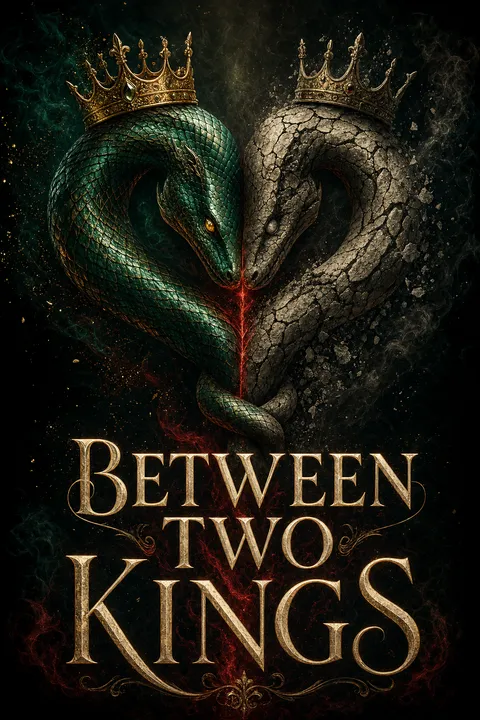


Plot Summary
Annulment in the Dungeon
Tem,1 now wed to the basilisk Serpent King Caspen,2 is summoned alone to the human castle by Leo,3 the newly crowned human king she also loves and secretly married. She learns why she was called: Leo3 wants their union dissolved so he can wed Evelyn,5 the first love Tem1 herself ordered him to find.
In the freezing dungeon, watched by the imprisoned former king Maximus,11 the two sign the paperwork, their fingers brushing once in electric, aching longing. Leo3 refuses to take back her silver ring. Rather than sever ties completely, he proposes weekly Sunday dinners so their two kingdoms, teetering toward war, might learn to coexist. Tem1 agrees, dreading the ritual of watching Leo3 build a life with another woman.
The book opens on renunciation rather than union, inverting the marriage plot: a wedding is undone before our eyes. Straube frames Tem's central wound immediately, she engineered her own heartbreak by ordering Leo away, so her suffering is self-authored guilt, not simple loss. The dungeon setting literalizes imprisonment: Maximus caged, the marriage entombed, feelings buried. The refused ring signals that legal dissolution cannot dissolve emotional bonds. The Sunday-dinner bargain is a masterstroke of romantic torture, converting statecraft into a recurring wound. From the first page the novel establishes its governing tension: institutional obligation versus ungovernable desire, and the impossibility of choosing between two whole loves.
Home Under the Mountain
Back in the caves, Tem1 loses herself in Caspen,2 who calmly insists her seeing Leo3 cannot bother him because she chose him. Yet she cannot master transitioning and struggles with basilisk customs: sex at every meal, assumed consent, an intoxicating elixir brewed from essence.
When mating season begins, Caspen2 introduces his brothers. Apollo,4 arrogant and predatory, immediately flirts and claims ancient first rights to her should Caspen2 ever die. Damon,8 gentler and warmer, charms her at once.
Tem1 also forges an unlikely friendship with Adelaide,7 Caspen's2 former betrothed, who becomes a trusted confidante. Amid the revelry, Tem1 feels open hostility from the Senecas, her own estranged quiver, who resent her marrying a Drakon, and Caspen2 warns that Rowe,9 the basilisk he once maimed, will seek revenge.
Worldbuilding here doubles as characterization: basilisk society externalizes appetite, treating sex as communal, non-possessive, and hierarchical, which throws Tem's stubbornly human jealousy into relief. Her failure to transition is quietly ominous, a body refusing to comply, foreshadowing hidden magical cost. The brothers function as thematic mirrors: Apollo embodies desire without sentiment, Damon warmth without threat, Caspen love burdened by rule. Adelaide's friendship rewrites the expected romantic-rival dynamic into female solidarity, a deliberate genre subversion. The Seneca hostility and Rowe's looming grudge plant the political powder keg, reminding readers that Tem's Hybreed power is coveted, making her body a contested resource long before the tournament arrives.
The Blood Bond's Cruel Law
Visiting her human mother Daphne12 and basilisk father Kronos,10 Tem1 confesses she may have made a mistake letting Leo3 go. Kronos10 warns gently that the heart cannot be reasoned with and that loving two people is perilous for a creature bound by blood.
Later, Caspen2 finally reveals the horror behind his family's grief: his mother fell in love with and slept with another basilisk, shattering the blood bond to his father. The curse compelled the betrayed husband to kill her, and a young Caspen2 watched it happen.
Basilisks share bodies freely, he explains, but never their hearts. Tem1 realizes with mounting dread that her own blood bond to Caspen2 carries this same lethal law, and that her stubborn, unfading love for Leo3 is precisely the forbidden sin it punishes.
This is the novel's structural depth charge: a rule introduced casually that will detonate at the climax. Straube weaponizes exposition, letting readers understand the machinery of doom before Tem fully does. The distinction between shared bodies and unshared hearts articulates the book's thesis, that fidelity is emotional, not physical, a radical reframing for a why-choose romance. Kronos, the absent father who understands his daughter better than anyone, becomes an oracle of fate versus feeling. Caspen's inherited trauma humanizes his later possessiveness: he has literally seen love become an execution order. The scene converts Tem's romantic dilemma from angst into a countdown, love as a slow-acting poison.
Dinner With Evelyn
At the first Sunday dinner, Caspen2 teases Tem1 to distraction in the carriage, then leashes his temper as they finally meet Evelyn,5 Leo's3 sweet-seeming betrothed. Tem1 interrogates her: Evelyn5 claims she abandoned Leo3 only because Maximus11 forged a breakup letter, which she conveniently burned.
Caspen2 privately tells Tem1 the woman is lying. Tem1 also learns of the food shortage crippling the village now that the bloodletting has ceased, and Evelyn's5 tone-deaf obsession with an extravagant wedding staged on Kora's sacred night.
Cornered afterward for so-called girl talk, Evelyn5 drops the mask and taunts Tem1 that Leo3 began as hers and is hers again, warning her not to interfere. Tem1 leaves the castle certain that Evelyn5 is a manipulator concealing the real reason she once left.
The dinner is social theater, four people performing civility over a table shaped, pointedly, as a circle of false equality. Evelyn enters as the innocent, but her burned-letter alibi is too neat, and Caspen's lie-detecting instinct plants the mystery that will pay off in the dungeon. Straube uses the food shortage to expose the moral cost of Tem's earlier idealism: mercy toward basilisks starves the humans, complicating any easy ethics. Evelyn's pivot from saccharine to menacing reveals her as Tem's structural foil, a woman who weaponizes softness rather than sharpness. The wedding-on-Kora's-night detail marks her hubris and greed, seeding the later revelation that she loves gold, not Leo.
Feed Us
Seeking her best friend Gabriel6 at the tavern, Tem1 discovers he has been organizing the village rebellion. The people are starving because ending the bloodletting cut off the royals' supply of gold.
She follows the men to the town square, where they overwhelm the guards and one smears chicken excrement across the church's marble steps into two damning words: feed us. Gabriel,6 exhilarated, admits he masterminded the protest and warns Tem1 she is now seen as one of them, aligned with both the snakes and the royals.
The blasphemous desecration reveals how swiftly Leo's3 mercy has curdled into public fury. Tem,1 horrified, understands that her own plea to end the bloodletting has, however unintentionally, endangered her human friends, her lover-king,3 and the fragile peace between the species.
The protest dramatizes unintended consequence, the recurring engine of Tem's grief. Her compassion for basilisks becomes cruelty toward humans, illustrating that in a zero-sum world every mercy is also a theft. Gabriel's radicalization introduces the novel's proletarian dimension: while royals and serpents debate love, ordinary people starve, and the excrement-scrawled scripture literalizes sacred order defiled by material desperation. Straube complicates Tem's dual identity, she belongs to two peoples and betrays each by serving the other. The scene also fractures the story's warmest friendship, converting Gabriel from confidant into a competing moral claim. Peace, the book insists, is not merely fragile but structurally impossible between predator and prey.
The Slap and the Serpent Brother
Returning alone, Tem1 is cornered by Apollo,4 who taunts her, listens to her racing heart, and dares her to taste him. Overwhelmed, she slaps him, and the blow releases a surge of power that thrills rather than injures him; he refuses to heal the mark, wanting a reminder of her, and tells her to come to him only when she craves what Caspen2 will not give.
Days later, at the ouroboros ceremony, Tem1 joins a living chain of basilisks with Adelaide7 and Caspen,2 until Apollo's4 arrival nearly triggers a dangerous hive orgasm. Later, when she stumbles into Apollo4 pleasuring himself to the sight of her in the banquet hall, Caspen2 joins rather than forbids, and the three of them cross a charged new erotic threshold together.
The slap is the novel's cleverest reversal: Tem's attempt to erect a boundary becomes an intimacy, an exchange of power that Apollo savors as a kiss. Straube externalizes ambivalence, resistance and attraction rendered indistinguishable. Apollo's refusal to heal the welt reframes desire as a wish to be marked, to bear evidence of the other. The ouroboros, an infinite loop of shared pleasure, embodies basilisk ontology: selfhood dissolved into community. Crucially, Caspen's participation rather than jealousy signals that within this culture, watching and sharing are acts of love and control at once. Tem is being seduced not by one man but by a worldview that treats her divided heart as natural.
A King on a Leash
At a dinner where Leo3 looks pale and strained, an exasperated Tem1 tells him to calm down, and to her horror he instantly, helplessly obeys. She realizes the crest she performed at their wedding did far more than save his life: it bound him to obey her commands. Confessing the truth, she promises never to order him again.
Leo,3 gutted to learn she once commanded him to seek Evelyn,5 admits he no longer trusts his greedy bride5 and no longer wants this marriage. Because touching each other risks catastrophe, they strike a fragile bargain: Leo3 will pour everything he cannot say aloud into secret letters and hide them away. It is a reckless valve for a love neither can extinguish, and a hidden bomb awaiting exactly the wrong reader.
The accidental command crystallizes the ethics of power the novel keeps circling: Tem holds absolute dominion over Leo, and her horror at wielding it distinguishes her from Caspen and Maximus, men who consider control a right. Consent becomes the moral fault line between species. Leo's confession that he does not want this life converts him from obstacle to fellow prisoner, deepening reader sympathy. The letters are a beautifully doomed device, a Chekhov's gun of the heart, an attempt to quarantine feeling that instead documents and preserves it. Straube frames writing itself as both catharsis and evidence, foreshadowing that words meant to relieve longing will become weapons in others' hands.
The Church Burns
At the winter full-moon celebration, the feast tables sit nearly bare. Gabriel,6 now fully radicalized, warns Tem1 away, calling her one of the enemy, then leads the uprising. Guards are overwhelmed, the church is set ablaze, and an explosion levels Kora's house of worship as villagers scatter into the night.
A bleeding Gabriel6 drags Tem1 to safety but refuses to stop, vowing the royals are only the beginning and the basilisks are next. The escalation terrifies Tem,1 who now watches peace slip beyond reach.
Desperate, she resolves on a gamble: bringing Gabriel6 beneath the mountain so he might see basilisks as people rather than monsters, hoping that empathy could somehow halt the accelerating spiral toward open war between humans and serpents.
The destroyed church marks the point of no return for the human rebellion: material starvation has consumed even the sacred. Gabriel's transformation from comic, flirtatious best friend into a revolutionary leader is the novel's most tragic secondary arc, love and ideology pulling a friendship apart. Straube stages the fire as apocalyptic punctuation, ending the era of possible reconciliation through polite dinners. Tem's response, radical empathy through exposure, reveals her governing faith: that proximity breeds humanity, that if the two peoples truly saw each other they could not slaughter each other. It is a hopeful, arguably naive thesis the book will test brutally, weighing coexistence against the iron logic of predator and prey.
Gabriel Under the Mountain
Tem1 persuades Caspen2 to permit Gabriel's6 visit. Fearless and delighted, Gabriel6 drinks the elixir and, drawn to Damon,8 joins the mating-season revelry, kissing Tem,1 Damon,8 and others in a warm communal tangle that Caspen2 oversees. The night succeeds beyond hope: Gabriel6 is enchanted rather than repulsed, and gentle Damon8 chooses him as a mate, an emotional bond of genuine feeling.
But triumph curdles when a scream reveals four words scrawled in blood on the courtyard wall: give her to us. The Senecas have run out of patience. They intend to seize Tem,1 the coveted Hybreed, by force. Caspen2 sweeps her to safety while Damon8 protects Gabriel,6 and Tem1 grasps that her very existence has become the fuse for a brewing basilisk civil war.
Gabriel's success validates Tem's empathy experiment, humanization through intimacy, and simultaneously deepens the friendship's transformation: her human anchor is now claimed by the serpent world, mirroring her own dual belonging. Damon's choosing him rewrites the mate-bond as tender rather than transactional, offering a hopeful counter-model to the possessive love elsewhere in the book. Yet the bloody wall message punctures the idyll, reasserting that Tem's body is political capital, coveted power to be owned. Straube braids the personal and the political: a love story blooms in the same room a war declares itself. The scene reframes Tem from romantic subject to strategic object, setting the tournament's terms of possession.
Consummate or He Dies
Tem's1 chronic inability to transition finally gets an explanation. Her father Kronos,10 learning she crested Leo3 out of love, reveals the ancient magic's condition: a crest performed in love must be consummated through sex, or the bond will strangle her power and eventually kill its object.
Leo3 is already fading, the scent of decay gathering around him. Yet consummation carries its own doom, for sleeping with Leo3 would break Tem's1 blood bond to Caspen2 and trigger the same curse that once forced Caspen's2 father to murder his mother.
Caspen2 would be compelled to kill her. Tem1 is caught in an impossible arithmetic: inaction sentences Leo3 to death, action sentences her own. There is no clever loophole this time, only two loves and two deaths balanced on one choice.
This is the novel's fulcrum, where the two magical systems introduced earlier, crest and blood bond, lock into a lethal contradiction. Straube's structural rigor pays off: setups planted casually now snap shut like a trap. The revelation reframes Tem's earlier symptoms, her arousal near Leo, her failing transitions, as the body enforcing fate against the will. The dilemma is a pure tragic engine: every path costs a life she cannot bear to lose. It also indicts Caspen retroactively, since he ordered the crest, making him architect of the doom he will suffer. The scene transforms romantic indecision into existential emergency, forcing the reader to feel the countdown quicken beneath every subsequent choice.
Blood for Gold
When Evelyn5 pressures Leo3 to revive the bloodletting, Tem1 volunteers her own blood rather than let any basilisk suffer, forcing Leo3 to watch her wired into the extraction machine. In the dungeon, the imprisoned Maximus11 laughs at her stubbornness and hands her the truth she suspected: he never wrote a breakup letter.
Evelyn5 abandoned Leo3 because Maximus11 paid her, having caught her stealing golden cutlery, and she returned only when Leo3 became king, chasing wealth, not love.
Afterward, a drunk and guilt-ridden Leo3 begs Tem1 in the parlor to simply order him to end it, but she refuses to control him again. They edge close, breathless and aching, before she flees, now holding hard proof that Evelyn5 is a fortune-hunter wearing the face of devotion.
Tem's self-sacrifice weaponizes empathy: by putting her own body under the wires she makes abstract cruelty personal, forcing Leo to confront the true face of the bloodletting he sanctioned. It is moral aikido, using her suffering as argument. Maximus, the caged villain, becomes an unlikely truth-teller, and Straube lets the antagonist articulate the theme of greed versus authenticity that defines Evelyn. The parlor scene stages the crest's cruelty from the other side: Leo begs to be commanded, hungry for the very control Tem refuses to exercise, and her restraint becomes the proof of her love. Consent, again, is the novel's ethical center, freely refusing power is itself an act of devotion.
Learning to Turn People to Stone
Furious that Caspen2 refuses to teach her petrification, Tem1 asks Apollo4 instead. He leads her, naked, to a dying farmer and guides her through transitioning and siphoning a life force until flesh hardens into granite.
The kill floods her with intoxicating power and unbearable arousal, and Apollo,4 honoring a promise to bring her release without full sex, satisfies the surge against a low stone wall. Then he shows her a hidden vault: rows of petrified humans, centuries of basilisk vengeance for the bloodletting.
Tem1 returns home marked by Apollo's4 essence, and Caspen,2 catching the scent, is coldly wounded, less by the intimacy than by the killing itself. He had warned she was not built to be a murderer, and now that innocent line has been crossed.
Petrification functions as a corruption arc: Tem crosses from victim to killer, and the aftermath's forced arousal literalizes power as an aphrodisiac, an unsettling meditation on how violence and desire share circuitry. Apollo, the teacher of forbidden things, becomes Tem's dark tutor precisely where Caspen plays protector, and the contrast crystallizes the brothers' philosophies: Caspen shields her from monstrousness, Apollo hands her the full breadth of her nature. The statue vault is a devastating image, coexistence exposed as mutual, hidden atrocity, undercutting Tem's dream of peace. Caspen's cold reaction is misread and telling: his grief is less jealousy than the loss of her innocence, the shine he could not keep untarnished.
The Marriage Contested
One night Tem1 and Caspen2 suddenly cannot touch; an invisible barrier holds them apart. Adelaide7 explains that the Senecas have formally contested their inter-quiver marriage, invoking an ancient tournament for Tem's1 hand, sanctioned by the goddess Kora.
Twelve contenders will compete across three tiers of strength, seduction, and heart, and Tem's1 own heart will render the final, unbreakable verdict. The challenger is Rowe,9 the basilisk Caspen2 once castrated, now returned having monstrously forged himself a new cock of solid gold, a forbidden violation of nature that grants him terrifying power.
Should Rowe9 win, Tem1 must marry him. Caspen2 is coolly confident, but Tem1 is terrified, knowing her divided heart could betray them both before hundreds of watching basilisks and hand her to the man who wants her dead.
The untouchable barrier is exquisite torture, denying the couple their one reliable language, sex, precisely when they most need reassurance, and forcing them into words and tenderness instead. Straube turns deprivation into intimacy. The tournament externalizes Tem's internal crisis: the heart she cannot govern becomes a public verdict she cannot fake, raising the stakes of self-knowledge to life-or-death. Rowe's self-forged golden phallus is grotesque and thematically loaded, a man who literally manufactures the potency Caspen took from him, embodying power seized rather than earned, the very heresy that threatens basilisk order. The contest reframes marriage as combat and consent as ritual, exposing how a culture that prizes freedom still cages its queen in tradition.
The Tournament of Kings
In the first tier Rowe9 illegally bites Caspen,2 siphoning his power and winning the round, which forces Tem1 to bed all eleven remaining contenders in the final tier, including Rowe's9 chilling golden cock and, at last, Apollo,4 with whom she fully consummates their long-simmering tension. When the closing ritual demands her heart name its true match, Tem1 freezes: it calls with equal force to Caspen2 and to the absent Leo,3 threatening to expose everything.
Rather than let her die revealing the truth, Apollo4 forcibly extracts her love for Leo3 so her heart can crown Caspen2 the victor. Reunited and able to touch again, Tem1 is flooded with relief, but Apollo4 warns the extraction is only temporary, and that he now knows her most dangerous secret.
The tournament literalizes the why-choose romance's core anxiety: a heart forced to declare a single winner cannot, because Tem's love is genuinely plural. Straube stages this as physiological impossibility, not indecision, insisting the plural heart is real, not fickle. Rowe's cheating bite escalates him from rival to existential parasite, siphoning Caspen toward slow death. Apollo's extraction is the novel's most morally complex act of love: he mutilates her feeling to save her life, playing surgeon to her heart, and pays with the burden of her secret. The scene reframes Apollo entirely, the shallow flirt revealed as the one willing to carry unbearable knowledge and act without reward, redefining what devotion can look like.
The Weasel Massacre
Amid grief and fragile reconciliation, panic floods the collective basilisk mind: someone has loosed a weasel into the caves, whose scent is fatal to serpents. Tem,1 immune as a Hybreed, hunts it down and snaps its neck, but forty-six basilisks lie dead, including the blood-bound bride she once blessed.
She learns the villagers, following Vera's14 boasts, engineered the attack as revenge for the deaths of Jonathan and Christopher. The atrocity hardens Caspen2 past forgiveness; he demands that Leo3 apologize in person, inside the caves.
Tem1 helps mourn and bury the dead, sensing the truce between species has finally, irreparably snapped. Whatever comes next, she knows, will be paid for in far more blood than a single small creature could ever spill.
The weasel is grotesque irony: the mightiest predators felled by a house-cat-sized pest, a reminder that every power carries an absurd, humiliating weakness. Straube uses it to dramatize collective grief, the hive mind means every death is felt by all, making mass murder a shared wound rather than distant statistic. The attack also completes the human rebellion's moral fall, from feeding themselves to slaughtering en masse, mirroring the basilisks' own hidden atrocities. Caspen's demand that Leo apologize underground reads as reasonable but conceals strategy, planting suspicion for the climax. The scene marks the death of Tem's coexistence dream: exposure bred not empathy but escalation, and the ledger of vengeance now runs both directions without end.
A Wedding and a Departure
Summoned to stay at the castle before Leo3 and Evelyn's5 wedding, Tem1 endures Evelyn's5 calculated cruelties: a bedroom across from Leo's,3 decorations copied from Tem's1 own wedding, and a smug confession that she was indeed bought off and has secretly read Leo's hidden letters.
Evelyn5 even eyes the weasel's basilisk corpses as fresh material for bloodletting. At the celebration, when a royal sneers at Tem1 as a mere chicken farmer, Leo3 snaps and publicly defends his true wife, humiliating Evelyn,5 who storms out.
Later, alone with Tem,1 Leo3 hears from her lips that his father11 paid Evelyn5 to leave him. He sends Tem1 back to the caves, resolved to make his own choice at last. By the next dinner, Evelyn5 is gone and the bloodletting is abolished for good.
Evelyn reaches full villainy here, not through violence but through avarice and psychological warfare, the copied wedding a chilling act of identity theft, the coveting of corpses exposing greed stripped of any human floor. She is Tem's dark twin: both village women offered escape, but where Evelyn sells herself, Tem sacrifices herself. Leo's public defense is his moral turning point, choosing authenticity over appearance, the very virtue Evelyn lacks. Straube lets the truth of the paid letter finally reach its intended ear, closing a mystery seeded chapters earlier and freeing Leo to choose. The departure clears the board romantically while leaving the deadlier magical dilemma, consummate or die, fully, terrifyingly intact.
The Sacrifice of the Serpent King
Under the pretext of an apology, Caspen2 forces Leo3 into a council meeting, secretly intending for Tem1 to consummate the crest and reclaim her power before the Senecas strike. As Rowe's9 rebellion erupts and the mountain fractures, Tem1 and Leo3 finally sleep together, restoring her ability to transition. Caspen2 flees so the curse cannot compel him to kill her, while Apollo4 restrains him.
Tem1 confronts Rowe,9 dives into Kora's sacred lake to channel the goddess, and siphons Rowe9 to death, absorbing the power of two kings. Then Apollo4 keeps a hidden vow: he bites and drains Caspen,2 killing his own brother so Caspen2 need never be forced to murder Tem.1 Caspen2 dies in Tem's1 arms, naming Leo3 her true last love and calling her worth every sacrifice.
The climax resolves the tragic equation not by cheating the curse but by rerouting its cost onto a willing third party, Apollo's fratricide as ultimate love, the debt between brothers finally paid. Caspen's flight reframes his earlier coldness: he engineered Leo's underground visit to save Tem, meaning his cruelty was concealed sacrifice all along. Tem's channeling of Kora completes her arc from powerless farm girl to goddess-touched queen who defeats the man who forged power against nature. The gut-punch is thematic: Tem's plural heart, which the whole book insisted could not choose, is resolved only by death removing one beloved. Straube refuses a tidy polyamorous ending, honoring the genre's darkness, love here demands a corpse.
Epilogue
With Caspen2 dead, Tem's1 golden claw necklace melts away and her freckles vanish; her basilisk half dies with him, leaving her wholly human. The surviving serpents, now led by Apollo,4 prepare to retreat to the sea, waiting respectfully for her to grieve. Apollo4 and Damon8 formally waive their rights to her, each releasing her with a final kiss, and Gabriel6 departs with Damon.8
Tem1 returns to Leo,3 and they remarry in her parents' garden with Leo's sister Lilly13 officiating. She keeps fragments of power: healing, shifting emotions, mind-speaking with her father.10 At last Leo3 lets her read the hidden letters, including a farewell from Caspen,2 who chose to die so she could live and love without the curse.
The denouement literalizes loss through the body: melted gold, erased freckles, a serpent self extinguished, making grief physical rather than merely stated. Straube resists erasing Caspen; his farewell letter reframes the entire novel as his act of love, recasting jealousy and manipulation as protection. The retained powers signal that Tem is transformed, not restored, she carries both loves forward, one living, one absorbed into who she has become. The garden remarriage returns her to human roots and mortality, and the novel quietly reframes mortality as gift: a finite life fully loved over an eternal one half-lived. The letters, long a device of concealment, become communion, closing the story on truth freely given.
Analysis
Between Two Kings is a why-choose romantasy that takes its central conceit seriously as tragedy rather than fantasy fulfillment. Its governing question, can a heart love two people fully and equally, is answered emphatically yes, and then punished. Straube builds an elegant machine of two magics, the crest and the blood bond, whose collision makes Tem's1 plural love literally lethal: to save one beloved is to doom the other. The book refuses the easy polyamorous resolution its genre often grants, insisting instead that irreconcilable loves exact irreconcilable costs. The plot's engine is unintended consequence. Every merciful choice Tem1 makes, ending the bloodletting, ordering Leo3 away, cresting him, boomerangs into starvation, war, and death, dramatizing a world where compassion and cruelty are zero-sum and peace between predator and prey may be structurally impossible. The recurring image of coexistence, the hidden vault of petrified humans mirroring the memorial of drained basilisks, argues that mutual atrocity, not harmony, is what species actually share. Thematically the novel is preoccupied with consent and power. Tem's1 horror at commanding Leo,3 her refusal to control him even to save herself, marks the moral line separating her from the tyrants and predators around her; freely relinquishing power becomes the truest proof of love. Against this, Evelyn5 embodies greed and inauthenticity, Tem's1 dark mirror who sells herself where Tem1 sacrifices herself. Finally, the book meditates on mortality versus eternity. Tem's1 basilisk immortality is repeatedly framed as burden, and the resolution reframes a finite human life fully loved as preferable to an endless one half-lived. Its emotional power lies in this insistence that love worth having is love that costs something, that sacrifice, not possession, is devotion's highest form. The wound it leaves is intentional and earned.
People Also Read
Characters
Tem (Temperance)
Torn Hybreed queenA former chicken farmer turned queen of the basilisks, Tem is half-human, half-basilisk, and the novel's driving consciousness. Impatient, stubborn, and ruled by feeling rather than reason, she chafes against basilisk traditions of order and self-control even as she embraces their sexual freedom. Her defining wound is a plural heart: she loves two men fully and equally and refuses to accept that she must choose. Psychologically she is shaped by a childhood of exclusion and inadequacy, so validation, being seen, wanted, and called worthy, is oxygen to her. Fiercely loyal, she will bleed, kill, or sacrifice herself before letting harm reach those she loves. Her arc traces the collision between human conscience and basilisk instinct, guilt and desire, mercy and power.
Caspen
The Serpent KingThe ancient, powerful ruler of the basilisks and Tem's1 blood-bonded husband, Caspen is her first love and steadfast protector. Centuries old, he is patient where Tem1 is impulsive, controlled where she is chaotic, and devoted to a fault. He believes in her greatness before she does and delights in teaching her, yet carries the burden of leadership and a childhood scarred by witnessing his father's cursed violence. His love expresses itself through devotion, shielding, and an almost worshipful attention to her pleasure. Beneath his stoicism runs deep sentiment and a possessive streak he struggles to master. His refusal to let her become a killer reveals a man trying to preserve her innocence even as his world demands otherwise.
Leo
Newly crowned human kingThe white-blond human king, once Tem's1 brief husband, whom she crested and then ordered to find his first love. Slender, silver-eyed, and disarmingly eloquent, Leo wears his emotions openly and loves with a slow-burning constancy. Raised under a cruel father11 whose sins he inherits but rejects, he strives daily to be better than his lineage, abolishing torture and choosing conscience over comfort. His weakness is a paralysis born of obligation, caught between duty to his people, a scheming betrothed5, and a heart that will not release Tem1. Bound to her by magic he does not understand, he is both her devoted equal and her helpless subject. His growth is a movement from passive suffering toward decisive integrity.
Apollo
Caspen's provoking brotherCaspen's2 brother, who holds ancient first rights to Tem1 and pursues her relentlessly with wicked wit and predatory confidence. Where Caspen2 is refined, Apollo is loose and reckless, walking the line between what is right and what is possible. He teaches Tem1 forbidden things and takes everything as a challenge, hiding genuine feeling behind crude teasing. Yet beneath the arrogance lives a fierce, self-sacrificing protector who loves in his own boundaryless way, without judgment or expectation. He notices what others miss about Tem1, and his loyalty to his brother2 runs deeper than their rivalry suggests.
Evelyn
Leo's scheming betrothedLeo's3 first love, returned to reclaim him now that he is king. Sweet-faced and doe-eyed, Evelyn presents innocence while wielding quiet, calculating power. She covets gold, status, and comfort above all, a wolf in sheep's clothing who diminishes Tem's1 history with Leo3 and treats affection as strategy. She is Tem's1 dark mirror: a village woman who chose to be bought rather than to sacrifice.
Gabriel
Tem's radiant best friendTem's1 lifelong best friend, a charming, flamboyant castle servant with an unquenchable appetite for pleasure and mischief. Fearless and warm, he accepts Tem's1 monstrous secret without flinching. When starvation grips the village, he becomes an unlikely rebellion leader, straining their friendship as his loyalty to his people collides with her divided allegiances. His generous, sunlit spirit makes him beloved by nearly everyone he meets.
Adelaide
Wise Seneca confidanteA poised, elegant Seneca basilisk once betrothed to Caspen2, who becomes Tem's1 unexpected friend and guide to serpent customs. Rather than a jealous rival, she offers steady counsel, honesty, and solidarity. Secretly involved with Caspen's2 sister Cypress, she understands both quivers' grievances and helps Tem1 navigate rituals, politics, and her own tangled heart with graceful candor.
Damon
Gentle youngest brotherCaspen's2 youngest brother, slim and mild-mannered, the least severe of the siblings. Kinder and more playful than Apollo4, he proves trustworthy and sincere. His genuine, tender connection with Gabriel6 offers a hopeful model of love amid the book's darker entanglements, and he becomes a reliable protector of those Tem1 holds dear.
Rowe
Vengeful Seneca challengerA Seneca basilisk who nurses a generations-deep grudge against Caspen2, who once maimed him and killed his father. Bitter, ruthless, and hungry for power, Rowe rejects basilisk law in favor of seizing dominance by any means. He covets Tem's1 Hybreed power and dreams of remaking serpent society under his rule, making him the story's most dangerous antagonist.
Kronos
Tem's basilisk fatherTem's1 estranged basilisk father, who lives quietly with her human mother12. Slow-spoken and wise, he offers gentle, oracular counsel about the heart and warns of the dangers facing his daughter1, understanding her with uncanny insight despite years apart.
Maximus
Imprisoned former kingLeo's3 cruel father, the deposed human king now chained in his own dungeon. Malicious and unrepentant, he nonetheless dispenses uncomfortable truths, revealing secrets about Evelyn5 and taunting Tem1 about the impossibility of true peace.
Daphne
Tem's human motherTem's1 human mother, who lives in a quiet cottage tending her garden. A source of comfort and grounding refuge for Tem1, she once refused basilisk tradition herself, and her fierce independence clearly lives on in her daughter1.
Lilly
Leo's perceptive sisterLeo's3 princess sister, who sees clearly that her brother3 still loves Tem1 and urges her toward honesty. Warm and quietly wise, she wants Leo's3 genuine happiness above appearances or political convenience.
Vera
Spiteful village rivalA cruel village girl from Tem's1 past who reappears bitter and diminished, spreading spite and serving, wittingly or not, as a pawn in darker schemes against the basilisks.
Plot Devices
The Crest
Binding of savior and savedAn ancient basilisk magic Tem1 performed on Leo3 at their wedding to save his life, binding him to obey her commands. Introduced as a gift, it proves to carry a hidden, lethal condition: when performed in love, the crest must be consummated through sex or it will strangle Tem's1 power and kill its object. This transforms Tem's1 romantic longing into a countdown, since Leo3 visibly deteriorates as the bond goes unfulfilled. The device drives the novel's central dilemma by colliding with the blood bond, making the act that saves one lover doom the other. Its slow reveal, from command tool to death sentence, structures the story's escalating dread and forces the climactic sacrifice.
The Blood Bond and Golden Claw
Lethal marital magicThe sacred, irreversible bond joining Tem1 and Caspen2, symbolized by matching necklaces forged from basilisk essence into claw shapes. It ties their very lives together and enforces absolute fidelity of the heart: if the bonded partner falls in love with and sleeps with another, a curse compels the betrayed spouse to kill the betrayer. Established early through the story of how Caspen's2 father was forced to murder his mother, the device functions as a ticking bomb beneath Tem's1 love for Leo3. The physical necklace also serves as a barometer of the bond's state. Its collision with the crest creates the impossible arithmetic that governs the entire plot and detonates in the climax.
The Bloodletting
Torture-to-gold economyThe royal practice of imprisoning basilisks and draining their blood, which alchemically becomes gold, funding the human kingdom. Its abolition, won through Tem's1 plea, is the novel's political engine: with the gold supply gone, the village starves, protests erupt, and pressure mounts to restart the torture. The device forces impossible ethical tradeoffs, since mercy toward basilisks becomes cruelty toward humans, and it personalizes horror when Tem1 volunteers her own blood. It also fuels basilisk vengeance, embodied in a hidden vault of petrified victims and the retaliatory violence between species. As both economic system and moral wound, it makes coexistence between the two peoples structurally, tragically difficult.
Leo's Hidden Letters
Quarantined confession of loveA pact Tem1 devises so that Leo3 can pour everything he cannot say aloud into secret letters and hide them, giving their forbidden feelings a harmless outlet while they belong to others. The letters are meant as catharsis but instead become dangerous evidence, since they document a love that basilisk law and human marriage both forbid. They are discovered and read by the wrong person, weaponized in psychological warfare, and ultimately serve as proof of Leo's3 constancy. The device explores writing as both relief and incrimination, and pays off emotionally when the letters finally reach their intended reader, transforming from a symbol of concealment into an act of communion.
The Tournament
Public verdict of the heartAn ancient, goddess-sanctioned contest triggered when the Senecas contest Tem's1 inter-quiver marriage, rendering her and Caspen2 unable to touch until it resolves. Twelve contenders compete across three tiers, strength, seduction, and heart, and the ritual ends by forcing Tem's1 own heart to name its true match in a binding, unfakeable verdict before the whole society. The device externalizes Tem's1 internal crisis, converting private indecision into a life-or-death public reckoning, and raises the possibility that her divided heart could hand her to an enemy. It also stress-tests basilisk ideals: a culture prizing sexual freedom still cages its queen in tradition, exposing the limits of that freedom.
Download PDF
Download EPUB
.epub digital book format is ideal for reading ebooks on phones, tablets, and e-readers.








































