Key Takeaways
1. Philanthropy's Paradox: Abundant Drops, Fragmented Buckets
Philanthropy today generates a world in which experiments multiply but very little sums.
A Golden Age of Giving. The United States is experiencing an unprecedented "golden age of philanthropy," with over $300 billion donated annually to a burgeoning sector of nearly 2 million nonprofit organizations. This immense generosity, however, masks a critical inefficiency: despite record funding, significant social progress remains elusive, particularly for "mid-cap" nonprofits with annual budgets between $5 million and $20 million. These organizations, often innovative and effective on a smaller scale, struggle to achieve the exponential growth needed to tackle pervasive social problems.
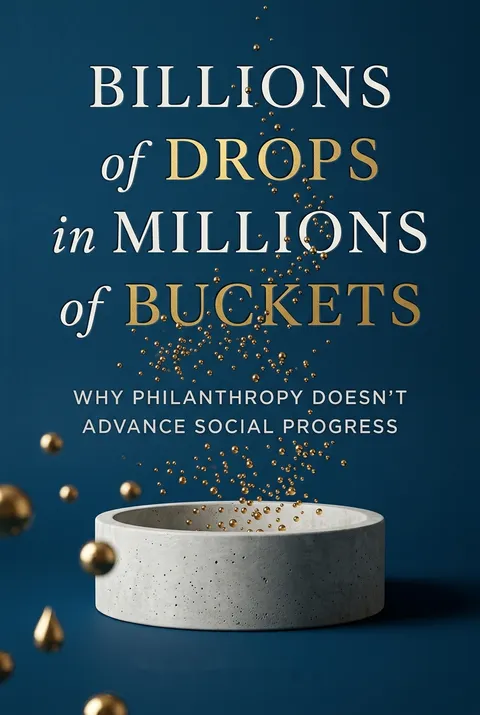
The Funding/Performance Disconnection. A core problem is that funding is rarely tied to performance or impact. Donors, lacking reliable metrics to compare nonprofit effectiveness, often spread their resources too thin across many recipients, leading to "fragmentation." This "overdiversification" minimizes risk but also stifles the potential for "transformative social impact"—solutions that fundamentally alter systemic issues. The current system, likened to "billions of drops in millions of buckets," prioritizes fundraising over measurable results, diverting precious resources and management attention from mission-critical activities.
The Cost of Inefficiency. This fragmentation creates a massive opportunity cost for society. Nonprofits spend an exorbitant amount—between $10 and $24 for every $100 raised—on fundraising, compared to $2 to $4 for for-profit companies. This inefficiency, coupled with the constant "tyranny of the grant cycle" and restrictive funding, prevents even the most promising social enterprises from building the robust organizational capacity needed for significant expansion. Without a mechanism to channel "smart money" to the most effective organizations, the sector remains underperforming, despite its vast financial resources.
2. The American Dream Recedes: A Call for Transformative Impact
If America is to remain a first-class nation, it cannot have a second-class citizenship.
A Dream in Decline. After decades of remarkable social progress following the Great Depression, the American Dream—defined by educational and economic opportunity, freedom, and a better life for children—has been receding for millions. Studies show increasing inequality and declining social mobility, with poor and low-income families more likely to remain stuck in poverty across generations. This creates a "permanent underclass" that lacks access to basic tools for self-sufficiency, such as quality education and stable employment.
The Untenable Status Quo. The indefinite continuation of these "100 million problems"—massive, pervasive, and incapacitating social challenges—is simply unsustainable. While not a sudden catastrophe, the gradual erosion of opportunity poses a "boiled frog" problem, threatening domestic tranquility and global competitiveness. The consequences are dire:
- Rising youth violence and incarceration rates
- Persistent educational achievement gaps
- Widening life expectancy disparities between rich and poor
- Increased unemployment and drug abuse
Government's Diminished Capacity. The public sector, once the primary engine of social reform (e.g., Social Security, GI Bill, Head Start), is increasingly unable to address these complex, systemic issues alone. Factors like political partisanship, demographic shifts, and looming fiscal realities limit government's ability to implement comprehensive, long-term solutions. This necessitates a greater, more effective role for the nonprofit sector, working in partnership with business and government, to produce "transformative social impact" and reinvigorate the American Dream.
3. Beyond Organic Growth: Crossing the Chasm to Mainstream Solutions
It remains very difficult, however, to see how the many small and isolated success stories of donors around the country ever amount to anything vaguely resembling a meaningful response to any of the major social problems.
Incremental Growth Isn't Enough. Even highly successful social enterprises like Teach For America and Jumpstart, despite impressive annual growth rates, reach only a tiny fraction of the millions of people who need their services. Their "organic growth" is insufficient to solve "100 million problems" within an acceptable timeframe. The existing fundraising system, focused on continuous, small-scale efforts, cannot support the exponential growth required for systemic change.
Moore's Chasm in Philanthropy. Applying Geoffrey Moore's "Crossing the Chasm" model reveals a critical gap between early-market success and widespread adoption in the social sector.
- Early Market (Innovators & Early Adopters): Risk-tolerant funders and partners support nascent, unproven innovations.
- The Chasm: A perilous divide where incremental growth stalls because "mainstream market" customers (e.g., large public foundations, government agencies) are fundamentally pragmatic and risk-averse.
- Mainstream Market (Early Majority): These customers demand "whole product solutions"—comprehensive, reliable, and proven interventions that address their complex problems with minimal risk and customization.
The "Whole Product Solution" Challenge. To cross this chasm, social innovators must develop a "whole product solution" that integrates their core innovation with all necessary complementary products and services. For a large urban school district, this might include:
- Robust operations and management systems
- Comprehensive monitoring and performance measurement
- Effective parental and volunteer engagement strategies
- Strategic corporate and community partnerships
This requires significantly more funding and organizational capacity than traditional models provide, making it a formidable barrier for mid-cap nonprofits.
4. Intermediation is Key: From Chaos to Coordinated Capital
The economic problem of society is . . . the utilization of knowledge which is not given to anyone in its totality.
The Nonprofit Information Gap. Philanthropy suffers from a severe "nonprofit information gap." Donors lack rigorous, reliable, and standardized data on nonprofit performance and impact, making it nearly impossible to make informed choices that maximize social return. This absence of clear "price signals," unlike in financial markets, prevents capital from flowing efficiently to the most effective organizations. The "truth is out there," but it's dispersed and unaggregated.
Intermediation as "Adult Supervision." To overcome this fragmentation and information deficit, the nonprofit sector needs robust "intermediation"—mechanisms and entities that stand between donors and recipients to facilitate more intelligent capital allocation. Just as eBay introduced "adult supervision" (e.g., dispute resolution, buyer protection) to its chaotic marketplace, philanthropy needs:
- Selection Error Mitigation: Rigorous search processes to identify promising nonprofits.
- Execution Risk Mitigation: Financial and non-financial support to help social entrepreneurs deploy growth funding effectively.
The Rise of Nonprofit Finance Agents. A new breed of "nonprofit finance agents" (e.g., SeaChange Capital Partners, NFF Capital Partners) is emerging, adopting a "private placement" model from the business world. These intermediaries:
- Consolidate Funding: Aggregate large grants ($5M-$30M) from sophisticated social impact investors.
- Conduct Due Diligence: Rigorously vet nonprofits for "growth readiness" and viable strategic plans.
- Provide Oversight: Monitor expenditures and report progress, ensuring accountability.
This "closed intermediation" model, while highly selective, represents a crucial step towards performance-based philanthropy, demonstrating how concentrated capital can drive significant impact.
5. Growth Capital Demands New Financial Discipline
They deplete the past and rob the future to finance the present.
Revenue vs. Growth Capital. A fundamental barrier to scaling nonprofits is the failure to distinguish between "revenue" (funds for ongoing operations) and "growth capital" (funds for expansion). Most nonprofits commingle all incoming money, treating it as revenue for immediate needs. This "hand-to-mouth" existence prevents them from strategically investing in long-term capacity building, trapping them on a "fundraising treadmill."
The Need for Capital Accounting. To attract "third-stage funding," mid-cap nonprofits must adopt rigorous financial management practices, including separate accounting for revenue and growth capital. This allows them to:
- Ensure Sustainability: Confirm sufficient and reliable revenue for current operations.
- Track Growth Progress: Monitor the "burn rate" of growth capital against strategic objectives.
- Demonstrate Competence: Prove to investors they can manage large, multi-year, unrestricted funds effectively.
Without this fiscal discipline, investors lack confidence that their larger bets will be used to achieve sustainable, exponential growth.
The "Take-Off" Step Function. George Overholser's "take-off" model illustrates how growth capital can elevate a nonprofit to a higher operational scale, which is then sustained by increased revenue. This "step function" requires:
- Strategic Growth Plans: Clear, verifiable plans for expansion.
- Accountability: Demonstrable alignment between expenditures and strategic progress.
- Investor Confidence: Assurance that funds are managed to achieve specific, long-term objectives.
This shift from "chronic bailouts" to performance-driven investment is essential for breaking the "glass ceiling" of nonprofit growth and enabling transformative social impact.
6. Markets Can Guide Giving: The Power of Performance Signals
The perfect is the enemy of the good.
The Illusion of Financial Precision. The notion that financial markets are perfectly rational instruments for measuring "real" value is a "happy delusion." Stock prices are not definitive, but rather "rich summaries" of imperfect, incomplete, and often subjective information aggregated from countless market participants. They are "constructs" that serve as dynamic signals, guiding capital towards more productive enterprises, even with inherent inaccuracies. This "magic of the markets" is its ability to make sense of chaos and facilitate efficient allocation.
Social Value as a Market Signal. Similarly, social impact, though difficult to quantify precisely, possesses inherent "value." The challenge for the nonprofit sector is not a lack of value, but the absence of a "mechanism for communicating information" about that value. If philanthropists want to maximize the impact of their giving, they need "directional signals and relative rankings" to differentiate between "more" and "less" effective nonprofits. This doesn't require perfect measurement, but rather "good enough" information to improve upon the current, largely uninformed allocation.
Collective Intelligence for Social Good. Financial markets work because they aggregate the "imperfect judgments" of a "vast amount of imperfect and unreliable information" from diverse investors, extracting a consensus that guides resource flow. The nonprofit sector, with its millions of engaged donors, volunteers, and professionals, possesses a similar potential for "collective intelligence." By harnessing this "wisdom of crowds," a market-like mechanism could:
- Increase Signals, Reduce Noise: Provide clearer indications of nonprofit effectiveness.
- Differentiate Performance: Help identify which "stocks" (nonprofits) are likely to "go up" (produce more impact).
- Drive Productivity: Channel funds to organizations capable of greater social benefit.
This approach, while not perfect, offers a pragmatic path to "performance-based philanthropy" and greater social progress.
7. Prediction Markets: Harnessing Collective Wisdom for Social Good
Nobody knows anything. But everybody, it turns out, may know something.
Forecasting the Future of Impact. Prediction markets are online platforms designed to aggregate dispersed information from traders to forecast future events. These markets, which have consistently outperformed traditional methods like polls and expert panels in diverse fields (e.g., elections, product sales, disease outbreaks), offer a compelling model for informing philanthropic decisions. By allowing a diverse group of knowledgeable individuals to "trade" on the likelihood of a nonprofit achieving specific goals, these markets can generate a collective probability of success.
How Prediction Markets Work. Participants are given virtual currency to buy and sell "stocks" representing specific outcomes (e.g., "Able Charter School will increase graduation rates to 75% by 2009").
- Incentives: Traders are motivated to maximize virtual profits, encouraging them to:
- Gather information
- Reveal their true beliefs
- Express confidence levels through trade volume
- Dynamic Pricing: Stock prices reflect the market's real-time consensus, shifting as new information emerges.
- Information Aggregation: The market effectively "unearths the reasons behind the forecasts," providing valuable insights beyond mere predictions.
Applicability to Nonprofits. While most prediction markets have focused on "determinate" outcomes (where the actual result is eventually known), "indeterminate" markets can also provide valuable "decision support" for complex problems lacking clear-cut answers. The nonprofit sector, with its inherent ambiguities in measuring social impact, is particularly well-suited for this approach. The sheer number of passionate and informed stakeholders—donors, volunteers, staff, beneficiaries—could create an unusually robust information market, providing "rank intelligence" to guide philanthropic investments.
8. The Impact Index (IMPEX): A Platform for Performance-Driven Philanthropy
Many people have been thinking about the creation of a social stock market, but as yet no standard or platform exists as a marketplace or clearinghouse.
Designing the IMPEX. The Impact Index (IMPEX) is proposed as a virtual nonprofit stock market, a performance-ranking engine to guide "smart money" to high-impact mid-cap nonprofits. Its design must adhere to critical success factors for prediction markets:
- Clear Predictions: Stocks (events) must be precisely defined, valuable, and actionable.
- Engaged Community: Attract a large, diverse, informed, and active community of traders.
- Effective Incentives: Motivate participation through intrinsic (altruism, good citizenship) and potentially extrinsic (non-monetary prizes) rewards.
The IMPEX would evolve through stages: lab experiments, pilot projects with real data, and eventual broader rollout, with strict eligibility criteria for participating nonprofits.
Platform Leadership for Systemic Change. IMPEX.org, envisioned as a nonprofit entity, would act as a "platform leader," fostering a "whole product solution" for results-driven philanthropy. Like Apple's iPhone platform, it would:
- Convene Stakeholders: Organize a coalition of foundations, social entrepreneurs, researchers, and tech partners.
- Drive Complementary Innovation: Encourage external entities to develop tools and services around the IMPEX platform.
- Generate Data: Produce rich performance data to inform third-stage funders.
This integrated ecosystem would shift the burden of finding and vetting high-impact nonprofits from individual donors to a collective, market-driven mechanism.
A New Normal for Giving. The IMPEX aims to create a "new normal" where philanthropic capital flows are driven by performance, not just serendipity or reputation. By leveraging collective intelligence and providing actionable "rank intelligence," the IMPEX could:
- Defragment Capital: Consolidate funding streams for greater impact.
- Reduce Fundraising Burden: Free up nonprofits to focus on mission-critical work.
- Scale Solutions: Enable growth-ready mid-caps to tackle "100 million problems" and achieve transformative social impact.
This innovative approach offers a pragmatic path to bridge the information gap and unlock the full potential of philanthropy.
Review Summary
The reviews for Billions of Drops in Millions of Buckets are mixed, with an overall rating of 3.30 out of 5 based on 20 reviews. One reader gave it 2 out of 5 stars, criticizing the book for not offering constructive solutions to the problems nonprofits face, despite accurately identifying these issues. The reviewer also noted that the author tends to repeat himself excessively throughout the book. This feedback suggests that while the book may provide valuable insights into nonprofit challenges, it falls short in providing actionable strategies for improvement.
Download PDF
Download EPUB
.epub digital book format is ideal for reading ebooks on phones, tablets, and e-readers.








































