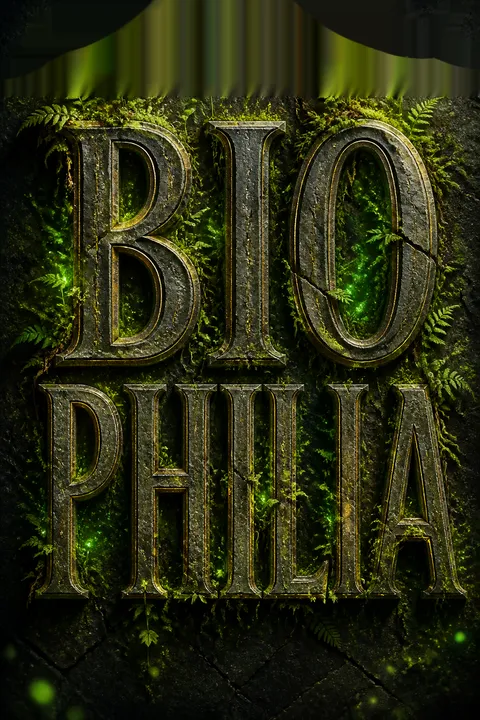

Key Takeaways
1. Biophilia is an innate, evolutionarily programmed affinity for life
To an extent still undervalued in philosophy and religion, our existence depends on this propensity, our spirit is woven from it, hope rises on its currents.
Innate human drive. Biophilia is the genetically determined tendency of human beings to focus on life and lifelike processes. From infancy, we are drawn to living things like moths to a porch light, seeking out novelty and diversity in the natural world. This is not a passing cultural fad but a fundamental component of our mental development and spiritual well-being.
Coevolutionary bonds. Our minds evolved in constant dialogue with the natural world, creating deep-seated psychological dependencies on other organisms. When we interact with nature, we are not merely visiting an external gallery; we are engaging with the very matrix that constructed our cognitive faculties. This relationship is characterized by:
- An automatic distinction between the animate and inanimate
- A subconscious craving for biological variety and complexity
- A sense of tranquility and focus when immersed in natural settings
The naturalist's trance. When we narrow our focus to a few centimeters of soil or a single tree trunk, we enter a state of heightened awareness. This "hunter's trance" is an evolutionary adaptation that allowed our ancestors to survive by detecting subtle patterns in their environment. By understanding other organisms, we ultimately elevate our own self-worth and place a greater value on the miracle of existence.
2. The superorganism reveals how complex systems emerge from simple, hardwired rules
The social master plan is partitioned into the brains of the all-female workers, whose separate programs fit together to form a balanced whole.
Emergent social complexity. An ant colony, such as the leafcutter Atta, operates as a single "superorganism" without any centralized command or leader. The queen is not an authority figure but a passive egg-laying machine, while the collective intelligence of the colony is distributed among millions of workers. Each individual insect executes simple, localized instructions based on its size, age, and chemical cues.
Intricate division of labor. The leafcutter economy is a marvel of biological engineering, organized around an assembly line of specialized workers. These insects have evolved a unique symbiotic relationship with a specialized fungus, which they cultivate on a substrate of freshly cut leaves. The tasks are divided with extreme precision:
- Large soldiers defend the nest with powerful, wire-cutter jaws
- Medium-sized foragers harvest leaves and carry them home like parasols
- Tiny gardeners crush the leaves, plant fungal strands, and weed out alien molds
Chemical communication networks. The superorganism is bound together by a sophisticated system of chemical signals, or pheromones, that guide behavior. A single milligram of trail substance is potent enough to guide billions of ants, demonstrating how social insects live in a rich, non-visual world of smell and taste. By studying these organic machines, we gain profound insights into how complex, adaptive systems can self-assemble from basic, hardwired components.
3. Understanding nature requires navigating multiple scales of time and space
The modern biological vision sweeps from microseconds to millions of years and from micrometers to the biosphere.
Varying temporal dimensions. To comprehend the full scope of life, we must learn to shift our perception across different scales of time. Human beings naturally exist in "organismic time," where actions are measured in seconds and minutes, driven by cellular electrical impulses. However, to understand the underlying machinery of life, we must zoom in and out of other temporal realms:
- Biochemical time: Measured in milliseconds, where enzymes cleave proteins and ions flow across membranes
- Ecological time: Measured in decades and centuries, tracking the succession of ecosystems and populations
- Evolutionary time: Measured in millennia, where individual identities dissolve and genes diffuse through pools
The expansionist approach. Modern biology has flourished by adopting an "expansionist" philosophy, which assumes that all living phenomena are ultimately obedient to the laws of physics and chemistry. This perspective rejects the need for a mystical "vital force," choosing instead to explain complex biological structures through material, step-by-step processes. By mapping the connections between molecules, cells, organisms, and ecosystems, science systematically demystifies the living world.
The reductionist dilemma. While reductionism is highly effective for analyzing the physical components of life, it can alienate those who cherish the holistic beauty of nature. The challenge for modern thinkers is to reconcile the machine with the garden, ensuring that scientific analysis does not strip away our sense of wonder. Ultimately, a complete understanding of any species requires us to synthesize our hard-won analytical data back into a unified, aesthetic appreciation of the living organism.
4. Science and art are convergent pathways to discovering human nature
The fiery circle of disciplines will be closed if science looks at the inward journey of the artist's mind, making art and culture objects of study in the biological mode, and if the artist and critic are informed of the workings of the mind and the natural world as illuminated by the scientific method.
Shared creative origins. Although science and art are often viewed as opposing forces, they draw from the same subconscious wellsprings of human curiosity. Both enterprises rely on intuition, imagery, and the pursuit of hidden patterns to make sense of a chaotic universe. While the scientist seeks a generalizing formula to explain the physical world, the artist invents specific cases to evoke precise emotional truths.
The cycle of intellect. The study of a magnificent creature, like the Emperor of Germany bird of paradise, illustrates how analysis and synthesis must work in tandem. A scientist may dissect the bird's plumage, neurobiology, and mating rituals down to the cellular level, temporarily reducing its magic. However, true understanding is only reached when these pieces are synthesized back into a holistic vision, renewing our poetic appreciation:
- Analysis breaks down the organism into genes, cells, and chemical reactions
- Synthesis reconstructs the living creature within its ecological context
- The final perception blends scientific clarity with the ancient emotions of the hunter and poet
Bridging the cultural divide. The historic alienation between the sciences and the humanities can be resolved by recognizing their mutual dependence. As cognitive biology begins to map the physical pathways of the human brain, it provides artists with a deeper understanding of the mental structures they manipulate. Conversely, the humanities enrich scientific inquiry by reminding us of the personal, moral, and aesthetic dimensions of our biological existence.
5. The human mind relies on elegance, metaphor, and analogy to process reality
Mathematics and beauty are devices by which human beings get through life with the limited intellectual capacity inherited by the species.
Cognitive shortcuts. The human brain is a highly sophisticated but physically limited organ that cannot process the infinite complexity of the external world piece by piece. To compensate for these limitations, the mind relies on "elegance"—the ability to organize vast amounts of sensory data into simple, workable categories. We use metaphor and analogy to link new experiences to existing mental structures, allowing us to make rapid decisions essential for survival.
The power of synecdoche. Both art and science utilize synecdoche, a cognitive technique where a carefully chosen part represents the entire whole. A single, striking image in a poem or a simplified mathematical model in ecology can transmit a complex truth with maximum efficiency. This process relies on:
- Node-link memory structures that connect concepts and emotions
- Spreading activation, which retrieves associated memories when triggered
- Aesthetic preferences for symmetry, simplicity, and moderate redundancy
The island biogeography model. The development of the theory of island biogeography by Robert MacArthur and Edward O. Wilson exemplifies this creative process. By treating islands as simplified, dynamic systems where species numbers are balanced by immigration and extinction, they transformed a muddled discipline into a predictive science. This elegant model proved highly heuristic, demonstrating how a simple mathematical analogy can spark a revolution in ecological research and conservation practice.
6. Cultural archetypes like the serpent are rooted in evolutionary survival mechanisms
Humanity's concrete experience with poisonous snakes gave rise to the Freudian phenomena after it was assimilated by genetic evolution into the brain's structure.
Prepared learning biases. The human fascination with snakes is a classic example of how evolutionary pressures shape cultural archetypes. We do not inherit an instinctual fear of snakes; rather, we inherit a "prepared learning bias" that makes us acquire this fear with incredible ease after the age of five. This genetic predisposition is shared with other primates, such as vervet monkeys and chimpanzees, who use specific alarm calls to alert their groups to ophidian threats.
From reptile to archetype. Over hundreds of thousands of years, the constant threat of venomous snakes turned a simple biological hazard into a powerful cultural symbol. The sleeping brain retrieves these deeply embedded evolutionary memories, weaving them into vivid dreams of the "Serpent"—a protean, intelligent presence that represents power, sex, and death. Across global cultures, this archetype manifests in diverse religious and mythological forms:
- The Aztec plumed serpent, Quetzalcoatl, representing death and resurrection
- The double-entwined snakes of the caduceus, symbolizing healing and medicine
- The serpent in the Garden of Eden, embodying the knowledge of good and evil
The biology of human nature. This translation of natural threats into cultural symbols reveals that human nature is not a blank slate shaped entirely by historical events. Instead, our minds are biologically channeled to react to specific environmental cues, creating a shared foundation of myths and rituals. By understanding the evolutionary origins of these biases, we can demystify our psychological complexes and appreciate the deep biological roots of our cultural heritage.
7. Human habitat preferences are shaped by a genetic memory of the African savanna
The bipedal locomotion and free-swinging arms fitted these ancestral forms very well to the open land, where they were able to exploit an abundance of fruits, tubers, and game.
The savanna hypothesis. For millions of years, our hominid ancestors lived and evolved on the tropical savannas of Africa, avoiding both dense rain forests and barren deserts. This parklike landscape, characterized by wide grasslands dotted with groves of trees, provided the optimal conditions for early human survival. Today, even though we possess the technology to live in any climate, we retain a subconscious, genetic preference for this ancestral habitat.
The triple aesthetic criteria. When given a completely free choice, humans consistently design and seek out environments that mimic the key features of the ancient savanna. This "savanna gestalt" is characterized by three specific topographic elements that once maximized our chances of survival:
- Elevated vantage points (cliffs or hills) that offer a clear view of resources and threats
- Open, tree-studded grasslands that provide both visibility and physical shelter
- Proximity to bodies of water, which offer food, defense, and a natural perimeter
Landscaping as genetic memory. This evolutionary preference explains why the wealthy build estates on high bluffs overlooking lakes, and why cities invest heavily in parks and gardens. From Roman courtyards to Japanese gardens, we prune trees to resemble African acacias and arrange spaces to create a sense of open, safe terrain. When we are deprived of these natural elements, our mental health suffers, proving that we cannot easily snap the psychic threads that bind us to our evolutionary home.
8. Biodiversity is an invaluable, largely untapped library of genetic information
Each of the millions of species can be visualized as a book in a library.
An unexplored treasure trove. The millions of species sharing our planet represent an astronomical repository of genetic information, shaped by billions of years of evolutionary trial and error. Yet, humanity currently depends on less than 1 percent of this biodiversity for its survival, relying heavily on a handful of domesticated crops. The vast majority of wild plants, animals, and microorganisms remain completely unstudied, representing an immense, untapped resource for medicine, agriculture, and industry.
Miracle species of the wild. Even our limited exploration of wild species has yielded revolutionary breakthroughs that have saved millions of lives and generated billions of dollars in economic value. Nature has already done the hard work of synthesizing highly potent chemical defenses, which we can harvest and adapt for our own use:
- The rosy periwinkle, which produces alkaloids that treat childhood leukemia and Hodgkin's disease
- The winged bean of New Guinea, a fast-growing "one-species supermarket" where every part is edible and highly nutritious
- Wild perennial maize (Zea diploperennis), which carries genes that could revolutionize global corn agriculture
The genetic looseleaf notebook. With the advent of modern genetic engineering, wild species are no longer just sources of raw materials; they are "looseleaf notebooks" from which we can extract individual genes. We can transfer desirable traits, such as disease resistance or drought tolerance, from wild organisms into our fragile crop plants. To allow these species to go extinct before we have even discovered them is an act of supreme economic and scientific folly.
9. A deep conservation ethic must be grounded in biological self-interest
The only way to make a conservation ethic work is to ground it in ultimately selfish reasoning — but the premises must be of a new and more potent kind.
The limits of surface ethics. Traditional arguments for conservation often rely on "surface ethics," such as treating animals as surrogate kin or appealing to abstract moral duties. While these sentiments are noble, they are easily swept aside during times of economic hardship, political instability, or war. To build an enduring conservation ethic, we must align our moral reasoning with the hard realities of human biology and evolutionary self-interest.
Preserving our cognitive matrix. We must protect the natural world not for its sake, but for our own; our minds were assembled within this biological matrix, and our sanity depends on its preservation. When we destroy natural habitats and drive species to extinction, we are dismantling the very environment that created and sustains the human spirit. This irreversible loss of genetic diversity is the one mistake our descendants are least likely to forgive, as it permanently limits their future options:
- Extinction is currently occurring at a rate of thousands of species per year
- Unlike economic or political crises, the loss of biodiversity takes millions of years to correct
- The first rule of intelligent tinkering is to keep all the pieces of the system
A formula for reenchantment. A deep conservation ethic recognizes that we are a biological species and will find no ultimate meaning apart from the remainder of life. By fostering a sense of biophilia in every individual, we can regain the excitement of exploring a mysterious, untrammeled world that lies within walking distance of our homes. Humanity is exalted not by standing apart from nature, but by knowing it so well that we elevate the very concept of life itself.
Review Summary
Reviews of Biophilia are largely positive, averaging 4.27 out of 5. Many readers praise Wilson's beautiful writing, blending personal memoir, field observations, and philosophical reflection to argue humanity's innate connection to nature. Standout essays on superorganisms, serpents, and habitat preference are frequently highlighted. Critics note inconsistency in structure, with some finding the essays disjointed or tangential. Several readers found the book dated in places, while others felt already converted to its core ideas. Overall, most consider it an important, inspiring work promoting conservation ethics and a deeper relationship with the natural world.
People Also Read



About the Author
Download PDF
Download EPUB
.epub digital book format is ideal for reading ebooks on phones, tablets, and e-readers.








































