

Plot Summary
Prologue
Tyler Jennings1 opens with a confession: to keep a secret, you must become the lie. In parallel, teenage Larissa2 watches from the mezzanine as her brother Roc16 confronts their father Ciro4 — one of America's oldest mafia dons. Ciro4 disowns him.
Roc16 drives into a storm while Larissa2 screams, the estate gates locking her inside with a damaged mother, a helpless little brother, and a pair of chilling blue eyes watching from the shadows — Alonzo,5 a boy delivered to Ciro4 as payment for a debt.
Months before the main story begins, Larissa's2 mentor Tula6 declares her ready to claim her station. Across the ocean, Tyler1 leads a predawn raid on a trafficker's mansion, driven by a dead brother's unfinished task list and a fading belief that the scales can still be tipped.
The Don's Daughter Knocks
She arrives at two a.m. in a raincoat over lingerie, having exploited a neighbor's habit of ordering escorts to bypass security. Tyler,1 twelve drinks deep and still suited, assumes Tobias3 sent her. He pins her to his door, kisses her, slides fingers between her thighs.
She kisses back — because it feels good — until she reveals she's not a call girl. She knows about the Raven tattoo on his arm and what his organization truly is. Sobering fast, Tyler1 demands her identity.
She refuses, instead chanting her surname letter by letter as the elevator doors close between them — DiCicco. Tyler1 watches recognition split his reflection in the polished steel. By the time he rams his shoulder into the sealed doors, she's already vanished from his building.
A Bird-Watcher Identified
Tyler1 confesses his catastrophic error to President Preston Monroe10 and Tobias3 over a secure line. The woman who outmaneuvered his building is the daughter of Ciro DiCicco4 — the arms dealer Tyler1 suspects has been rerouting military guns into civilian hands for decades.
Background checks returned records so pristine they screamed fabrication. Her real history: shipped to Italy at seventeen, groomed by notorious donna Tula DiGiovanni,6 and recently summoned home as Ciro's4 chosen successor. Her final test — identify and eliminate the Ravens.
Tyler's1 blood chills further when the timeline crystallizes: Larissa2 has been surveilling them since before she left America. Eight years of watching, and they never detected a single trace. His team recaptures her within hours. She walked straight into the car.
The Donna's Bargain
Confined to a windowless guest room, Larissa2 drops all pretense with Tyler.1 Ciro4 ordered her to destroy the Ravens, but she wants the opposite — she wants her father's4 reign ended. She'll deliver every captain, every connection in exchange for one thing: freedom from a life she never chose.
She rattles off details about Antony Livingston,9 the billionaire Ciro4 betrothed her to — a man whose polished image conceals what she considers genuine evil. She stabbed Antony9 with a steak knife during a chaperoned date; he called it foreplay.
Tyler1 installs her in his penthouse, not as a partner but as a captive asset, treating her with undisguised contempt for the blood she carries. She retaliates by walking around in negligee, testing his discipline. He refuses to eat the Italian feast she spends hours preparing.
Stranded Without Sound
Mid-argument, a blast tears through Tyler's1 penthouse. Larissa2 loses consciousness, surfacing in fractured glimpses — smoke, muzzle flashes, Tyler1 on his knees. She wakes deaf, ribs bruised, strapped into a vehicle rocketing through forest.
Tyler1 has taken her entirely off-grid: no phone, no signal, no connection to anyone. For days she communicates through gestures while he feeds her rations, gives her morphine, and chops wood with manic precision. He forces her to type intelligence about Ciro's4 organization onto an offline laptop.
Her hearing returns before she admits it. Tyler1 catches the deception — proving he detected the shift in her breathing the moment it happened — turning their isolation into a chess match where both players know the other is cheating, and neither can afford to stop.
The Soldier's Hypothetical
During a trek to a freezing river, Tyler1 answers Larissa's2 question about why he fights. He builds a parable: a young newlywed enlists, survives combat that shreds his innocence, comes home unable to stop the shuttering images. He slowly heals.
One night, finally dancing with his wife again, a teenager opens fire in a nightclub with a gun that was rerouted from a military shipment — a gun that belonged in a soldier's hands. The veteran dies shielding the room.
Tyler1 connects the story to his crusade: ensuring military weapons stop ending up in civilian massacres. The farmer-soldier's gun was rerouted by men like Ciro.4 Larissa2 understands then that her father didn't just run an empire — he supplied the bullets that orphaned children in Tyler's1 country.
Perfume and Punishment
Tyler1 leaves camp to handle presidential business, dispatching Julien8 — his deadliest Raven — to guard Larissa.2 When he returns, Chanel clings to his collar. Larissa2 recognizes the scent instantly. Rather than correct her assumption that he was with another woman, Tyler1 lets jealousy do its work.
They collide in the tent — teeth, nails, spit — until restraint shatters. The sex is punishing and raw, devoid of tenderness. He treats it exactly as promised: as nothing. He finishes and vanishes into the dark.
Larissa2 lies alone knowing two truths simultaneously: that no one will ever make her feel this way again, and that Tyler1 just proved he can weaponize desire without breaking stride. Outside the tent, Tyler1 grips himself against a tree, tormented by the fact that she's already under his skin.
Feral in the Dark
Tyler1 returns from a botched operation — a fake safehouse rigged to identify his men — and confronts Larissa2 in total darkness, convinced she orchestrated the trap. His voice is lethal, inhuman.
She strips naked in the freezing air and roars back, daring him to kill her, declaring she's already survived worse hells than his. They crash into each other on the frozen ground, clawing through mud and fury until something shifts. For blinding minutes, Tyler1 enters the emotional space he shared only with his dead wife15 — and Larissa2 follows him there.
Their connection becomes overwhelming, primal, undeniable. Then he shuts the door on her. She rises, delivers the speech that haunts him: she wants a real life, flesh on flesh, and no one is coming to save her.
The Assassin and the Fiancé
Julien's8 overnight assessment of Larissa2 yields an ambiguous verdict: she's holding back, but not in the way Tyler1 fears. She senses Julien's8 true purpose — to execute her if warranted — and tells him she wanted to be the wolf in the Ravens' Norse mythology, an ally, not a devourer.
Meanwhile, Antony Livingston9 appears inside the White House during a state dinner, flanked by armed guards who bypassed every protocol. He confronts Tyler1 beneath a Roosevelt portrait, making veiled threats about Larissa.2
Tyler1 discovers two agents on his own cherry-picked team were bought. The twin intrusions — from Julien's8 inconclusive judgment and Antony's9 brazen violation of the most secure building in America — reveal the enemy's reach extends far deeper than any of them anticipated.
Daniello's Standoff
Daniello DiGiovanni11 — Tula's6 brother, a nearly three-hundred-pound former soldier whose combat legend Tyler1 heard about during his own Marine service — materializes in camp holding twin Glocks. Tyler's1 armed drone hovers overhead.
Larissa2 throws herself between them, screaming that killing Daniello11 would ignite a mafia war of unprecedented scale. The standoff breaks when she removes her cornicello necklace and presses it into Daniello's11 palm — the gift from her cousin was always a tracking beacon.
Tyler1 agrees to erase all footage of the man who has survived by remaining invisible. After Larissa2 retires, the two warriors talk through the night. Tyler1 learns that Daniello11 earned his own bubble of peace — wife, son, freedom from violence — and guards it the way Tyler1 guards his birds.
Fever and First Honesty
Weeks of exposure collapse Larissa's2 body. Tyler1 carries her to Tobias3 and Cecelia's14 Virginia farmhouse, where he nurses her through six days of fever, coughing blood, and delirium. When her infection finally breaks, the war between them quiets into something unfamiliar — honesty without ammunition.
Tyler1 admits he's grieving Delphine15 for the first time, that she predicted another woman would come and he'd weaponize grief to push her away. Larissa2 confesses she's never felt safe enough to be sick in front of anyone.
They lie face-to-face on the bed, whispering about his parents' apple farm, her olive grove, the texture of boring lives neither has lived. He asks if she sleeps without nightmares now. She doesn't answer, and he understands the silence perfectly.
Ciro's Mansion Falls
Tyler1 leaves Larissa2 alone with a loaded Beretta in an unlocked drawer and his truck idling outside, GPS locked onto Ciro's4 Asheville mansion. She races there coughing blood while Tyler's1 forces simultaneously breach it. Inside the fortress, they uncover a vault of horror: hundreds of abuse videos, whips with worn handles, and evidence linking Ciro4 to the arms shipments Tyler1 has hunted his entire career.
Upstairs, a gunfight erupts at Ignacio's17 door — but the shooter isn't Ignacio.17 Both the boy and Alonzo5 are missing. Tyler's1 gut drops as Larissa's2 most dangerous omission clicks into place: she arranged for Alonzo5 to extract her brother17 before the raid began, using the chaos of Tyler's1 own operation as cover for her parallel mission.
Larissa Pulls the Trigger
Larissa2 stumbles into the campsite to find Tyler1 with a gun trained on her bound father.4 Ciro's4 captains watch their own executions on a tablet. Tyler1 waits. Larissa2 seizes the test — ordering the killings, proving she was already donna.
Then she turns to Tyler1 and unleashes everything: at seventeen, she spotted him leaving an Asheville jewelry store, saw his tattoo matching the one on Roc's16 arm the night he vanished, and followed him to Triple Falls. She shaped herself for Tyler1 over eight years, loved him from afar, came to save him.
She presses the Beretta to Ciro's4 forehead and fires. Then she drops the gun at Tyler's1 boots and tells him to finish his mission. Russell's voice crackles through: Peter12 is alive. Tyler's1 weapon slips from his fingers.
The Birthmark on Film
Tyler1 surfaces from two days of catatonia. Tobias3 opens Dom's laptop alongside footage recovered from Ciro's4 mansion — the stone backgrounds match. Tyler's1 mind races to the birthmark on Larissa's2 hip, the one he'd kissed a dozen times.
He finds it on-screen: visible between the bloodied fingers of a child no older than seven. Ciro4 subjected his own daughter to the systematic abuse that Dom spent his final year documenting — the same evil that tortured their brother's mind before he died.
Tyler1 collapses into Tobias3 and Russell's arms, sobbing, begging them to say it isn't true. Russell tries to shield him from additional footage, but Tyler1 has already seen enough. The man who weaponized Larissa's2 feelings now understands what she could never bring herself to confess.
Crashing Through the Grove
Sean7 formally expels Tyler1 from the Ravens — a unanimous decision, including the president.10 It's an intervention disguised as exile. Tyler1 rages, then crumbles at his parents' farm, where his mother forces a reckoning: start therapy or lose everything.
He begins treatment with a combat-veteran therapist, then flies to Italy alone, crashing a catering truck through Tula's6 olive grove under gunfire. He finds Larissa2 and confesses his love, reveals she's pregnant — a fact she didn't know. She fires a shot past his head.
Denny,7 another Raven, arrives and confesses he killed Larissa's2 brother Roc16 years ago for battering his wife. Tula6 slaps Tyler.1 Daniello11 nearly kills him. Larissa2 orders them all to leave and take Tyler1 with them. He's carried away unconscious.
Two Miracles in His Arms
Tula6 finally summons Tyler1 to Barga. A nurse places a bundle in his arms — a boy in a blue beanie named Alexander. Tyler1 weeps, memorizing every crease of his sleeping son's face, when the nurse returns with a second bundle. A girl in pink. Macey. Twins — and Larissa2 hid the second baby from everyone.
Both names derive from Alexander the Great, Tyler's1 lifelong hero: a reminder to Larissa2 of both the deception that conceived them and the devotion their existence demands. Tyler1 breaks completely, clutching his children and praying aloud to a God he's only beginning to believe in. Tula6 grants him six weeks of access. Larissa2 watches from a distance, refusing to see him, but allows the father his miracle.
Chanel Under the Tree
Tyler1 returns for Christmas, and he and Larissa2 share genuine laughter at midnight mass for the first time. But when a final gift emerges from under the tree — a bottle of Chanel — Larissa2 drops it like a grenade.
Tyler1 recognizes Antony's9 fingerprints: someone inside the compound aided delivery. That night, Tyler1 and Alonzo5 wait in Cosima's darkened room as Ignacio17 — radicalized by Antony's9 whispered lies about Larissa2 killing Roc16 and becoming Ciro4 — approaches his catatonic mother with a straight razor.
Tyler1 shields Larissa2 while Alonzo5 subdues the boy. Afterward, Tyler1 reveals the hardest truth: he found the childhood abuse footage and destroyed every person connected to it. Larissa2 breaks against him, and he holds her until exhaustion takes over.
Midnight Without the Bang
New Year's Eve. Larissa2 prepares a secret date in the wine cellar — food, candles, Italian opera at eardrum-shattering volume — then drags Tyler1 downstairs in his socks.
He's bewildered by her manic energy until midnight arrives: pots crash overhead where she's emptied the kitchen of cookware, the music drowning what she feared most — the crack and boom of fireworks triggering his PTSD. The realization that she dismantled an entire celebration to protect his fragile recovery obliterates his last resistance. She whispers that she's his.
They make love on the dining table as the new year begins above them. Days later, Tyler1 visits Delphine's15 wildflower field and discovers he can no longer feel her presence. He whispers goodbye, thanks her for sending his miracle, and flies home to Barga.
Epilogue
Tyler1 sits Larissa2 in his lap as Raven wings are tattooed onto her back — his ink on her skin, their alliance sealed permanently. He proposes with Alexander the Great's dying wishes as his vow: to be remembered honestly, as a flawed and messy human who laughed in the dark. She accepts.
But their hard-won peace fractures when Antony Livingston9 video-calls Tyler,1 Tobias,3 and Preston10 simultaneously, revealing he orchestrated the Founding Fathers terrorist attacks, that he's been surveilling their families for years, and that debts owed since before any of them were born are now coming due. Tyler1 grips Larissa's2 hand as the call cuts. The greatest battle of their lives has only begun.
Analysis
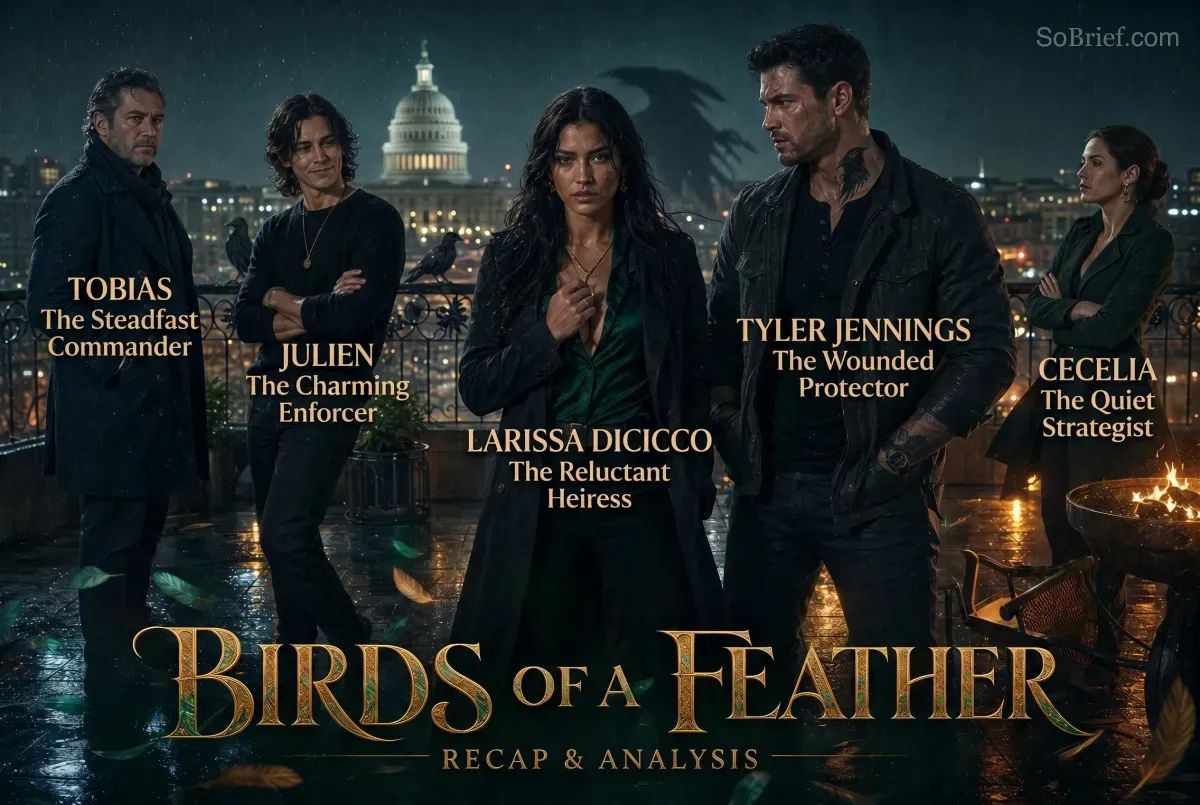
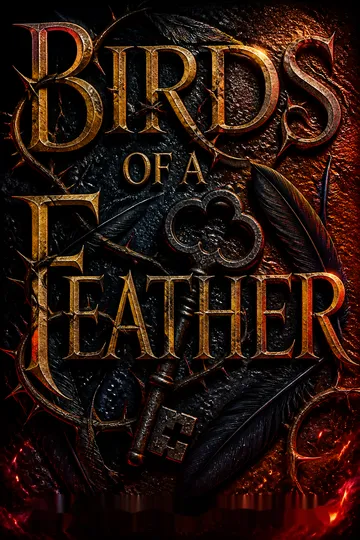
Birds of a Feather interrogates a question few dark romances dare to ask honestly: what happens when two people weaponized by their respective worlds collide not as lovers but as opposing intelligence assets? Tyler1 and Larissa2 don't fall in love despite their circumstances — they fall because of them. Their shared fluency in deception, violence, and emotional compartmentalization creates an intimacy requiring no translation, which is precisely why it terrifies them both.
The novel's deepest insight concerns the paradox of protection. Tyler1 builds his identity around shielding others — his birds, his president, his son — yet his protective instincts become the very mechanism through which he inflicts his worst harm. His treatment of Larissa2 replicates the pattern he despises in other men: weaponizing a woman's vulnerability under the guise of necessity. The book refuses to let him off the hook with noble motive. His cruelty is cruelty, full stop, and the narrative demands reckoning without the armor of mission or duty.
Larissa's2 arc inverts the typical dark-romance trajectory. She doesn't need to be broken to be rebuilt — she arrives already reconstructed by Tula,6 already capable, already lethal. Her vulnerability isn't weakness but deliberate exposure: she chooses to show Tyler1 her scars because she believes he's worth the risk. When that gamble fails catastrophically, her response is not collapse but coronation.
The treatment of PTSD refuses sentimentality. Tyler's1 dissociative episodes, panic attacks, and emotional shutdown are rendered with clinical specificity — not as romantic damage to be healed by love, but as a chronic condition requiring professional intervention, daily management, and the humility to stop performing invincibility. Love doesn't cure him. Therapy, accountability, and choosing to stop lying to himself begin the process. Love merely provides the reason to start digging.
Ultimately, the novel argues that the most dangerous lie isn't the one told to enemies — it's the one a protector tells himself about why he can never be protected in return.
Review Summary
Birds of a Feather receives overwhelming praise from readers, earning a 4.74/5 rating. Reviewers consistently highlight the explosive chemistry between Tyler and Larissa, describing her as a fierce, resilient, and beloved new female lead. Kate Stewart's emotional storytelling deeply resonates, with many noting the book's exploration of grief, trauma, and redemption. The full-cast audiobook narration, particularly Grayson Owens as Tyler, receives special acclaim. Nearly every reviewer mentions being blindsided by the shocking ending, leaving them desperate for the next installment.
People Also Read



Characters
Tyler Jennings
Raven soldier, presidential guardA decorated ex-Marine turned presidential bodyguard who leads a covert vigilante organization called the Ravens. Tyler's defining trait is extraordinary self-control: he can dissociate at will, detect lies with near-perfect accuracy, and function under inhuman pressure. But this armor was forged from devastating loss—his wife Delphine's15 death left him emotionally frozen for years, operating as a weapon rather than a man. Beneath tactical brilliance lies a heart that beats in broken rhythm, still pledged to a dead woman's memory. His greatest fear is vulnerability; his greatest flaw is mistaking emotional shutdown for strength. Father to adopted son Zach13, Tyler's protective instincts are absolute but dangerously weaponized against anyone who threatens what he refuses to feel.
Larissa DiCicco
Mafia heiress turned donnaThe only daughter of one of America's most feared mafia dons, forged in a house where whips replaced discipline and cruelty was choreographed. Sent to Italy at seventeen to train under donna Tula DiGiovanni6, she spent years being sculpted into a successor while secretly plotting her father's4 destruction. Her intelligence matches Tyler's1, as does her capacity for deception, but where his armor is emotional detachment, hers is weaponized composure. Beneath the donna's exterior lives a woman who craves the most ordinary of lives: good food, real laughter, love without ulterior motive. Her eight-year surveillance of Tyler1 began as curiosity about her brother's16 tattoo and evolved into devotion—a private faith in a man she'd never met, sustained through a window without sound.
Tobias
Raven leader, Tyler's brotherTyler's1 closest brother in the Ravens and their de facto leader. A polished Frenchman who runs his covert empire with equal parts strategy and sentiment. Tobias's defining tension is between his devotion to wife Cecelia14 and his responsibility as the man who must make impossible calls. His relationship with Tyler1 functions as a partnership between equals who refuse to admit how deeply they need each other. Tobias carries guilt for the burdens Tyler1 has shouldered on his behalf, and his fear of losing Tyler1 drives decisions that range from brilliant to catastrophic.
Ciro DiCicco
Mafia don, Larissa's fatherA don who embodies the worst of generational mafia power. Ciro's cruelty is systematic and inventive—he beat his wife with a belt at the dinner table before his captains, held his toddler son underwater for a perceived slight, and used his children as instruments of legacy rather than objects of love. His paranoia grew with his empire, turning his mansion into a fortress of unspeakable secrets. His reach extends from politicians to gang leaders, his leverage built on favors too dark to refuse.
Alonzo
Larissa's shadow and first loveDelivered to Ciro's4 doorstep as a child in payment for a family debt, Alonzo became Ciro's4 bodyguard, Larissa's2 protector, and her first love. His glacial blue eyes and near-mute exterior conceal a man who has absorbed decades of violence to shield others. He carries the scars literally—his back is a map of lash marks taken in Larissa's2 place. His loyalty transcends any title or obligation. After years of forced separation, Alonzo's love for Larissa2 remains the singular axis around which his existence turns.
Tula DiGiovanni
Legendary donna, Larissa's mentorThe most formidable donna in the global mafia—a woman who killed the former boss, ruled through her husband for years, then claimed the throne openly. Larissa's2 maternal cousin and mentor, Tula spent a decade transforming a heartbroken teenager into a weapon-grade leader. She has nine children and a marriage others envy, proving power and love need not be mutually exclusive. Her fury, when provoked, is legendary, and her protection is absolute—but never free.
Sean Roberts
Tyler's oldest friend and RavenTyler's1 childhood friend and the emotional conscience of the Ravens. Sean masks genuine depth beneath cocky charm and chain-smoking, but his capacity for love—for wife Tessa, his children, and his brothers—drives every decision. He understands grief intimately and refuses to let Tyler1 disappear into his own darkness. His willingness to deliver brutal truths costs him dearly but stems from a love he considers non-negotiable.
Julien
The Ravens' deadliest operativeA former French soldier whose lethal competence is matched only by his emotional detachment. Julien trusts no one, loves nothing yet, and treats every encounter as a tactical exercise. Tyler1 sends him to assess Larissa2 knowing Julien would execute her without remorse if warranted. His verdict carries more weight than any other judgment in Tyler's1 world. Enigmatic and quietly searching for something he cannot yet name.
Antony Livingston
Billionaire sociopath, true villainLarissa's2 betrothed by arrangement, Antony presents as American aristocracy personified—prep-school pedigree, billionaire net worth, magazine-cover smile. Behind this curated exterior operates a mind Larissa2 compares to the Antichrist. His obsession with Larissa2 is possessive rather than romantic. He moves through the world's most protected spaces as if invisible, his connections and true agenda obscured by decades of patient positioning and resources that dwarf governmental reach.
Preston Monroe
US President, secret RavenThe sitting president, secretly a Raven since youth. Tyler's1 principal charge and friend, Preston wields his office against entrenched corruption—from pharmaceutical monopolies to military profiteering—with a fearlessness that makes him as many enemies as allies.
Daniello DiGiovanni
Tula's enforcer brotherTula's6 brother and a legendary former soldier whose reputation precedes him across continents. Nearly three hundred pounds of protective menace devoted entirely to his wife Taylor, their son, and Larissa2.
Peter
Tyler's protégé RavenRecruited from a jail cell and transformed into a valued Raven. Fiercely loyal to Tyler1 with a devotion that borders on filial, Peter's impulsive bravery proves both his greatest asset and his most dangerous liability.
Zach
Tyler's adopted sonMature beyond his years, Zach grew up watching his father1 grieve and learned to carry weight no teenager should. His emotional intelligence often surpasses Tyler's1, making him both anchor and mirror.
Cecelia
Tobias's wife, inked RavenTobias's3 fiercely protective wife whose own tortured history with the Ravens gives her unique insight into Tyler's1 suffering. She serves as emotional interpreter between the brothers when words fail.
Delphine
Tyler's deceased wifeTyler's1 late wife, whose death shaped every choice he has made since. A woman of vision and faith, she taught Tyler1 to manage his dissociative states and foresaw that he would find love again.
Roc
Larissa's lost older brotherThe firstborn son who bore Ciro's4 worst abuse before fleeing the family. His Raven tattoo, glimpsed the night he vanished, unknowingly started Larissa's2 eight-year quest to find Tyler1.
Ignacio
Larissa's fractured younger brotherLeft behind in Ciro's4 care when Larissa2 was sent to Italy, the years of abuse fractured Ignacio's mind. Volatile, medicated, and susceptible to manipulation, he represents both Larissa's2 deepest guilt and her most urgent mission.
Plot Devices
The Cornicello Necklace
Tracking beacon disguised as charmGifted to Larissa2 by her cousin before she left Barga, the horn-shaped talisman—traditionally meant to ward off evil—conceals a tracking beacon. Tyler1 suspects its purpose early but allows it to remain, curious about who will come calling. The necklace functions as Larissa's2 insurance policy and lifeline to the DiGiovanni family, ultimately summoning Daniello11 to the campsite when Larissa2 fails to check in. Its dual nature mirrors the story's central tension: protection and surveillance are often the same act, differing only in who holds the receiver.
The Chanel Perfume
Weapon of emotional manipulationChanel perfume operates as a recurring instrument of psychological warfare across multiple wielders. Tyler1 applies a sample bottle to his collar to make Larissa2 believe he slept with another woman, weaponizing her jealousy to maintain emotional dominance. Much later, the same sample bottle becomes the evidence of his deception when he tosses it at her feet. Antony9 repurposes the scent as a Christmas threat, echoing Ciro's4 tradition of gifting his wife Chanel annually. The perfume transforms from a tool of seduction into a signature of betrayal, each appearance stripping away another layer of trust.
Dom's Laptop and Task List
Posthumous mission catalystThe encrypted laptop of Dominic, a deceased Raven brother, contains years of investigation into global atrocities—human trafficking networks, corrupt officials, and connected criminal empires. Cracking its password after Dom's death launched the Ravens' vigilante crusade and directly connects Ciro DiCicco4 to the arms-dealing network Tyler1 has hunted since joining the Marines. The laptop functions as a dead man's conscience, passing the psychological burden of what Dom witnessed alone onto those who survive him, while providing the operational intelligence needed to act on his unfinished work.
Tyler's Dissociative 'Blink'
Mental armor and prisonTyler's1 ability to will himself into a dissociative fugue state—what he calls 'the black' or 'the pocket'—serves as his primary emotional defense mechanism. Taught to him by Delphine15, the technique allows him to suppress all feeling and operate with lethal precision during missions. But what began as a tactical asset has become a psychological cage: Tyler1 increasingly uses dissociation to avoid grief, intimacy, and accountability. His months-long blackout after losing Larissa2 represents the technique's most dangerous extreme—a man so practiced at vanishing inside himself that he nearly fails to return.
The Raven Tattoo
Identity marker and vulnerabilityThe ink marking every Raven member functions simultaneously as a badge of brotherhood, a covenant of purpose, and a potentially fatal liability. Larissa's2 entire mission begins because she recognizes the tattoo on Roc's16 arm and later on Tyler's1. The mark connects soldiers across class, nationality, and background under a shared mission to protect—but it also makes them identifiable to enemies. The Founding Fathers' trap is specifically designed to photograph and identify inked operatives. The tattoo embodies the story's central paradox: the same marks that bind these men together make them targets.
Ravenhood Legacy Series Series

About the Author
Other books by Kate Stewart







Download PDF
Download EPUB
.epub digital book format is ideal for reading ebooks on phones, tablets, and e-readers.








































