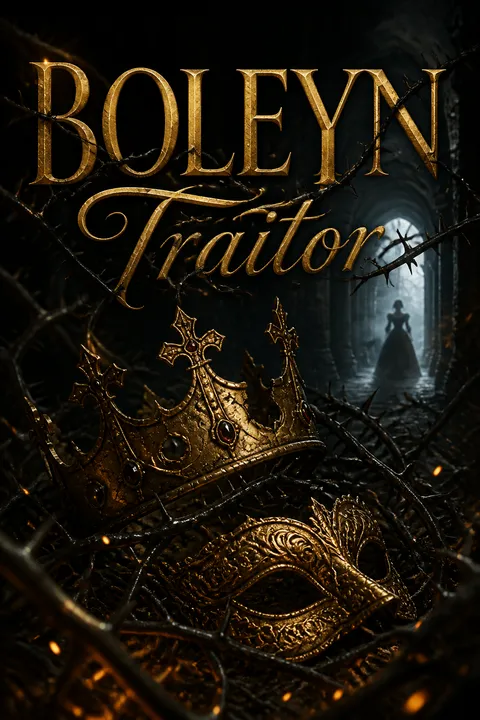

Plot Summary
Masks and Mirrors
Jane Boleyn, Lady Rochford, navigates the dazzling but dangerous Tudor court, where everyone wears a mask—sometimes literally, often figuratively. As Anne Boleyn's sister-in-law and lady-in-waiting, Jane learns early that survival depends on knowing when to hide and when to reveal. The court is a stage, and Jane, both participant and observer, becomes adept at reading the subtle cues of power, ambition, and desire. Her marriage to George Boleyn, Anne's brother, binds her to the Boleyns' meteoric rise, but also to their vulnerabilities. Jane's intelligence and education, rare for a woman of her time, make her both valuable and suspect. In this world, secrets are currency, and Jane's ability to keep them—or use them—will shape her fate.
The Queen's Game
As Anne becomes queen, Jane witnesses the relentless pressures of producing an heir and maintaining the king's favor. Anne's court is vibrant, intellectual, and reformist, but also rife with jealousy and intrigue. Jane's role as confidante and spy deepens; she is tasked with managing rivalries among the ladies and reporting on potential threats. The king's wandering eye and the ambitions of old noble families threaten Anne's position. Jane's loyalty is tested as she balances her duty to Anne with her own survival instincts. The court's games—masques, dances, and flirtations—mirror the real games of power, where a misstep can mean disgrace or death.
Rise and Ruin
The Boleyns' ascent brings them titles, wealth, and influence, but also enemies. Jane's marriage to George is both a personal and political alliance, yet it is fraught with distance and unspoken pain. Anne's failure to produce a male heir sows doubt in the king's mind, and the old guard—led by the Howards and the Spanish party—waits for their chance to strike. Jane's skills as a courtier and informant are in high demand, but she is increasingly aware that her fortunes are tied to the Boleyns' fate. When Anne miscarries, the family's enemies circle, and Jane is forced to choose between truth and expediency.
Exile and Return
After a failed attempt to remove a rival from Anne's court, Jane is scapegoated and sent away, learning the pain of being "dropped" by those she served. In exile at her family's country estate, she reflects on the transactional nature of courtly love and loyalty. Her education and ambition seem wasted in the quiet countryside, but she is eventually summoned back to court by Thomas Cromwell, the king's powerful secretary. Jane's return is not a restoration of old bonds, but a new chapter as a tool in Cromwell's network, her eyes and ears in the queen's rooms. She learns that survival means adapting to new masters and new games.
The Machinery of Power
The court is now a machine, with Cromwell as its engineer. Jane becomes his trusted informant, reporting on the queen's pregnancies, the king's moods, and the shifting alliances among courtiers. The dissolution of the monasteries and the execution of Thomas More and Bishop Fisher mark a new era of tyranny and reform. Jane sees how power is manufactured, how laws are bent to the king's will, and how even the most sacred institutions can be destroyed. She is both participant and witness, complicit in the machinery that will eventually turn against her and those she loves.
The King's Wives
Jane serves five queens: Katherine of Aragon, Anne Boleyn, Jane Seymour, Anne of Cleves, and Katheryn Howard. Each reign is a lesson in the volatility of royal favor and the precariousness of women's lives. Jane Seymour's brief triumph is followed by her death in childbirth; Anne of Cleves is set aside through a carefully orchestrated annulment, with Jane's help. Katheryn Howard's youth and beauty captivate the king, but her inexperience and longing for love make her vulnerable. Jane's role shifts from advisor to accomplice, as she helps Katheryn meet her lover, Thomas Culpeper, believing it may secure the queen's future—or her own.
Court of Spies
The Tudor court is a labyrinth of surveillance, coded letters, and betrayals. Jane's training as a spy—her knowledge of languages, codes, and courtly etiquette—makes her indispensable to Cromwell and later to the Howards. She navigates the dangerous currents of religious reform, foreign alliances, and personal vendettas. The line between truth and fabrication blurs, as confessions are extracted, evidence manufactured, and loyalty is always in question. Jane's own survival depends on her ability to anticipate danger, but she is haunted by the knowledge that even the most careful courtier can be undone by a single whisper.
The Tyrant's Shadow
As the king ages, his paranoia and cruelty intensify. Friends and favorites are executed on flimsy charges; laws are rewritten to justify his desires. Jane witnesses the transformation of a once-glorious court into a place of fear and suspicion. The machinery of power, once wielded by Cromwell, now serves only the king's whims. Jane's complicity in the system becomes a source of guilt and dread. She sees how easily love can turn to hate, and how quickly a queen can become a traitor. The court's rituals—masques, dances, confessions—become hollow, masking the terror beneath.
Love and Betrayal
Katheryn Howard's affair with Thomas Culpeper, facilitated by Jane, is both a rebellion against the king's tyranny and a desperate grasp at happiness. Jane, moved by the young queen's passion, risks everything to help them meet in secret. But the court is always watching, and secrets cannot be kept forever. When rumors reach the king, an investigation begins, and Jane is caught in the web she helped spin. The line between love and betrayal blurs, as confessions are coerced and blame is shifted. Jane's loyalty to Katheryn and to her own survival are in conflict, and the consequences are fatal.
The Fall of Anne
The investigation into Katheryn's past mirrors the downfall of Anne Boleyn. Accusations of precontract, adultery, and treason are leveled with ruthless efficiency. Jane is interrogated, isolated, and ultimately betrayed by those she trusted. The machinery of the court, once her tool, now grinds her down. The executions of Katheryn, Culpeper, and Dereham are spectacles of cruelty, designed to erase the memory of love and dissent. Jane, declared mad, is spared immediate execution, but her fate is sealed by a new law that allows the king to kill even the insane. The cycle of rise and ruin is complete.
The Queen's Confessions
In the Tower, Jane reflects on the confessions extracted from queens and courtiers alike. She sees how truth is shaped by power, how words are twisted to serve the king's narrative. Her own confession is both a plea for mercy and a final act of agency. She understands that silence is no protection, that madness is no refuge. The court's obsession with confession—public and private—reveals the emptiness at its heart. Jane's final confession is not of guilt, but of complicity in a system that destroys those who serve it best.
The Price of Silence
Jane's madness, real or feigned, is her last defense against a world gone mad. She sees that the court's greatest sin is not ambition or desire, but the refusal to say "no" to tyranny. The deaths of Anne, George, Katheryn, and so many others are the price paid for silence and compliance. Jane's own execution is both a punishment and a release. In her final moments, she recognizes that the only way to defeat a tyrant is to refuse to play his game. Her story is a warning to those who would survive by silence alone.
The Madman's Court
The court Jane once loved is now a place of ghosts and memories. The king, surrounded by flatterers and sycophants, is more isolated than ever. Laws are changed to justify his cruelty; friends and enemies alike are swept away. Jane's reflections in the Tower reveal the true cost of serving a madman: the loss of self, the destruction of love, the erasure of history. The court's rituals and entertainments are revealed as distractions from the horror at its core. Jane's madness is both a symptom and a protest, a refusal to accept the world as it is.
The Last Masque
As Jane and Katheryn await execution, the court prepares for the next queen, the next masque, the next cycle of hope and despair. Jane's life, shaped by performance and deception, ends with a final act of defiance. She recognizes that the court's endless dance is a trap, and that true freedom lies in the courage to refuse. The executions are both spectacle and warning, a reminder that no one is safe in the madman's court. Jane's story is not just a personal tragedy, but a reflection of a society that values obedience over truth.
No One Says No
Jane's final insight is that tyranny thrives when no one dares to say "no." The court's complicity, the willingness to play along, enables the king's madness and cruelty. Jane's own silence, her failure to speak out, is both her downfall and her legacy. The deaths of so many—Anne, George, Katheryn, Cromwell, and Jane herself—are the inevitable result of a system that rewards compliance and punishes dissent. The lesson is clear: the only way to stop a tyrant is to refuse to play his game, to say "no" before it is too late.
The End of the Dance
With Jane's execution, the story of the Boleyns and their allies comes to an end. The court moves on, preparing for the next queen, the next intrigue, the next betrayal. Jane's life, marked by ambition, intelligence, and adaptability, is both a cautionary tale and a testament to the resilience of those who survive in the shadows. Her final act is not one of submission, but of recognition: the dance is over, and the masks have fallen. The court will continue, but Jane's story remains as a warning and a mirror to all who would serve power without question.
Analysis
A modern meditation on power, complicity, and survivalBoleyn Traitor is more than a historical novel; it is a psychological and political exploration of what it means to live—and die—under tyranny. Through Jane Boleyn's eyes, Philippa Gregory interrogates the costs of ambition, the dangers of silence, and the corrosive effects of power wielded without restraint. The novel's structure, built around cycles of rise and fall, confession and denial, performance and reality, mirrors the endless dance of the Tudor court—a dance that ultimately destroys those who play it best. Gregory's portrayal of Jane is both sympathetic and critical: she is a survivor, a victim, and a participant in her own undoing. The book's central lesson is that tyranny thrives not only on the will of the powerful, but on the compliance of those who serve them. The refusal to say "no"—to power, to injustice, to cruelty—is both a personal and a collective failing. In an age where the machinery of power can grind down even the most skilled and intelligent, Boleyn Traitor is a warning and a call to courage: the only way to defeat a tyrant is to refuse to play his game.
Review Summary
Reviews for Boleyn Traitor are largely positive, averaging 4.18/5, with many praising Philippa Gregory's vivid storytelling and fresh portrayal of Jane Boleyn as a complex, sympathetic figure rather than a historical villain. Fans of Tudor history particularly appreciated the rich court intrigue and feminist reappraisal of Jane's character. Critics, however, found the novel repetitive, especially those familiar with Gregory's earlier work The Boleyn Inheritance, which covers similar ground. Some noted the book's length and dry pacing as drawbacks, while others questioned Gregory's failure to acknowledge her own previous negative portrayal of Jane.
People Also Read




Characters
Jane Boleyn, Lady Rochford
Jane is the central figure, a woman of intelligence and ambition navigating the treacherous world of the Tudor court. Married to George Boleyn, she is both insider and outsider—valued for her skills, but never truly secure. Jane's psychological complexity lies in her adaptability: she is a loyal servant, a cunning informant, and, at times, a pawn in others' games. Her relationships—with Anne and George Boleyn, Thomas Cromwell, and the queens she serves—are marked by both genuine affection and calculated self-preservation. Jane's greatest strength is her ability to read the court's shifting tides, but her greatest weakness is her inability to say "no" to power. Her complicity in the machinery of tyranny ultimately leads to her downfall, as she is consumed by the very system she helped sustain.
Anne Boleyn
Anne is both Jane's sister-in-law and the catalyst for much of the court's drama. Her intelligence, wit, and reformist zeal make her a magnet for both admiration and hatred. Anne's rise to queenship is marked by boldness and innovation, but also by a refusal to compromise. Her inability to produce a male heir and her enemies' relentless plotting lead to her tragic fall. Anne's relationship with Jane is complex—part alliance, part rivalry. She embodies the dangers of female ambition in a patriarchal world, and her execution sets the pattern for the court's cycles of rise and ruin.
George Boleyn
George is Jane's husband and Anne's beloved brother. Handsome, witty, and well-educated, he is both a court favorite and a target for jealousy. His close relationship with Anne, both emotional and intellectual, becomes fodder for scandal and accusation. George's marriage to Jane is affectionate but distant, marked by shared ambition rather than deep intimacy. His downfall—caught in the web of accusations against Anne—reveals the court's capacity for betrayal and the fragility of even the most favored courtiers.
Thomas Cromwell
Cromwell is the architect of the new Tudor court, a commoner who rises to unprecedented power through intelligence, ruthlessness, and adaptability. He is both Jane's patron and her model, teaching her the arts of espionage, code, and survival. Cromwell's ability to bend the law and orchestrate the downfall of enemies makes him indispensable—until he, too, is destroyed by the king's caprice. His relationship with Jane is one of mutual respect and shared complicity, but also of exploitation. Cromwell's fall signals the end of an era and the triumph of unchecked tyranny.
Henry VIII
Henry is the sun around which the court revolves—brilliant, magnetic, and increasingly dangerous. His need for love, admiration, and heirs drives the court's endless cycles of hope and despair. As he ages, his paranoia and cruelty intensify, and he becomes both unpredictable and unchallengeable. Henry's relationships with his wives, courtiers, and advisors are marked by both genuine affection and ruthless self-interest. His inability to accept limits—on his power, his desires, or his mortality—makes him both tragic and monstrous.
Katheryn Howard
Katheryn is the king's fifth wife, a teenager thrust into the role of queen. Her longing for love and her affair with Thomas Culpeper are both acts of rebellion and desperate attempts at happiness. Katheryn's naivety and lack of education make her vulnerable to manipulation, but her capacity for love is genuine. Jane's decision to help her is both an act of empathy and a fatal miscalculation. Katheryn's execution is both a personal tragedy and a symbol of the court's destruction of innocence.
Thomas Culpeper
Culpeper is Katheryn's confidant and lover, embodying the dangers of desire in a world ruled by suspicion. His relationship with Katheryn is passionate but ultimately fatal, as their secret meetings are discovered and used as evidence of treason. Culpeper's charm and boldness make him both attractive and dangerous. His fate is sealed by the court's need for scapegoats and the king's need for vengeance.
Francis Dereham
Dereham is a figure from Katheryn's past, whose claims of intimacy and promises of marriage become the basis for the investigation into the queen's conduct. His braggadocio and lack of discretion make him an easy target for the court's wrath. Dereham's downfall is both a result of his own actions and the court's need to construct a narrative of betrayal and sin.
Thomas Howard, Duke of Norfolk
The duke is the head of the Howard family and a master of courtly survival. His ambition for his family is matched only by his willingness to sacrifice its members when necessary. He is both Jane's patron and her judge, urging her to save herself even as he distances himself from her and Katheryn. The duke's pragmatism is both his strength and his curse, as he survives by abandoning those closest to him.
Lady Mary (Mary Tudor)
Mary is the daughter of Katherine of Aragon, sidelined by her father's marriages and the court's shifting allegiances. Her presence is a constant reminder of the costs of ambition and the fragility of status. Mary's intelligence and dignity earn her respect, but her fate is always uncertain. She is both a potential ally and a threat to those who serve the king's new wives.
Plot Devices
Courtly Performance and Masques
The narrative is structured around the metaphor of the court as a stage, where everyone plays a role and wears a mask. Masques, dances, and rituals are both entertainment and political maneuvering, allowing characters to hide their true intentions and desires. This device underscores the theme of duplicity and the dangers of living in a world where appearance is everything. The constant shifting of roles and alliances creates suspense and highlights the precariousness of survival.
Confession and Interrogation
The motif of confession—public and private, coerced and voluntary—runs throughout the story. Characters are forced to confess not only their actions but their thoughts and desires, often under threat of torture or death. The process of interrogation reveals the court's obsession with control and the impossibility of true innocence. Confessions are shaped by power, and the truth is always contingent on what the king wants to hear.
Foreshadowing and Repetition
The narrative uses foreshadowing and echoes of past events to create a sense of inevitability. The downfall of Anne Boleyn is mirrored in the fate of Katheryn Howard; the machinery that destroys one queen is repurposed for the next. Jane's reflections on past betrayals and executions serve as warnings for the present, and the repetition of accusations, trials, and executions underscores the futility of seeking safety in a world ruled by a tyrant.
Psychological Realism
The story delves deeply into the psychological motivations of its characters, particularly Jane. Her internal conflicts—between loyalty and self-preservation, love and ambition, truth and silence—are rendered with nuance and empathy. The use of interior monologue and close third-person narration allows readers to experience the emotional stakes of each decision. The court's external rituals are contrasted with the characters' private fears and desires, creating a rich tapestry of human complexity.
Tyranny and the Law
The narrative structure highlights the ways in which laws are rewritten, trials are staged, and evidence is manufactured to justify the king's will. The use of writs of attainder, retrospective legislation, and coerced confessions reveals the court's descent into legal and moral chaos. The story's climax—Jane's execution under a law changed specifically to allow it—serves as a powerful indictment of tyranny and the dangers of unchecked authority.


Download PDF
Download EPUB
.epub digital book format is ideal for reading ebooks on phones, tablets, and e-readers.








































