
Key Takeaways
1. Simplicity over Baroque Complexity
I have, in short, preferred to satisfy an expectation rather than to provide a startling shock.
The evolution of style. Early in a writer's career, there is a strong temptation to overcomplicate prose with exotic vocabulary, baroque structures, and showy local color. Borges admits to playing the "sedulous ape" to seventeenth-century Spanish baroque writers, resulting in heavy, convoluted sentences that collapsed under their own weight. True maturity in writing involves stripping away these purple passages to find a clean, logical voice that prioritizes the reader's understanding over superficial dazzle.
Returning to sanity. Achieving a direct and clear style requires a deliberate shift in focus. Instead of trying to shock or surprise the reader with linguistic gymnastics, the mature writer seeks to satisfy expectations through elegant simplicity. This transition can be seen in Borges' later works, which ground themselves in familiar, everyday settings rather than abstract, dizzying mazes. Key elements of this transition include:
- Using precise, authentic local details instead of generic, romanticized myths.
- Avoiding unnecessary linguistic ornamentation that slows down the narrative.
- Focusing on logical progression and clarity to make the reading experience seamless.
The power of restraint. By embracing a more straightforward approach, a writer actually liberates the words, giving them a quiet vitality. When the tricks of a complex style are discarded, the remaining prose feels natural, as if the truth of the story was always there waiting to be expressed. Ultimately, simplicity is not a lack of sophistication, but the very peak of artistic refinement.
2. The Primacy of Situation in Short Fiction
Therefore—if I may be allowed a sweeping statement—in writing a novel, you should know all about the characters, and any plot will do, while in a short story it is the situation that counts.
Plot versus character. The fundamental difference between a novel and a short story lies in their structural focus. A novel has the space to explore the deep, psychological complexities of its characters, making the specific plot secondary to who they are. In contrast, a short story must establish its impact quickly, relying on a singular, powerful situation or plot to drive the narrative forward.
Minimalist characterization. In short fiction, characters do not need to be highly complex psychological portraits like Hamlet or Raskolnikov. Instead, they can be simple, primitive figures who represent broader human experiences or archetypes. This allows the central conflict or situation to remain the focal point of the reader's attention. For example:
- In "The End of the Duel," the two main characters are simple, primitive gauchos who are essentially the same man.
- Their lack of complex internal analysis keeps the focus entirely on their bizarre, shared destiny.
- The narrative relies on the sheer absurdity and horror of their final race to deliver its emotional punch.
The strength of the anecdote. Many great short stories begin as simple anecdotes that the writer carries around for years. By focusing on the core situation of the anecdote and stripping away unnecessary character details, the writer creates a tight, effective narrative. The situation itself becomes the vessel for deeper philosophical or emotional truths.
3. Plausibility Trumps Raw Reality
Reality is not always probable, or likely.
The paradox of truth. Real life is full of bizarre, chaotic, and highly improbable events that would feel completely unbelievable if written down exactly as they happened. Because of this, a fiction writer cannot simply copy reality; they must carefully curate and tone down real events to make them plausible. The writer's primary duty is to make the story feel true to the reader's imagination, even if that means altering the historical facts.
The art of selectivity. To make a narrative convincing, a writer must use circumstantial invention to ground the story in a believable reality. This involves adding small, authentic details while leaving out the highly improbable elements of the real-life source material. Borges illustrates this selective process through several techniques:
- Using specific, real-world locations (like actual street corners) to establish immediate trust.
- Inventing minor, realistic details (like a specific name for a dog) to flesh out a bare anecdote.
- Toning down real-life coincidences that would strike the reader as too convenient or theatrical.
Believability over accuracy. If a writer tells an improbable story in an improbable way, the reader's imagination will instinctively reject it. By slowing down the narrative and focusing on plausible, logical steps, the writer coaxes the reader into accepting the extraordinary. In the end, a well-crafted lie in fiction is often far more convincing than the raw, unvarnished truth.
4. Separating Personal Ideology from Creative Dreams
Everybody knows my opinions, but as for my dreams and my stories, they should be allowed their full freedom, I think.
The independence of art. A writer's creative output must remain free from the constraints of their personal political and social ideologies. While a writer may hold strong opinions in their daily life, forcing these views into their fiction turns art into a mere fable or political tract. True literature emerges from the subconscious and the dream world, which must be allowed to operate without ideological interference.
The trap of committed literature. Writing with the explicit goal of promoting a specific political or social agenda—often called littérature engagée—limits the natural scope of a story. Great writers often find themselves writing against their own private moral or political positions because the story demands it. This separation of art and ideology is crucial for several reasons:
- It prevents the narrative from becoming a preachy, one-dimensional lecture.
- It allows characters with opposing views to be portrayed with genuine depth and tragedy.
- It preserves the mysterious, open-ended nature of creative dreams.
Trusting the subconscious. A writer does not choose their subjects; the subjects choose them, nagging at the mind until they are written down. By keeping personal opinions in a watertight compartment, the writer allows these subconscious stories to find their own natural, unbiased expression. The ultimate duty of a writer is simply to be a writer, letting the work speak for itself.
5. Mastering Classical Forms Before Attempting Free Verse
to break the rules, you must know about the rules.
The illusion of free verse. Many young poets mistakenly begin their careers by writing free verse, believing it to be the easiest path because it lacks strict rules. In reality, free verse is the most difficult form of poetry because it requires the writer to invent their own internal structure from scratch. Without an underlying structure, free verse easily degenerates into shapeless, meaningless prose that leaves the reader cold.
The safety of traditional structures. Classical poetic forms, such as the sonnet, provide a pre-existing framework that actually makes the act of writing easier. The constraints of rhyme and meter limit the writer's choices, forcing them to find creative solutions and unexpected words. This structured discipline is essential for several reasons:
- It prevents the poet from being entirely at the mercy of unguided "genius."
- It teaches the writer how to manage rhythm, pacing, and musicality.
- It connects the modern writer to a long, rich literary tradition.
Earning the right to experiment. A poet must first demonstrate their mastery of traditional forms before they can successfully break them. By learning the rules of classical prosody, the writer builds the technical skill and inner strength required to write effective free verse later on. Innovation is only meaningful when it is grounded in a deep understanding of what came before.
6. Poetry as a Gift from the Subconscious
All this boils down to a simple statement: poetry is given to the poet.
The passive reception of art. Poetry is not something that can be forced or written at will; it is a gift that must be received with patience and attention. The poet must remain receptive to the sudden, quiet moments when a line, a rhythm, or a hazy notion begins to form in the mind. Trying to force a poem through sheer ambition or intellectual effort usually results in stiff, lifeless verse.
The process of composition. Once a poetic idea is received, the writer must allow it to develop naturally without immediate tampering. Borges describes a highly organic method of composition that relies on physical movement and memory before any words are committed to paper:
- Walking up and down, letting the inner voice shape the rhythm of the lines.
- Dictating the rough draft to avoid the mechanical distraction of writing.
- Laying the draft aside for a week or more to gain critical distance.
The necessity of letting go. After revising a poem several times, a writer must eventually publish it to prevent themselves from changing it endlessly. Publishing is a way of declaring the work finished so the writer can move on to new creative endeavors. Ultimately, the poet is merely a scribe for a deeper, mysterious force that must be trusted.
7. The Dual Paths of Translation
I think there are two legitimate ways of translating.
Literalism versus re-creation. Translation is a delicate art that offers two distinct, equally valid approaches to the original text. A literal translation seeks to preserve the exact word order and syntax of the source language, which often produces a beautiful, exotic strangeness in the target language. On the other hand, a re-creation prioritizes the spirit and music of the original, rephrasing the text to make it flow naturally.
The beauty of the foreign. When a translator chooses the literal path, they can create a unique poetic effect by introducing foreign rhythms into English. This technique can make the familiar sound wonderfully strange and evocative, as seen in classic translations of Eastern literature. Key aspects of this approach include:
- Preserving the literal word order to create an unusual, striking cadence.
- Allowing the target language to be stretched and modified by the source language.
- Capturing the specific cultural flavor of the original text.
The music of re-creation. When a translator chooses to re-create, they are free to alter the literal words to achieve a more natural, wistful music. This approach requires the translator to be a skilled writer in their own right, capable of finding equivalent expressions that evoke the same emotional response. Both paths are legitimate, depending entirely on the translator's artistic goals.
8. The Collaborative Fusion of Minds
We don't think of ourselves as two men when we are working.
The unity of collaboration. A truly successful translation is not a mechanical exchange of words, but a deep, intellectual collaboration where two minds merge into one. When working together, the author and the translator must set aside their personal egos and focus entirely on the perfection of the work. This collaborative fusion allows the translation to capture the true, living voice of the author.
The mechanics of partnership. Borges and his translator, Norman Thomas di Giovanni, developed a highly effective, multi-stage method for translating prose. This process ensured that the final English text was both faithful to the original and highly readable as an independent work of art:
- Preparing a rough, literal draft to establish the basic meaning of the text.
- Discussing the draft line-by-line to clarify the author's specific intentions and historical context.
- Polishing the English sentences to ensure they sound natural and spoken.
- Reading the final draft aloud without reference to the Spanish to check the overall rhythm.
The freedom to improve. Working closely with the author gives the translator the confidence to make bold, creative departures from the literal text. It allows them to clarify obscure passages, add necessary context for foreign readers, and even improve upon the original prose. Through this shared dedication, the translation becomes a genuine re-creation rather than a pale imitation.
9. Prioritizing Tone and Sentence Structure over Word-for-Word Accuracy
the worst fault in a translation is not getting a word wrong but getting the author's tone, or voice, wrong.
The supremacy of voice. The ultimate goal of any translation is to capture the author's unique tone and voice, rather than simply matching words in a dictionary. A literal, word-for-word translation often results in stiff, unnatural prose that completely misrepresents the fluid, living quality of the original. The translator must focus on writing effective, natural sentences in the target language that evoke the same atmosphere as the source text.
The mechanics of English prose. Different languages have entirely different ways of looking at the world and structuring thought. To translate effectively into English, a writer must understand the natural rhythms and structural rules of English prose, which often differ wildly from Spanish:
- Avoiding the literal translation of Spanish syntax, which can sound incredibly stilted in English.
- Using the natural English sentence pattern (placing the strongest element at the very end) to create impact.
- Toning down local slang and modernisms to preserve a timeless, classic quality.
The art of rewriting. A translator must be a skilled writer who is willing to rewrite and reshape sentences to make them sing in the target language. Getting a single word wrong is a minor slip, but losing the author's voice is a fatal error that ruins the entire work. By prioritizing tone and structure, the translator ensures that the author's genius is fully realized in a new tongue.
Review Summary
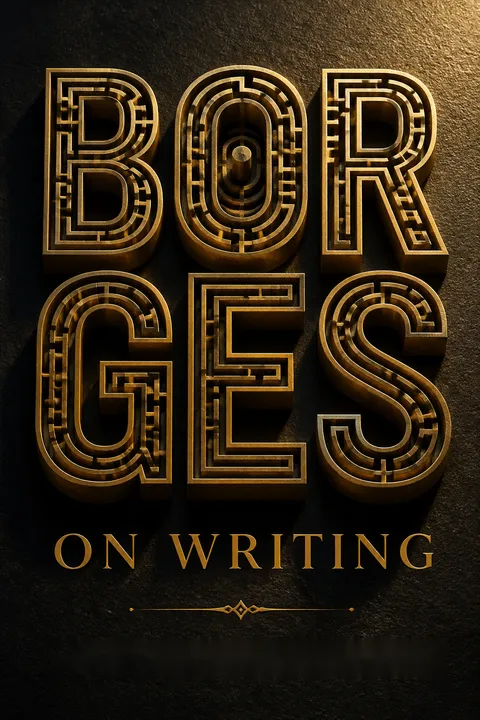
Reviews of Borges on Writing are largely positive, averaging 4.07/5. Readers appreciate the intimate glimpse into Borges' creative process, drawn from transcribed Columbia University seminars covering fiction, poetry, and translation. Many highlight the fascinating dynamic between Borges and his translator, Di Giovanni. The translation section receives particular praise for its technical depth. Some critics note the transcript format feels uneven in places, and occasional confusion arises from its lecture-style delivery. Overall, it is widely recommended for aspiring writers and Borges enthusiasts alike.
About the Author
Other books by Jorge Luis Borges
Download PDF
Download EPUB
.epub digital book format is ideal for reading ebooks on phones, tablets, and e-readers.








































