
Key Takeaways
The Money Game is rigged so that you always lose
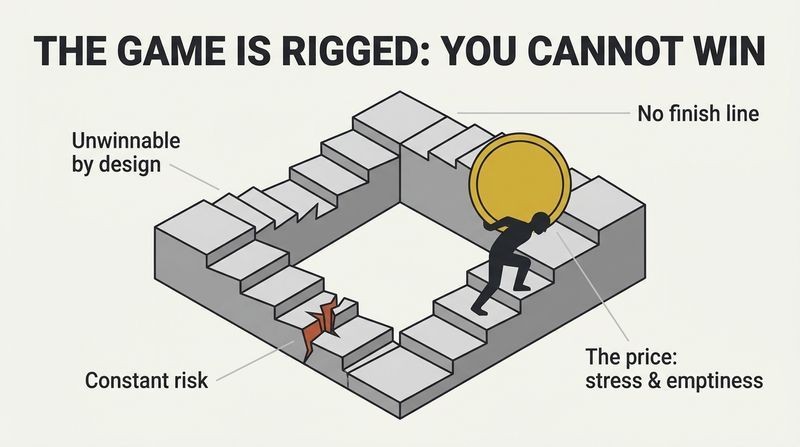
No matter how much you pile up, you pay. Scheinfeld, who built fortunes (including growing Blue Ocean Software from $1.27 million to $44.3 million before its $177 million sale to Intuit), argues money is not serious business but an elaborate game with arbitrary rules. The problem: this game is unwinnable by design.
Four structural traps guarantee failure:
1. There is no clear definition of winning (millionaire? billionaire?)
2. Your money is always at risk (crashes, lawsuits, theft, divorce)
3. There is no official ending point (retirement does not stop the risk)
4. There is always a price to pay (stress, illness, loneliness, emptiness)
Even those who seem to win end up sick, divorced, or asking 'Is this all there is?' You cannot out-earn a game with no finish line.
The framing of money as an unwinnable game echoes the 'hedonic treadmill' from psychology: research by Brickman and Campbell shows people adapt to gains and return to baseline satisfaction. Scheinfeld's point that 'there is always a level above yours' is well documented by social comparison theory. Where he diverges from mainstream finance is his refusal to offer better play. Most advisors say budget smarter; he says quit. That is bold and clarifying, though skeptics will note that food, shelter, and medicine remain stubbornly real regardless of one's philosophical stance toward currency.
You are an infinite being playing a deliberately limited game
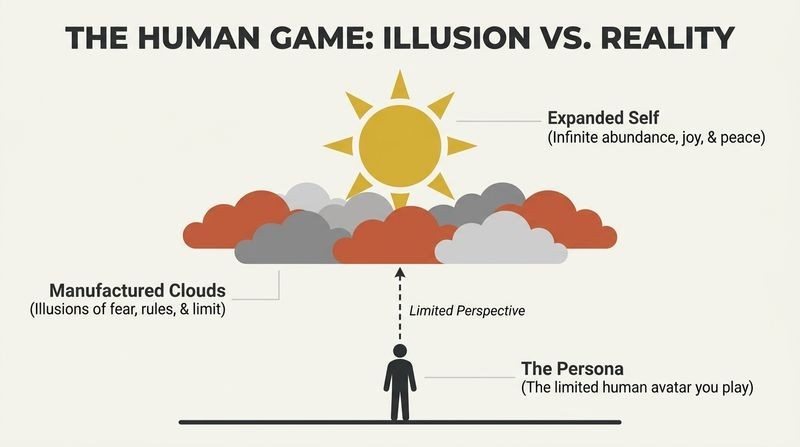
Life answers three ancient questions. Who am I? An infinitely powerful being whose natural state is abundance, joy, and peace. Why am I here? To play 'The Human Game' for the sheer challenge of it. What is my purpose? To play it in your own unique way.
The Human Game has a Prime Directive borrowed from Star Trek: explore what happens when unlimited power limits itself. To do this, your infinite self (the 'Expanded Self') creates a Persona (the you reading this) and hides all its power, convincing the Persona it is weak, poor, and vulnerable. Scheinfeld uses the sun-and-clouds metaphor: the sun (your true power) always shines, but you manufacture clouds (illusions of limitation) and convince yourself the clouds are all there is.
This is essentially Vedantic nondualism (Atman as Brahman, the world as maya) repackaged with sci-fi metaphors. The 'game of self-forgetting' resembles philosopher Alan Watts's description of God playing hide-and-seek with itself. What is distinctive is Scheinfeld's insistence that limitation is chosen and purposeful, not a fall or punishment. This reframes suffering as self-authored adventure. The obvious tension: it risks spiritual bypassing, treating genuine trauma as elective entertainment. Critics in psychology would caution that telling abuse survivors they scripted their pain can be harmful. Scheinfeld leans hard into a metaphysics that comforts some and unsettles others.
Consciousness collapses infinite possibility into your physical reality
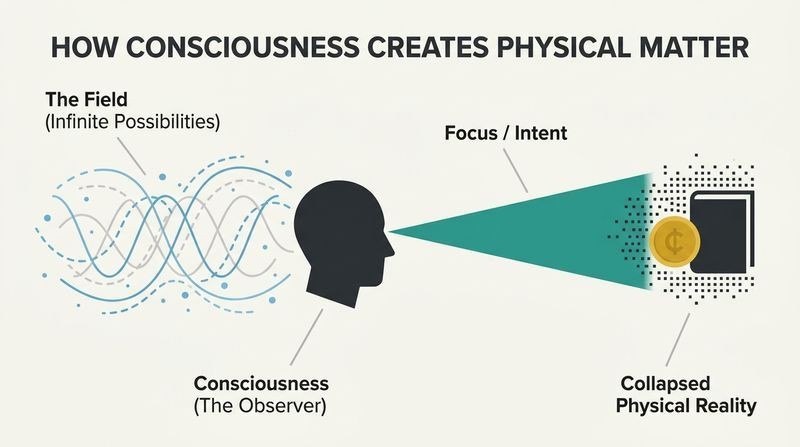
Science backs the philosophy, Scheinfeld claims. He draws on quantum physics interpretations from David Bohm, Amit Goswami, and Michael Talbot's The Holographic Universe. The core model has four parts: The Field (infinite potential energy, also called the Zero Point Field), particles, the physical universe, and Consciousness (the real you).
The claim: nothing exists 'out there' independently. When your Consciousness focuses on The Field with intent, infinite possibility 'collapses' into a single reality, like the observer effect in quantum experiments. Your checking account, your bills, this book itself have no independent existence. You construct them, particle by particle. He points to dreams as proof: at night your mind generates entire worlds, people, and places that feel utterly real but exist only in you.
This is where the book invites the most scrutiny. The observer effect in quantum mechanics refers to measurement disturbing subatomic systems, not human minds wishing bank balances into being. Physicists like Sean Carroll and Sabine Hossenfelder have repeatedly criticized the leap from quantum indeterminacy to consciousness-creates-reality (popularized by What the Bleep Do We Know?). The dream analogy is genuinely interesting and aligns with predictive-processing neuroscience, which shows the brain constructs perception. But constructing perception is not the same as constructing matter. Readers should treat the science here as evocative metaphor rather than literal physics.
Other people are actors reading scripts you wrote
Your hologram has a cast. Scheinfeld argues everyone you meet is your creation, like actors in your private movie, with no independent power in your reality. Most people are mere 'extras'; only a few play starring roles. He invokes the mirror: people reflect back what you believe about yourself.
They serve three functions:
1. Reflect your own thoughts and beliefs (a coworker who underpays you mirrors how you undervalue yourself)
2. Deliver knowledge or insight (a teacher, a book, a stranger)
3. Set events in motion (someone offers a job, runs a red light, hands you a contract)
He sidesteps the obvious paradox (how can you create me while I create you?) by invoking 'tangled hierarchy' from quantum physics: some loops cannot be solved logically, only exited by keeping focus on yourself.
The reflection principle has real therapeutic cousins: Jungian projection (we see disowned parts of ourselves in others) and cognitive behavioral work on how beliefs shape interpretation of social cues. Treating irritating people as mirrors can genuinely defuse blame and increase self-awareness. The solipsistic extreme, however, is ethically fraught. If others have no real inner lives, what grounds compassion or accountability? Scheinfeld insists this 'devalues no one,' but a worldview where your spouse is a scripted extra strains ordinary moral intuitions. The 'tangled hierarchy' move conveniently forecloses the strongest objection rather than answering it.
Judgment is the glue that keeps your limitations real
Beliefs alone do not stick; judgment cements them. Scheinfeld explains how limiting patterns ('eggs') get built in The Field. First you form a belief ('I have $500 and $750 in bills'). Then you judge it ('That's bad, I can't pay'), which reinforces its reality. Then you add 'consequences' (late fees, collection agencies, shame, or on the positive side, pride and promotions). Each layer pours more power into the egg, locking the illusion in place.
This is why positive thinking, affirmations, and the Law of Attraction fail to deliver consistently: they are Phase 1 techniques, deliberately sabotaged so they cannot work reliably. You can visualize all day, but without changing the underlying pattern in The Field, nothing shifts in your hologram.
The insight that evaluation, not mere observation, locks in suffering is psychologically sound and ancient. Stoics distinguished events from judgments about events (Epictetus: people are disturbed not by things but by their opinions of things). Cognitive therapy targets exactly these appraisals. Buddhist non-attachment similarly identifies grasping and aversion as the engine of suffering. Scheinfeld's swipe at the Law of Attraction is shrewd marketing positioning: he explains away the entire self-help canon's failures as intentional design, making his method unfalsifiable but also strangely consoling to people burned by vision boards. The 'consequences strengthen the glue' layer is a genuinely useful refinement.
Reclaim hidden power by diving into discomfort, not avoiding it
Discomfort marks buried treasure. The central tool is 'The Process.' Wherever you feel fear, anger, or anxiety, the greatest power is hidden, because you had to spend enormous energy convincing yourself the threat was real. Instead of fleeing bad feelings, you charge into them.
The steps: dive into the discomfort, feel its full intensity (no analyzing), at the peak tell the truth ('I am creating this, it is not real, it is a creation of my Consciousness'), then reclaim your power ('I reclaim my power from this creation now'), feel it surge back, and finally appreciate the magnificence of the illusion you built. Scheinfeld likens Phase 1 living to running from storms; in Phase 2 you say 'bring it on,' because each storm is power waiting to be retrieved.
Stripped of metaphysics, The Process is a recognizable emotional-exposure technique. It resembles Eugene Gendlin's Focusing, somatic therapies, and the exposure paradigm in treating anxiety: approaching rather than avoiding feared stimuli reliably reduces their grip. Acceptance and Commitment Therapy similarly teaches making room for discomfort instead of suppressing it. The 'feel it at full intensity' instruction maps onto research showing emotional labeling and full processing reduce amygdala reactivity. The spiritual framing ('I am the Power and Presence of God') may be optional scaffolding; the underlying mechanism (turn toward the feeling, do not fight it) has solid empirical support and may be the book's most practically valuable contribution.
Treat every payment as an expression of appreciation, not a loss
Money's real purpose is appreciation, not exchange. Scheinfeld reframes bills as 'requests for appreciation.' Every time you pay, you received value (a meal, a home, a phone), so paying is really saying thank you. And since you create everything, you are ultimately appreciating yourself.
The payoff is energetic, like a slot machine returning three dollars for every dollar fed in: as you express appreciation, your capacity to receive it (in the form of money) expands. He instructs readers to stop dreading bills and instead, while signing each check, genuinely feel gratitude for the creation it represents. Crucially, you must actually feel it, not fake it, because there is no one to fool but yourself. Neutral, flat bill-paying wastes the opportunity; resentful bill-paying enlarges the limitation.
The gratitude reframe has the strongest independent research backing of anything in the book. Studies by Robert Emmons and Michael McCullough link gratitude practices to higher wellbeing, better sleep, and even improved relationships. Behavioral economics shows that the 'pain of paying' (Drazen Prelec) genuinely reduces enjoyment of purchases; reframing payment as appreciation could plausibly blunt that pain. Reframing spending from depletion to circulation also echoes abundance-mindset findings. The weak link is the literal claim that gratitude causes money to flow back. Correlation between grateful people and prosperity is confounded by countless variables. As a psychological hygiene practice, though, this is low-cost and well-supported.
Living in reactive mode beats chasing goals and plans
Surrender the driver's seat to your Expanded Self. Phase 1 worships proactivity: set goals, take massive action, hustle. Phase 2 inverts this. You wake up, see what gets 'popped into your hologram,' and respond to whatever you feel genuinely motivated to do, then repeat the next day. No five-year plans, no agendas, no desired outcomes.
The handyman metaphor: you wait for the day's projects, then pull the right tool from your belt (The Process for discomfort, the Mini-Process for limiting illusions without discomfort, appreciation, and empowered vocabulary). Critically, you never reclaim power in order to fix, change, or improve your circumstances, because wanting to fix something is judging it, which re-cements it. You reclaim power purely to reclaim power, and your reality transforms on its own as a byproduct.
This is the book's hardest sell in a productivity-obsessed culture, and also its most intriguing. The 'detach from outcomes' principle is pure Bhagavad Gita (act without attachment to fruits) and aligns with research on intrinsic versus extrinsic motivation: doing things for their own sake (autotelic flow, per Csikszentmihalyi) often produces better results than outcome-fixation. The paradox that wanting change blocks change resembles the 'law of reversed effort' (Watts) and clinical findings that trying too hard to sleep causes insomnia. The danger is obvious: pure reactivity could rationalize passivity or avoidance. Scheinfeld bets the Expanded Self keeps you busy; for some readers that bet is reckless.
Expect weird glitches as proof you create reality
The Matrix flickers. Scheinfeld fills a chapter with 'postcards' meant to show reality is unstable. A lost wallet reappears under a car seat after using The Process. A missing $50,000 transfer shows up as an extra $50,000 (balance reads $101,000). Highway exit 9 vanishes five times in a row. Three identical pairs of jeans fit completely differently. A guinea pig dies, a nanny passes out drunk, and a Father's Day Corvette materializes via a forgotten raffle ticket.
These 'weird things,' he argues, are your Expanded Self demonstrating your power and the made-up nature of everything. He explicitly warns readers not to model his experiences, since each person's hologram is custom-built. The intensity of weirdness signals the size of the expansion underway.
These anecdotes are the book's evidentiary Achilles heel and its emotional engine. Each story has mundane explanations: confirmation bias, banking errors, inattentional blindness (the famous invisible-gorilla experiments show people miss exits all the time), memory distortion. Scheinfeld preempts skeptics ('you can say I spaced out') but dismisses the rebuttal rather than testing it. Yet narratively these tales do real work: they make an abstract metaphysics feel lived and concrete, which is why the genre relies on them. A charitable reading: even if the events are ordinary, the practice of interpreting life as malleable and self-authored can reduce anxiety and increase a sense of agency.
Cross the Busting Loose Point and money becomes like breathing
The destination: Cosmic Overdraft Protection. After enough power reclamation, you cross the 'Busting Loose Point,' a threshold of total trust that your infinite abundance is real. Past it, you stop checking balances, tracking flow, or asking 'can I afford this?' You express appreciation for what you want first, and the money takes care of itself.
Scheinfeld compares it to breathing: you never measure your air supply or hoard it; you trust it is there. His own crossing took 18 months of intense financial 'panic and terror' (collapsing businesses, a $40,000 roof, a $13,000 mold problem) before record profits arrived unbidden. The deeper logic from quantum physics: if you stop looking at numbers, there is no collapse from infinite to finite, so you remain in pure abundance. Net worth becomes pointless when every check clears automatically.
The breathing metaphor beautifully captures what economists call a scarcity versus abundance mindset, and Sendhil Mullainathan's research shows scarcity literally taxes cognition, narrowing focus and lowering effective IQ. Releasing financial anxiety could plausibly improve decisions and opportunity-spotting. But 'stop checking your balance and trust the universe' is dangerous advice for anyone without Scheinfeld's accumulated wealth and safety net. He crossed over with millions already banked; survivorship bias looms large. The genuinely useful kernel: chronic financial vigilance can become its own prison, and loosening the death-grip on numbers may reduce suffering. The literal 'checks always clear' promise should not be tested by the financially precarious.
Once free, you play games purely for the joy of playing
Work becomes creative ecstasy. After busting loose, you can still run businesses, trade stocks, or write books, but the motivation flips entirely. It is no longer about customers, sales, or profit; it is about your own fun and expansion. Scheinfeld describes offering a coaching program on a whim and creating $210,000 in two minutes, yet the number meant nothing to him because he was already 'breathing.'
He invokes J.K. Rowling, who wrote Harry Potter from inspiration with no master plan and watched it become a phenomenon. That, he says, is Phase 2 surfing: catch a wave that looks interesting, ride it until you are done, then wait for the next, savoring the surprise of what unfolds rather than snapping your fingers for instant results. The journey is the entire point.
This reframing of work as play maps onto self-determination theory: autonomy, mastery, and purpose drive deeper satisfaction than money (Daniel Pink's Drive synthesizes this). The Rowling example is double-edged. Survivorship bias again: thousands write from pure inspiration and never sell a copy, so 'follow joy and abundance follows' cherry-picks the lottery winner. Still, the underlying claim that intrinsically motivated, flow-driven work tends to be both more enjoyable and frequently more excellent is well supported. The 'savor the unfolding rather than rush to the result' wisdom is a genuine corrective to outcome-obsessed achievement culture, and resonates with research showing anticipation and process often deliver more happiness than acquisition.
Analysis
Busting Loose from the Money Game is a hybrid of New Age metaphysics, quantum-flavored pop science, and practical emotional technique, wrapped in the confessional voice of a serial entrepreneur. Scheinfeld's structure is deliberate and pedagogical: philosophy first (you are an infinite being playing a self-limiting game), then borrowed science (consciousness collapses The Field into a hologram), then tools (The Process, appreciation, reactive living), then testimonials and Q&A. The book belongs to the prosperity-consciousness lineage of Wallace Wattles, Neville Goddard, and Arnold Patent (whom he credits), but distinguishes itself by explaining why other manifestation methods fail rather than simply adding another.
Intellectually, the book is two things fused. One is a metaphysical claim that reality is literally mind-created, which leans on contested interpretations of quantum mechanics that working physicists overwhelmingly reject. The leap from the measurement problem to 'your checking account is your creation' is the genre's signature overreach, popularized by What the Bleep Do We Know? The other is a psychological toolkit that works regardless of whether the metaphysics is true. Strip away The Field and Expanded Selves, and The Process is exposure therapy plus emotional acceptance; the appreciation practice is evidence-backed gratitude work; reactive living is non-attachment and intrinsic motivation. This dual nature is the book's commercial genius: literalists get cosmic permission, pragmatists get techniques.
The deepest concern is scope and safety. Scheinfeld crossed his 'Busting Loose Point' already holding Intuit's millions, then advises the financially precarious to stop tracking money and trust 'Cosmic Overdraft Protection.' Survivorship bias is structural, not incidental. The solipsism (others as scripted extras) also raises ethical questions about compassion and accountability the book waves away via 'tangled hierarchy.' Read as literal physics or financial planning, it is reckless. Read as a contemplative reframe for chronic money anxiety and a permission slip to stop the achievement treadmill, it offers real, if oversold, relief.
Review Summary
Busting Loose From the Money Game receives mixed reviews. Many readers find it mind-bending and transformative, praising its unique perspective on reality and consciousness. They appreciate the book's approach to shifting perceptions about money and life. However, some criticize it as pseudoscience or overly complex. Critics argue that the author misappropriates scientific concepts and lacks philosophical rigor. The book's unconventional ideas about reality creation and infinite abundance resonate with some readers but alienate others. Overall, it's seen as a polarizing work that challenges traditional thinking about money and existence.
FAQ
What is Busting Loose From the Money Game by Robert Scheinfeld about?
- Core premise: The book argues that the traditional "Money Game" is unwinnable because it is based on false beliefs about money, scarcity, and effort.
- Philosophical foundation: Scheinfeld introduces the idea that we are infinite beings playing a human game in a holographic reality, where money and limitations are illusions created by our consciousness.
- Practical transformation: The book provides a step-by-step process to dissolve limiting beliefs and reclaim your power, fundamentally changing your relationship with money and life.
- Two phases of experience: It distinguishes between Phase 1 (living in limitation) and Phase 2 (reclaiming infinite abundance and power).
Why should I read Busting Loose From the Money Game by Robert Scheinfeld?
- Challenge to conventional beliefs: The book questions deeply ingrained assumptions about money, scarcity, and success, offering a radically different perspective.
- Mind-blowing strategies: It combines philosophy, quantum physics, and practical tools to help readers break free from financial stress and limitation.
- Proven, actionable process: Scheinfeld shares a unique "Busting Loose Process" and other tools that have helped many people experience true financial freedom and joy.
- Relatable stories: Real-life examples illustrate the journey, making abstract concepts accessible and inspiring.
What are the key takeaways from Busting Loose From the Money Game by Robert Scheinfeld?
- Money is an illusion: Financial limitations are holographic illusions created by your consciousness; the supply of money is actually unlimited.
- You create your reality: Your consciousness creates everything you experience, including money, people, and circumstances.
- Traditional Money Game is unwinnable: Playing by conventional money rules leads to stress and dissatisfaction; true freedom comes from creating your own rules.
- Appreciation is essential: Expressing genuine appreciation for yourself and your creations is the real purpose of money and the foundation for attracting abundance.
What are the main rules of the traditional Money Game according to Robert Scheinfeld?
- Belief in limited supply: The Money Game teaches that money is scarce and must be carefully managed to avoid running out.
- Effort equals money: It promotes the idea that you must work harder or smarter to increase your money supply.
- Money moves in and out: Money is seen as something that flows away when spent and must be earned to replenish.
- False assumptions: Scheinfeld argues these rules are arbitrary beliefs designed to keep you playing a losing game.
How does Robert Scheinfeld define money and financial limitation in Busting Loose From the Money Game?
- Money as illusion: Money, bank accounts, and financial statements are described as illusions created by your consciousness, not real entities.
- Limiting beliefs as "eggs": Beliefs that money is scarce or real are "limiting eggs" installed in The Field, trapping you in financial limitation.
- Reversing beliefs: The process involves affirming "It’s an illusion, I’m creating it," and reclaiming power from these illusions.
- Empowering vocabulary: The book suggests changing financial vocabulary (e.g., "cost" becomes "request for appreciation") to support expansion.
What are Phase 1 and Phase 2 in Busting Loose From the Money Game by Robert Scheinfeld?
- Phase 1 - Limitation: In Phase 1, people believe money and the external world are real and have power over them, leading to fear and reactive behavior.
- Phase 2 - Reclaiming power: Phase 2 is about recognizing the illusion, reclaiming power from limiting beliefs, and living by following inspiration.
- Living in reactive mode: Instead of proactive goal-setting, Phase 2 encourages living moment-to-moment, responding to what appears in your reality.
- Ultimate freedom: The goal is to play The Human Game without limits, fully embracing infinite abundance and creative ecstasy.
What is the "Busting Loose Process" in Busting Loose From the Money Game and how does it work?
- Six-step method: The process involves diving into discomfort, feeling it fully, telling the truth about your power, reclaiming that power, opening to your infinite nature, and expressing appreciation.
- Purpose: It dissolves limiting beliefs and patterns ("eggs") in The Field that create financial and life limitations.
- Effect: Reclaiming power from these patterns collapses illusions of limitation, allowing infinite abundance to flow naturally.
- Practice: The process requires courage and persistence, but becomes easier and more natural with regular use.
What is the Mini-Process in Busting Loose From the Money Game and when should it be used?
- Mini-Process definition: The Mini-Process is a simplified version of the main process, used when there is no discomfort but a limiting illusion is recognized.
- How it works: It involves affirming that the illusion is not real and reclaiming power from it without diving into discomfort.
- Purpose: Both the main process and Mini-Process help drain power from limiting beliefs, accelerating your journey through Phase 2.
- Daily application: Regular use of these processes helps collapse patterns that keep you locked in financial limitation.
How does appreciation play a role in Robert Scheinfeld’s method for financial freedom in Busting Loose From the Money Game?
- True purpose of money: Money is a tool to express appreciation for yourself as the creator and for the value you receive.
- Shift in perspective: Instead of dreading expenses, you express genuine appreciation for the creation and value behind them, which expands abundance.
- Appreciation expands abundance: Expressing appreciation activates a circular flow of abundance returning to you multiplied.
- Authentic feelings matter: The feelings behind appreciation are more important than the words; authentic appreciation is key to unlocking abundance.
How does Robert Scheinfeld describe the nature of reality and the role of consciousness in Busting Loose From the Money Game?
- Holographic universe metaphor: Reality, including money, is a holographic illusion created by your consciousness focusing intent on the infinite potential of the Zero Point Field.
- Patterns and power: You create detailed patterns in The Field and apply power to them, which manifest as your physical and financial experiences.
- Consciousness as creator: You and your Expanded Self are the consciousness creating everything you experience, including money, people, and events.
- Money is created, not earned: Money does not come from outside sources; it is created by your consciousness and can be created in unlimited amounts.
How does Busting Loose From the Money Game by Robert Scheinfeld address the role of other people in your reality?
- Actors in your hologram: Other people are creations of your consciousness, playing roles you create to support your Human Game experience.
- No independent power: They have no power or decision-making authority beyond what your Expanded Self gives them.
- Reflections and support: People reflect your beliefs, share wisdom, or set things in motion to support your journey.
- Focus on your creation: Instead of trying to change others, focus on your own reactions and use the process to reclaim your power.
What can I expect on the journey through Phase 2 in Busting Loose From the Money Game by Robert Scheinfeld?
- Expect discomfort: You will feel uncomfortable often, especially at the start, as you reclaim power from limiting beliefs.
- Weird experiences: Strange, unusual, or surreal events may occur to show you your power and challenge your beliefs.
- Core belief challenges: All your core money beliefs will be pushed, prodded, and ultimately collapsed.
- Confusion and frustration: You may feel overwhelmed or disoriented at times, but applying The Process will help you move through these feelings.
Download PDF
Download EPUB
.epub digital book format is ideal for reading ebooks on phones, tablets, and e-readers.








































