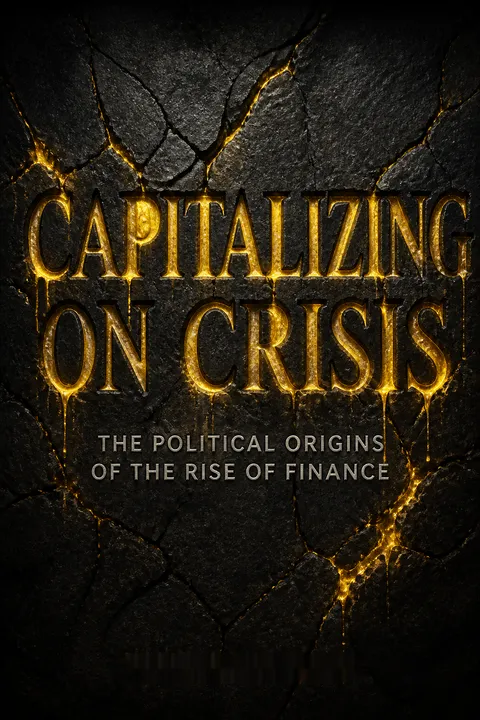
Key Takeaways
1. Financialization: An Inadvertent State Solution to 1970s Crises
Thus financialization was not a deliberate outcome sought by policymakers but rather an inadvertent result of the state’s attempts to solve other problems.
Unintended consequences. The dramatic rise of finance in the U.S. economy, termed "financialization," was not a grand design but an unforeseen byproduct of policymakers grappling with severe economic and political challenges in the late 1960s and 1970s. Facing a confluence of crises, the state improvised solutions that, over time, inadvertently prepared the ground for an era dominated by financial activities. This highlights how major economic transformations can emerge from a series of contingent, reactive decisions rather than a clear, proactive strategy.
Beyond speculation. While financialization is often associated with speculative bubbles or the "shareholder value" revolution, this book argues for a deeper, state-centric origin. Policymakers, seeking to escape immediate dilemmas, constructed a policy regime that deepened the economy's reliance on financial channels. This perspective integrates the role of the state as an active, though not always intentional, shaper of market structures, moving beyond views that treat state action as merely an exogenous constraint.
Policy regime's impact. The core policy shifts that fostered financialization included:
- Deregulation of U.S. financial markets.
- Increased dependence on foreign capital inflows.
- A radical change in U.S. monetary policy.
These changes collectively led to a macro-economic environment characterized by dramatically expanded credit and high, volatile interest rates, which in turn propelled profit-making through financial rather than productive activities.
2. The Triple Crisis of the 1970s: Social, Fiscal, and Legitimation
The central thesis of this book is that the turn to finance allowed the state to avoid a series of economic, social, and po liti cal dilemmas that confronted policymakers beginning in the late 1960s and 1970s, paradoxically preparing the ground for our own era of fi nancial manias, panics, and crashes some three de cades later.
A confluence of pressures. The late 1960s and 1970s saw the U.S. state entangled in a "triple crisis" that challenged its capacity to govern. This period marked a turning point from postwar abundance to an era of perceived scarcity, forcing difficult trade-offs that policymakers struggled to manage. Inflation, in particular, acted as a common thread, exacerbating each dimension of the crisis.
Three faces of crisis:
- Social Crisis: Slowing economic growth intensified distributional conflict, as various social groups competed for increasingly limited resources. Inflation became a "curious social game" where groups tried to advance their claims, leading to an endless cycle of price increases that masked underlying tensions.
- Fiscal Crisis: A structural gap emerged between rising state expenditures (to support both capitalist profits and social welfare) and insufficient tax revenues. This led to increased deficit financing, further fueling inflation and straining the state budget.
- Legitimation Crisis: Public confidence in the state's ability to effectively manage the economy and address social imbalances plummeted. Policymakers were seen as ineffective, leading to questions about the "governability" of advanced capitalist nations.
Avoiding the "public household." Daniel Bell had envisioned a "public household" where society would openly debate and forge a consensus on resource allocation. Instead, policymakers found ways to avoid these politically fraught decisions. The subsequent turn to finance offered an unexpected, albeit temporary, escape from these dilemmas, allowing the state to defer direct confrontation with the hard choices of a post-affluent society.
3. Domestic Financial Deregulation Unleashed Unrestrained Credit
In removing regulations on fi nancial markets, policymakers effectively opened the taps on credit expansion, with the result that the market , rather than regulators, would determine access to credit.
Malfunctioning controls. The New Deal financial system, with its core Regulation Q (interest rate ceilings on deposits), was designed to stabilize the economy and channel capital. However, persistent inflation in the 1970s caused Regulation Q to malfunction, leading to chronic "disintermediation" where funds flowed out of regulated institutions (like thrifts) into higher-yielding market instruments. This starved crucial sectors like housing, small businesses, and municipal governments of credit, creating intense social and political pressure.
The dilemma of allocation. Policymakers faced an impossible choice: either directly allocate scarce credit, which was politically contentious and led to accusations of a "credit police state," or allow market forces to decide. The latter option, deregulation, promised to relieve the state of this unpalatable task. The emergence of the "consumer-saver," demanding market rates on deposits (e.g., through money market mutual funds and "wild card" certificates), provided a powerful constituency for deregulation.
The 1980 Act and its aftermath. The Depository Institutions Deregulation and Monetary Control Act of 1980 eliminated interest rate ceilings on consumer deposits. This pivotal legislation:
- Removed "speed limits" on credit expansion, allowing credit to flow freely to the highest bidder.
- Made credit significantly more expensive, as borrowers competed without restraint.
- Depoliticized credit allocation by shifting decision-making from regulators to the market.
This transformation inadvertently set the stage for financialization by fostering an environment of abundant, albeit costly, credit, while simultaneously demobilizing the consumer movement that had initially championed deregulation.
4. Global Capital Inflows Rescued Reagan's Deficits, Distorting the Economy
What the Reagan policymakers discovered in the early 1980s, then, was that they lived in a world in which capital was available in a potentially limitless supply.
The crowding-out paradox. The Reagan administration's economic policies—combining massive tax cuts with increased military spending—led to unprecedented budget deficits. Conventional wisdom predicted "crowding out," where government borrowing would preempt private investment, driving interest rates sky-high and stifling economic recovery. However, this dire forecast did not materialize, thanks to an unexpected influx of foreign capital.
An inadvertent discovery. Policymakers, initially unfamiliar with the implications of newly liberalized global capital markets, were surprised to find foreign investors, particularly from Japan, voraciously buying U.S. Treasury securities. This was driven by:
- Japan's high savings rate and maturing economy, which redirected capital abroad after its own budget surplus.
- The deregulation of Japanese financial markets in 1980, facilitating capital outflows.
- Paul Volcker's aggressively high interest rates, implemented to combat inflation, which made dollar-denominated assets highly attractive.
Harnessing global finance. While initially unplanned, the Reagan administration quickly recognized the benefits of these capital inflows. The "Feldstein Doctrine" argued that foreign capital supplemented national savings, preventing crowding out and preserving jobs. The Treasury Department actively encouraged these inflows by:
- Eliminating the 30% withholding tax on foreign interest income.
- Launching foreign-targeted Treasury securities programs.
- Issuing "bearer bonds" for anonymous international investors.
This effectively unchained the state from fiscal constraints, allowing it to defer politically difficult decisions about budget austerity.
5. Monetary Policy Shifted to Covert Control, Masking Political Blame
Thus monetarism provided the Federal Reserve with the po liti cal cover it needed to push interest rates high enough to sharply contract the economy and suppress the infl ationary pressures that had troubled policymakers for more than a de cade.
The legitimation crisis. By the late 1970s, the Federal Reserve faced a severe legitimation crisis. With inflation soaring and unemployment rising, public confidence in the state's economic management was at an all-time low. Policymakers needed to take drastic action to stabilize the economy but feared direct political blame for the inevitable pain of higher interest rates and slower growth. This dilemma spurred a search for methods that could guide market outcomes while obscuring the state's active role.
The "Volcker Shock" and monetarism. In October 1979, Federal Reserve Chairman Paul Volcker adopted monetarism, shifting the Fed's focus from directly setting interest rates to targeting the money supply. This was a strategic move to:
- Depoliticize interest rates: By claiming to control the money supply, the Fed could argue that rising interest rates were a natural market response, not a deliberate policy choice.
- Break inflation psychology: A dramatic, seemingly technical shift signaled a strong commitment to fighting inflation, aiming to reset market expectations.
While Volcker himself was skeptical of pure monetarism, its political utility in providing "cover" for aggressive tightening was undeniable, leading to the severe recession of 1981-1982.
Post-monetarist adjustments. Monetarism proved unsustainable due to financial innovation that made the money supply an unreliable target. However, the lesson of political insulation persisted. The Fed then adopted "borrowed reserves targeting" (1982-1987), which allowed the federal funds rate to fluctuate, making it "appear a bit more market determined than Fed determined." This continued effort to "re-naturalize" the economy, presenting policy choices as market-driven rather than state-imposed, became a defining feature of monetary policy, even as it gradually loosened the Fed's direct control over credit expansion.
6. Transparency Paradoxically Led to Market-Driven Policy and Lost Control
Policymakers, it increasingly appeared, did not set policy: they merely validated market expectations of policy, consistent with the balance of risks in the economy.
The limits of obfuscation. The stock market crash of 1987 exposed the liabilities of ambiguous monetary policy. In a crisis, clarity was paramount, forcing the Fed to directly target interest rates. This led to a period of experimentation, culminating in a surprising shift towards greater transparency, particularly under Chairman Alan Greenspan. The conventional wisdom that secrecy enhanced central bank effectiveness was challenged by the idea that credibility, built through clear communication, could make policy more potent.
"Open mouth operations." Beginning in 1994, the Fed started publicly announcing its interest rate targets. This radical departure was intended to:
- Enhance predictability: Inform markets of policy intentions, allowing them to "move ahead" of the Fed and amplify policy effects.
- Manage expectations: Use communication to "condition" bond market responses, reducing the need for frequent or large adjustments to the federal funds rate.
This strategy, dubbed "open mouth operations," meant that market expectations could sometimes substitute for actual policy action, seemingly making policy more efficient and less politically visible.
Abdication of control. However, this reliance on market expectations created a dangerous feedback loop. If markets moved in anticipation of Fed actions, and the Fed then "validated" those expectations, policymakers risked losing independent judgment and becoming mere followers of market sentiment. This culminated in the "Greenspan doctrine," which argued against central banks actively controlling asset prices. The Fed's efforts to depoliticize its role by "following the market" ultimately led to:
- A significant loss of control over the pace of credit expansion.
- The fueling of asset price bubbles, as the market became a "lax master" of restraint.
This dynamic, while politically convenient, laid the groundwork for the devastating financial crisis of the 2000s.
7. Financialization Deferred, Rather Than Resolved, Underlying Scarcity
But critically, the turn to fi nance did not play this role by virtue of unleashing a new era of economic growth— long the American remedy for distributional confl ict (Collins 2000). Rather, domestic fi nancial deregulation, the restructuring of global capital markets, and changes in the implementation of monetary policy removed internal and external constraints on the expansion of credit in the U.S. economy, fueling fi nancialization while also alleviating resource constraints.
An illusion of abundance. The financialization of the U.S. economy, driven by policy choices, created an apparent escape from the resource constraints and distributional conflicts that plagued the 1970s. This was not achieved through renewed productive growth, but by removing traditional "speed limits" on credit expansion. Policymakers found that relying on market mechanisms to discipline demands for capital paradoxically led to an era of seemingly limitless credit.
The mechanisms of deferral:
- Domestic deregulation: Eliminated interest rate ceilings, allowing credit to flow freely and abundantly, albeit at a higher price.
- Global capital inflows: Attracted by high U.S. interest rates, foreign capital financed massive government deficits, preventing crowding out and ensuring liquidity.
- Monetary policy: Shifted to indirect methods, which, while politically expedient, ultimately ceded control over credit expansion to market forces.
These interconnected policies transformed an era of capital scarcity into one of apparent prosperity, effectively depoliticizing contentious decisions about resource allocation.
Fragile foundations. This model, however, was inherently fragile. It merely suspended, rather than eliminated, the underlying problem of scarcity. The rapid pace of credit expansion fueled asset price bubbles and a debt-financed consumption boom, transferring inflationary pressures from goods and services to financial markets. This created an economic system built on precarious foundations, where the illusion of endless capital masked growing imbalances and deferred the inevitable reckoning with distributional questions.
8. Depoliticization Eroded State Capacity and Public Consent
But while reliance on market mechanisms provided essential protection to policymakers, it also involved a signifi cant loss of control over the outcomes of policy.
Governing "at one remove." Depoliticization, a key feature of the financialization era, was not the absence of politics but a reorganization of the boundary between the political and the economic. It allowed policymakers to guide the economy indirectly, shielding themselves from direct responsibility for unfavorable outcomes like inflation or unemployment. This involved:
- Naturalizing market forces: Presenting economic events as outcomes of immutable market laws rather than state action.
- Transferring authority: Shifting decision-making from elected officials to non-elected bodies (like the Federal Reserve) or to the private realm of consumer choice.
- Technocratic expertise: Framing policy as objective, technical decisions, distancing them from value-laden political debates.
This strategy offered political protection but came at a significant cost to the state's capacity and legitimacy.
Loss of control and consent. While depoliticization successfully deflected blame, it simultaneously eroded the state's ability to effectively manage the economy and secure public consent. By ceding control over credit expansion to market mechanisms, policymakers inadvertently fostered instability and asset bubbles. Furthermore, by withdrawing from explicit responsibility for economic outcomes and distributional justice, the state undermined the normative foundations for its actions.
The boomerang effect. The state's efforts to avoid political conflict by governing through the market proved to be a self-limiting strategy. As the financial crisis unfolded, the very mechanisms designed to depoliticize the economy left the state ill-equipped to respond. The public, accustomed to market-driven narratives, reacted with bewilderment or hostility to renewed state intervention, highlighting the erosion of collective capacities to address issues of economic justice and forge a new social compact.
9. The Market: A Surprisingly Lax Master of Economic Discipline
Paradoxically, the market was not the strict disciplinarian imagined by neoliberal visionaries, operating with the blunt force of unforgiving nature, but a surprisingly lax master.
Neoliberal ideals vs. reality. Neoliberal ideology championed the market as a strict disciplinarian, capable of imposing austerity and rational allocation where the state had failed. Policymakers embraced this vision, believing that by removing state controls, the market would naturally curb excessive demands and restore economic balance. However, the experience of financialization revealed a starkly different reality: the market proved to be a surprisingly permissive force, failing to impose the discipline that policymakers sought.
Unleashed, not restrained. Instead of rationing scarce capital, financial deregulation and global capital flows unleashed an unprecedented expansion of credit. This meant that:
- Borrowers were not deterred: Consumers, corporations, and even the government continued to borrow, seemingly indifferent to the rising cost of credit.
- Credit flowed freely: The traditional "speed limits" on credit were removed, leading to a seemingly limitless supply of capital.
- Asset bubbles proliferated: Excess liquidity and speculative behavior were channeled into financial markets, creating unsustainable asset price inflation.
This "lax master" allowed demands to proliferate without effective restraint, leading to a debt-financed boom that masked underlying economic fragilities.
The inevitable reckoning. The market's failure to discipline meant that the fundamental problems of scarcity and distributional conflict were merely deferred, not resolved. The illusion of endless prosperity, built on ever-expanding credit, eventually collapsed with the financial crisis. This exposed the limitations of depoliticization as a governance strategy and the market's inability to self-regulate in a way that ensures long-term stability. The crisis underscored that economic problems are inherently political, requiring conscious decisions about allocation and justice that the market alone cannot provide.
Review Summary
Reviewers overwhelmingly praise Capitalizing on Crisis as a concise, well-researched, and accessible account of U.S. financialization. Many highlight Krippner's central argument that financialization was an unintended consequence of policymakers avoiding difficult distributional decisions during the crises of the 1970s. Readers appreciate the book's tight scope, clear writing, and cohesive narrative connecting deregulation, monetary policy, and credit expansion. Some critics note limitations, including insufficient attention to global dynamics and capital's role, but most consider it essential reading for understanding modern finance and political economy.
People Also Read









Download PDF
Download EPUB
.epub digital book format is ideal for reading ebooks on phones, tablets, and e-readers.








































