
Key Takeaways
A character is not a person; it is a crafted metaphor for humanity
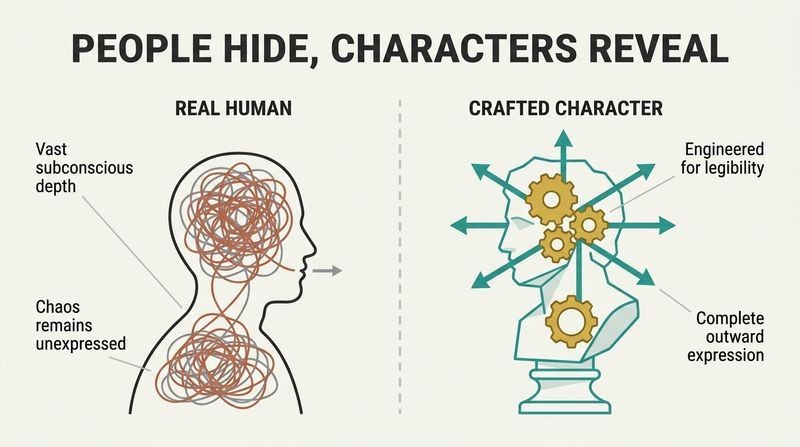
People hide; characters reveal. McKee opens with a provocation: a character is a work of art, no more a human being than a marble statue is a woman. Real people experience far more than they express, while characters express everything they experience. That inversion is why brilliantly written characters feel more vivid, more knowable, and more real than the people we actually meet, including ourselves.
They also stand still for study. Walter White or Odysseus will hold their pose while we probe their motives, whereas our own subconscious stays stubbornly hidden. A character enters a story as a container of the past and a sponge for the future, engineered to be known to the core. We love characters in ways we rarely love people, because we understand them better.
What's striking is how this reframes the writer's job: not to photograph reality but to out-compete it. The claim echoes cognitive science on "narrative transportation," where readers report knowing fictional minds more intimately than real acquaintances. Theory of mind research supports McKee: we infer others' interiors constantly but verify almost nothing. A useful tension worth noting is that documentary and autofiction blur this line, suggesting the character/person divide is a spectrum rather than a wall. Still, the core insight is liberating for writers paralyzed by fidelity to "what really happened." Fiction's power lies precisely in its selective, expressive artifice, not its accuracy.
Stop asking whether your story is plot-driven or character-driven
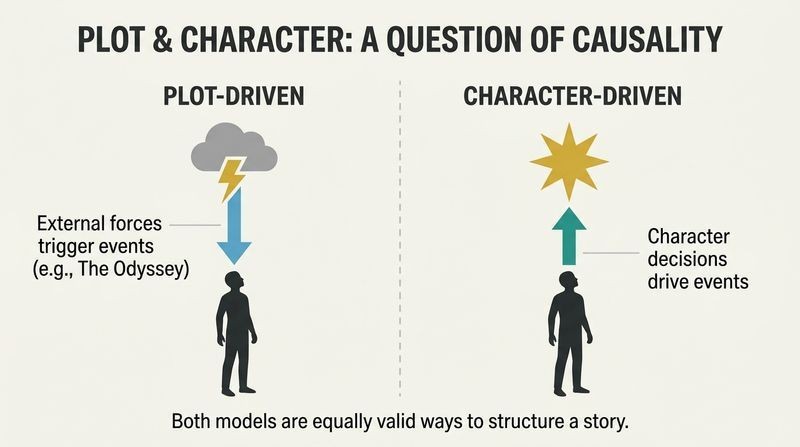
The oldest debate in writing is a category error. Aristotle ranked plot above character; nineteenth-century novelists flipped him. McKee says both miss the point: plot IS character and character IS plot, two sides of one coin. A role becomes a character only when an event brings his choices to life; an incident becomes a story event only when a character causes or suffers its change.
Diagnose causality, not quality. The only useful distinction is where turning points originate. In plot-driven tellings, forces beyond the character's control (natural disasters, war, blind luck) trigger the big events. In character-driven tellings, the protagonist's own conscious and subconscious choices drive the story. Neither is nobler. Homer's Odyssey is plot-driven and immortal. "Character-driven" is often just code for cultural snobbery about art versus commerce.
This dismantling of a sacred binary is one of the book's sharpest moves. McKee correctly identifies that "character-driven" functions as a class marker, signaling prestige, public funding, and critical approval versus disposable mass entertainment. Screenwriting culture has weaponized the phrase for decades. The deeper point connects to systems thinking: internal states and external events form a feedback loop, each continuously generating the other. One caveat: while the coin metaphor is elegant, working writers still find the causality question genuinely useful for diagnosing a stalled draft. McKee grants this. The reframe from value judgment to structural diagnosis is the practical gift here.
Pressure reveals true character; the higher the risk, the deeper the truth
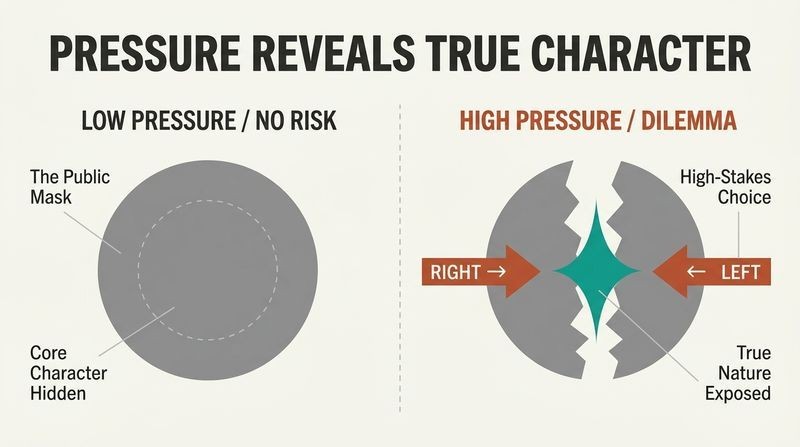
Divide every role into two layers. Characterization is everything observable: age, dress, job, speech, mannerisms, the mask worn in public. True character is the inner nature revealed only through choices made under pressure. Audiences instinctively distrust the mask and keep asking, "But who is he really?"
Only dilemmas expose the core. A choice between an obvious good and an obvious bad reveals nothing; everyone picks the positive. The revealing decision is between two things of near-equal value, positive or negative. When Llewelyn Moss in No Country for Old Men keeps the stolen drug money knowing it may cost his life, his choice under maximum risk exposes who he truly is. McKee's law: the greater the risk and the freer the choice, the deeper and truer it cuts.
This is McKee's most portable tool, and it aligns with moral psychology. Milgram and later behavioral economics showed that stated values predict little; costly choices predict everything. The insight that free choice matters more than constrained choice is subtle and important: a priest refusing to renounce his faith reveals less than an atheist doing so, because sacred vows reduce the freedom. Behavioral scientists call this the "costly signaling" principle. One extension worth flagging: reactions, not just choices, individualize a character. Two brave people choose to fight; how they tremble, joke, or freeze while doing it makes them unrepeatable.
Build complexity from consistent contradictions, not from piled-up traits
A dimension is a living contradiction. McKee borrows Heraclitus: reality holds together through opposites (hot and cold make temperature, wet and dry make humidity). Characters work the same way. When one trait consistently contradicts another (generous yet ruthless, brilliant yet blundering), the tension between them fuses into a dimension. Dimensions make us wonder which side will surface next, which makes characters unpredictable and magnetic.
Contradiction must be consistent and unresolvable. Rescuing a kitten once is not a dimension; it is cheap sympathy. Odysseus, history's first multidimensional character, holds eight contradictions (truthful yet deceitful, protecting yet jeopardizing his men). Tony Soprano runs twelve. Walter White reaches sixteen, split between his caring surface and his savage alter ego Heisenberg. The more dimensions, the more relationships and screen time needed to reveal them.
The dimension-as-contradiction model is McKee's most original contribution to craft, and it maps neatly onto personality psychology's recognition that humans hold opposing traits activated by context. What's valuable is the insistence on consistency and irresolvability: random inconsistency reads as bad writing, while a stable, unwinnable inner war reads as depth. This resonates with Marvin Minsky's "society of mind" and internal family systems therapy, both of which frame the self as competing subagents. A caution: the dimension-counting (8, 12, 16) risks becoming a checklist fetish. Depth is not arithmetic. Still, the underlying principle, that paradox is the engine of fascination, is durable and true.
A character can only be as deep as the forces trying to break him
Antagonism is the sculptor. McKee's causal law: a character grows only as multidimensional as the conflict he confronts. Depth of character is a measure of inner complexity, and complexity cannot exceed the pressure that exposes it. A protagonist facing weak obstacles stays shallow because nothing forces his hidden selves into the open.
Work outward through four levels of conflict. Antagonism comes from physical forces (nature, disease, time), social institutions (jobs, governments, law), personal relationships (family, friends, lovers), and the inner war within the mind itself. The most powerful stories pull conflict inward until private and subconscious battles matter more than external ones. If you want a richer protagonist, McKee says, do not add traits: intensify and diversify the opposition until his choices multiply and his nature is forced to reveal itself.
This principle is why weak villains produce weak heroes, a lesson screenwriters relearn constantly. It parallels the psychological concept of post-traumatic growth: people discover capacities under duress they never accessed in comfort. McKee's insistence on four graduated levels gives writers a diagnostic ladder, and the claim that great stories migrate conflict inward tracks the modern prestige-drama shift from external quests to interior collapse. The constructive challenge: some masterpieces (pure action, farce) thrive on shallow characters facing enormous external stakes and never intend interiority. McKee acknowledges this via his genre taxonomy. Depth is a choice, not a universal obligation, but where you want it, opposition is the only path.
To write a character, become their first actor using the Magic If
Act it out from the inside. McKee adapts Stanislavsky's Magic If. The wrong question is "If I were here, what would I do?" because you are not the character. The wrong question is also "What would my character do?" because that seats you in the audience, guessing at emotions (and guesses become cliches). The right question is: "If I WERE this character in this situation, what would I do?" This is writing in-character.
Inhabit, don't observe. The writer paces the floor, arms waving, living inside the role's senses so the character's anger flares in the writer's own chest. The prerequisite is self-knowledge, because the only mind you will ever know unmasked is your own. McKee dismisses the romantic notion that characters "take over" as literary narcissism; a painter's red does not choose its own shade.
The distinction between the three versions of the Magic If is deceptively precise and genuinely useful. Neuroscience of imagination supports it: simulating an experience from a first-person, embodied perspective activates motor and emotional circuits that detached third-person analysis does not, which is why embodied rehearsal outperforms abstract planning. Method acting and improv training rest on the same mechanism. McKee's swipe at "characters who refuse to obey" is bracing and defensible, though many working novelists report the sensation genuinely, and it may reflect subconscious processing surfacing as felt autonomy rather than mysticism. Either way, the actionable core stands: feel the scene, don't narrate it.
Motivation pushes from the past; desire pulls from the future
Two engines, opposite directions. McKee separates two terms writers usually blur. Motivations are subconscious appetites (for survival, sex, power, meaning, immortality) rooted in the past that push a character forward like wind in a sail. Desire is the specific object the character consciously pursues to rebalance a life thrown off-kilter, and it pulls him toward the future.
The inciting incident fuses them. A story opens with life in rough balance, then an event (Romeo meets Juliet, Hamlet learns of the murder) knocks it sideways. That event awakens a latent motivation and focuses it onto a concrete object of desire: Juliet as wife, a dead shark, an identity. Ernest Becker's claim that death is life's ultimate motivator anchors McKee's ranked list, from primal survival up to transcendence. Motivation never changes; only technology and circumstance do.
Distinguishing the diffuse push of motivation from the targeted pull of desire clarifies a chronic confusion in craft talk. It parallels the psychological split between drive states (hunger, status-seeking) and goal representations (that specific job, that specific person). McKee's Becker-inflected ranking (immortality, survival, balance, pleasure, power, meaning) is essentially a dramatist's remix of Maslow with mortality salience at the root, and terror management theory in social psychology offers empirical backing that death awareness quietly shapes ambition and creativity. The practical payoff: when a character's actions feel arbitrary, the writer probably has a desire without a motivation, a goal with no ancient hunger beneath it.
Give your protagonist a subconscious want that sabotages their conscious goal
Contradiction beats alignment. When a complex protagonist chases a conscious object of desire, McKee says the inciting incident should also stir a subconscious counter-desire that opposes it, making the character his own worst enemy. If both desires point the same way (hungry, so he eats), there is no depth and no one notices. The interest lives in the collision.
Reverse reflection creates the drama. In Carnal Knowledge, Jonathan consciously seeks the perfect woman to love while subconsciously loathing every woman he seduces, systematically crushing each one. In Kramer vs. Kramer, Ted consciously wants his old workaholic life back while a buried need to become a loving father takes over. The subconscious, McKee notes, never lies and obeys one command: survive. Its wants surface only through choices under pressure, glimpsed by the audience but invisible to the character.
This is dramatic irony relocated inside a single skull, and it is the backbone of psychologically rich storytelling. It maps directly onto psychodynamic theory (the ego's conscious aims undercut by repressed drives) and onto modern dual-process models where fast, automatic systems override deliberate intentions. Addiction narratives are the clearest real-world case: the conscious plan to quit, the subconscious pull to use. The craft value is precision: McKee insists the two desires must genuinely contradict, not merely coexist. A minor limitation is that overusing this device produces predictably self-defeating protagonists, a cliche of prestige TV. The subconscious counter-desire works best when its content genuinely surprises.
Design a character incomplete, then engineer the crisis that completes them
Four steps to a finished role. McKee frames character design as Preparation, Revelation, Change, and Completion. At the inciting incident, a major character has never lived at the limits of her capacity; she is raw material with a void McKee calls need. Need is different from desire: desire is the goal she chases, need is the unrealized human potential only the author can see.
Build the climax backward from the void. The writer asks: given this person's untapped depths, what single event would drive her to experience her humanity at its absolute limit? That event becomes the inciting incident. By the climax, the events she survives push her emotional and mental capacities to the edge until nothing is left unrevealed, unfelt, or unexpressed. Medea murdering her children to punish Jason is a character pushed to a stunning, complete extreme.
The need-versus-desire split is one of the book's most useful planning tools, and it inverts the usual outside-in outlining. Instead of plotting events and hoping character emerges, McKee starts with the character's latent ceiling and reverse-engineers the crisis that hits it. This resembles the concept of a "eudaimonic arc" in narrative psychology, where fulfillment comes from realizing dormant capacities under strain. The elegant implication is that the inciting incident is not arbitrary; it must be keyed precisely to the protagonist's specific incompleteness. One nuance: many beloved characters (comic obsessives, action heroes) have no need and never complete, and McKee is clear these are legitimate, just different.
No character reveals himself alone; design a cast to draw out every facet
Relationships are the reveal mechanism. McKee's cast principle: every character draws traits and truths out of every other. Since no one exposes all sides of themselves to any single person, you surround a protagonist with roles each engineered to activate a different dimension. In Pride and Prejudice, Elizabeth's four contradictions are each mirrored and sharpened by one of her four flat sisters, keeping her at the center while individualizing all five.
Anchor empathy in a Center of Good. Readers instantly scan a story for a positive charge to attach to, the Center of Good: a glow of loyalty, wit, or courage that contrasts with a darker surrounding world. It is why audiences root for the Corleones (loyal amid betrayers) and even for Hannibal Lecter (brilliant and calm amid sadistic jailers). Place it in your protagonist, cast him as an underdog, and empathy flows.
The cast-as-system idea elevates character work from solo portraiture to network design, and it anticipates how ensemble prestige television actually functions: each supporting role is a lens. The Center of Good concept is a shrewd correction to the naive belief that audiences need "likable" heroes. They need a relative moral high point, which is why antiheroes work when their world is darker still. This tracks empathy research showing identification is comparative and context-dependent, not absolute. The underdog requirement connects to just-world psychology: audiences withhold empathy from overdogs like the Zuckerberg figure in The Social Network. Sympathy is liking; empathy is "someone like me." Only the latter drives immersion.
Realism means dimensional contradiction; symbolism means one pure, rigid essence
Two poles of the character spectrum. McKee arrays roles from brightest symbol to grayest stock: archetypes (the Earth Mother, pure essence, no subtext), allegories (one value personified, like Joy or Sadness in Inside Out), types (an animated adjective, like Grumpy the dwarf), and stocks (a job, like the sweating divorce lawyer). Symbolic characters are the same inside as out, incapable of change, instantly understood.
Realism inverts every quality. Realistic characters battle inner demons rather than external monsters, hold contradictory dimensions rather than one solid essence, demand work to understand, and end in irony rather than wish fulfillment. McKee warns: never let readers consciously think "Oh, he's a symbol for..." or the character flattens. Smuggle the archetype beneath a never-seen-before surface so its power reaches the subconscious without announcing itself.
This taxonomy usefully explains why a Marvel superhero and a Better Call Saul protagonist require entirely different construction, and why mixing their logics produces incoherence. The warning against visible symbolism echoes a broad principle in aesthetics: art that flags its own allegory (a corporate villain named Mr. Biggman) collapses into kitsch. McKee's swipe at Joseph Campbell's monomyth as "more invention than legend" is provocative and shared by serious folklorists who find the hero's journey overfitted. The valuable takeaway for writers is diagnostic clarity: decide which pole you are working near, because the tools (wish fulfillment versus irony, essence versus contradiction) do not interchange. Genre is a promise about which reality the reader is entering.
Analysis
McKee's Character is the third pillar of his craft trilogy (after Story and Dialogue), and it is best understood as an extended argument against a false binary that has organized creative-writing discourse for a century: plot versus character. His thesis, that the two are a single coin, frees the rest of the book to treat character as the load-bearing structure of all narrative. The book is framework-driven anthology-style: dense with taxonomies (four selves, sixteen primary genres, ten symbolic gradations) and validated through case studies drawn from Odysseus to Tony Soprano to Walter White. Its difficulty for a summarizer lies in that density; McKee reiterates principles across new contexts by design, so the connective tissue matters as much as any single rule.
The book's intellectual spine is the principle of contradiction. From Heraclitus's unity of opposites, McKee derives his most original tool: the dimension, a consistent, irresolvable contradiction that generates the unpredictability we experience as depth. This is genuinely useful and maps onto contemporary psychology's context-dependent, multi-agent view of the self. Where the book is strongest is in operationalizing interiority: the characterization/true-character split, choices under pressure as the only trustworthy revelation, and the conscious/subconscious desire contradiction give writers concrete diagnostic questions rather than vague encouragement.
Where it invites pushback: the dimension-counting can tip into pseudo-quantification, and McKee's confident dismissals (Campbell's monomyth, the "characters who take over" romance) are more assertion than argument, however bracing. His humanist, tough-minded aesthetic clearly prefers ironic realism over wish fulfillment, a taste he mostly owns honestly. The final quarter, mapping casts as counterpoint systems (Pride and Prejudice, A Fish Called Wanda, Breaking Bad), is the payoff: character is relational, revealed through networks of contrast. For any writer, the durable gift is a shift from decorating characters with traits to engineering the pressures and relationships that force truth into the open.
Review Summary
Character by Robert McKee is a comprehensive guide on creating compelling characters for various storytelling mediums. While many readers found it insightful and practical, some criticized its nihilistic undertones and excessive examples from dark, mature stories. The book explores character dimensions, contradictions, and design, drawing from literature, film, and TV. Most reviewers praised McKee's expertise and found the book valuable for writers, though some felt it could be better organized and more concise.
People Also Read


FAQ
What is Character: The Art of Role and Cast Design for Page, Stage, and Screen by Robert McKee about?
- Comprehensive character creation: The book is a deep exploration of how to design multidimensional, memorable characters for stories across literature, theater, and film/TV.
- Four-part structure: McKee organizes the book into sections on the praise of character, building characters, the character universe, and character relationships, offering a layered approach.
- Focus on complexity and metaphor: Characters are presented as artistic metaphors for humanity, with an emphasis on inner contradictions and the interplay of conscious and subconscious desires.
- Practical and theoretical blend: The book combines philosophical, psychological, and storytelling theory with actionable advice and case studies.
Why should I read Character by Robert McKee?
- Master storytelling craft: McKee’s insights help writers, actors, and creators develop compelling, believable, and emotionally resonant characters.
- Deep psychological understanding: The book delves into the conscious-subconscious conflict, moral dilemmas, and the complexity of human motivations, helping writers avoid clichés.
- Actionable tools and examples: Readers gain practical advice on character arcs, dimensions, and cast dynamics, supported by detailed examples from literature, film, and television.
- Bridges theory and practice: McKee’s methods are grounded in decades of experience and analysis, making them relevant for both beginners and advanced storytellers.
What are the key takeaways from Character by Robert McKee?
- Characters as contradictions: Memorable characters are defined by internal contradictions and multidimensionality, not by static traits.
- Unity of plot and character: Plot and character are inseparable; events and character choices are two sides of the same coin.
- Importance of cast design: The relationships and contrasts among characters in a cast are essential for revealing and deepening character dimensions.
- Audience engagement: Empathy, not just sympathy, is crucial for audience connection, and writers must balance good and bad traits to maintain interest.
How does Robert McKee define the difference between fictional characters and real people in Character?
- Characters as metaphors: Characters are artistic creations, designed to be emotive and meaningful representations of humanity, unlike real people who are ever-evolving.
- Finished vs. evolving: A character is a finished work within the story’s timeframe, while a real person is a work-in-progress with a life beyond any narrative.
- Clarity and complexity: Characters are crafted to be clearer and more accessible than real people, who often conceal their inner lives.
- Expressive design: Every aspect of a character is intentionally revealed or concealed by the author for narrative effect.
What are the ten essential faculties or traits a writer needs to create characters, according to Robert McKee’s Character?
- Taste and knowledge: Writers need discernment to reject banality and a deep understanding of their story’s world and humanity.
- Originality and showmanship: True originality comes from unique insights, and writers must balance truth with entertainment.
- Audience awareness and mastery of form: Sensitivity to audience impact and a strong grasp of story structure are crucial.
- Hatred of clichés and moral imagination: Avoiding clichés and expressing dynamic values drive authentic character creation.
- Ideal self and self-knowledge: Writers must bring their best, most honest selves and deep self-understanding to their work.
What is the principle of "dimensional character" in Character by Robert McKee?
- Unity of opposites: Dimensional characters embody contradictions within and between their outer traits, inner selves, and subconscious desires.
- Six types of dimensions: Contradictions can exist between aspects of characterization, between characterization and true character, and between conscious and subconscious desires.
- Defining dimension: One contradiction often stands out as the defining trait that shapes a character’s unique identity and arc.
- Complexity and unpredictability: These dimensions make characters unpredictable, engaging, and lifelike.
How does Robert McKee explain the relationship between plot and character in Character?
- Plot and character unity: McKee asserts that "plot is character; character is plot," emphasizing their inseparability.
- Event and character interplay: Story events cause characters to act or react, while character choices drive the plot’s meaningful changes.
- Balanced causality: Both external forces (plot-driven) and internal motivations (character-driven) are essential, and the creative challenge is to unify them.
- Narrative momentum: The interplay between plot and character propels the story forward and reveals character depth.
What are the four major steps of character design in Character by Robert McKee?
- Preparation: Characters begin incomplete at the inciting incident, with unrealized potential and needs.
- Revelation: The story reveals the character’s true nature through choices and actions, often contrasting with initial impressions.
- Change: Characters may evolve or devolve in morality, mentality, or humanity, experiencing positive or negative arcs.
- Completion: At the climax, characters fulfill their potential or face tragic limits, delivering emotional and thematic resolution.
How does Robert McKee define and use the "Magic If" technique in character creation?
- Imaginative empathy: The "Magic If" invites writers and actors to imagine themselves in a character’s situation for authentic reactions.
- Inside-out approach: Writers ask, "If I were this character in this situation, what would I do?" to inhabit the character’s consciousness.
- Dynamic improvisation: This technique generates spontaneous, believable behavior and emotional depth.
- Essential for complexity: It is crucial for writing in-character and creating nuanced, multidimensional roles.
What is the role of conscious and subconscious conflict in character design, according to Robert McKee’s Character?
- Active subconscious: McKee emphasizes the subconscious as an active, cognitive force influencing desires and actions below awareness.
- Janus-faced mind: The conscious and subconscious selves are inseparable yet conflicted, creating complex inner struggles.
- Moral struggle: Characters must confront antisocial or violent subconscious impulses, which is a primary moral challenge.
- Narrative tension: This duality drives internal conflict and adds depth to character arcs.
How does Robert McKee distinguish between realistic and symbolic characters in Character?
- Realistic characters: These have complex psychologies, inner contradictions, and change over time, requiring audience empathy.
- Symbolic characters: They embody archetypes or social roles, are often one-dimensional, and serve metaphorical or thematic functions.
- Conflict and detail: Realistic characters face inner conflicts and are richly detailed; symbolic characters engage in external conflicts and are simplified for recognition.
- Examples: McKee contrasts Batman (symbolic) with Jimmy McGill (realistic) to illustrate these differences.
What is the importance of cast design and character relationships in Character by Robert McKee?
- Interconnected traits: Characters reveal themselves through relationships, with each cast member drawing out traits and contradictions in others.
- Cast mapping: McKee suggests mapping characters in concentric circles around the protagonist to visualize oppositions and affinities.
- Dynamic interactions: Contrasting traits among characters create dynamic interactions that clarify and deepen characterization.
- Case studies: Examples like Pride and Prejudice and Breaking Bad show how cast design supports complex character development.
About the Author


Download PDF
Download EPUB
.epub digital book format is ideal for reading ebooks on phones, tablets, and e-readers.








































