


Plot Summary
The Fury Feels Again
Bleeding out in the ruins of fallen Cinder Vale, the emotionless warrior Kaiser2 survives the dagger Everest1 buried in his chest. His giant Werewolf brother North6 carries him onto an evacuation train, where Kaiser2 laughs, weeps, and rages for the first time in his life, terrifying his family.
His adoptive mother Mirelle7 confesses the truth: years ago she paid the Reapers to smother his childhood grief, and their spell stole every feeling he possessed. Everest's1 Void magic shattered that curse. Now sensation swamps him, and one hunger eclipses all others. He dispatches his little blue Sayer Dragon, Calcifiend,17 to secretly shadow Everest,1 certain the unfinished business between them will not be settled by his supposed death.
The opening inverts the typical villain: a killing machine reborn into raw, uncontrolled affect. Peckham and Valenti frame emotional suppression as a mother's misguided mercy, indicting the impulse to numb pain rather than metabolize it. Kaiser's flailing between rage, guilt, and tenderness dramatizes emotional illiteracy as a developmental wound, not a moral one. The choice to open on the antagonist-adjacent figure destabilizes reader loyalties immediately. His fixation on Everest, the woman who both killed and freed him, seeds the book's central paradox: that the person who inflicts your deepest wound can also be the one who returns you to yourself.
A Witch Renamed and Leashed
In Stormfell's Wrathbane Palace, the Succubus warrior mocked as the Sky Witch3 is elevated to General Vesper Dragonsbane3 after delivering the captured Dragon, Bastian,4 to Prince Dragor.9 Dragor's9 cunning brother Evard10 corners her with a marriage offer designed to spite his sibling.
Dragor9 keeps dangling the only reward she craves, permission to hunt Cayde Avior, the spy who murdered her sisters, and refuses to grant it until her loyalty is proven beyond doubt.
Then he reveals a devastating secret: the Void is not a weapon but a Fae woman, Everest,1 whom Vesper3 once trained beside. He commands Vesper3 to capture her. Vesper3 stays silent about knowing Everest,1 quietly choosing to shield her, and realizes her worship of Dragor9 has soured into loathing.
Vesper's storyline interrogates power as a gilded trap. Renaming her, marrying her upward, promising vengeance always deferred: these are mechanisms of control disguised as elevation. Her refusal to betray Everest, made in silence rather than defiance, marks the first crack in her performed loyalty. The section stages the Crossborn condition as perpetual conditional belonging, always proving worth to those who despise her origins. Dragor's revelation weaponizes intimacy, turning shared history into a hunting order. Vesper's dawning contempt is not rebellion yet but recognition, the psychological precondition for it, that devotion given to a manipulator is a debt that can never be repaid.
The Void's Hollow Victory
Reunited with her ruthless father, Commander Abraham Rake,8 Everest1 is paraded across Cascada as Kysharna, the prophesied savior. Crowds claw at her, courtiers weep and fawn, and she feels only suffocation. She misses Harlon,12 the friend who chose the Reapers over her, and cannot stop dreaming of the enemy she believes she slew.2
Her half-brother Ransom,5 once her cruelest tormentor, now visits with grudging honesty and goads her to wield her leverage. Everest1 forces her reluctant father8 to march the army to war within four weeks, learning her true power: without her Void, Cascada cannot win. Yet every chant of her name rings hollow, and she nurses a swelling dread that becoming a legend has cost her everything that ever mattered.
Everest embodies the ache of achieved ambition. She spent a life starved for recognition; now, drowning in worship, she discovers adulation is not the same as being seen. The fawning crowds render her an object, a solution to be consumed, which reawakens her battlefield trauma of grasping hands. Her banter with Ransom offers the book's cleverest emotional beat: shared hatred feels safer than false affection because it is at least real. Her intrusive fixation on the enemy she killed foreshadows the collapse of her binary morality. This is the psychology of disillusionment, the slow horror of getting exactly what you wanted.
The Dragon's Golden Chains
Bastian,4 the last living Dragon, has spent weeks imprisoned in a Stormfell tower, a magic-sealing crystal lodged in his flesh so he cannot shift. Prince Dragor9 arrives to taunt him about Vesper,3 the general who chained him, then makes his pitch: swear service to Stormfell and win a title, vast lands, treasure, and most temptingly, healed wings and the open sky.
He even parades a hooded figure to sweeten the terms. After centuries buried underground by the Reapers, starved of flight, Bastian4 must choose between rotting in luxury or becoming Dragor's9 war mount. His hatred for Vesper3 burns hot, yet the promise of wind beneath his wings proves the single shackle he cannot break, binding him to the very captors he despises.
Bastian's arc studies freedom as the most seductive coercion. Dragor understands that a being defined by flight can be enslaved most effectively by offering flight back. The Dragon's centuries of solitary captivity have made him a hoarder of longing, and his weakness for treasure literalizes how deprivation warps desire. The negotiation scene is a masterclass in how oppressors launder domination as opportunity. Bastian accepting the collar to fly again is not weakness but the cruel arithmetic of the powerless: partial freedom bought with servitude. His simmering rage at Vesper, laced with something closer to betrayal, quietly signals a bond that was never merely captor and captive.
Schooling a Warrior's Heart
Sheltered in Ravensview, Pyros's secret refuge carved inside a mountain, Kaiser2 learns to name his emotions under North's6 patient coaching, smashing furniture and even choking his own mother7 when rage overwhelms him.
At Mirelle's7 war council, gang leaders demand alliances she refuses, insisting she will never bow to Stormfell or Avanis. Pressed to name a weakness of the Void, Kaiser2 instead threatens death to anyone who plots Everest's1 harm, exposing his obsession.
Privately Mirelle7 confides that she has long suspected the Reapers of monstrous deception, and that some ancient creature is being roused beneath Never Keep. Kaiser2 conceals Calcifiend's spy-link to Everest,1 quietly hatching a reckless plan to reach her, torn between wanting her captured and wanting her entirely for himself.
This section literalizes emotional education as combat training. North teaches Kaiser to breathe through feeling as one teaches a child impulse control, and the violence of Kaiser's learning curve, choking the woman who raised him, dramatizes how suppressed grief returns as aggression. The council introduces the geopolitical stakes beneath the romance: Mirelle's refusal of alliance versus survival. Kaiser's public declaration protecting Everest converts private obsession into political liability, aligning his heart against his people. His ambivalence, kill her or claim her, reflects the unresolved trauma of a man whose only prior emotion was the desire her power awakened. Love and vengeance remain, for him, indistinguishable instincts.
Captor Turned Confidante
At the battle of Pomair, Everest1 unleashes the Void against Stormfell, nullifying magic on both sides, while Bastian4 tears across the sky as a Dragon ridden into war by Dragor.9 Vesper3 leads her Sinfair legion of windriders and, ordered to seize the Void, snatches Everest1 into the clouds. Instead of delivering her to Dragor,9 she carries Everest1 to a distant crag.
There the two women, who forged a fragile alliance at Never Keep, admit they each hid the truth, argue, and confess they missed one another. Vesper3 releases her, declaring she will never again be a pawn or a princess to anyone. The battle collapses into mutual retreat, and Vesper3 resolves, at last, to answer only to herself.
The clifftop scene is the emotional hinge of the war narrative: two women bred to kill each other choosing conversation over duty. Their friendship models reconciliation across enemy lines, the book's thesis that peace is chosen, never imposed. Vesper's refusal to hand Everest over is her first active treason, and crucially it is motivated by affection, not strategy. The battlefield seen from distance, reduced to a stain on green land, offers the authors' clearest anti-war image. Vesper's vow to serve no one reframes her entire arc: vengeance was always a leash others held. Autonomy, she realizes, is the freedom she actually hungers for.
Blood in the Waterfall Woods
In a captured Pyros town, Ransom5 finds three young Flamebringer girls hiding in a tavern wardrobe and tries to smuggle them out, but Rake's8 cronies drag them off to be tortured. Everest,1 unable to stomach the coming cruelty, sends Calcifiend17 to set a distracting fire, then shifts into her Leopard form and slaughters the sadists Agatha and Jacobin to free the children.
Paralyzed by Medusa venom, she must trust Ransom5 to hide her and fabricate a drunken alibi. The half-siblings who spent childhoods loathing each other are now welded together by a treasonous secret. It is Everest's1 first true rebellion against the father whose approval she once craved8 above all else, and the moment her conscience overtakes her ambition.
The rescue crystallizes Everest's moral awakening through action rather than reflection. Choosing three enemy children over her father's favor, she inverts the tribal logic that has organized her entire world. The Ransom alliance is the book's quiet triumph: siblings raised as rivals discovering that a shared conscience binds tighter than shared blood ever did. Their fabricated alibi makes complicity intimate, a secret that can only be survived together. Psychologically, Everest is beginning to separate identity from paternal approval, the individuation that trauma so often delays. Mercy here is not softness but the hardest, most dangerous choice available to her.
The Dance and the Scars
Forced together at a Stormfell ball, Bastian4 and Vesper3 turn a dance into a scandalous power struggle before she lures him to her chambers. There he commands her to shift into her full Succubus form and reveals what she hides: the healed stumps where her wings were butchered by fellow recruits who deemed a Crossborn unworthy of flight.
She admits she avenged herself and found her only family in her lost sisters Dalia and Moraine. Two broken souls share a bed and a truce, and Vesper3 proposes they secretly follow the ether whispering her name to restore corrupted keystones. Later, repairing one nearly drags Bastian4 into the abyss, and Vesper3 hauls him back with a kiss neither can dismiss as mere lust.
The chapter's power lies in exposure as intimacy. Bastian, himself defined by wings and flight, insists Vesper reveal her stolen ones, recognizing that her armor of insults exists to preempt cruelty. Her mutilation is the literal wound beneath the metaphor of a woman who makes herself hateful so rejection cannot surprise her. Their pact around the keystones fuses romance with quest, giving two people who trust nothing a shared purpose. The near-loss in the ether raises the stakes: caring again means having something to lose. Their kiss, argued over as lust, is the beginning of Vesper's terrifying admission that she wants to be saved.
A Letter on the Blood Moon
At Never Keep, the Reaper Harlon12 watches the Cardinal Reaper Solomon16 return and, instead of punishing the acolytes summoning the creature now called Caelum, praise them and claim the beast as his weapon.
Sickened, Harlon12 secretly studies their forbidden tomes and learns Caelum will cross into the world on the coming blood moon, and that only the Void can nullify the moon's summoning magic. He hires the roguish trader Mavus13 to carry a warning letter to Everest.1
When Everest's1 desperate plea to the Magistrine official Donavon is dismissed as blasphemy against the stars, Mavus13 reveals himself, delivers Harlon's12 letter, and agrees to help. Everest1 suddenly has a deadline, a mission, and an unpredictable ally who claims he simply craves the chaos of shaking the Reaper tree.
Harlon's arc dramatizes faith curdling into horror. His idol Solomon, once his moral compass, becomes proof that institutional piety can sanctify atrocity. The letter transforms Everest from a war's weapon into a prophesied savior of a different order, one who must defy every nation rather than serve one. Donavon's refusal to believe her indicts the way sacred authority insulates itself from truth, gaslighting witnesses into blasphemers. Mavus enters as the trickster archetype, charming and unreadable, whose stated love of chaos should unsettle more than it reassures. The section reframes the entire war as a distraction from an existential threat feeding on it.
The Queen Weds the Vampire
Cornered by the advancing Void, Mirelle7 makes her boldest gambit and marries Lazarus Astrophel,14 king of the Vampires from the distant land of Effelridge. At the ceremony she and Lazarus14 slit an Avanis spy's throat as a wedding gift, then consummate their union before the entire hall to prove the alliance is no political farce.
North6 recoils at bedding down beside bloodsuckers, yet the Vampires bring formidable dual-element power and, crucially, knowledge of the stardust archways and the eschaton star menacing all lands.
Kaiser2 reveals to the assembled gang leaders that the Void has been secretly allied with the Sky Witch,3 and pitches his own audacious scheme to draw Everest1 into their fold, threading every storyline toward the coming reckoning.
Mirelle's marriage is realpolitik as theater. The public consummation weaponizes intimacy for legitimacy, an inversion of the private betrayals that drive the romance plots. Her willingness to trade Pyros's ancient prejudices for survival contrasts sharply with the other lands' suicidal pride, positioning her as the pragmatist who understands that hatred is a luxury the endangered cannot afford. The Vampires' arrival expands the map beyond the war-locked continent, hinting at a wider world. Kaiser's disclosure of the Void-Witch alliance converts scattered subplots into a single converging engine. This is the moment factions begin dissolving into a coalition, foreshadowing the book's argument that only unity can survive Caelum.
The Massacre at Cinder Vale
Everest's1 Void breaches Cinder Vale, letting Cascada retake the city from Avanis. But when the Stonebreakers kneel in surrender, Abraham Rake8 slaughters the captives, savoring their terror. Everest,1 revolted, finally sees her father8 as a monster she can never satisfy or redeem.
Meanwhile the Avanis scholar Septa,11 whose ingenious pit-and-chasm defenses had briefly stalled the Void, is swept down a flooding staircase and nearly murdered by an Incubus wearing the stolen face of her secret love, Earl Tarlord.18
She escapes, warns the true Earl18 of the impostor among them, and is abandoned as the last underbeast retreats without her. Two women on opposite sides are undone by the same war's savagery, one betrayed by kin, the other left to the mercy of enemies.
The massacre is Everest's point of no return, the atrocity that makes her father unlovable and her complicity unbearable. Rake embodies war stripped of purpose, cruelty as identity, killing not to win but to feed himself. Septa's parallel introduces a crucial motif: the Incubus who steals the face of one's deepest desire, weaponizing love itself. That Septa's most secret longing is her Earl externalizes the shame of forbidden feeling. The two women's mirrored ruin, betrayer within and betrayer without, underscores how war corrodes both victors and vanquished. The impostor thread plants the seed of the book's ultimate revelation about who has truly been orchestrating the carnage.
A Crown Bought in Blood
Prince Evard10 publicly announces his marriage to Vesper,3 and the dying king approves it, binding her into the Aquila line against her will. When the old king collapses dead, his sealed decree names Princess Laurena heir, but Dragor9 runs his sister through before she can rule. Roarson's loyalists clash with Dragor's9 forces; Bastian,4 compelled by his oath, is forced to shift and burns Roarson alive to save Dragor.9
Vesper3 cuts a bloody path out, saving Evard10 and striking a fresh bargain: he will locate Cayde for her while she helps him toward the throne. Later she boldly parlays with the newly crowned King Dragor,9 securing Evard's10 safety and cementing her precarious place among monsters who merely wear finer skins than she does.
The succession bloodbath exposes the rot at Stormfell's core: a throne is not inherited but seized over corpses. Bastian's forced burning of Roarson is the cruelest demonstration of his collar, autonomy overridden by magical oath, love made complicit in murder. Vesper's pivot from Dragor to Evard reveals her survival intelligence, converting a forced marriage into leverage. Evard emerges as the rare powerful figure who values her without wanting to consume her, complicating the reader's map of allies. The parlay scene showcases Vesper's evolution from pawn to player. Yet every advance is stained, underscoring that in this world, even winning requires becoming what you hate.
The Runt Ends the Commander
Kaiser2 stows away aboard Rake's8 ship to reach Everest1 but is captured and hauled to the brig, where Rake8 tortures Avanis prisoners and forces Ransom5 to watch, then seizes the mud-caked scholar Septa11 to mutilate her for sport. Watching her father8 revel in torture, Everest1 finally breaks. She severs his sword arm, and when he screams for aid she and Kaiser2 finish him together, beheading the commander8 who once slaughtered Kaiser's2 family.
Branded a traitor by her own people, Everest1 frees the captives, including Septa,11 and plunges into the water with Kaiser2 and Ransom,5 choosing exile over savagery. Her lifelong craving for her father's8 approval dies with him, replaced by a freedom that is equal parts terror and exhilaration.
Patricide here is liberation, not tragedy. Everest and Kaiser executing Rake together fuses their arcs: the man who killed his family and the daughter he brutalized dispatch him as one, transforming shared trauma into shared justice. The scene collapses the enemies-to-lovers tension into grim partnership, the first act they choose in unison. Freeing Septa closes the loop from the Cinder Vale mercy, cementing Everest's new ethic. Psychologically, this is the completed individuation the book has built toward: identity finally severed from paternal validation. Yet the authors refuse triumph, coding her freedom as vertigo, the disorientation of a person who no longer knows who she is without the cage.
Enemies Under One Mountain
After a harrowing chase and a daring rescue of Ransom5 and Galomp,15 Kaiser's2 stardust archway delivers Everest's1 band to Ravensview, where Vesper3 and Bastian,4 snared by Kaiser's2 Vampire scheme, have also been brought.
Lazarus14 lays bare the truth: the eschaton star feeds on war's bloodshed through corrupted ley lines, and only Vesper's3 ether magic can restore the keystones that starve it. He offers both women a free life in Effelridge as payment.
When Everest1 reveals Harlon's12 blood moon deadline, the impossible coalition forms: Flamebringers, Vampires, a Dragon,4 the Void, and Cascadian traitors bound by a common doom. Together they repair the Cascadian keystone in a flooding sea cave, Vesper3 nearly drowning to finish it, and prepare to storm Never Keep within the week.
This is the thematic payoff of every prior alliance: sworn enemies discovering that survival demands the unity their ancestors forbade. The bickering coalition, North against Ransom, Kaiser against everyone, dramatizes how deeply hatred is habituated even among the willing. The keystone-in-the-sea-cave sequence raises the physical stakes while binding the group through shared near-death. Lazarus's offer of Effelridge dangles the utopian alternative to the war-lands: a society organized by mutual respect rather than elemental supremacy. The section argues that cooperation is not idealism but the only rational response to an existential threat, and that the war itself has been the monster's true food all along.
The Reckoning at Stone Castle
In Avanis, Vesper3 finally hunts down Cayde, whose true name is Alestro, the cursed husband of the scholar Septa.11 She tortures and kills the man who murdered her sisters, but the vengeance leaves her hollow and suicidal until Everest1 and Bastian4 drag her back from the brink. Septa,11 discovering the intruders at the keystone, chooses to help rather than betray them, since restoring the corrupted stone will rid her land of its wrongness.
Vesper3 carves runes into her own flesh and nearly dies severing the final ley line's corruption, saved only by ether's healing price. Escaping on Bastian's4 back with Kaiser2 and North6 snatched from a burning treetop, the reunited allies race toward the blood moon's final battle.
Vesper's revenge delivers the book's sharpest lesson: vengeance is a destination that offers no arrival. Killing Cayde does not resurrect her sisters or fill the void his crime carved, and her subsequent suicidality reveals that grief, not justice, was always the wound. Everest's intervention, invoking that her sisters would want her to save the world rather than die for them, reframes survival as the truer honoring of the dead. Septa's choice to aid former enemies completes her mirroring arc, proving conversion across enemy lines is possible even for the war's most sheltered figures. Vesper's near-fatal sacrifice foreshadows the climax's demand that she risk everything for love rather than vengeance.
Voiding the Blood Moon
At Never Keep, the Vampires create a distraction while Everest,1 Vesper,3 Bastian,4 Kaiser,2 and Mavus13 reach the chasm where the Reapers summon Caelum. Everest1 hurls her Void against the blood moon itself and, straining past all limits, accidentally shatters the ancient barrier that has caged the Waning Lands from the wider world.
Vesper3 binds the rising beast with ether while Kaiser2 and Bastian4 butcher the Reapers. Then Mavus13 tumbles into the pit and rises transformed, his face flickering through Dragor,9 the Cardinal Reaper,16 and countless others, revealed as a shapeshifting Incubus who has fused with the monster. As Caelum escapes on black wings, fire-winged twins and a tattooed winged stranger appear, scolding the exhausted allies for their poor timing.
The climax detonates the book's structural secret: the trader, the tyrant king, and the high priest were one Incubus all along, a puppeteer wearing the war's every powerful face. This retroactively reframes the entire plot as manipulation, the enemies who fought so hard were dancing to a single hidden tune. Everest's shattering of the barrier is a triumph laced with catastrophe, victory that opens a new unknown. The intrusion of fire-winged strangers signals a wider cosmos and cliffhanger continuation. Thematically, the monster escaping despite total sacrifice insists that some evils outlast heroism, and that the war's true architect was never any nation but appetite itself, endlessly feeding on division.
Epilogue
Broken in the snow and still wearing Dragor's9 stolen face, the Incubus converses with the monster Caelum inside his own mind. He confesses that centuries ago he killed the real prince9 and took his place, just as he has worn countless powerful faces across the lands. For all those years the beast was his creature, gifting him the gemstones that granted immortality while he fed it with war's endless deaths.
But the monster he served has now forced itself inside him, demanding more souls for the reaping. Cornered, the Man of Many Faces strikes yet another bargain, agreeing to keep Caelum fed in exchange for his continued reign, though he senses he is no longer the master of the fate they weave as one.
The epilogue reframes the villain as a tragic strategist consumed by his own instrument, a Faustian bargainer who outsmarted everyone except the thing he bargained with. His revelation that he has orchestrated the war from behind multiple thrones recasts the entire trilogy's conflict as manufactured, elemental hatred cultivated deliberately to feed a monster. The chilling inversion, that the puppet master has become the puppet, delivers the horror of ambition without limit meeting a power that recognizes no partnership. His final bargain, made from weakness rather than cunning, signals his coming downfall while raising the stakes for the finale: the world now faces not a beast alone but a beast piloting a face no one will suspect.
Analysis
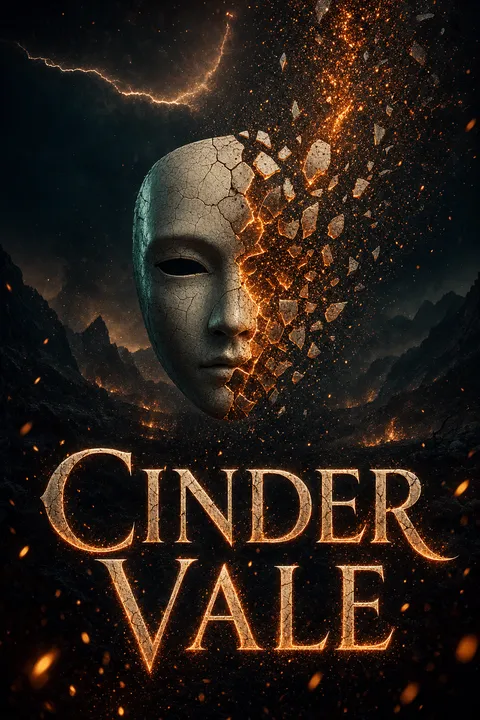
Cinder Vale is, beneath its dark Fae spectacle, a sustained argument that war is a manufactured appetite rather than a natural state. Across three braided enemies-to-lovers arcs, the authors dramatize reconciliation as the only sane response to a world engineered for division. Everest,1 Vesper,3 Bastian,4 and Kaiser2 each carry a wound inflicted by the very tribalism their nations sanctify, and each must betray their homeland to become whole. The recurring motif of the mask, Kaiser's2 suppressed emotions, Vesper's3 armor of insults, the Incubus who literally wears others' faces, insists that identity built to survive cruelty eventually becomes its own prison. Healing, the book proposes, requires exposure: Bastian4 forcing Vesper3 to reveal her severed wings, North6 teaching Kaiser2 to name his feelings, Everest1 confessing love in the face of death. Vengeance is unmasked as a false destination; Vesper's3 revenge against Cayde delivers only emptiness, teaching that grief cannot be paid off in blood. The novel's most radical political claim, voiced by both Everest1 and Kaiser,2 is that peace enforced by domination is merely deferred war, and that only chosen unity across elements can end the cycle, an idea embodied by Lazarus's14 Effelridge and Mirelle's7 pragmatic Vampire alliance. The climactic twist, that a single shapeshifting Incubus has puppeteered multiple thrones to feed a monster on the war's dead, retroactively indicts every character's hatred as cultivated deception. This reframes the entire genre convention of ancient enmity: the enemies were never really enemies, only livestock kept fighting. The shattered barrier and arriving strangers gesture beyond the closed world, suggesting liberation and new peril alike. Ultimately the book locates hope in the individuation of its wounded protagonists, who learn that choosing love and refusing to be pawns is itself a revolutionary act against the architects of endless bloodshed.
Review Summary
Cinder Vale is the third book in the Sins of the Zodiac series, earning an impressive 4.58/5 across thousands of reviews. Readers are captivated by the slow-burn enemies-to-lovers romances, particularly the tension between Kaiser and Everest, alongside Bastian and Vesper. Character growth, witty banter, and multi-POV storytelling are widely praised. The shocking ending left readers emotionally devastated and desperately anticipating book four. Many recommend reading Zodiac Academy first for maximum emotional impact.
Characters
Everest Arcadia
The Void, reluctant saviorA Cascadian warrior long dismissed as a runt, now the prophesied Void whose power nullifies all magic. Daughter of the brutal commander Abraham Rake8 and half-sister to Ransom5, she has spent her life starving for recognition and her father's8 approval. Fierce, sharp-tongued, and stubborn, she craves belonging yet instinctively pushes people away. Newly worshipped as Kysharna, she discovers that adulation feels nothing like being seen. Her conscience increasingly wars with her ambition as she witnesses her people's cruelty. Haunted by the enemy she believes she killed2 and torn between old hatreds and inconvenient new bonds, Everest is a young woman learning that the legend she chased may have cost her the only things that ever mattered.
Kaiser Brimtheon
The Fury rebornA monstrous Flamebringer warrior known as the Fury, adopted as a boy by Mirelle7 and raised alongside North6. For most of his life a Reaper spell suppressed all his emotions, leaving him a placid, feelingless killer. Everest's1 Void magic shattered that curse, flooding him with sensations he cannot name or control. Now he lurches between rage, tenderness, guilt, and obsession, learning emotional literacy like a child in a warrior's body. His fixation on Everest1, the woman who both killed and freed him, blurs the line between wanting her dead and wanting her entirely. Fiercely loyal to North6 and Calcifiend17, Kaiser is dangerous, disoriented, and searching for who he truly is beneath the numbness.
Vesper
The Sky Witch, CrossbornA Crossborn Succubus warrior of Stormfell, scorned for being born to another land yet risen to General. Known and feared as the Sky Witch, she wears every cruel label as armor, making herself hateful so rejection can never surprise her. Beneath the bravado lies profound grief for her lost sister-warriors, Dalia and Moraine, and a mutilation that shaped her: wings butchered by cruel recruits. Consumed by a vow to avenge her sisters against the spy Cayde, she practices dark ether magic and treads a lonely, self-destructive path. Brilliant, lethal, and allergic to being anyone's pawn, Vesper is a woman convinced she deserves only ruin, quietly terrified of anyone who insists otherwise.
Bastian Carderrin
The last DragonThe only living Dragon, imprisoned for centuries underground by the Reapers before being captured for Stormfell. Ancient, powerful, and defined by an insatiable hunger for the sky, he agrees to servitude in exchange for healed wings and freedom to fly. Marked by the Tower tarot card he believes dooms him to destruction, he carries the weariness of a man who has ruined everything he touched. His initial fury at Vesper3 for chaining him slowly transforms into fierce devotion. Patient where she is volatile, he insists on seeing the wounded truth beneath her armor and refuses to be merely used. Bastian craves a single mortal lifetime lived fully, and he wants to spend it with her.
Ransom
Everest's rival half-brotherAbraham Rake's8 son and Everest's1 lifelong tormentor, a Merrow warrior who once basked in their father's8 favor. As Rake's8 affections shift to the Void, Ransom's certainties crumble. Beneath the swagger hides a coward who has never truly killed in battle and a conscience that surfaces when cruelty crosses a line. Grudgingly, he becomes Everest's1 unlikely ally and self-declared sentinel, bound to her by shared secrets and a rejection of their father's8 savagery.
North
Kaiser's Werewolf brotherA towering, warm-hearted Werewolf, Kaiser's2 adoptive brother and emotional tutor. Loud, irreverent, and quick to laugh, he patiently teaches Kaiser2 to name and control his feelings. He fears snakes, drowning, and commitment, having sworn off men after a disloyal lover broke his heart. Beneath the comic energy lies fierce devotion to his family and a steadying loyalty that anchors Kaiser2 through his chaotic rebirth.
Mirelle Brimtheon
The Matriarch of PyrosThe Matriarch, ruler of Pyros and adoptive mother to Kaiser2, North6, and many war orphans. A strategist of ruthless cunning who commands magpies and gang leaders alike, she once paid the Reapers a terrible price to spare Kaiser's2 grief. Fiercely protective, morally flexible, and always three plans ahead, she will trade tradition, pride, even her own body for her people's survival, never showing her full hand even to her children.
Abraham Rake
Cascada's ruthless commanderEverest1 and Ransom's5 father, the revered and feared commander of Cascada's armies. A merciless warlord who lives for conquest and takes pleasure in the suffering of the defeated. He bullied and belittled Everest1 her whole life, then showered her with hollow affection once her Void made her valuable. Charismatic to his troops and monstrous behind closed doors, he embodies war as appetite, treating even his children as tools.
Dragor Aquila
Ambitious prince of StormfellA cold, striking prince of the air kingdom who holds both Vesper3 and Bastian4 under his control through oaths and captivity. Consummately manipulative, he elevates Vesper3 only to leash her, dangling her vengeance as bait while demanding endless proof of loyalty. Locked in a lethal contest with his siblings for their dying father's crown, he treats every person as a piece to be positioned on his board.
Evard Aquila
Cunning schemer princeDragor's9 younger brother, commander of Stormfell's smallest army but its sharpest tactician. Uninterested in the flesh and haunted by a lost love, he pursues Vesper3 as a powerful political match rather than a romantic one, offering her genuine aid in her vengeance. A rare figure who values her without wishing to consume her, he schemes patiently toward a throne he means to share.
Septa Thorngrove
Avanis scholarA Sphynx scholar of Avanis, married to the cursed spy Alestro yet secretly longing for the fearsome Earl Tarlord18. Bookish, perceptive, and physically frail, she proves her worth by devising the pit-and-chasm defenses that briefly stall the Void. Underestimated by her crude husband and the court, she gradually finds respect and courage, ultimately forced to choose between loyalty to her land and the truth she witnesses.
Harlon Brook
Disillusioned ReaperEverest's1 dear friend who chose the Reapers over her, now stationed at Never Keep. His faith collapses as he witnesses the Reapers summoning a monster and his mentor Solomon16 sanctioning atrocity. Wracked with guilt for once trying to force Everest's1 hand, he risks everything to spy on his order and smuggle out a warning, praying she will forgive him and heed his desperate plea.
Mavus Angelico
Roguish nomad traderA charming, unpredictable trader who roams the Waning Lands aboard the floating town Wandershire, dealing in secrets as readily as goods. He once sold Everest's1 identity yet claims to have elevated her to glory. Self-professed lover of chaos, always angling for coin and mayhem, he agrees to help against the monster for reasons of his own. Impossible to fully trust, impossible to fully dismiss.
Lazarus Astrophel
Vampire king of EffelridgeThe copper-haired ruler of the Vampires from the peaceful land of Effelridge beyond the war-torn nations. Wielding multiple elements and endless charm, he marries Mirelle7 to forge an alliance and brings crucial knowledge of the eschaton star and the stardust archways. He preaches unity across elements and bloodlines, offering the war-weary a glimpse of a world organized by respect rather than conquest.
Galomp
Everest's loyal sentinelA gentle, pale-haired giant of unusual height and simple, earnest speech, and one of Everest's1 few true friends. Guileless and devoted, he names himself her sentinel and follows her into deadly danger without hesitation. His warmth and loyalty offer Everest1 a rare taste of friendship untainted by fear or flattery, and his blunt honesty cuts through the schemes around her.
Solomon Imai
The Cardinal ReaperThe supreme leader of the Reapers, who claims to be the stars' chosen ear. After professing doubt, he embraces the summoning of the monster Caelum and names himself its master, feeding it sacrifices at Never Keep and hunting the Void for his own ends.
Calcifiend
Kaiser's Sayer DragonA small, shimmering blue Sayer Dragon bonded to Kaiser2, whom he rescued as an injured hatchling. Adorable and loyal, he serves as Kaiser's2 secret eyes on Everest1, though his affections increasingly stray to her, making him a charming double agent between two enemies.
Earl Tarlord
Avanis warlordThe fearsome, blood-drenched Manticore warlord of Avanis who conquered Cinder Vale and built a castle atop its ruins. Brutal in battle yet surprisingly attentive to Septa11, he values her mind and quietly stirs the longing she struggles to suppress.
Plot Devices
The Void
Magic-nullifying superweaponEverest's1 rare and prophesied power to cancel all magic, dragging it into oblivion. Wielded like an invisible blade, it strips enemies of their elements, their Order forms, and their defenses, felling entire armies. Because it cannot distinguish friend from foe and only strikes in straight lines, it endangers her own allies as much as her enemies, forcing careful positioning in battle. The device makes Everest1 the single most coveted figure in the war, the promised key to victory or peace, which is precisely why every nation hunts her. Crucially, it does not affect magic already stored in runes or certain crystals, a limitation that shapes both her enemies' strategies and the story's climactic gamble against the blood moon.
Keystones and the ether
Corrupted power feeding evilAncient stone monoliths, carved with zodiac faces, that anchor the ley lines channeling the world's magic through the earth. Someone has driven iron spikes into them, corrupting the flow so that the deaths of war are siphoned to feed the lurking monster rather than returning to the land. Vesper3, uniquely able to wield the dark magic called ether, is drawn by voices whispering her name to repair each keystone, a process that demands blood sacrifice and nearly kills her every time. The device links the seemingly endless war to a hidden purpose, reframing the bloodshed as deliberate nourishment for a growing horror, and it gives Vesper3 a redemptive quest that runs parallel to her hunt for vengeance.
Calcifiend's spy-link
Secret surveillance of the belovedKaiser's2 bond with his Sayer Dragon lets him see through Calcifiend's17 eyes, and he sends the little creature to secretly watch Everest1 at all times. This spy-link keeps Kaiser2 tethered to the woman who obsesses him, feeding his longing and jealousy while she believes the dragon is merely her adopted pet. It allows the hidden coalition to track the Void's movements, informs Kaiser's2 audacious plan to reach her, and creates dramatic irony as Everest1 confides secrets to a creature reporting straight to her enemy. When his link is exposed, it brands her a traitor by proving she once let the Sky Witch3 go free, tightening the web binding all sides together.
Stardust archways
Instant travel across landsAncient stone archways that, when fed a pinch of glittering stardust, open a vortex allowing passage from one land to another in a single step, defying time and space. Long hidden by the Reapers and known to the Vampires, they let the coalition cross the continent in moments, delivering strike teams to distant keystones and to Never Keep. The stardust itself can only be created by Dragon fire scorching fallen comets, which retroactively explains the horror of Bastian's4 centuries of captivity: he was enslaved to manufacture it. The archways collapse the vast map into striking range, enabling the climactic assault, while their forbidden power hints at how easily armies could be moved to wage total war.
The eschaton star and blood moon
Apocalyptic summoning deadlineA ravenous, sentient monster called Caelum, or the eschaton star, waits in an abyss beneath Never Keep, fed by war's deaths and desperate to cross into the world and devour everything. The Reapers plan to summon it fully on the night of the blood moon, whose lunar magic can open the gateway between realms. Harlon's12 stolen prophecies reveal that only the Void can nullify the moon's power and thwart the crossing, imposing a ticking clock that unites sworn enemies into a single coalition. The device transforms the entire war narrative into a race against an existential threat, revealing that the endless conflict between nations was never the true story but merely fuel for something far worse.
About the Author
Other books by Caroline Peckham



Download PDF
Download EPUB
.epub digital book format is ideal for reading ebooks on phones, tablets, and e-readers.








































