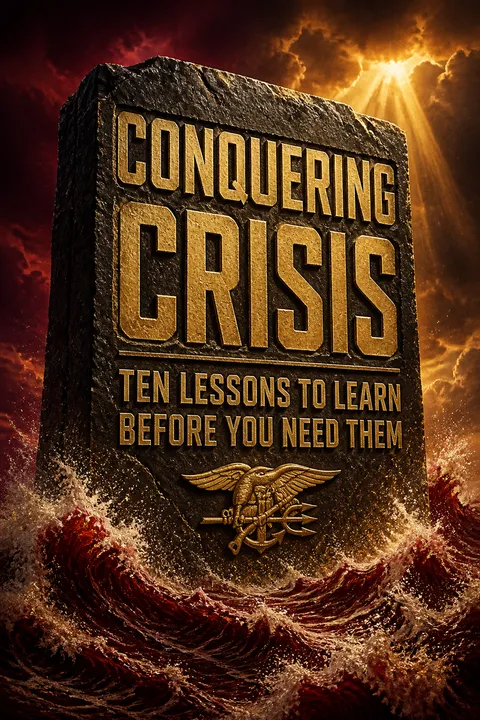

Key Takeaways
1. First reports are always wrong; verify before you act.
When a crisis explodes, the people on the ground are generally panicked, traumatized, or under so much burden to report that they get the facts wrong.
Skepticism is mandatory. In the initial moments of any disaster, information is highly volatile, fragmented, and frequently incorrect. McRaven illustrates this with the Battle of the Bulge, where Allied commanders dismissed early warnings of a massive German buildup due to a false sense of security. Leaders must resist the urge to make definitive public statements or take drastic actions based on unverified initial reports.
Verify before acting. To prevent making critical errors, leaders must establish a systematic process to filter incoming data. During a deployment in Chile, McRaven's team detonated a massive demolition charge, initially reporting zero damage based on quick, local feedback. However, a physical inspection of the nearby village revealed that the blast wave had shattered every window in town, proving that early assessments are often dangerously incomplete.
Key verification steps. To manage the assessment phase effectively, leaders should implement the following protocols:
- Maintain healthy skepticism toward both exceptionally good and exceptionally bad news.
- Avoid making absolute, declarative statements to superiors or the public early on.
- Establish a corporate procedure to evaluate the quality and source of incoming information.
2. Assemble a "Council of Colonels" to get the unvarnished truth.
A Council of Colonels. It was an old Army term for a group of experienced men and women who wouldn’t hesitate to speak truth to power.
Combatting organizational groupthink. During a crisis, internal teams naturally become defensive, seeking to protect their reputation and justify past decisions. When the US Ambassador to Afghanistan accused McRaven's special operations task force of causing "strategic defeat" through night raids, McRaven's initial instinct was to angrily defend his men. Realizing he needed objective ground truth, he assembled a "Council of Colonels"—a handpicked group of trusted, candid advisors to investigate the operations.
Unvarnished truth-telling. Led by Colonel Bill Ostlund, this council bypassed traditional hierarchies to deliver a blunt, painful assessment: the night raids were indeed alienating local Afghans and conventional forces. This honest feedback allowed McRaven to temporarily halt operations, restructure coordination protocols, and integrate Afghan partners. Without this independent council, the task force would have continued down a path of strategic failure.
Advisory team guidelines. When building your own advisory council during a crisis, keep these principles in mind:
- Select members from outside your immediate inner circle who are not afraid of personal cost.
- Ensure the council has direct access to raw data and frontline personnel.
- Use the council selectively to avoid undermining the established chain of command.
3. Bad news does not get better with age; report it immediately.
If you fail to notify your boss, if you fail to make the bad news public, if you fail to disclose all the unpleasant details, the crisis will get worse.
Bad news ages poorly. Delaying the disclosure of a mistake or disaster never mitigates its impact; it only erodes trust and compounds the damage. McRaven learned this firsthand in Iraq when his operators accidentally killed a security guard who turned out to be Prime Minister al-Maliki's cousin. Instead of waiting for morning, McRaven immediately woke up General Dave Petraeus at 2:30 a.m. to report the incident, allowing the command to initiate damage control before sunrise.
The cost of concealment. In contrast, McRaven points to the Iran-Contra affair, where President Ronald Reagan's administration repeatedly deflected and withheld information about arms sales to Iran. This attempt to control the narrative severely damaged Reagan's credibility, dragged out congressional investigations for years, and tanked his approval ratings. Transparency and immediate accountability are the only ways to preserve long-term organizational integrity.
Immediate reporting protocols. To handle bad news effectively, leaders must adhere to a strict reporting discipline:
- Notify superiors immediately, regardless of the hour or the incompleteness of the details.
- Accept full responsibility for the incident rather than shifting blame to subordinates.
- Present a clear, actionable plan to address and resolve the crisis alongside the bad news.
4. Weaponize the truth through radical transparency.
John Richardson understood that the only way out of a crisis is to ensure that the truth and transparency lead the way.
Weaponizing radical transparency. When an organization is engulfed in a public relations nightmare, hiding behind corporate jargon or legal shields only fuels public suspicion. McRaven demonstrated the power of transparency in Afghanistan by inviting skeptical journalists directly onto his top-secret base to observe the rigorous targeting process. By showing them the extensive measures taken to avoid civilian casualties, he transformed hostile critics into fair, objective reporters.
Owning the failure. A powerful military example of this occurred in 2017 when the US Navy suffered two catastrophic ship collisions (the USS Fitzgerald and USS John S. McCain) that killed seventeen sailors. Rather than obfuscating the systemic training and operational failures, Chief of Naval Operations Admiral John Richardson stood before the public, detailed every single error, and declared, "I own this!" This raw honesty disarmed critics and allowed the Navy to begin rebuilding its reputation.
Transparency action steps. To weaponize the truth during a crisis, leaders should execute the following:
- Stand in full view of the public and answer difficult questions directly and honestly.
- Praise and protect internal whistleblowers who brought the crisis to light.
- Share detailed, unvarnished reports of the failures with stakeholders and peers.
5. Move all your options forward to maximize decision space.
The leader leaves no option unexamined in an attempt to move all their options as close to the crisis site as possible.
Maximizing decision space. In a rapidly evolving crisis, a lack of information can paralyze decision-making if leaders rely on a single course of action. During World War II, Winston Churchill faced an existential threat from the German battleship Tirpitz. Rather than relying solely on aerial bombing, Churchill demanded and moved forward multiple highly creative options, including a daring commando raid on the Saint-Nazaire dry dock and the deployment of experimental X-Craft midget submarines.
Parallel planning in action. Similarly, during the 1990 Iraqi invasion of Kuwait, President George H.W. Bush and Brent Scowcroft immediately mobilized diplomatic, economic, and military options in parallel. They deployed carrier battle groups, secured UN resolutions, and built a global coalition simultaneously. By moving all options forward, they preserved maximum decision space, ensuring they were prepared for any turn of events.
Preserving operational flexibility. To ensure your organization has sufficient flexibility during a crisis:
- Develop and resource multiple contingency plans simultaneously rather than sequentially.
- Deploy trusted, competent professionals directly to the crisis site to monitor developments.
- Maintain a pre-rehearsed plan for rapidly mobilizing diverse corporate resources.
6. Trust the Second Law of Thermodynamics: inaction breeds chaos.
Left alone, the natural state of things moves toward maximum entropy.
Inaction breeds chaos. The Second Law of Thermodynamics states that physical systems naturally degenerate into maximum disorder (entropy) unless acted upon by an external force. McRaven applies this scientific principle to leadership, arguing that crises never resolve themselves through passive waiting. In 2006, McRaven sought approval to strike Al Qaeda leader Mokhtar Belmokhtar in Algeria, but faced resistance from officials who preferred to wait and let the situation resolve itself.
The cost of delay. Because the strike was delayed and ultimately compromised, Belmokhtar remained free to orchestrate devastating terror attacks over the next decade, resulting in the deaths of over 150 people. McRaven uses the "Strategic Decision Curve" to show that as time passes, the difficulty of resolving a crisis increases exponentially. Decisive action must be taken early, even when information is incomplete, to arrest the momentum of chaos.
Decisive action principles. To combat entropy in your organization during a crisis:
- Accept the inherent risks of taking action rather than defaulting to comfortable paralysis.
- Understand that delaying a difficult decision only makes its eventual execution harder.
- Intervene aggressively to disrupt the crisis's momentum before it gains complexity.
7. Do not rush to failure under the pressure of urgency.
If you rush through the planning and the preparation, then it’s likely your actions will be flawed and result in failure.
The danger of artificial urgency. While speed is essential in a crisis, there is a critical difference between acting decisively and rushing blindly into execution. McRaven highlights the tragedy of Operation Eagle Claw, the failed 1980 mission to rescue American hostages in Iran. Driven by political pressure and a perceived shortage of time, the military rushed the planning and aborted crucial dress rehearsals, leading to a catastrophic helicopter collision at Desert One.
Deliberate preparation over haste. In contrast, during the 2011 raid on Osama bin Laden's compound, McRaven resisted the urge to rush the execution. Despite intense pressure, he insisted on three weeks of rigorous, repetitive rehearsals, simulating every potential failure—including a helicopter crash. When a helicopter did crash during the actual mission, the team transitioned seamlessly to their backup plan because they had not rushed their preparation.
Avoiding the rush to failure. To maintain a deliberate pace under extreme pressure:
- Use all available "runway" (time) to plan, prepare, and rehearse before initiating action.
- Never sacrifice essential training or safety checks to satisfy external timelines.
- Anticipate and thoroughly rehearse worst-case scenarios and contingency plans.
8. Micromanagement is necessary to establish clear expectations.
What I have found is that you need to micromanage people until they know precisely what you require of them.
Redefining a taboo word. In modern business, micromanagement is widely viewed as a toxic leadership trait that stifles employee autonomy. However, McRaven argues that during a crisis or high-stakes operation, hands-on leadership is absolutely essential. As a young operations officer, McRaven was corrected by his commanding officer, Bob Mabry, who explained that micromanagement is not about a lack of trust, but about ensuring absolute clarity of expectations.
Precision in execution. This philosophy is epitomized by legendary UCLA basketball coach John Wooden, whose "Pyramid of Success" emphasized mastering the smallest details, down to how players put on their socks to prevent blisters. By micromanaging practices and repeating plays to the point of perfection, Wooden ensured his players executed flawlessly under pressure. In a crisis, leaders must be exacting in their instructions to eliminate ambiguity and prevent catastrophic misunderstandings.
Effective oversight strategies. To apply constructive micromanagement when the stakes are high:
- Establish highly specific, unambiguous expectations for every member of the team.
- Deeply examine the technical details of your organization's contingency plans.
- Loosen the reins only after your team has demonstrated a perfect understanding of your intent.
9. Dictate the tempo of the crisis to regain control.
To shift the crisis in your favor and shape the outcome, you must take the initiative and strike boldly against the most vulnerable area of the crisis.
Reclaiming the initiative. When a crisis strikes, the sheer speed of unfolding events can easily overwhelm an organization, forcing leaders into a purely reactive posture. During the Second Punic War, the Roman general Scipio Africanus realized that directly confronting Hannibal on Italian soil was a losing battle. To dictate the tempo, Scipio launched an indirect, bold invasion of Carthage, forcing Hannibal to retreat from Rome to defend his homeland.
Slowing the adversary. McRaven applied this lesson in 1990 when boarding the non-compliant Iraqi tanker Amuriyah. The ship's master was ignoring radio commands and maintaining full speed, dictating the tempo of the encounter. To regain control, McRaven threatened an emergency shutdown of the ship's engines—a move that would ruin the propulsion system. This decisive leverage forced the master to immediately order his crew to stop resisting.
Tempo control tactics. To shift the momentum of a crisis in your favor:
- Identify and target the most vulnerable, high-leverage aspect of the problem.
- Execute a single, powerful action designed to slow down the fastest-moving threat.
- Consolidate your gains and deploy heavy resources to dictate the final outcome.
10. Prioritize morale checks to keep your team effective.
If, as a leader, you fail to maintain and manage the morale of your staff, you will find good advice lacking, your organizational response times slow, and your best people weighed down by fear, indecision, and self-doubt.
The strategic value of morale. Morale is not a soft, secondary concern; it is the primary driver of an organization's operational effectiveness during a crisis. When McRaven had to publicly cancel a highly controversial, multi-million-dollar land project in Houston, his personal reputation and his staff's spirits were crushed. A timely "morale check" from a trusted colleague reminded him that his team was watching his reaction to the failure.
Leading with visible confidence. To restore his team's confidence, McRaven spent the following days walking the halls, laughing, engaging with staff at all levels, and projecting a calm, reassuring presence. By managing his own composure and actively showing his employees that they were valued, he prevented the crisis from paralyzing the university system. Leaders must actively manage their time to prioritize the emotional well-being of their workforce.
Morale management protocols. To sustain your team's spirit during difficult times:
- Maintain a highly visible, confident, and approachable presence throughout the organization.
- Cultivate a trusted personal confidant who can boost your own spirits and keep you grounded.
- Actively demonstrate care for the rank-and-file employees who bear the brunt of the crisis.
Review Summary
Conquering Crisis receives high praise from readers, with an average rating of 4.39/5. Reviewers appreciate McRaven's practical advice, engaging storytelling, and leadership insights drawn from his military experience. The book's ten lessons for crisis management are widely seen as valuable for both military and civilian contexts. Readers find the anecdotes compelling and the advice actionable. Some critics note repetition of themes from McRaven's previous works, but most consider it a worthwhile read for anyone facing challenges or in leadership positions.
Download PDF
Download EPUB
.epub digital book format is ideal for reading ebooks on phones, tablets, and e-readers.








































