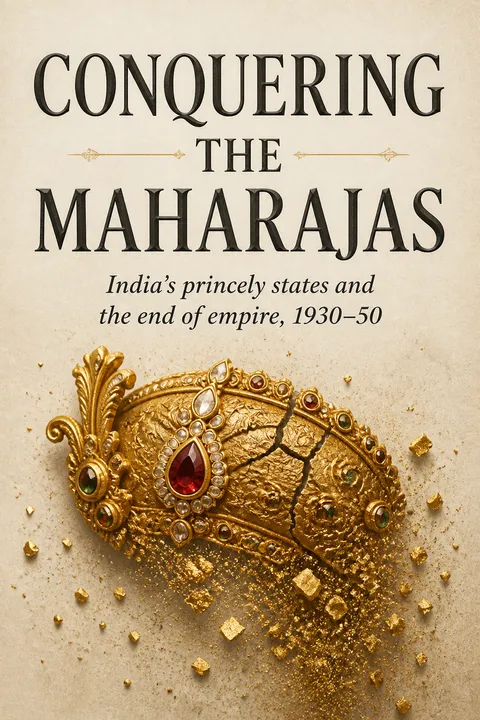
Key Takeaways
1. Layered sovereignty defined the relationship between the British Crown and the princely states.
The native Chief has become by our policy an integral factor in the imperial organisation of India.
Fragmented imperial authority. The British Raj operated on a system of indirect rule, leaving over 560 princely states with internal autonomy while the Crown held ultimate suzerainty. This created a complex universe of shared sovereignty where local rulers maintained their thrones through treaties and sanads.
The intervention paradox. Although British viceroys repeatedly promised to respect the princes' sovereign rights, the Political Department frequently interfered in internal affairs to correct maladministration or depose highly erratic rulers. Examples of this intervention include:
- The deposition of Baroda's ruler in 1875 for misrule and attempting to poison a British resident.
- The forced exile of Alwar's Maharaja in 1933 due to financial chaos and severe oppression of his subjects.
Laissez-faire consequences. In the early twentieth century, a policy of general non-intervention was adopted to secure the princes' loyalty against rising nationalist sentiment. This hands-off approach insulated the rulers from political realities, fostering a false sense of permanent autonomy that would shatter when British protection was abruptly withdrawn.
2. The failed All-India Federation of the 1930s foreshadowed the difficulties of postcolonial integration.
The relationship of the Paramount Power with the states is not a merely contractual relationship, resting on treaties made more than a century ago.
A stillborn scheme. The Government of India Act of 1935 proposed an All-India Federation to unite the British provinces and the autonomous princely states under a single federal structure. However, the scheme required voluntary accession by a majority of the states, effectively giving the conservative rulers a veto over India's constitutional progress.
Fears of erosion. The princes consistently opposed the federation because they feared a centralized federal government dominated by nationalist politicians would erode their treaty-guaranteed sovereignty. Key sticking points included:
- Disagreements over representation in the federal legislature.
- Concerns regarding the loss of state revenues from customs and excise duties.
- Suspicion over the jurisdiction of the Central Intelligence Bureau within state borders.
Suspension and legacy. With the outbreak of the Second World War in 1939, the British government suspended the federation preparations, leaving the states in an ambiguous political limbo. The decade of fruitless negotiations proved that the layered sovereignty of indirect rule had created deeply entrenched interests that would resist any voluntary constitutional reform.
3. Grassroots popular movements undermined the traditional legitimacy of autocratic rulers.
The mainstay of the autocracy of the Indian princes is the British power and with the British off the scene, the edifice of the autocratic princely structure will also crumble...
The popular awakening. During the 1920s and 1930s, the subjects of the princely states began to organize politically, forming local organizations known as Praja Mandals. Coordinated by the All-India States' People's Conference, these groups agitated for civil liberties, responsible government, and an end to feudal exploitation.
Shifting Congress policy. Initially, the Indian National Congress maintained a hands-off policy toward the states to focus on challenging British rule in the provinces. However, this changed with the Haripura Resolution of 1938, which declared the states to be an integral part of India and authorized active support for the subjects' struggles. This shift resulted in:
- Protests and satyagrahas erupting across numerous states, including Rajkot, Mysore, and Travancore.
- Princes facing dual pressure from top-down nationalist demands and bottom-up popular uprisings.
- The British government responding by enacting protective laws to shield the rulers from external political agitation.
The crumbling edifice. The growing alliance between the nationalist movement and the states' subjects stripped the princes of their moral claim to represent their people. It became clear that once the protective umbrella of British military power was removed, the autocratic durbars would be unable to withstand the democratic aspirations of their own populations.
4. The lapse of British paramountcy left a dangerous constitutional vacuum in South Asia.
When a new fully self-governing or independent Government or Governments come into being in British India... the rights of the States which flow from their relationship to the Crown will no longer exist...
The legal void. The Indian Independence Act of 1947 did not partition the princely states; instead, it unilaterally terminated British paramountcy and declared all existing treaties null and void. This legal maneuver technically restored complete sovereignty to the rulers, leaving them untethered from any central authority on August 15, 1947.
Conflicting interpretations. The sudden withdrawal of the Crown created a highly contested debate over where ultimate political power and sovereignty resided.
- The princes and the Muslim League argued that the states had the legal right to declare complete independence.
- The Indian National Congress insisted that the states could not exist in isolation and must join the successor dominions.
- Departing British officials like Conrad Corfield actively encouraged the princes to assert their independence to protect their privileges.
Threat of Balkanization. The prospect of hundreds of independent kingdoms scattered across the subcontinent threatened the security, economic viability, and territorial integrity of both India and Pakistan. This constitutional ambiguity set the stage for intense diplomatic maneuvering and eventual military clashes as the successor states scrambled to secure their borders.
5. The States Department used a minimalist strategy to prevent the immediate Balkanization of India.
...if we did not handle it promptly and effectively, our hard-earned freedom might disappear through the States' door.
A clean slate. Established in June 1947 under the leadership of States Minister Sardar Vallabhbhai Patel and Secretary V.P. Menon, the States Department faced the monumental task of integrating the princely states. Menon realized that the lapse of paramountcy, by wiping out old treaty rights, offered a unique opportunity to negotiate on a clean slate.
The minimalist compromise. To secure quick accessions before the August 15 deadline, Menon devised a brilliant, limited strategy. He drafted an Instrument of Accession that required the princes to surrender control over only three vital subjects:
- Defense: A matter no individual state could realistically manage alone.
- External Affairs: A subject inextricably linked to national security.
- Communications: The essential life-lines of the modern nation-state.
Preserving internal autonomy. In all other matters of internal administration, the Indian government promised to scrupulously respect the autonomous existence of the states. This pragmatic compromise allayed the immediate fears of the rulers, allowing Patel and Menon to shepherd the vast majority of the princes into the Indian Union in a remarkably short period.
6. Travancore, Bhopal, and Jodhpur illustrated the intense initial resistance to joining the Indian Union.
The Rulers of States are perplexed and anxious; they realise that their former protectors, the British, are going, that they will be subject to the agitation of Congress, and that the end of their autocracy and easy living is in sight.
Coastal defiance. Travancore, rich in monazite sands and possessing a thriving maritime trade, was the first to declare its intention to remain independent. Its powerful Diwan, Sir C.P. Ramaswamy Iyer, sought British and Pakistani support, but his bid collapsed after he survived a near-fatal assassination attempt by a local communist, forcing the Maharaja to capitulate.
The Chancellor's defeat. The Nawab of Bhopal, Hamidullah Khan, served as the leader of the princely opposition, viewing the British withdrawal as a personal betrayal. He resisted accession to avoid placing his state at the mercy of a Congress-dominated government, but eventually conceded defeat under intense personal pressure from his close friend, Lord Mountbatten.
Border flirtations. In a surprising turn, the young Hindu Maharaja of Jodhpur, Hanwant Singh, flirted with acceding to Pakistan after receiving highly lucrative trade and arms concessions from Mohammad Ali Jinnah.
- Jinnah offered Jodhpur free port access at Karachi and unrestricted arms imports.
- Patel countered by matching these offers and warning of the communal dangers of a Hindu-majority state joining Pakistan.
- Under intense pressure, the Maharaja signed the Instrument of Accession in a dramatic meeting where he briefly threatened V.P. Menon with a revolver.
7. Jammu and Kashmir became a permanent flashpoint due to a clash of local rebellion, tribal invasion, and contested accession.
The Maharaja has told me that his ambition is to make Kashmir the Switzerland of the East—a State that is completely neutral.
The neutral dream. Maharaja Hari Singh, a Hindu ruler governing an overwhelmingly Muslim population, hoped to preserve his sovereignty by remaining independent of both India and Pakistan. However, his indecisiveness was shattered by a major tax revolt in the Poonch region, which quickly escalated into an armed rebellion supported by elements in Pakistan.
The tribal onslaught. On October 22, 1947, thousands of armed Pashtun tribesmen from Pakistan's frontier poured across the border, quickly overwhelming the state's defenses and advancing toward the capital, Srinagar.
- The desperate Maharaja appealed to India for immediate military assistance.
- India refused to intervene unless the Maharaja signed the Instrument of Accession.
- Hari Singh signed the accession on October 26, and Indian troops were airlifted into Srinagar the following morning.
An unresolved legacy. The deployment of Indian troops sparked the first Indo-Pakistani war, which ended in a UN-mediated ceasefire and the division of the state along the Line of Control. The promised plebiscite to confirm the popular will was never held, leaving Jammu and Kashmir's political status a deeply contested and violent issue for decades to come.
8. Hyderabad's bid for independence provoked a decisive and violent military intervention.
This will be the end of you, and your money.
The landlocked empire. Hyderabad, one of the largest and wealthiest princely states, was ruled by a Muslim Nizam, Mir Osman Ali Khan, who governed a predominantly Hindu population. The Nizam refused to accede to India, believing his immense wealth and resources gave him the legal right to establish an independent sovereign state in the heart of the subcontinent.
The rise of extremism. As negotiations with New Delhi dragged on under a temporary standstill agreement, the internal situation in Hyderabad rapidly deteriorated.
- The militant Islamic organization Ittihad-ul-Muslimeen, led by Kasim Razvi, took control of state policy.
- Its paramilitary wing, the Razakars, unleashed a reign of terror against the Hindu majority and conducted raids into Indian territory.
- A widespread communist-led peasant rebellion erupted in the rural Telangana region.
Operation Polo. Fearing a total breakdown of law and order and a potential communal massacre, the Indian government launched a multi-pronged military invasion on September 13, 1948. The poorly equipped Hyderabad forces surrendered within five days, ending over two centuries of Asaf Jahi rule and resulting in a highly controversial military administration that witnessed severe retaliatory communal violence.
9. Junagadh: Between the sea and a hard place
The Nawab's Gamble. Junagadh, a small state in the Kathiawar peninsula with a majority Hindu population, was ruled by a Muslim Nawab, Mahabat Khan. On 15 August 1947, the Nawab announced his decision to accede to Pakistan, arguing that the state's coastline provided a direct connection to Karachi. This decision was accepted by Pakistan on 15 September, provoking a sharp reaction from the Indian government.
The Indian Response. India viewed Junagadh's accession as a direct threat to regional security and a violation of the geographic principles of Partition.
- India instituted a strict economic blockade, cutting off food and essential supplies to the state.
- Indian troops occupied Junagadh's tributary states, Mangrol and Babariawad, which had acceded to India.
- A parallel "Provisional Government" (Arzi Hukumat), led by Samaldas Gandhi, launched a popular armed campaign to liberate the state.
Capitulation and Plebiscite. With the state's economy collapsed and the Nawab having fled to Karachi with his family and treasury, the Diwan, Shah Nawaz Bhutto, invited the Indian government to take over the administration. India annexed the state in November 1947 and subsequently held a referendum in February 1948, in which the subjects voted overwhelmingly (over 99%) to join the Indian Union.
10. Kalat's forced integration into Pakistan sparked decades of frontier conflict and Baloch nationalism.
From whatever angle we look at the present Government of Pakistan, we will see nothing but Punjabi Fascism.
The frontier claim. The Khan of Kalat, Ahmad Yar Khan, asserted that his vast, sparsely populated state in Balochistan was an independent sovereign entity akin to Nepal or Afghanistan. Following the British withdrawal, the Khan declared Kalat's independence, a move initially tolerated by a weak Pakistani government consumed by the crises of Partition and Kashmir.
Undermining the Khan. To force the Khan's hand, the Pakistani government accepted the independent accession of Kalat's three subsidiary states—Las Bela, Kharan, and Mekran—in March 1948. This move cut Kalat off from the sea and half its territory, leaving the Khan politically isolated and vulnerable to a potential Pakistani military intervention.
The birth of rebellion. Under intense pressure and misled by an incorrect Indian radio broadcast, the Khan signed the Instrument of Accession on March 27, 1948. This forced integration immediately provoked a rebellion led by the Khan's brother, Prince Abdul Karim, marking the beginning of a decades-long conflict between Baloch nationalists and the Pakistani state.
11. The abolition of princely privileges completed the transition from colonial indirect rule to modern democratic states.
We were the princes; no one mourned our passing.
Amalgamation and unions. Following their accession, the princely states were rapidly consolidated into larger, democratically administered states' unions or absorbed into neighboring provinces. The princes surrendered their remaining political authority in exchange for tax-free annual allowances, known as privy purses, and the retention of their personal properties and titles.
The final dissolution. The compromise that allowed the former rulers to exist as a privileged aristocratic class within a democratic republic was short-lived.
- In 1971, Indian Prime Minister Indira Gandhi introduced the 26th Amendment to the Constitution, stripping the princes of their titles, privileges, and privy purses.
- In 1972, Pakistani President Zulfiqar Ali Bhutto implemented a similar measure, abolishing all remaining princely privileges and privy purses.
- The former rulers were forced to adapt to life as ordinary citizens, with many entering business, politics, or quiet retirement.
Dismantling indirect rule. The abolition of the princely order marked the final triumph of centralized, democratic state sovereignty over the fragmented, layered sovereignty of the colonial era. By conquering the maharajas, both India and Pakistan dismantled the institutional legacy of British indirect rule, establishing the uncontested authority of the postcolonial state over its entire territory.








































