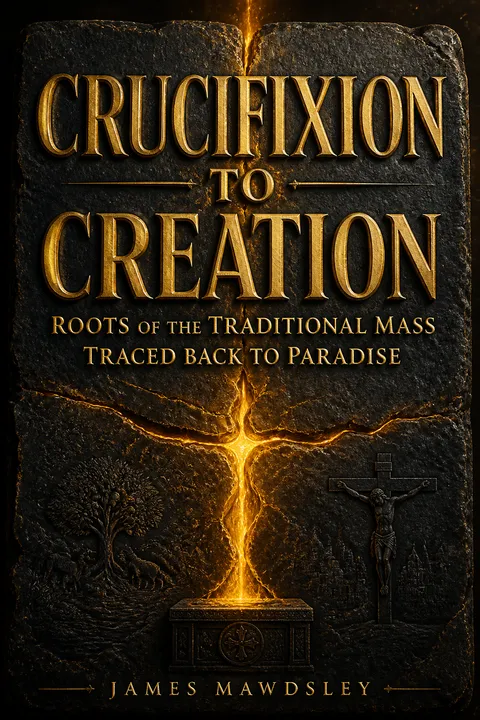
Key Takeaways
1. The Traditional Mass possesses an eternal DNA tracing back to Paradise.
The DNA of Holy Mass is eternal, from beyond the beginning of time.
An unchanging pattern. The Traditional Latin Mass is not a mere historical relic of the Council of Trent or the Gregorian era; it is the cosmic backbone of creation. Absolute Wisdom, God, wrote the final end of the universe into its very beginning, ensuring that the Holy Sacrifice of Calvary was anticipated from the Garden of Eden.
Prefigured in code. For thousands of years before the Last Supper, the ceremonies of Jerusalem’s Temple, the desert tabernacle of Moses, and the sacrifices of the Patriarchs prefigured Christ's ultimate offering. The essential signs of the Mass—bread, light, and incense—carry the exact same salvific meaning across generations:
- The table of presence foreshadows the Bread of Life.
- The seven-branched candlestick represents the Light of the World.
- The altar of incense symbolizes the sweet prayers of the saints.
An indestructible liturgy. Because the Mass of Ages is an expression of eternity, it remains completely indestructible despite modern attempts to uproot it. Contemplating this ancient continuity gives us the clarity to see that what God laid into the foundation of creation—the Cross, Sacrifice, and Love—cannot be removed without the universe itself collapsing.
2. The Lamb of God is a cosmic reality slain from the beginning of the world.
The Lamb so vital after the end of time, Who died and rose at the centre of time, is in fact crucial from the beginning.
The eternal victim. Long before St. John the Baptist declared "Behold the Lamb of God," the sacrificial lamb was the heartbeat of divine worship. In the courts of Jerusalem's Temple, the daily offering of immaculate, year-old lambs pointed directly to the sinless, silent humility of Jesus Christ before His unjust judges.
Massive historical scale. The sheer volume of animal sacrifices in the Old Testament was designed by God to strike our imaginations and emphasize the gravity of sin. From the rededication of the Temple to the restored Passovers, the blood of hundreds of thousands of victims prefigured the Most Precious Blood of Christ:
- Solomon sacrificed 120,000 sheep at the Temple's inauguration.
- King Josiah offered 37,600 lambs for the restored Passover.
- Hezekiah sacrificed 17,000 sheep to purify the sanctuary.
Typology of silence. From Abel’s firstling lamb to Abraham’s ram caught in the briers, these innocent creatures opened not their mouths, mirroring Christ's silent self-surrender. This meekness is not weakness but an unconquerable divine power that defeats death and writes our names in the Lamb's eternal Book of Life.
3. The Cross is the structural blueprint of both Scripture and Creation.
In the first sentence of the Bible, the beginning and end stands at the centre. Like the Cross.
Cosmic vertical and horizontal. The Cross is not an afterthought of redemption but the very framework of reality, written into the first sentence of Genesis. By analyzing the Hebrew letters of the opening word Bereshit, we discover a hidden, prophetic anagram: "Son of God, Lamb of the Cross."
Prefigured in wood. Throughout the Old Testament, every significant miracle and instrument of salvation is achieved through the mystery of wood, pointing directly to the Crucifixion:
- Noah’s ark of squared wood saves humanity from the flood.
- Moses’ staff divides the Red Sea and sweetens bitter waters.
- Aaron’s dead rod blossoms to confirm his high priesthood.
- Elisha’s wooden stick recovers the lost iron axe head.
Marked for salvation. Just as the Israelites were marked with the tav (originally drawn as a cross) to escape the destroying angel, so must our souls be marked by the Cross. In the Traditional Mass, the priest signs himself and the gifts over seventy times, weaving the shape of our redemption into the liturgy.
4. The Altar of Incense reveals the co-redemptive, golden soul of Mary.
The two altars — Christ and Mary — are described in the Book of Exodus twice.
Two distinct altars. In the Mosaic tabernacle, God commanded the construction of two altars: the bronze altar of holocaust outside, and the golden altar of incense inside. While the bronze altar represents Christ’s bloody, public sacrifice on Calvary, the golden altar represents the silent, interior, and golden soul of the Blessed Virgin Mary.
A sweet-smelling offering. Standing just before the veil of the Holy of Holies, the golden altar of incense was reserved exclusively for sweet-smelling, perpetual prayers, mirroring Mary's constant intercession. The parallels between this altar and the Ark of the Covenant are striking:
- Both were constructed of incorruptible acacia wood.
- Both were completely overlaid and crowned with pure gold.
- Both housed the intimate, hidden presence of the Divine.
Co-redemptive union. On Calvary, Mary united her maternal heart so perfectly to the Sacrifice of her Son that she became the golden altar of reconciliation. In every Traditional Mass, this union is honored through the prayers of the Offertory and the Canon, acknowledging her unique participation in our redemption.
5. Light is an ontological parable of Christ's dual nature and timelessness.
The sensible perception of light is a metaphor for the spiritual apprehension of truth...
The first creation. "Fiat lux" was God's first creative decree, translating the uncreated light of the Trinity into a material, temporal reflection. Light is constant, transcends time, and propagates itself instantaneously, serving as a perfect physical metaphor for the rapid spread of the eternal Gospel.
Dual nature of light. Modern physics has revealed that light is simultaneously a wave and a particle, beautifully mirroring the dual nature of Jesus Christ as True God and True Man:
- The wave, being everywhere at once, represents His omnipresent divinity.
- The particle, being localized and experiencing inertia, represents His finite humanity.
- Matter converting into light (E=mc²) represents our deification through grace.
The sevenfold spectrum. The seven-branched Menorah in the Temple, fueled by pure olive oil, represents the sevenfold gifts of the Holy Ghost. In the Traditional Mass, the central crucifix is flanked by six candles, emphasizing that Christ on the Cross is the source of all spiritual illumination.
6. Jerusalem is "The Place" where history's pivotal events converge.
The place of the stone altar, the very place upon which Adam was created and upon which he made his first offering to G-d, is itself the very foundation of our memory of who we are.
A sacred geography. God chose one specific geographical location—Mount Moriah, later Jerusalem—for the most critical events of both creation and redemption. This sacred spot, known in Hebrew as HaMakom, acts as a physical portal where the finite earth ascends to meet the limitless heavens.
Nine historical layers. Long before the Crucifixion, HaMakom was consecrated by a series of monumental events that prefigured the Sacrifice of Christ:
- Adam was created from this dust and later buried at Golgotha.
- Abel was murdered in this field, his blood crying to heaven.
- Noah built his altar of thanksgiving here after the Flood.
- Abraham bound Isaac on this rock, and Jacob dreamed of the ladder.
Universalized in the Mass. By dying on the Cross outside the city walls, Jesus translated this localized, geographical sanctuary into a universal foundation. Today, every consecrated Catholic altar around the world becomes HaMakom, bringing the eternal presence of God directly into our local parishes.
7. The Altar steps symbolize our purgative, illuminative, and unitive ascent.
The journey, to the place where we are called, is not flat, but it is an ascent.
An uphill climb. Approaching the altar of God is not a casual walk but a spiritual climb up the holy mountain of God, which is Christ Himself. This physical and spiritual ascent is built into the very architecture of traditional churches, which utilize steps to elevate the sanctuary.
Symbolism of the steps. The number of steps leading up to the altar is never arbitrary, but carefully calculated to convey profound theological truths:
- Seven steps represent the seven gifts of the Holy Ghost.
- Three steps symbolize the theological virtues of faith, hope, and charity.
- Five steps represent the five saving wounds of Christ.
- The eighth level represents the day of Resurrection and eternity.
A liturgical rehearsal. By ascending these steps, the priest acts in the person of Christ, leading the faithful out of the flat, mundane world. This physical movement trains our souls to persevere through the steep, difficult trials of life, looking upward to our heavenly home.
8. The Tabernacle's threefold structure maps the journey of the soul.
The spatial pattern has three stages: the court; the Holy Place; the Holy of Holies.
The spiritual itinerary. The tabernacle of Moses was designed according to a heavenly pattern to map the three classical stages of the spiritual life. This threefold structure guides the soul from the outer world of sin into the intimate, silent embrace of the Blessed Trinity.
Three distinct phases. Each section of the tabernacle corresponds to a specific phase of our purification, illumination, and ultimate union with God:
- The Outer Court (purgative) features the bronze altar of bloody sacrifice.
- The Holy Place (illuminative) contains the golden Menorah and Shewbread.
- The Holy of Holies (unitive) houses the Ark and the Divine Presence.
Perfected in the Mass. The Traditional Mass preserves this exact structure, leading us from the penitential Prayers at the Foot of the Altar to the illumination of the Gospel. Finally, the priest enters the Holy of Holies at the altar, offering us union through Holy Communion.
9. The Catholic Priesthood is defined by five immutable, Christocentric marks.
The higher the rank in the sacerdotal hierarchy, the greater the restrictions on marriage.
A divine institution. The Catholic priesthood is not a human career but a participation in the eternal, unchangeable priesthood of Jesus Christ. This sacred office is defined by five distinct, Christocentric marks that have been prepared since the beginning of the world.
Five essential marks. These characteristics are woven into the fabric of the priesthood to safeguard its supernatural efficacy and protect the flock:
- Sacrificial: The priest exists primarily to offer the Holy Sacrifice for sins.
- Male: He acts in persona Christi, representing the active, initiating Bridegroom.
- Hierarchical: He is ordered under bishops, maintaining apostolic continuity.
- Celibate: He renounces earthly marriage to be exclusively wedded to the Church.
- Fruitful: He begets spiritual children for eternity through the Sacraments.
Under modern attack. Today, these five marks are under fierce assault by faithless churchmen who wish to secularize the priesthood. Any attempt to introduce female priests, abolish celibacy, or flatten the hierarchy is a diabolical effort to sever the Church from her eternal roots.
10. Transubstantiation is the ultimate conversion of dust into divinity.
By transubstantiation things once of the soil — bread, wine and even man — are made divine.
The greatest wonder. Transubstantiation is the most stupendous event on earth, occurring silently and hidden from human eyes at every single Mass. In one instant, the priest pronounces the words of consecration, and the entire substance of bread and wine is converted into God.
From dust to glory. This miraculous conversion is the ultimate fulfillment of the natural process of growth, showing how God intends to deify His creation:
- Wheat draws nutrients from the dust to produce grain.
- Man harvests, mills, and bakes the grain to make bread.
- The priest offers this bread, and God converts it into Himself.
- We consume this Bread to be transformed into the Body of Christ.
A pledge of eternity. By eating the Flesh of the Lamb, our mortal nature is slowly but surely assimilated into His immortal nature. Transubstantiation is the ultimate homecoming, reversing the curse of Eden and guaranteeing that those who eat this Bread will live forever.
I confirm that I have written detailed takeaways for ALL 10 key takeaways in the format requested.
Download PDF
Download EPUB
.epub digital book format is ideal for reading ebooks on phones, tablets, and e-readers.








































