
Key Takeaways
1. Old Testament Typology Reveals the Sealed Endgame
Recognition of their first fulfilment two thousand years ago gives us unshakeable certainty that they will be finally fulfilled in her again at the end of time.
Scriptural rhymes. Typology is the study of Old Testament prefigurements that find their ultimate spiritual meaning in Jesus Christ and His Mother. God orchestrates history so that past events, persons, and objects act as prophetic blueprints for the final victory of good over evil.
Unlocking the mysteries. As the labor pains of the end times intensify, the spiritual sense of Scripture yields up its secrets to those who have ears to hear. The New Testament explicitly validates this method of reading the Old:
- Jonah's three days in the whale prefigures Christ's burial.
- The waters of the Flood prefigure baptism.
- Sarah and Hagar serve as an allegory for the two covenants.
Invincible confidence. Recognizing these patterns arms the faithful with unshakeable certainty that the endgame is already sealed. By studying how God delivered His people in ancient times, we gain the spiritual nerve to withstand the trials of the final tribulation.
2. The Protoevangelium Establishes Perpetual Enmity
It is a theological acclamation of Jesus acting in Mary and Mary in Jesus — a kind of circumincession of their souls, or perfect harmony of intellect, will and emotions.
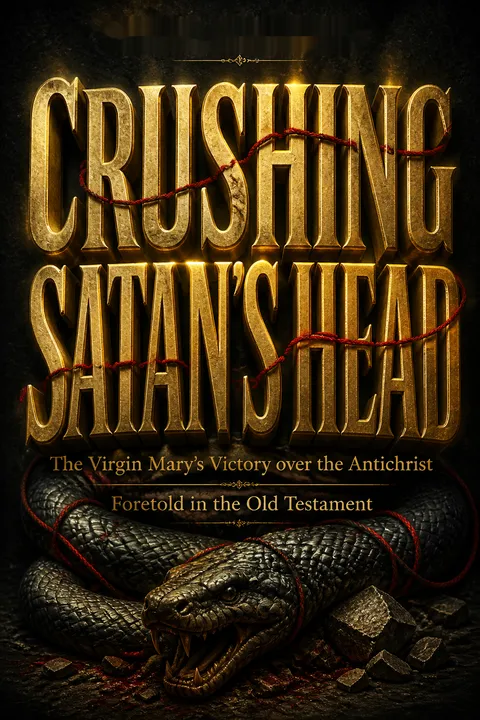
The first gospel. In Genesis 3:15, immediately after the Fall, God declared perpetual warfare between the serpent and the Woman, and between their respective offspring. This foundational prophecy, known as the Protoevangelium, promises that the Woman, acting in perfect union with her divine Son, will ultimately crush the head of Satan.
The devil's confusion. Satan's pride was deeply wounded by the revelation that a humble human woman would be instrumental in his defeat. Throughout history, the devil has sought to understand how a creature lower than the angels could strip him of his power:
- He failed to foresee the mystery of the Incarnation.
- He mistakenly believed that killing Jesus on the Cross would secure his dominion.
- He realized too late that Mary's perfect cooperation with God on Calvary sealed his eternal ruin.
Absolute enmity. Mary's victory is uniquely hers because she never once succumbed to the serpent's temptations. Her lifetime of sinless cooperation with grace stands as an uninterrupted rebuke to Satan's rebellion, proving that humility and obedience are the ultimate weapons against hell.
3. Jael and the Woman of Thebez Prefigure the Crushing of the Antichrist's Head
If we allow them no sway in our souls, then we have crushed the serpent’s head.
The tent peg of Jael. In the Book of Judges, Jael defeats the oppressive general Sisera by driving a tent peg through his temple while he sleeps. This graphic act of violence is a vivid prefiguration of Mary crushing the head of the Antichrist, demonstrating that God uses the humble and unexpected to destroy the proud.
The millstone of Thebez. Similarly, the anonymous woman of Thebez saves her city's citadel by dropping an upper millstone from a tower, fracturing the skull of the tyrant Abimelech. These historical events illustrate the inevitable self-destruction of evil when it confronts the fortress of faith:
- The high tower represents taking refuge under Mary's maternal protection.
- The sealed gate of the tower signifies Christ, the impenetrable door.
- The falling millstone represents the sudden, crushing descent of divine judgment.
Crushing personal sin. We participate in this crushing victory whenever we reject Satan's seductions and refuse to allow sin any foothold in our lives. By maintaining personal purity and resisting the corrupting influences of the world, we drive the spiritual tent peg into the enemy's head.
4. Jephthah’s Daughter and the Wise Woman of Abel Highlight Self-Sacrifice and Wisdom
The greatest fight to be had is not physical, the ultimate war is not going to be nuclear, but in the spirit God gains His victory, in the soul which refuses to sin, in the heart which never ceases to trust.
The ultimate holocaust. Jephthah’s daughter willingly offered herself as a sacrifice to fulfill her father's vow after his victory over the Ammonites. Her submissive spirit and voluntary self-gift prefigure Mary’s silent, agonizing co-redemptive sacrifice on Calvary, where she offered her only-begotten Son to the Father.
Wisdom over weapons. In another key narrative, the wise woman of Abel-Bethmaacah saves her blockaded city from destruction by convincing the inhabitants to decapitate the rebel Sheba. Her intellectual and spiritual intervention proves that wisdom is far superior to weapons of war:
- Sheba represents the Antichrist, who incites rebellion against the true King.
- The wise woman represents Mary, who guides the faithful to reject sin.
- Decapitating the rebel signifies the total expulsion of evil from our midst.
Spiritual warfare. These stories teach that the final battle against the Antichrist will not be won by physical force, but by total consecration and spiritual alignment with God's will. Like Jephthah's daughter, we must be ready to lose our lives in this world to secure eternal victory in the next.
5. Judith and Esther Demonstrate the Power of Feminine Virtue and Intercession
O daughter, you are blessed by the Most High God above all women on earth; and blessed be the Lord God, who created the heavens and the earth, who has guided you to strike the head of the leader of our enemies.
The sword of Judith. Judith, a chaste and prayerful widow, saved Israel from the globalist tyranny of Holofernes by decapitating him with his own sword. Her victory was achieved through a combination of deep prayer, fasting, and bold action, showing that feminine virtue is a lethal threat to the pride of Satan.
The intercession of Esther. Queen Esther risked her life by approaching King Ahasuerus unsummoned to plead for the salvation of her genocidally threatened people. Her successful intercession resulted in the destruction of the wicked Haman on the very gallows he had prepared for the righteous:
- Haman represents the Antichrist, who seeks to eliminate true worship.
- Esther's beauty and simplicity represent Mary's immaculate grace.
- The reversal of the decree shows that evil inevitably falls back on its own head.
Maternal protection. Both Judith and Esther act as powerful types of Mary, who intercedes for her children in the courts of Heaven and actively protects them from demonic destruction. Their triumphs assure us that no earthly or diabolical power can withstand the maternal care of our Queen.
6. Susanna Illustrates the Invincible Power of Chastity and Refusal to Sin
Greater fortitude lies in resisting sin, even at the risk of one’s life.
Choosing death over sin. Susanna, falsely accused of adultery by two corrupt judges after she refused their sexual advances, preferred to face execution rather than sin in the sight of the Lord. Her absolute refusal to compromise her purity represents the highest form of spiritual fortitude, which ultimately brought about the exposure and destruction of her tormentors.
The role of Daniel. God raised up the holy spirit in young Daniel to cross-examine the corrupt judges, exposing their contradictory lies and vindicating Susanna's innocence. This dramatic turnaround prefigures the final Judgment, where the hidden deeds of the wicked will be unveiled and the righteous will be gloriously vindicated:
- The garden of Susanna represents the paradise of the Church.
- The corrupt judges represent the deceptive, predatory nature of the devil.
- The conflicting testimonies of the accusers demonstrate the inherent incoherence of falsehood.
Chastity as power. Susanna's story reveals that purity is not a passive weakness, but an active spiritual force that crushes the serpent. By remaining steadfast in our moral convictions, even when surrounded by institutional corruption, we allow Christ to expose and defeat the works of darkness.
7. The Four Women of Matthew's Genealogy Announce the Annunciation
This run of surprises is a multi-millennial preparation for the biggest surprise of all: a virgin conceiving by the power of God the Holy Ghost.
The genealogical anomalies. St. Matthew’s genealogy of Jesus breaks the traditional patriarchal pattern by explicitly naming four Old Testament women: Tamar, Rahab, Ruth, and Bathsheba. Each of these women conceived her child under highly unusual, providential circumstances by someone greater than her supposed husband.
Foreshadowing the Virgin Birth. This deliberate inclusion serves as a divine preparation for the ultimate miracle of the Virgin Birth, where Mary conceived by the power of the Holy Spirit:
- Tamar conceived by Judah, the patriarch, rather than his sons.
- Rahab conceived by Salmon, a prince of the tribe of Judah.
- Ruth conceived by Boaz, a wealthy and powerful redeemer.
- Bathsheba conceived Solomon by King David, the anointed ruler.
Redeeming the outcast. By weaving these women into the biological lineage of the Messiah, God demonstrates His power to draw perfect good out of human weakness and unconventional situations. Their presence in the genealogy validates Mary's miraculous conception and highlights the universal scope of Christ's redemptive mission.
8. The Scarlet Thread of Redemption Links the Heroines
The scarlet of the Passion marks this way from the dangerous city into the peaceful household of Our Lady, into God’s House.
The symbolic cord. A continuous thread of red symbolism runs through the stories of the Old Testament heroines, pointing directly to the saving Blood of Jesus Christ. Rahab’s scarlet cord, hung from her window to spare her household from the destruction of Jericho, serves as a primary type of the Paschal mystery.
Weaving the tapestry. This red thread connects various moments of salvation history, illustrating that our deliverance is bought at a great price:
- The scarlet thread tied to the wrist of Tamar's twin son, Zerah.
- The red vestments and cords of blue worn by the Levitical High Priest.
- The scarlet cloak placed upon Jesus during His mock trial and Passion.
The anchor of hope. The Hebrew word for Rahab's cord, tikvah, also means "hope" or "expectation," indicating that our ultimate hope is anchored in the Passion of Christ. By remaining within the household of the Church, marked by this saving scarlet, we are preserved from the fiery destruction of the world.
9. St. Joseph is Prefigured by the Patriarch Joseph
The first Joseph laid by bread, not for himself, but for all people; the second Joseph received into his keeping that Living Bread Which came down from heaven, not for him only, but for the whole world.
The parallel Josephs. St. Joseph, the adoptive father of Jesus, is beautifully prefigured by the ancient Patriarch Joseph, who was sold into Egypt. Both men shared a name meaning "increase," possessed outstanding purity, and were guided by God through prophetic dreams to preserve life during times of crisis.
Guardians of the bread. The structural similarities between their lives reveal a deliberate divine design to prepare the world for the silent guardian of the Holy Family:
- Both Josephs went down into Egypt to escape death and preserve the seed of Israel.
- The first Joseph stored up physical grain to save nations from physical famine.
- The second Joseph guarded the Living Bread of Heaven, Jesus Christ, to feed the souls of the world.
Patron of the Church. Just as Pharaoh made the first Joseph lord of his household and ruler over all Egypt, so God appointed St. Joseph as the patron and protector of the Universal Church. His silent, humble service remains a powerful model of how we must guard and cherish the presence of Christ in our lives.
10. The Final Battle is Spiritual and Demands Liturgical Purity
In the end, my Immaculate Heart will triumph.
The liturgical crisis. The Book of Judith warns that the ultimate vulnerability of God's people lies in their temptation to compromise their traditions and treat holy things with irreverence. In the face of modern apostasy, the Church must resist the temptation to accommodate the world or desecrate the Holy Eucharist.
Preserving the sacred. Treating the Blessed Sacrament with casual indifference or adopting secularized forms of worship weakens the spiritual defenses of the faithful:
- The consecrated vessels of the Temple were too holy to be handled by profane hands.
- The desecration of these vessels historically brought swift divine judgment upon empires.
- Maintaining traditional, reverent worship is essential for surviving the final tribulation.
The Marian triumph. Our Lady of Fatima's promise that her Immaculate Heart will triumph assures us that the final victory is already secured for those who remain faithful. By committing ourselves to prayer, penance, and total consecration to Jesus through Mary, we become active participants in crushing the serpent's head.
Download PDF
Download EPUB
.epub digital book format is ideal for reading ebooks on phones, tablets, and e-readers.








































