Key Takeaways
1. The Second Law of Thermodynamics reveals a profound mystery about the Big Bang's initial low entropy.
It’s one of the biggest puzzles of cosmology where the organization comes from, and in what way the Big Bang really represents organization in any case.
Universal principle. The Second Law of Thermodynamics states that the 'randomness' or 'disorder' (entropy) of an isolated system continually increases over time. This law is unique among physical laws as it is an inequality, not an equality, asserting that entropy is greater (or at least not smaller) at later times. This ubiquitous principle governs everything from an egg smashing to paint mixing, reflecting a commonplace, seemingly inevitable feature of existence.
The Big Bang paradox. While the Second Law explains why things become more disorganized, it doesn't explain why the universe started in such an incredibly organized, low-entropy state. An explosion, like the Big Bang, intuitively suggests chaos and high entropy, yet it must have been a state of "extraordinarily tiny entropy" to allow for the subsequent, observed increase in disorder and the emergence of complexity, including life. This initial low-entropy condition is the fundamental mystery that underpins the Second Law as we experience it.
Arrow of time. The Second Law provides the physical basis for our perception of the arrow of time. Without an initial low-entropy state, the universe would quickly reach thermal equilibrium, a state of maximum disorder where no useful work could be done, and no complex structures could form or evolve. The mystery of the Big Bang's specialness is, therefore, the mystery of why time has a direction and why our universe is capable of supporting life and consciousness.
2. Entropy is a measure of phase-space volume, and its increase is overwhelmingly probable, but the Big Bang defies this.
Lowness of entropy refers to manifest speciality, which is seen in special values of the macroscopic parameters.
Quantifying disorder. Entropy is precisely defined by Boltzmann's formula, S = k log V, where V is the volume of a "coarse-graining region" in phase space. Phase space represents all possible positions and momenta of a system's constituent particles. A larger V means more microscopic configurations correspond to the same macroscopic state, hence higher entropy. The logarithm ensures that entropies of independent systems are additive.
Overwhelming probability. The vast dimensionality of phase space means that states corresponding to higher entropy (more disordered macroscopic appearances) occupy astronomically larger volumes than low-entropy states. Therefore, any system evolving dynamically is overwhelmingly likely to move from a smaller phase-space volume to a larger one, leading to an increase in entropy. This explains why an egg smashes but never spontaneously reassembles.
The Big Bang's improbability. If the Big Bang were merely a random event, it would be overwhelmingly probable for it to have started in a high-entropy state, like a "horrendous mess of congealing black holes." The observed low-entropy Big Bang, with its smooth, uniform initial conditions, represents an incredibly tiny region in phase space. The probability of finding ourselves in such a special universe by chance is absurdly small, around 1/10^10^124, demanding a profound theoretical explanation beyond mere chance or standard inflationary models.
3. The Big Bang was uniquely special: high matter entropy (thermal equilibrium) but extraordinarily low gravitational entropy (smoothness).
This early spatial uniformity represents the universe’s extraordinarily low initial entropy.
CMB's dual message. The Cosmic Microwave Background (CMB) radiation, the "flash of the Big Bang," exhibits an almost perfect black-body spectrum, indicating that the early universe was in a state of thermal equilibrium. This implies a very high entropy for the matter content of the universe, as matter was uniformly distributed and hot. This seems to contradict the idea of a low-entropy Big Bang.
Gravitational entropy's role. The resolution lies in distinguishing between matter entropy and gravitational entropy. While matter was in thermal equilibrium, the gravitational degrees of freedom were profoundly suppressed. The early universe was extraordinarily uniform, lacking the clumping and irregularities that would signify high gravitational entropy. This initial smoothness, rather than the matter's thermal state, is the true manifestation of the Big Bang's low entropy.
Potential for complexity. This low gravitational entropy provided the "potential" for the universe's subsequent evolution and complexity. Just as a uniform distribution of stars has low gravitational entropy but can evolve into clumpy, high-entropy black holes, the early universe's smoothness allowed gravity to eventually form galaxies, stars, and planets. This gravitational clumping is the primary driver of entropy increase in the universe, ultimately enabling the conditions for life.
4. Black holes are the universe's primary entropy sinks, and their eventual evaporation is crucial for cosmic evolution.
Indeed, at the present epoch of the universe’s evolution, the greatest entropy contribution, by far, lies in large black holes, like the one at the centre of our own Milky Way galaxy, with a mass of around 4 000 000 times the mass of our Sun.
Gravitational clumping. Unlike gas in a box, which spreads out to increase entropy, gravitating matter clumps together. This clumping, leading to the formation of stars and eventually black holes, represents a massive increase in entropy. Black holes, by their very nature, are incredibly efficient at storing entropy, far surpassing the entropy contained in the CMB or other forms of matter.
Bekenstein-Hawking entropy. The entropy of a black hole is given by the Bekenstein-Hawking formula, proportional to the surface area of its event horizon. For a black hole of 4 million solar masses, its entropy is roughly 10^21 times the entropy per baryon in our galaxy, dwarfing all other entropy contributions in the observable universe. This enormous entropy value is consistent with the irreversible nature of black hole formation and the vast number of internal states they can represent.
Hawking evaporation. According to Stephen Hawking's theory, black holes are not entirely black but slowly radiate energy (Hawking radiation) and eventually evaporate. This process, though incredibly slow for large black holes (taking up to 10^100 years or more), is crucial. It ensures that black holes, the universe's ultimate entropy sinks, do not persist indefinitely, allowing their stored entropy to be released and eventually contributing to the "reset" mechanism of Conformal Cyclic Cosmology.
5. Conformal geometry and the decay of mass to zero are key to understanding the universe's ultimate fate.
The point is that, according to a massless particle, the passage of time is as nothing.
Massless physics. In the extremely early universe, particles were so energetic that their rest-masses were effectively irrelevant, behaving like massless particles such as photons. Similarly, in the very remote future, as the universe expands and cools indefinitely, all remaining particles (photons, gravitons, and eventually even electrons, protons, and dark matter) are hypothesized to become effectively massless, or their rest-masses decay to zero.
Conformal invariance. The physics of massless particles, including electromagnetism (photons) and gravity (gravitons), is governed by conformally invariant equations. This means these physical processes are insensitive to local changes in the overall scale factor of space-time, only respecting its "null-cone" or conformal structure. For massless particles, the concept of "time" as measured by massive clocks becomes meaningless.
Eternity's irrelevance. For a massless particle, eternity is "no big deal." It can traverse infinite stretches of time and space without experiencing a single "tick" of an internal clock. This philosophical shift suggests that in the remote future, when only massless particles remain, the universe itself "loses track of the scale of time," and its geometry effectively becomes purely conformal, allowing for a smooth transition to a new aeon.
6. Conformal Cyclic Cosmology (CCC) proposes an infinite succession of aeons, where one's remote future becomes the next's Big Bang.
The ‘\ +’ of each is to be identified with the ‘U −’ of the next, where the continuation of each aeon to the next is achieved so that, as a conformal space-time structure, the join is perfectly smooth.
Cyclic universe. Conformal Cyclic Cosmology (CCC) posits that the universe undergoes an endless succession of "aeons," each representing a complete cosmic history from a Big Bang to an infinitely expanding, empty future. The key idea is a conformal matching: the remote future of one aeon is conformally identified with the Big Bang of the subsequent aeon.
Conformal matching. This matching is possible because both the very early universe (Big Bang) and the very remote future (infinite expansion) are dominated by conformally invariant physics, where rest-mass is negligible. The infinite density and temperature of the Big Bang are "stretched out" by a conformal factor, while the zero density and temperature of the remote future are "squashed down," allowing for a smooth, finite join in terms of conformal geometry.
Beyond the Big Bang. This framework allows for a physically coherent "pre-Big-Bang" phase, which is simply the remote future of the preceding aeon. This avoids the paradox of a universe spontaneously appearing in an absurdly low-entropy state, as the low-entropy Big Bang of our aeon is a direct, deterministic consequence of the high-entropy, conformally smooth future of the previous one.
7. Information loss in black holes provides the necessary entropy "reset" for the cyclic universe.
I am thus asking the reader to accept information loss in black holes—and the consequent violation of unitarity—as not only plausible, but a necessary reality, in the situations under consideration.
The information paradox. A central tenet of quantum mechanics is "unitary evolution," which implies that information is never truly lost. However, black holes, by swallowing matter and eventually evaporating, appear to destroy information, leading to the "black-hole information paradox." This paradox is a major point of contention in theoretical physics.
Entropy "reset" mechanism. CCC requires that the vast entropy accumulated in black holes throughout an aeon must somehow be "reset" for the next aeon to begin with low entropy. This is achieved by accepting that information is lost in black holes. This loss effectively reduces the dimensionality of the universe's phase space, drastically "thinning it down" and allowing the entropy measure to be reset for the subsequent aeon.
Violation of unitarity. The destruction of information in black holes implies a violation of strict unitary evolution in quantum mechanics. This suggests that quantum gravity, the as-yet-undiscovered theory unifying quantum mechanics and general relativity, must be fundamentally time-asymmetric. This departure from conventional quantum theory is a crucial, albeit controversial, aspect of CCC's solution to the Second Law's mystery.
8. CCC predicts observable signatures in the Cosmic Microwave Background from prior aeons.
It is not at all out of the question, if CCC is right, that this information could eventually be teased out of the tiny irregularities in the CMB.
Trans-aeon signals. Despite the Big Bang's extreme conditions, CCC proposes that certain information from a previous aeon can propagate across the conformal boundary and leave subtle imprints on the Cosmic Microwave Background (CMB) of our own aeon. This is possible because the relevant physics (massless fields like gravitational waves) is conformally invariant, allowing signals to traverse the aeon boundary.
Black hole collision imprints. A key prediction involves gravitational radiation from supermassive black hole collisions in the previous aeon. These events would generate bursts of gravitational waves that, upon crossing into our aeon's Big Bang, would impart a "kick" to the primordial dark matter. This kick would manifest as geometrically precise concentric circles of slightly enhanced or diminished temperature in the CMB sky.
Observational test. Preliminary analysis of WMAP satellite data has been conducted to search for these circular anomalies. While initial "spikes" were found to be spurious, systematic departures from Gaussian randomness, particularly an excess of cold circles in a specific angular range, have been noted. Further analysis, accounting for distortions from intervening Weyl curvature, is needed to definitively confirm or refute these potential signatures of a prior aeon.
9. The cosmological constant and dark matter are integral to the CCC framework.
It is perhaps significant that the two so-called ‘dark’ quantities (‘dark matter’ and ‘dark energy’), that have gradually become apparent from detailed cosmological observations in recent decades, both appear to be necessary ingredients of CCC.
Dark energy's role. A positive cosmological constant (Λ), often referred to as "dark energy," is crucial for CCC. It drives the exponential expansion of an aeon in its remote future, leading to a spacelike future conformal boundary (+). This spacelike nature is essential for the smooth conformal matching with the spacelike Big Bang (U-) of the subsequent aeon. Without Λ > 0, the conformal matching would not be geometrically viable.
Dark matter's origin. CCC offers a novel interpretation for the origin of dark matter. The "phantom field" (ϖ-field), a mathematical construct arising from the conformal transformation at the aeon crossover, is proposed to become a real physical field in the new aeon's Big Bang. This field, initially massless, would then acquire mass (perhaps via the Higgs mechanism) and constitute the dark matter observed in our universe, playing a vital role in shaping large-scale structure.
Addressing cosmic puzzles. The framework integrates these two mysterious components of modern cosmology into a coherent narrative. The observed value of Λ, which seems coincidentally relevant today, is explained by anthropic reasoning within the cyclic model. The initial conditions for dark matter, which are crucial for galaxy formation, are naturally provided by the ϖ-field's emergence from the previous aeon's gravitational radiation.
Review Summary
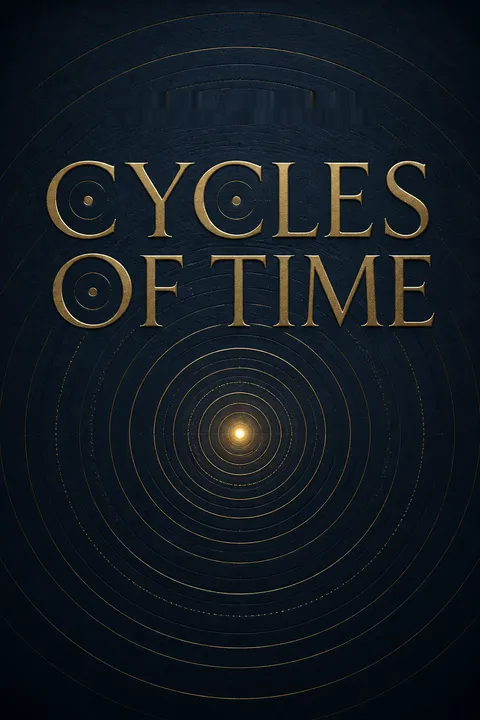
Cycles of Time receives mixed reviews, with many praising Penrose's innovative ideas but finding the book challenging to understand. Readers appreciate the exploration of cosmology and the concept of cyclic universes, but struggle with the technical content and mathematical complexity. Some find the book rewarding for those with a strong physics background, while others feel it's too dense for general readers. The theory of Conformal Cyclic Cosmology (CCC) is intriguing but speculative, and Penrose's communication style is criticized as unclear for non-specialists.
People Also Read






FAQ
What is "Cycles of Time" by Roger Penrose about?
- Conformal Cyclic Cosmology (CCC): The book introduces Penrose's revolutionary cosmological model, Conformal Cyclic Cosmology, which proposes that the universe undergoes infinite cycles or "aeons," each beginning with a Big Bang and ending in an exponentially expanding future.
- Challenging traditional cosmology: Penrose questions the standard Big Bang model and inflationary theory, offering a new perspective on what came before the Big Bang and the ultimate fate of the universe.
- Integration of physics and philosophy: The book blends deep physical insights with philosophical questions about time, entropy, and the nature of the universe.
Why should I read "Cycles of Time" by Roger Penrose?
- Groundbreaking cosmological ideas: Penrose is a renowned physicist, and his CCC model offers a bold alternative to mainstream cosmology, challenging readers to rethink the universe's origin and fate.
- Accessible yet rigorous: The book is written for a broad audience, balancing technical depth with clear explanations, making complex ideas approachable.
- Explores fundamental mysteries: It addresses profound questions about time's arrow, entropy, and the nature of singularities, which are central to understanding the cosmos.
What are the key takeaways from "Cycles of Time" by Roger Penrose?
- Universe as a cyclic entity: The universe may be an endless succession of aeons, each linked by conformal geometry rather than a singular beginning or end.
- Entropy and the Second Law: The book provides a novel explanation for the universe's low-entropy beginning and the arrow of time, rooted in the suppression of gravitational degrees of freedom at the Big Bang.
- Role of black holes and CMB: Black holes dominate the universe's entropy, and the cosmic microwave background (CMB) provides crucial evidence for Penrose's model.
- Observational predictions: CCC makes testable predictions, such as specific patterns in the CMB, offering ways to potentially confirm or refute the theory.
How does Roger Penrose’s Conformal Cyclic Cosmology (CCC) model work?
- Infinite succession of aeons: CCC posits that each universe (aeon) ends in an exponentially expanding, cold, and empty state, which is conformally rescaled to become the Big Bang of the next aeon.
- Conformal geometry as the bridge: The model uses conformal geometry to match the infinite future of one aeon to the Big Bang of the next, smoothing out singularities and allowing for a continuous cosmic history.
- Massless particles and scale invariance: In both the early universe and the remote future, massless particles dominate, making the physics conformally invariant and enabling the seamless transition between aeons.
How does "Cycles of Time" by Roger Penrose explain the Second Law of Thermodynamics and entropy in cosmology?
- Entropy’s arrow of time: Penrose emphasizes the puzzle of why entropy increases over time, given that physical laws are mostly time-symmetric.
- Low-entropy Big Bang: The book argues that the universe began in an extraordinarily low-entropy state, especially in terms of gravitational degrees of freedom, which sets the direction for entropy increase.
- Black holes and entropy: Black holes are the main contributors to the universe's entropy, and their eventual evaporation is crucial for resetting entropy between cosmic cycles in CCC.
What is the significance of the Big Bang’s “specialness” in "Cycles of Time" by Roger Penrose?
- Unusually low gravitational entropy: The Big Bang was not just hot and dense, but also highly ordered in its gravitational field, which is atypical for such a violent event.
- Suppression of gravitational degrees: This special initial condition is key to explaining why the Second Law of thermodynamics holds and why time has a direction.
- Foundation for cosmic cycles: The specialness of the Big Bang allows for the smooth transition between aeons in CCC, distinguishing it from other cosmological models.
How does "Cycles of Time" by Roger Penrose describe the role of black holes in the universe’s entropy and cosmic cycles?
- Dominant entropy reservoirs: Black holes contain vastly more entropy than all other forms of matter and radiation, making them central to the universe’s entropy budget.
- Hawking evaporation: Over immense timescales, black holes evaporate via Hawking radiation, eventually disappearing and allowing the universe to become dominated by massless particles.
- Transition between aeons: The disappearance of black holes is essential for the entropy reset required for the start of a new aeon in CCC.
What is the Weyl curvature hypothesis (WCH) in "Cycles of Time" by Roger Penrose, and why is it important?
- Vanishing Weyl curvature at the Big Bang: Penrose proposes that the Weyl curvature tensor, which measures the free gravitational field, vanishes or is finite at the Big Bang, indicating a highly ordered state.
- Distinguishing singularities: This hypothesis differentiates the low-entropy Big Bang singularity from the high-entropy, chaotic singularities inside black holes.
- Mathematical foundation for CCC: The WCH underpins the smooth conformal boundary between aeons, making the cyclic model mathematically consistent.
How does "Cycles of Time" by Roger Penrose use conformal geometry and massless particles to connect cosmic cycles?
- Conformal invariance in early and late universe: Near the Big Bang and in the remote future, the universe is dominated by massless particles, making the physics insensitive to scale and conformally invariant.
- Null cones and causal structure: The geometry of space-time is described by null cones, which determine the causal structure and are preserved under conformal transformations.
- Smooth transition between aeons: This conformal invariance allows for a mathematical extension of space-time, linking the end of one aeon to the beginning of the next.
How does "Cycles of Time" by Roger Penrose compare CCC to inflationary and other pre-Big-Bang cosmological models?
- Inflation vs. CCC: While inflation explains the universe’s large-scale uniformity, it does not address the fundamental low entropy of the Big Bang, which CCC explains through conformal geometry.
- No bounce or collapse: CCC rejects the idea of a bounce from a collapsing universe, as this would violate the Second Law by requiring a decrease in entropy.
- Distinct from string theory models: CCC does not rely on extra dimensions or brane collisions, instead using four-dimensional conformal geometry to connect aeons.
What observational evidence or predictions does "Cycles of Time" by Roger Penrose offer for CCC?
- CMB circular patterns: CCC predicts specific circular features in the cosmic microwave background (CMB) temperature fluctuations, potentially caused by events in the previous aeon.
- Alternative to inflationary signatures: The model provides a different explanation for the observed scale-invariant density fluctuations and large-angle correlations in the CMB.
- Preliminary data and future tests: Early analyses of CMB data have searched for these patterns, with intriguing but inconclusive results, suggesting further research could support or challenge CCC.
What are the implications of "Cycles of Time" by Roger Penrose for fundamental physics concepts like rest-mass, dark matter, and dark energy?
- Rest-mass fading: Penrose suggests that the rest-mass of fundamental particles may gradually fade to zero in the remote future, enabling the conformal matching of aeons.
- Dark energy as cosmological constant: CCC requires a positive cosmological constant (Λ), interpreted as dark energy driving the universe’s accelerated expansion.
- Emergence of dark matter: The conformal crossover may give rise to a scalar field interpreted as dark matter, which acquires mass in the new aeon.
- Challenges to charge conservation: The presence of charged particles in the remote future poses theoretical challenges, prompting Penrose to discuss possible resolutions within the CCC framework.
About the Author

Download PDF
Download EPUB
.epub digital book format is ideal for reading ebooks on phones, tablets, and e-readers.








































