Summary Temporarily Unavailable
This summary is temporarily unavailable and is currently being updated. You can still explore the FAQs and other metadata below.
Plot Summary
Virus Children's Awakening
In the aftermath of the SHEVA virus, a wave of children are born with subtle but profound genetic differences. These "virus children" are both beautiful and strange, possessing new ways of communicating and sensing the world. Their existence is met with suspicion and fear by the broader society, which sees them as a threat to the established order. Families with SHEVA children, like the Rafelsons, live in constant anxiety, torn between protecting their children and the pressure to conform. The children themselves sense their difference, longing for connection with others like them, even as they are isolated and surveilled. The world stands at a crossroads, uncertain whether to embrace or destroy what evolution has delivered.
Family Under Siege
Mitch and Kaye Rafelson, parents to Stella—a SHEVA child—navigate a world that has turned hostile. Their home is a fortress, their lives ruled by fear of government raids and the ever-present threat of violence from neighbors. Stella, growing into adolescence, feels the strain of isolation and the pain of being different. The family's love is strong but stretched thin, each member haunted by the knowledge that their unity could be shattered at any moment. The tension between parental protection and Stella's need for independence becomes a central conflict, as the outside world closes in.
The New Outcasts
Across America, the response to the virus children is draconian. Emergency Action, a government agency, establishes camps to contain and "manage" the new generation. Parents are forced to surrender their children or go into hiding. The camps are bleak, their purpose more about control than care. Public opinion, stoked by fear and misinformation, brands the children as monsters or abominations. Even those who try to help, like sympathetic scientists and politicians, find themselves outmaneuvered by bureaucratic inertia and political opportunism. The children become scapegoats for a society unable to face its own evolutionary future.
Science and Fear Collide
Researchers like Kaye and her colleagues struggle to unravel the mysteries of SHEVA and the new children. Their work is hampered by secrecy, suspicion, and the ever-present threat of government interference. Scientific debates rage over whether the children represent a disease or the next step in human evolution. Meanwhile, political actors exploit the crisis for power, using fear to justify ever more extreme measures. The line between science and politics blurs, with truth often the first casualty. The fate of the virus children hangs in the balance, dependent on discoveries that may come too late.
Stella's Flight
Driven by loneliness and a desperate need for belonging, Stella leaves her family's protection and ventures into the world. Her journey is fraught with danger—she encounters both kindness and cruelty, from strangers who see her as a curiosity or a threat. Along the way, she meets other virus children, each bearing their own scars from a society that rejects them. Stella's odyssey is a search for identity, for a place where she can be herself without fear. Her absence devastates her parents, who risk everything to find her.
Captured and Contained
Stella's quest leads her into the hands of Fred Trinket, a bounty hunter who collects virus children for government reward. She is locked away with other children, each with their own story of betrayal and loss. The group forms a fragile community, united by their difference and their longing for freedom. The threat of violence and exploitation looms, as the children realize they are valued only as commodities. Stella's resourcefulness and the bonds she forms with her fellow captives become their only hope for survival.
The Anatomy of Prejudice
The burning of a virus children's camp in Riverside, California, where hundreds die, marks a turning point. The event exposes the depths of societal hatred and the complicity of authorities who look the other way. Politicians debate civil rights, but the machinery of Emergency Action grinds on, stripping away protections and creating a new underclass. The Rafelsons, like many families, are forced to abandon their home and go on the run. The children's plight becomes a mirror for the nation's soul, revealing the cost of fear-driven governance.
The Virus Within Us
Kaye's research uncovers the paradox at the heart of the crisis: the very viruses that threaten humanity are also its creators. Endogenous retroviruses, once seen only as agents of disease, are shown to be essential to human development and evolution. Attempts to eradicate them lead to disaster, as embryos fail and immune systems collapse. The realization that "original sin" is written into the genome challenges both scientific and religious dogma. The virus children are not monsters, but the next chapter in the story of life—a truth too radical for many to accept.
The Children's Language
Among themselves, the virus children develop unique forms of communication—scenting, cheek-flashing, and double-speak. Their social structures, called demes, are fluid and cooperative, emphasizing connection over competition. These new languages and behaviors are incomprehensible and threatening to adults, who respond with attempts to suppress and control. Yet, within the children's communities, there is resilience, creativity, and a sense of hope. Stella, now a leader among her peers, finds meaning and belonging in these new forms of kinship, even as the outside world seeks to destroy them.
The Plague in the Camps
A mysterious illness sweeps through the virus children's camps, killing thousands. Panic grips the authorities, who fear a new pandemic. Scientists race to identify the cause, discovering that the disease is a recombination of common viruses and ancient genetic elements—deadly only to the new children. The outbreak exposes the vulnerability of the camps and the failure of the system meant to protect the children. The crisis forces a reckoning, as the truth emerges: the disease originated not with the children, but with adults, a tragic byproduct of fear and containment.
Escape and Exodus
As the camps descend into chaos, a network of sympathetic parents, scientists, and activists orchestrate escapes. Stella and a group of children flee across the country, pursued by authorities and bounty hunters. Their journey is perilous, but also transformative, as they discover hidden communities and allies willing to risk everything for their freedom. The exodus becomes a symbol of resistance, challenging the legitimacy of Emergency Action and inspiring others to question the status quo. The children's survival depends on solidarity, ingenuity, and the willingness of a few to defy unjust laws.
The Search for Sanctuary
Stella and her companions find sanctuary in Oldstock, a remote community founded by earlier generations of virus children and their allies. Here, they are free to live according to their own ways, to heal from trauma, and to build a new society. The community is a laboratory for the future, experimenting with new forms of family, education, and governance. Yet, even in sanctuary, the scars of the past linger, and the threat of discovery remains. The arrival of Mitch and Kaye, reunited with Stella, marks a moment of fragile hope—a family restored, but forever changed.
The Old Bones Speak
Archaeological discoveries at the Spent River site uncover evidence of ancient human and Homo erectus communities living together in cooperation. The find challenges long-held assumptions about human uniqueness and the inevitability of conflict between species. The bones tell a story of partnership, adaptation, and shared destiny—echoing the present struggle of the virus children. The past becomes a guide for the future, suggesting that coexistence, not domination, is the path forward. The discovery becomes a symbol of reconciliation, both scientific and social.
The Politics of Survival
As the truth about the virus children and the origins of the plague become public, political tides shift. Emergency Action is dismantled, and the camps are closed. Trials are held for those responsible for abuses, but justice is imperfect. The nation grapples with the legacy of fear-driven policies and the challenge of integrating the new generation. Some embrace the children as the future, while others cling to old prejudices. The struggle for survival becomes a struggle for meaning, as individuals and society alike confront the demands of change.
The Epiphany of Kaye
Kaye, haunted by loss and failure, experiences a profound epiphany—a sense of connection to something greater than herself, a "caller" that transcends biology and reason. Her experience blurs the boundaries between science and spirituality, offering a vision of love without judgment, of evolution as a process guided by freedom and creativity. Kaye's insight becomes a source of strength, enabling her to face the uncertainties of the future with hope. Her journey mirrors that of the virus children: from isolation and fear to acceptance and transformation.
The End of Emergency Action
Political and legal battles culminate in the dissolution of Emergency Action. Trials expose the abuses and failures of the system, and new policies are enacted to protect the rights of all children. The virus children are released from camps and allowed to rejoin society—or to form their own communities. The transition is fraught with difficulty, as old wounds heal slowly and trust is hard-won. Yet, the end of Emergency Action marks a turning point—a chance to build a more just and compassionate world, if only the lessons of the past are remembered.
Reunion at Oldstock
In the sanctuary of Oldstock, Stella, Mitch, and Kaye are reunited. The community thrives, experimenting with new forms of kinship and cooperation. Stella, now pregnant, prepares to bring a new life into the world—a symbol of hope and continuity. The family's journey, marked by loss and resilience, becomes a microcosm of the larger struggle for acceptance and understanding. Oldstock stands as a testament to the possibility of coexistence, a place where the future can be imagined and built.
Birth of a New World
Stella gives birth to a son, surrounded by her family and community. The event is both ordinary and miraculous—a new beginning for a new kind of human. The birth is celebrated not just as a personal triumph, but as a victory for all who have struggled and suffered. The world outside remains uncertain, but within Oldstock, there is hope. The story ends with a sense of peace and possibility, as the next generation takes its place in the ongoing dance of evolution. The silence that follows is not emptiness, but the signal of a new beginning.
Analysis
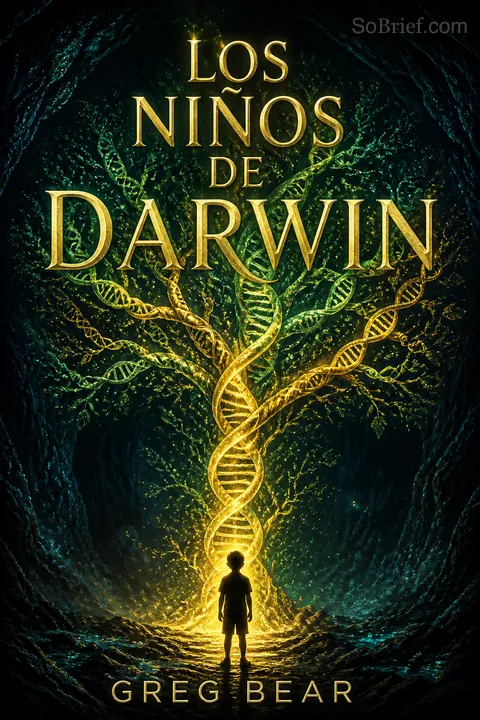
Darwin's Children is a profound meditation on evolution, fear, and the possibility of transformationGreg Bear's novel uses the lens of speculative biology to explore the deepest anxieties and hopes of contemporary society. The emergence of the virus children is both a literal and metaphorical challenge to the status quo, forcing individuals and institutions to confront the limits of tolerance, the dangers of fear-driven policy, and the necessity of adaptation. The novel's central lesson is that change—biological, social, or spiritual—is both inevitable and fraught with peril. Yet, Bear insists, it is also an opportunity for growth, connection, and the reimagining of what it means to be human. The story's emotional arc, from isolation and loss to reunion and new birth, mirrors the journey of evolution itself: painful, uncertain, but ultimately creative. In a world increasingly defined by division and anxiety about the future, Darwin's Children offers a vision of hope rooted in the acceptance of difference, the embrace of complexity, and the courage to love without judgment.
Last updated:
Report IssueReview Summary
Darwin's Children received mixed reviews, with ratings ranging from 2 to 5 stars. Many readers found it an engaging sequel to Darwin's Radio, praising Bear's exploration of evolutionary concepts and societal reactions to change. Some appreciated the character development and scientific depth, while others felt the plot meandered and lacked focus. Critics noted excessive scientific jargon and underdeveloped storylines. Overall, the book was seen as thought-provoking but not as compelling as its predecessor.
People Also Read
Characters
Stella Nova Rafelson
Stella is the daughter of Mitch and Kaye Rafelson, a SHEVA child born into a world that fears and rejects her kind. Sensitive, intelligent, and fiercely independent, Stella embodies the promise and peril of the new generation. Her journey from isolation to leadership among her peers is marked by longing, loss, and resilience. Stella's ability to communicate in new ways—through scent, cheek-flashing, and double-speak—makes her both a target and a beacon. Her relationships with her parents, fellow virus children, and ultimately her own child, reflect the deep psychological need for connection and acceptance. Stella's arc is one of transformation, as she moves from being an outcast to a creator of community and hope.
Kaye Lang Rafelson
Kaye is a molecular biologist whose research into endogenous retroviruses places her at the center of the crisis. As a mother, she is fiercely protective of Stella, yet struggles with guilt and helplessness as society turns against them. Kaye's scientific rigor is matched by a deep empathy, and her journey is one of both intellectual and spiritual awakening. Her epiphany—a sense of connection to a "caller" beyond biology—reframes her understanding of evolution, suffering, and love. Kaye's relationships with Mitch, Stella, and her colleagues are complex, marked by both intimacy and distance. Her character embodies the tension between reason and faith, and the possibility of reconciliation between science and the human spirit.
Mitch Rafelson
Mitch is an archaeologist whose life is upended by the birth of his daughter and the ensuing societal upheaval. He is practical, loyal, and deeply committed to his family, yet plagued by feelings of inadequacy and loss. Mitch's journey is one of endurance—he becomes a fugitive, a seeker, and ultimately a reconciler. His love for Stella and Kaye is unwavering, but he struggles to bridge the gap between the old world and the new. Mitch's encounters with ancient bones and lost civilizations mirror his search for meaning in the present. His psychological arc is one of acceptance, as he learns to let go of the past and embrace the future.
Will ("Strong Will")
Will is a fellow SHEVA child whom Stella meets during her captivity. Scarred by abuse and abandonment, Will embodies the psychological toll of societal rejection. He is resourceful and intelligent, but deeply damaged, unable to fully integrate into the new communities. His relationship with Stella is both tender and tragic—he becomes the father of her child, but ultimately cannot survive the weight of his pain. Will's story is a meditation on the limits of resilience and the cost of exclusion. His death is a catalyst for Stella's growth and the community's understanding of the need for compassion.
Mark Augustine
Once the powerful director of Emergency Action, Augustine is a complex figure—both architect and critic of the system that oppresses the virus children. Haunted by guilt and disillusionment, he becomes an unlikely ally to Kaye and the children, working behind the scenes to mitigate harm and eventually dismantle the machinery he helped build. Augustine's psychological journey is one of reckoning, as he confronts the consequences of his actions and seeks redemption. His relationships with colleagues, subordinates, and adversaries reveal the moral ambiguities of power and the possibility of change.
Rachel Browning
Browning is a high-ranking official in Emergency Action, responsible for many of the policies that devastate the virus children and their families. Driven by ambition and a belief in order, she becomes increasingly ruthless as the crisis deepens. Yet, beneath her hard exterior lies a capacity for doubt and regret. Browning's downfall is both personal and political—she is ultimately held accountable for her actions, but her fate is marked by isolation and bitterness. Her character explores the psychology of authority, the seductions of power, and the costs of dehumanization.
Carla Rhine
Mrs. Rhine is a survivor of the original SHEVA outbreak, isolated and studied as a biological anomaly. Her life is one of suffering and loneliness, yet she maintains a fierce dignity and a longing for understanding. Carla's correspondence with Kaye and Dicken provides a window into the human cost of scientific and political decisions. Her decline and death are both a warning and a testament to endurance. Carla's character embodies the psychological effects of isolation, the need for connection, and the tragedy of being made a scapegoat.
Christopher Dicken
Dicken is a scientist and epidemiologist whose career is defined by the pursuit of understanding SHEVA and its consequences. He is both a witness and a participant in the unfolding drama, often serving as a bridge between the scientific and political worlds. Dicken's empathy and integrity set him apart, and his relationships with Kaye, Mrs. Rhine, and others are marked by honesty and compassion. His psychological arc is one of perseverance in the face of uncertainty, and a commitment to truth even when it is inconvenient or dangerous.
Marge Cross
Cross is the CEO of Americol, a pharmaceutical giant deeply involved in the scientific response to SHEVA. Outwardly pragmatic and shrewd, she harbors her own spiritual experiences and doubts. Cross's support for Kaye and her willingness to challenge orthodoxy make her a key ally, but her position is always precarious. Her character explores the intersection of business, science, and personal belief, and the ways in which power can be used for both harm and healing.
Luella and John Hamilton
The Hamiltons are parents of a SHEVA child, emblematic of the countless families caught in the crisis. Their determination to protect their daughter and help others leads them into activism and resistance. Luella's warmth and strength, and John's quiet resolve, provide a counterpoint to the more prominent figures. Their psychological journey is one of hope amid adversity, and their actions help catalyze the movement toward justice and reconciliation.
Plot Devices
Evolution as Social Crisis
The central plot device is the sudden emergence of a new generation of humans, catalyzed by the activation of ancient viral elements in the genome. This evolutionary leap is not gradual, but abrupt and visible, forcing society to confront the meaning of humanity, identity, and belonging. The narrative structure alternates between intimate family drama and sweeping social commentary, using multiple perspectives to explore the consequences of change. Foreshadowing is employed through scientific debates and archaeological discoveries, hinting at the possibility of coexistence and the dangers of resistance. The story's climax is both personal and collective, as the birth of a new child symbolizes the opening of a new world.
Duality of Viruses
The novel uses viruses as a metaphor for both the dangers and the possibilities of change. Endogenous retroviruses are shown to be essential to human development, even as they are feared as agents of disease. This duality is mirrored in the characters' psychological struggles—fear and hope, isolation and connection, destruction and creation. The plot device of the "virus within us" challenges readers to reconsider the boundaries between self and other, past and future. The scientific revelations drive the narrative forward, forcing characters and society to confront uncomfortable truths.
Language and Communication
The virus children's unique ways of communicating—through scent, facial patterns, and double-speak—serve as both plot device and symbol. These languages are incomprehensible to adults, representing the generational divide and the challenge of integration. The development of demes and new social structures provides a framework for exploring themes of cooperation, empathy, and the limits of understanding. The narrative uses these devices to build tension and to suggest that true change requires not just new genes, but new ways of relating.
Political and Legal Structures
The machinery of Emergency Action, the camps, and the legal battles provide the backdrop for the personal stories. The narrative structure weaves together courtroom drama, political intrigue, and grassroots activism, showing how laws and policies shape individual destinies. The eventual dismantling of Emergency Action is foreshadowed by growing dissent and the exposure of abuses. The plot device of the trial and the select committee hearing serves as a crucible for truth and reconciliation, forcing characters to confront their complicity and their hopes for the future.
Spiritual Epiphany
Kaye's spiritual awakening, her sense of connection to a "caller," serves as both plot device and thematic anchor. This experience blurs the boundaries between science and faith, offering a vision of evolution as a process guided by love and freedom rather than blind chance or external design. The narrative uses Kaye's epiphany to explore questions of meaning, suffering, and the possibility of redemption. The silence that follows is not emptiness, but the signal of a new beginning.
About the Author
Greg Bear was a prolific American science fiction author known for his imaginative and scientifically-grounded novels. His work often explored themes of technological advancement, evolution, and cosmic exploration. Bear's notable series included the Forge of God books, The Way series, and the Darwin novels. He was recognized for his ability to blend hard science with compelling narratives, earning him multiple Hugo and Nebula awards. Bear's writing career spanned several decades, producing over 50 books that left a lasting impact on the science fiction genre. His final novel, The Unfinished Land, was published in 2021.
Download PDF
Download EPUB
.epub digital book format is ideal for reading ebooks on phones, tablets, and e-readers.








































