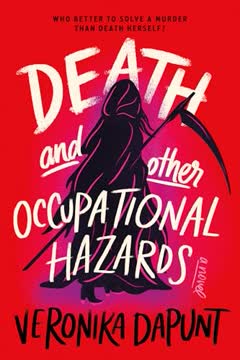
Plot Summary
Death's Eternal Job Review
Death, the narrator, laments her thankless, eternal job: ferrying souls from life to the afterlife. She's frustrated by humanity's fear and caricature of her as a skeleton in a black cloak, and by the Boss's (God's) insistence that she appear as humans expect. Death's work is emotionally draining, especially with humans, who react with terror, denial, or regret. She's surrounded by souls on the Boat to the Underworld, each coping differently with their end. Despite her cosmic importance, Death feels unappreciated and misunderstood, longing for connection and a sense of purpose beyond her grim reputation. Her relationship with the Boss is distant, and she's left questioning the meaning of her work and whether she can ever be seen for who she truly is.
A Sabbatical Among Mortals
After a particularly taxing period, Death requests a sabbatical from her cosmic duties, hoping to better understand humans and perhaps improve her own image. Life, her sister and cosmic counterpart, reluctantly helps her assume a human form—Delara Donn, a young woman in London. Life is skeptical, warning Death about the dangers of living as a mortal and the risk of truly dying. Their sibling rivalry is rooted in ancient grievances, but also deep care. Death's new existence is humbling: she's given a tiny, shabby flat, a flatmate, and a stack of job interviews. Life's arrangements are intentionally unglamorous, forcing Death to experience the struggles of ordinary people. Death is determined to use her time among humans to change perceptions and perhaps find fulfillment.
Becoming Delara: Law and Lies
As Delara, Death lands a job as a paralegal in a scrappy London law firm. She's fascinated by the legal world's rituals and the human obsession with rules, paperwork, and appearances. Her colleagues—Phil, Abby, Hinesh, and Gemma—are quirky, stressed, and mostly oblivious to her true nature. Delara's outsider perspective leads to comic misunderstandings, especially around social norms and technology. She's drawn to the idea of "making her case" to humanity, hoping to argue for a kinder view of Death. But her immersion in human life is complicated by the discovery of a mysterious, violent death that doesn't fit the cosmic Plan—a first in her eternal career. This anomaly shakes her confidence and sets her on a path of investigation.
The Unplanned Death
Delara investigates the death of Luigi Iuliano, a London mafioso killed by vampire fish—a bizarre, brutal demise that wasn't in the Plan. The Boss is evasive, admitting he doesn't know how it happened. Death is unsettled: if even one death can occur outside the Plan, the fabric of creation is at risk. She suspects the Temp (her cosmic substitute) or the Devil (now the VP for Pandemonium & Perdition) might be involved, but evidence is lacking. The law firm's mundane cases contrast sharply with Delara's existential crisis. She's forced to confront the limits of her power and the possibility that someone—or something—is tampering with the cosmic order, threatening not just her job, but reality itself.
The Living and the Dead
Delara, blending her legal and cosmic skills, pursues leads on the Unplanned death. She interviews witnesses, including Marco, a charming Italian parasitologist with mysterious connections to both the victim and the world of organized crime. Their rapport is tinged with mutual suspicion and attraction. Delara's attempts to navigate human relationships are awkward but sincere. Meanwhile, her sister Life warns her about the dangers of meddling and the fragility of her mortal body. Delara's investigation uncovers more oddities: ancient languages, mafia intrigue, and a pattern of deaths involving unusual biological agents. The boundaries between her cosmic and human selves blur, and she begins to experience vulnerability, fear, and even longing for connection.
The Devil's Modern Makeover
Delara tracks the trail of Unplanned deaths to the VP for Pandemonium & Perdition—the Devil, now inhabiting a suave Albanian crime boss. Their confrontation is a battle of wits, old grudges, and cosmic power. The VP denies responsibility for the Unplanned deaths but relishes Death's discomfort and hints at his own ambitions. He tries to seduce, manipulate, and ultimately harm Delara, exploiting her newfound mortality. Delara is stabbed in a London alley, saved only by the intervention of rats—creatures who, unlike humans, seem to respect her. The attack leaves her physically and emotionally shaken, and she's forced to reckon with the real possibility of her own death.
Stabbed and Mortal
Hospitalized and vulnerable, Delara is cared for by Life, who reveals the terrifying truth: if Delara dies in her human body, she dies for good. The cosmic rules are harsher than she realized. Their sibling bond is tested as old wounds resurface—Life's resentment over past cosmic catastrophes, Death's sense of inferiority, and their mutual inability to communicate. Delara's brush with death brings new empathy for human suffering and regret. She's torn between her duty to investigate the Unplanned deaths and the risk to her own existence. The experience deepens her understanding of fear, love, and the preciousness of life, even as the cosmic stakes escalate.
The Cost of Living
As Delara recovers, she resumes her investigation, now with a sense of urgency and dread. She discovers a second Unplanned death—an American scientist killed by a super-fungus, again outside the Plan. The pattern suggests a deliberate attack on the fabric of creation, with each victim connected to food, crime, or environmental harm. Delara's relationships with her human colleagues deepen; they suspect she's an undercover agent, not realizing the truth is far stranger. Marco becomes both a confidant and a suspect, his own secrets entwined with the mystery. Delara's sense of self fractures as she juggles cosmic responsibilities, human emotions, and the looming threat of apocalypse.
The Second Unplanned Death
Delara and Marco trace the Unplanned deaths to a global agro-business, uncovering a web of corruption, poisoned food, and mafia influence. The deaths—by vampire fish, fungus, and spiders—are not random but symbolic, each targeting those who profit from or perpetuate harm through food. Delara's investigation leads her to confront the limits of justice, the complexity of human evil, and the possibility that the cosmic Plan itself is unraveling. The Boss remains distant, Life is exhausted, and the Devil is both adversary and mirror. Delara's own humanity grows as she experiences love, pain, and the desire to protect those she cares about.
Bananas, Spiders, and Blame
A third Unplanned death—Cathy Hopper, a supermarket CEO killed by spiders—pushes Delara to the brink. She's framed by mysterious newspaper articles, accused of "lurking at crime scenes" and even dog theft. The media campaign is orchestrated by the Temp and the VP, aiming to discredit and isolate her. Delara is committed to a psychiatric hospital, abandoned by the Boss and betrayed by those she trusted. The Devil visits, urging her to end her own existence. Only the intervention of the Human Communications Director (the HCD, aka Jesus) and a prophet named Elsie saves her. Delara's ordeal exposes the cruelty of both cosmic and human systems, and the fragility of hope.
The Mafia's Poisoned Harvest
Delara and Marco travel to Sicily, investigating mafia-controlled tomato farms and the agromafia's deadly practices. They discover that the Unplanned deaths are linked by food tainted with poison, environmental destruction, and the exploitation of the vulnerable. The mafia's reach is global, and the cosmic consequences are dire. Delara's confrontation with mafia enforcers nearly costs her and Marco their lives, but her cosmic memories and powers resurface just in time. The investigation reveals that the true culprit behind the Unplanned deaths is not the Devil or the Temp, but someone closer to home—Life herself, driven to despair by the suffering in her creation.
Family, Betrayal, and Truth
Delara and Life finally face each other on a windswept beach. Life confesses to orchestrating the first Unplanned deaths, hoping to end her own existence and the suffering she feels in every living thing. The Devil exploited her actions to further his own ends. The sisters' relationship, strained by eons of rivalry and misunderstanding, is laid bare. Delara realizes that love—the very thing she thought was Life's alone—is also her own salvation. Their reconciliation is bittersweet, marked by grief, forgiveness, and the recognition that suffering and joy are inseparable. The cosmic balance is restored, but at a cost.
The Apocalypse Unfolds
The pattern of Unplanned deaths matches the breaking of the seals in the Book of Revelation. Each death brings the world closer to apocalypse, with Death, Life, the HCD, and the Devil as the four horsemen. The final Unplanned death—Garm, the rescued beagle—breaks the fourth seal. Delara's essence is unleashed, threatening to destroy all of creation. The Temp and the VP are revealed as cosmic usurpers, eager to seize Death's power. In a climactic confrontation, Delara must choose between annihilation and mercy, between cosmic duty and love. The fate of the world hangs in the balance.
The Fourth Horseman Rises
As her essence threatens to consume everything, Delara is torn between her ancient, destructive self and the love she has discovered as a human. The apocalypse is not averted by power, but by compassion—by Delara's refusal to let go of love, even in the face of ultimate loss. She contains her essence, saving Life and the world, but at the cost of her own existence. The Boss offers her a choice: remain in a peaceful afterlife, return as Death, or live as a human. Delara's journey has transformed her, but the decision is hers alone.
Love, Loss, and Letting Go
Delara spends her final days as a human with Marco, experiencing the fullness of love and the pain of impending separation. She realizes that her true calling is not to escape suffering, but to bear witness to it, to offer comfort at the end, and to honor the beauty of life. Her farewell to Marco is heartbreaking but necessary. She returns to her cosmic role, accompanied by the spirit of Garm, and reconciled with her sister. Together, Life and Death continue their eternal dance, guardians of beginnings and endings, sustained by the love that makes existence meaningful.
Death's Choice
In the aftermath, Death reflects on her journey: the meaning of suffering, the necessity of endings, and the miracle of love. She is changed—no longer just a force of destruction, but a witness to the preciousness of life. Her relationship with Life is renewed, their bond unbreakable. The world continues, fragile and beautiful, with Death and Life watching over it. The story ends with a sense of hope: that even in the face of death, love endures, and that every ending is also a beginning.
Analysis
A modern fable on mortality, meaning, and loveDeath and Other Occupational Hazards is a darkly comic, deeply humane meditation on what it means to live, to die, and to care. By reimagining cosmic forces as flawed, relatable beings, the novel invites readers to confront their own fears of death, regret, and insignificance. Its satire of bureaucracy and modern life is sharp, but never cynical; instead, it uses humor to illuminate the absurdity and beauty of existence. The central lesson is that suffering and joy are inseparable, that endings give meaning to beginnings, and that love—however fleeting or painful—is the greatest miracle of all. In an age obsessed with productivity, image, and denial of mortality, the book offers a radical alternative: to embrace vulnerability, to honor the bonds that sustain us, and to find purpose not in escaping death, but in living fully, loving deeply, and letting go when the time comes.
Review Summary
Death and Other Occupational Hazards is a darkly comic, multi-genre debut blending murder mystery, urban fantasy, philosophy, and romance. Readers largely praised its creative premise, witty humor, and the compelling portrayal of Death as a relatable, flawed female protagonist. The sibling dynamic between Death and Life was widely celebrated. Common criticisms include uneven pacing, an occasionally distracting romantic subplot, and an overstuffed plot that tries to balance too many genres. The ending drew strong emotional reactions, with many readers finding it unexpectedly heartfelt. Overall rating: 3.8/5.
People Also Read


Characters
Death (Delara Donn)
Death is the cosmic force responsible for endings, ferrying souls from life to the afterlife. She is ancient, powerful, and misunderstood—resented by mortals, caricatured as a skeleton, and underappreciated by her boss. Her relationship with her sister Life is fraught with rivalry, guilt, and longing for connection. As Delara, she experiences vulnerability, love, and the complexity of human existence. Her journey is one of self-discovery: from cosmic detachment to empathy, from loneliness to love. Death's arc is about accepting her role, embracing the pain and beauty of endings, and finding purpose in compassion.
Life
Life is Death's sister and cosmic counterpart, responsible for all beginnings and the flourishing of creation. She is vibrant, creative, and deeply empathetic, feeling the pain of every living thing. Her perfectionism and pride mask profound loneliness and exhaustion. Life's despair over the suffering in her world leads her to orchestrate Unplanned deaths, hoping to end her own existence. Her relationship with Death is central: a mix of rivalry, resentment, and deep, unspoken love. Life's arc is about accepting imperfection, seeking help, and recognizing that love and pain are inseparable.
The Boss (God)
The Boss is the ultimate authority, creator of the Plan, and manager of cosmic departments. He is wise but aloof, often unhelpful, and prone to cryptic pronouncements. His relationship with Death and Life is paternal but hands-off, preferring to let them solve their own problems. The Boss's interventions are subtle, guiding rather than commanding. He represents the mystery of existence, the limits of understanding, and the necessity of choice. His arc is static, but his presence shapes the destinies of all other characters.
The VP for Pandemonium & Perdition (The Devil)
The Devil, rebranded as the VP for Pandemonium & Perdition, is Death's cosmic rival and occasional collaborator. He delights in chaos, cruelty, and subverting the Plan. His modern persona is stylish, cunning, and obsessed with power. The VP's relationship with Death is antagonistic but also marked by grudging respect and shared history. He exploits weaknesses, orchestrates suffering, and seeks to usurp Death's role. Ultimately, his ambitions are thwarted by the power of love and the resilience of his adversaries.
The Temp
The Temp is Death's cosmic substitute, initially eager to please but increasingly ambitious and contemptuous. He is obsessed with efficiency, rules, and career advancement. The Temp's alliance with the VP is driven by a desire for power and recognition. His actions—framing Death, orchestrating media campaigns, and exploiting cosmic loopholes—threaten the fabric of creation. The Temp represents the dangers of bureaucracy without empathy, and the perils of ambition unchecked by wisdom.
Marco Altamura
Marco is an Italian parasitologist, charming, intelligent, and haunted by family tragedy. His connections to the mafia, food industry, and Unplanned deaths make him both a suspect and a confidant. Marco's relationship with Delara is central: a slow-burning romance marked by suspicion, vulnerability, and eventual revelation. He is brave, loyal, and willing to risk everything for those he loves. Marco's arc is about healing, trust, and the transformative power of love.
Garm
Garm is a rescued beagle, initially a lab animal, who becomes Delara's companion and spiritual guide. Her death is the catalyst for the final crisis, breaking the fourth seal and unleashing Death's essence. Garm's presence represents the purity of love, the pain of loss, and the hope of reunion. In the afterlife, she remains by Death's side, a reminder of what is worth saving.
Phil
Phil is Delara's employer at the law firm, a decent man struggling with financial pressures, difficult clients, and his own limitations. He is supportive but easily manipulated, ultimately betraying Delara under duress. Phil's arc is about the compromises of survival, the importance of integrity, and the possibility of redemption.
Gemma
Gemma is a solicitor at the law firm, stylish, inquisitive, and supportive. She suspects Delara's secrets but remains loyal. Gemma's determination to uncover the truth puts her in danger, but also helps Delara reconnect with her humanity. She represents the best of human friendship: acceptance, persistence, and care.
The Human Communications Director (HCD / Jesus)
The HCD is Death's friend and occasional savior, embodying kindness, humor, and resilience. His own history of betrayal and suffering gives him empathy for Death's struggles. The HCD's interventions are timely and transformative, helping Delara escape danger and find meaning. He represents the possibility of redemption, the power of love, and the importance of companionship in the face of cosmic adversity.
Plot Devices
Cosmic Bureaucracy and Satire
The novel's central conceit is the reimagining of cosmic forces—Death, Life, the Devil, God—as employees in a divine bureaucracy. This structure allows for satire of both human institutions and metaphysical questions. The use of job titles, performance reviews, and office politics grounds the story's absurdity in relatable experience, making existential themes accessible and comic.
First-Person, Unreliable Narration
The story is told entirely from Death's perspective, blending cosmic detachment with growing human vulnerability. Her voice is sardonic, self-deprecating, and increasingly emotional as she experiences love, fear, and regret. The unreliable narration—her confusion, memory lapses, and shifting self-understanding—mirrors her transformation and the instability of the cosmic order.
Foreshadowing and Symbolism
The pattern of Unplanned deaths is foreshadowed by references to the Book of Revelation, the breaking of seals, and the arrival of the four horsemen. Each death is symbolic—food, poison, environmental harm—linking personal tragedy to cosmic peril. The use of animals (rats, dogs, insects) as both helpers and victims underscores themes of innocence, loyalty, and the interconnectedness of life and death.
Blending of Genres
The novel shifts between dark comedy, detective story, cosmic fantasy, and philosophical meditation. The investigation of Unplanned deaths provides narrative momentum, while the cosmic bureaucracy and sibling rivalry offer humor and pathos. The blending of genres allows for exploration of deep questions—meaning, suffering, love—without sacrificing narrative drive or accessibility.
Emotional and Thematic Resonance
The story's emotional arc is driven by Death's journey from detachment to connection, from cosmic functionary to loving sister and partner. The power of love—romantic, familial, and platonic—is the force that averts apocalypse, redeems suffering, and gives meaning to existence. The narrative structure mirrors this transformation, moving from satire and irony to sincerity and hope.








































