

Key Takeaways
Democracy is not progress from monarchy but civilizational decline
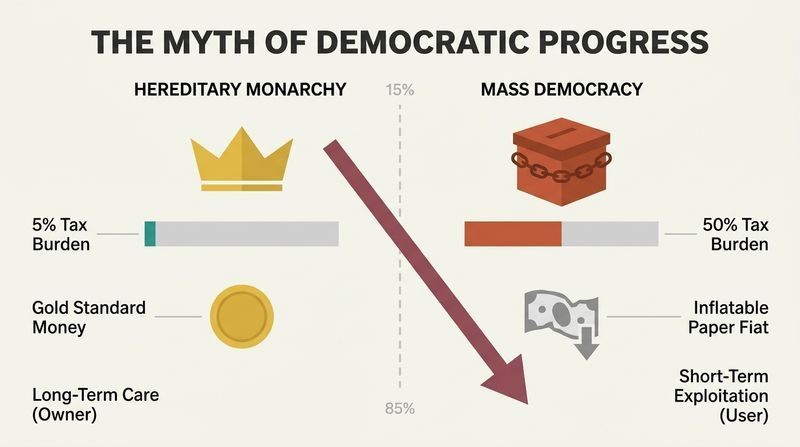
The book's central, contrarian thesis. Hoppe argues the near-universal shift from kings to elected parliaments after World War I, celebrated as liberation, actually made governance worse. He is no monarchist. His point is comparative: if you must have a state, hereditary monarchy beats democracy on economic and ethical grounds.
The measurable decline since 1918. He points to hard numbers: tax burdens rose from roughly 5% of national product under monarchy to around 50% under democracy. Government employment climbed from under 3% to 15-20% of the labor force. Public debt exploded, gold was replaced by inflatable paper money, and rates of divorce, illegitimacy, abortion, and crime climbed steadily. He reads twentieth-century Western history as a systematic unraveling rather than an ascent, with democracy as the engine.
What's striking is how Hoppe inverts the Whig theory of history, the comfortable assumption that humanity marches ever upward. His correlation is real but causation is contestable. The same century brought antibiotics, mass literacy, and tripled life expectancy. Critics note he selects decivilizational indicators while ignoring welfare gains. Yet the provocation is valuable: it forces readers to separate technological progress from political progress, which are often conflated. Public choice theorists like Buchanan reached milder versions of the same skepticism about majority rule. Hoppe simply refuses the anesthetic of assuming that whatever won must have deserved to.
A king owns his country; a president just rents it
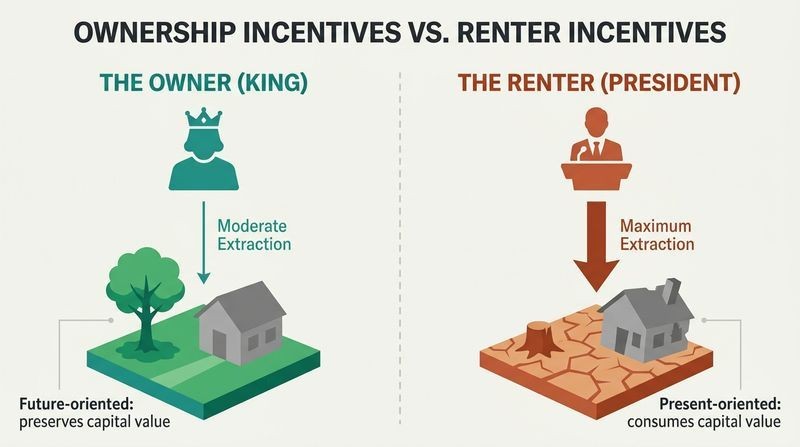
The ownership distinction drives everything. Hoppe reframes monarchy as privately-owned government and democracy as publicly-owned government. A hereditary king treats his realm as a capital asset he can sell, bequeath, and whose value he wants to preserve. A president is a temporary caretaker who controls current use but not capital value.
Incentives follow ownership. Because a king captures the resale value of his kingdom, he is future-oriented: he taxes moderately, since overtaxing his subjects shrinks the productive base and lowers his estate's worth. A caretaker president, unable to pocket capital value and facing a term limit, maximizes present extraction. What he does not grab now, he never will. Hoppe compares this to the difference between a private slaveowner who preserves his human capital and Soviet-style public slavery that consumed it, killing millions.
This is Hoppe's most original analytic move, applying capital theory to political constitutions. The logic mirrors the tragedy of the commons: a resource nobody owns gets consumed faster than one somebody owns. Economists studying dictatorship, notably Mancur Olson's stationary versus roving bandit distinction, reached parallel conclusions independently. The weakness: real kings launched ruinous wars, defaulted on debts, and squandered treasure on vanity. And democracies built durable institutions kings never managed. Hoppe's model captures a genuine incentive gradient but treats an idealized king against a realistic politician, stacking the comparison.
Your patience with the future is the hidden engine of civilization
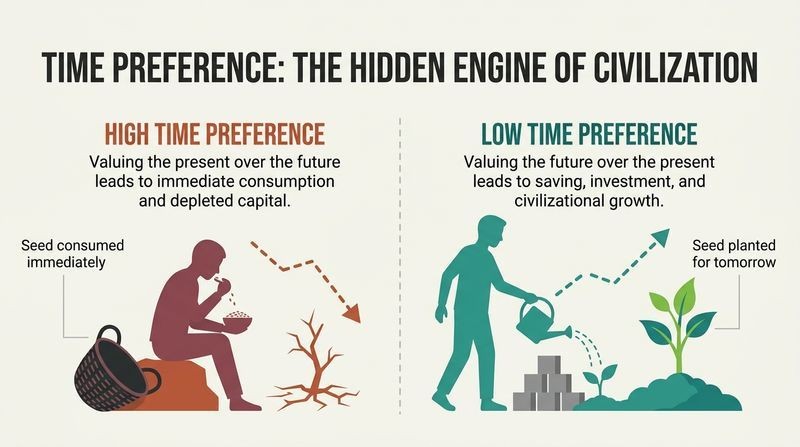
Time preference is the master variable. Time preference is the degree to which someone values present satisfaction over future satisfaction. Everyone prefers goods now over goods later, but the rate varies. A low time preference means you save, invest, and plan for distant goals. A high one means you grab, consume, and live day to day.
Falling time preference builds civilization. When people save and accumulate capital, wages rise, life expectancy grows, and horizons lengthen, pulling even present-oriented people toward patience. Hoppe borrows sociologist Edward Banfield's portrait of the chronically poor as radically present-oriented, unable to defer gratification, drifting between jobs. The upshot: family breakdown, addiction, and crime share a common root in high time preference, not low income. Government aggression against property systematically raises time preference and reverses the civilizing process.
Grounding social order in time preference connects Hoppe to serious empirical work. Walter Mischel's marshmallow experiments found delayed-gratification ability in children predicted later life outcomes, and behavioral economists now treat hyperbolic discounting as central to addiction and poverty. Where Hoppe overreaches is direction of causation. Modern research suggests scarcity itself raises discount rates: chronic stress and uncertainty make short horizons rational, not just a character flaw. So the poverty-impatience link may run opposite to Banfield's claim. Still, framing institutions by whether they reward or punish patience is a genuinely useful lens across economics, criminology, and family policy.
Open the ruling class to everyone and exploitation gets worse
Free entry into government is the fatal flaw. Under monarchy, a sharp line separates the ruling family from everyone else, creating clear class consciousness and resistance to higher taxes. Under democracy, anyone can theoretically become president, blurring the line between rulers and ruled and creating the illusion that the people rule themselves.
This illusion disarms resistance. When expropriation looked like oppression by a distinct elite, the public opposed it. Once anyone can join the takers, opposition collapses, and taxes climb. Worse, democratic competition selects for skill at demagoguery. Hoppe argues elections make it nearly impossible for a decent person to reach the top, because winning requires promising the most with the least ability to deliver. He quotes H.L. Mencken's mockery of candidates who prove twice two is five, then six, then twenty.
The claim that open competition selects for the ruthless echoes Hayek's chapter Why the Worst Get on Top in The Road to Serfdom, though Hayek aimed it at totalitarianism. There is testable substance here: political scientists document how primary systems reward candidates who mobilize intense factions over moderate consensus-builders. Yet Hoppe ignores accountability's upside. Elections let citizens remove predators without assassination, the messy but real check monarchy lacked. His model also cannot explain why democracies, for all their flaws, have never fought wars against each other and generally protect speech and dissent better than the kings he prefers. The selection mechanism cuts both ways.
Kings fought polite wars; democracies invented total war
Ownership changes the character of warfare. Monarchical wars were dynastic property disputes over territory, financed largely from the king's own purse. Because the public saw war as the ruler's private affair, kings faced resistance to high war taxes and conscription, so they preferred expanding through marriage and land purchase over conquest.
Democracy nationalizes war. Hoppe cites military historians describing eighteenth-century warfare as an almost gentlemanly game with clear rules, sparing civilians, where a novelist could travel through enemy France barely aware a war was on. The French Revolution changed everything by fusing the people with the state. Wars became ideological crusades between whole nations, conscription became universal, the combatant-noncombatant distinction collapsed, and the twentieth century became one of the most murderous in history, culminating in weapons of mass destruction.
The limited-war thesis has real historical backing. Eighteenth-century cabinet wars were indeed more contained than the mass-mobilization slaughters of 1914 to 1945, and the shift tracks the rise of nationalism, as Michael Howard documented. But Hoppe underweights technology. Machine guns, railroads, and industrial production made mass carnage possible regardless of regime type. Napoleon, his own prime villain, was a self-crowned emperor, not an elected caretaker. And absolute monarchs ran the Thirty Years War, which killed a larger share of Central Europe's population than either world war. The regime-to-brutality link is suggestive but the mechanism is muddier than the framework admits.
Redistribution manufactures more of exactly what it subsidizes
A machine that breeds its own justification. Democracy, Hoppe argues, is a device for legalized wealth redistribution, and it collides with the iron economic law that you get more of whatever you subsidize. Every transfer takes from producers (the haves of something good) and gives to non-producers (the have-nots), reducing the incentive to produce and increasing the incentive not to.
The predictable outputs. Subsidize poverty and get more poverty. Pay for unemployment and get more unemployment. Support single motherhood and illegitimacy rises. Insure against illness and malingering and neuroticism spread. Hoppe extends this to civil servants, arguing they pay no real taxes since their salaries come from taxes, making them net tax consumers. The welfare state thus continually enlarges the very problems it claims to solve, requiring ever more taxation to sustain.
The incentive-effects argument is mainstream economics, echoed by Charles Murray's Losing Ground, which Hoppe cites, and it captures something real about moral hazard. Unemployment insurance does modestly lengthen job searches, a finding replicated widely. The overreach is treating every social outcome as pure incentive response while ignoring insurance value and the structural causes of poverty. Modern evidence on unconditional cash transfers, from Kenya to Finland, often shows recipients working as much and investing more, contradicting the strong version. The claim that civil servants pay no taxes is a clever accounting reframe but obscures that their labor produces services someone values. The direction is sound; the magnitudes are exaggerated.
Any state monopoly on justice will overprice and pervert justice
A tax-funded protector is a contradiction. Hoppe defines a state as a compulsory territorial monopoly over ultimate decision-making plus the power to tax. He argues no such institution can protect property, because it is an expropriating property protector. Grant one agency the exclusive right to judge all disputes and to set its own price by force, and elementary monopoly theory predicts rising prices and falling quality.
Justice bends toward its monopolist. If the only place to appeal for justice is the government, justice gets distorted in the government's favor, constitutions and supreme courts notwithstanding, since those courts are themselves government organs deciding the limits of government power. Hoppe invokes Lysander Spooner's image: a highwayman who robs you at least does not pretend to be your protector or demand your continued loyalty afterward. The state does both.
This is the anarcho-capitalist core, inherited from Rothbard and Gustave de Molinari, who in 1849 first proposed competitive security production. The monopoly critique is logically tight given its premises. The unanswered empirical question is whether protection is a normal good subject to ordinary competition or a natural monopoly plagued by the very violence-escalation problems states supposedly solve. Skeptics ask what stops competing defense agencies from becoming warring statelets, which is roughly how actual states emerged. Somalia's stateless decades are the uncomfortable natural experiment. Hoppe's reply, that insurance firms would internalize the costs of conflict, is elegant but untested at scale.
Let insurance companies, not governments, sell you protection
The positive alternative to the state. Hoppe proposes that in a stateless natural order, security would be provided by competing private insurance firms funded by voluntary premiums. Insurers already indemnify against theft and disaster, command capital reserves dwarfing many governments, and have a direct financial stake in preventing crime because they must pay out claims.
Why insurance disciplines aggression. Because premiums are voluntary and firms compete, prices fall and quality rises, the opposite of a monopolist. Crucially, only accidental, unprovoked harms are insurable. You cannot insure against consequences of your own aggression, so every insurer must contractually forbid its clients from aggressing. Known aggressors become uninsurable outcasts, economically isolated and weak. Competing insurers, forced to arbitrate disputes across their client bases, would generate a unified body of law through consensus rather than legislation, producing genuine legal certainty.
The insurance model is Hoppe's most constructive contribution, converting an abstract ideal into an operational sketch. The insight that insurability requires excluding self-provoked harm elegantly builds nonaggression into the incentive structure rather than merely preaching it. Real-world analogues exist: medieval merchant law (lex mercatoria), private arbitration in modern commerce, and Iceland's medieval competitive legal system studied by David Friedman. The hard problem is the transition and the free-rider dimension of collective defense against a hostile state army. Insurance handles diversifiable, random risk well; it handles correlated, deliberate, existential threats poorly, which is precisely why nuclear war and invasion are uninsurable in the actual market.
Constitutions cannot cage a government that interprets its own limits
The founding error dressed as safeguard. Hoppe treats the U.S. Constitution not as a triumph but as a fateful mistake. It explicitly granted Congress the power to tax and legislate, powers even absolute kings only assumed rather than openly claimed. Kings were seen as discoverers of eternal law, not makers of it; legislators became open manufacturers of new law.
Self-limitation is a fantasy. Drawing on John C. Calhoun, Hoppe argues any written limit interpreted by the government's own courts becomes a license for expansion. The dominant party favors broad construction; the minority's strict reading has no enforcement power. Two centuries later the results are in: a near-negligible early tax burden became over 40% extraction, gold became inflatable paper, and a noninterventionist republic became the world's foremost military power. The experiment in limited government, he concludes, failed by design.
Calhoun's prophecy that constitutional courts staffed by the government would ratify rather than restrain state power has aged uncomfortably well, as anyone tracking the expansion of the commerce clause can attest. The structural point, that a referee employed by one team is no referee, is genuinely hard to rebut. Yet the counterfactual is unclear. Constitutions may not stop growth but might slow it or channel it, and cross-country comparisons suggest rule-of-law constraints correlate with prosperity. Hoppe treats the failure to achieve perfect limitation as total failure, a purist standard that discards partial goods. The diagnosis is sharper than the all-or-nothing verdict warrants.
Real liberty means the freedom to exclude and discriminate
Private property is the right to say no. Hoppe argues that a genuinely free society would be strikingly less tolerant and more discriminatory than the modern welfare state, because private property inherently means exclusion. To own something is to have the right to exclude others, set conditions, and expel trespassers.
Forced integration versus voluntary separation. He contends the welfare state has stripped owners of the right to exclude through antidiscrimination and open-immigration policies, producing forced integration that breeds conflict. His alternative is covenant communities: proprietary neighborhoods, like modern gated communities or shopping malls owned by a single entity, that set their own membership rules. Different communities would discriminate differently, producing what Rothbard called a gorgeous mosaic. Democrats, communists, and those advocating lifestyles incompatible with a covenant's purpose would be contractually expelled to preserve the order.
This is the book's most incendiary strand, and the exclusionary conclusions have drawn intense criticism. The defensible economic kernel is real: freedom of association logically includes freedom of dissociation, and forced association does generate friction, a point sociologists studying tension in imposed integration have documented. But Hoppe slides from the abstract right to exclude on one's own property to endorsing sweeping ethnic and ideological expulsion, which many libertarians, including Cato-aligned thinkers he attacks, reject as incompatible with individual liberty rather than required by it. The tension between his celebration of the pioneer melting frontier and his insistence on homogeneous covenants is never fully resolved. Readers should engage this critically.
Secede into thousands of tiny states until the giant withers
Small is the strategy, not just the aesthetic. Because a monopoly of law and order requires legitimacy in public opinion, Hoppe argues the way to dismantle the central state is decentralization and secession, both inherently antimajoritarian acts. He envisions the West breaking into tens of thousands of free cities and regions, a proliferation of Monacos, Singapores, and Liechtensteins.
Why smallness disciplines power. The smaller a jurisdiction, the easier it is to vote with your feet, so governments must compete to keep productive residents by lowering taxes and regulation. Tiny territories are also forced toward free trade, since self-sufficiency would mean poverty. Hoppe warns against repeating the Confederacy's mistake of a large contiguous bloc that let Washington rally unified opposition. Instead, scatter secession across hundreds of small locations so no unified crackdown can form.
The competitive-jurisdictions argument has serious pedigree, from Charles Tilly on how European fragmentation bred liberty to Tiebout's model of citizens sorting among local governments by voting with their feet. Empirically, small open economies like Singapore, Switzerland, and Hong Kong do cluster near the top of economic freedom rankings, lending weight to the thesis. The mobility mechanism is genuinely powerful. The tension Hoppe underplays: fragmentation can also breed predatory microstates, trade barriers, and the very interstate warfare he decries, which is why merchants historically welcomed larger peaceful zones. His own account of medieval free cities existing within a feudal structure suggests scale and liberty interact in more complex ways than pure smallness.
Facts never settle debates; only theory can interpret history
Why the book is philosophy, not history. Hoppe insists he presents no new facts, only new interpretations, because facts alone cannot decide between rival explanations. Everyone agrees nineteenth-century America had low taxes and high growth, and the twentieth century high taxes and high growth. Did growth happen because of high taxes or despite them? Data cannot answer; the numbers are compatible with both stories.
The a priori method. Following Mises's praxeology, Hoppe claims certain propositions about human action are true independent of experience, knowable by reasoning about the nature of things, like the claim that a larger quantity of a good is preferred to a smaller one, or that price controls below market level cause shortages. Such theoretical truths let him correct and reconstruct the historical record rather than being ruled by it. History illustrates theory; it can neither prove nor refute it.
This methodological stance is the foundation everything else rests on, and it is where mainstream social science parts company most sharply with the Austrian School. The strength: Hoppe is right that raw correlations underdetermine causal claims, a point econometricians concede when they worry about identification. Pure empiricism cannot interpret itself. The vulnerability: elevating deduced axioms above all possible evidence risks unfalsifiability, the very charge Popper leveled at pseudoscience. If no observation could ever refute the theory, critics ask, what distinguishes confident insight from dogma? Hoppe would reply that logic corrects observation as in mathematics. Readers get an honest look at the engine driving the book's certainty.
Analysis
Democracy: The God That Failed is a work of political philosophy in the radical Austro-libertarian tradition of Ludwig von Mises and, above all, Murray Rothbard, whose ownership-based political economy Hoppe extends into a full theory of regime types. Its ambition is genuinely unusual: to argue that the twentieth century's signature political achievement, the triumph of democratic republicanism, was in fact a civilizational catastrophe, and that the deposed monarchies it replaced, whatever their flaws, embodied a superior incentive structure. Kings owned their realms as capital assets and thus husbanded them; elected caretakers merely rent power and thus strip-mine it. From this single distinction Hoppe deduces rising taxation, exploding debt, fiat inflation, total war, family breakdown, and moral decay.
The book's power lies in its relentless internal consistency. Grant the axioms of self-ownership, time preference, and the illegitimacy of monopoly, and the conclusions follow with almost geometric force. Its weakness is the mirror image: the whole edifice rests on an a priori method that treats deduction as immune to empirical refutation, and on an idealized monarch measured against a realistic politician. Hoppe selects decivilizational indicators while the same democratic century delivered unprecedented longevity, literacy, and prosperity, gains his framework struggles to accommodate.
What makes the work indispensable rather than merely provocative is its diagnostic clarity. Long before it becomes a manifesto for anarcho-capitalist secession and covenant communities, it forces readers to disentangle technological progress from political progress, to see constitutions as instruments that ratify rather than restrain power, and to ask who actually bears the costs of state action. The prescriptive conclusions, especially the exclusionary vision of homogeneous covenants, are where most readers will and should resist. But the analytic core, that ownership shapes stewardship and that unaccountable monopoly corrupts whatever it touches, is a lens worth borrowing even by those who reject nearly everything Hoppe builds with it.
Review Summary
Democracy: The God That Failed receives mixed reviews. Many praise Hoppe's critique of democracy and his arguments for monarchy and anarcho-capitalism, finding them thought-provoking and well-researched. Critics argue his ideas are flawed, impractical, and potentially dangerous. Some appreciate his unconventional thinking, while others find his views on race and culture offensive. The book's writing style is criticized for being repetitive and dense. Overall, readers find it a controversial but intellectually stimulating work that challenges conventional political thought.
People Also Read



FAQ
What is Democracy: The God That Failed by Hans-Hermann Hoppe about?
- Critical analysis of government forms: The book examines the historical transition from monarchy to democracy, arguing that this shift represents a decline in civilization rather than progress.
- Economic and ethical critique: Hoppe contrasts monarchy (private government ownership) with democracy (public government ownership), claiming democracy leads to higher exploitation, shortsightedness, and social decay.
- Proposal of a stateless society: The author advocates for a "natural order"—a stateless, market-based society grounded in private property and voluntary cooperation—as a superior alternative to both monarchy and democracy.
Why should I read Democracy: The God That Failed by Hans-Hermann Hoppe?
- Challenging mainstream assumptions: The book offers a radical critique of democracy, questioning widely held beliefs about its benefits and legitimacy.
- Insight into political and economic systems: Hoppe provides a unique perspective on how different forms of government impact social order, economic incentives, and cultural values.
- Alternative vision for society: Readers are introduced to the concept of a stateless, voluntary order, encouraging critical thinking about the role and necessity of government.
What are the key takeaways from Democracy: The God That Failed by Hans-Hermann Hoppe?
- Democracy as civilizational decline: Hoppe argues that democracy leads to increased exploitation, moral decay, and economic inefficiency compared to monarchy.
- Importance of private property: The book emphasizes that private property and voluntary association are foundational for a prosperous and orderly society.
- Delegitimization and secession: Hoppe suggests that delegitimizing democracy and pursuing decentralization or secession are necessary steps toward restoring liberty and social order.
What are the best quotes from Democracy: The God That Failed by Hans-Hermann Hoppe and what do they mean?
- "Democracy virtually assures that only bad and dangerous men will ever rise to the top of government." This highlights Hoppe's belief that democratic systems select for demagogues rather than virtuous leaders.
- "You can have one—socialism (welfare)—or the other—traditional morals—but you cannot have both." Hoppe argues that welfare states undermine traditional values and social cohesion.
- "Resolve to serve no more, and you are at once freed." This quote, inspired by Etienne de la Boetie, underscores the power of mass withdrawal of consent in delegitimizing government authority.
How does Hans-Hermann Hoppe compare monarchy and democracy in Democracy: The God That Failed?
- Monarchy as private ownership: Monarchs treat the state as their private property, incentivizing them to preserve its long-term value and moderate exploitation.
- Democracy as public ownership: Democratic leaders are temporary caretakers with incentives to maximize short-term gains, leading to higher taxation, debt, and social decay.
- Class consciousness and legitimacy: Monarchy maintains clear class distinctions and resistance to government overreach, while democracy blurs these lines, making government expansion easier.
What is the concept of "time preference" in Democracy: The God That Failed and why is it important?
- Definition and significance: Time preference refers to the tendency to value present goods over future goods, influencing saving, investment, and social progress.
- Government impact: Hoppe argues that government intervention, especially under democracy, raises time preference, encouraging present-oriented behavior and undermining civilization.
- Civilizational consequences: High time preference leads to shortsightedness, consumption, and social decay, while low time preference fosters capital accumulation and long-term planning.
Why does Hans-Hermann Hoppe argue that democracy leads to economic decline and social decay in Democracy: The God That Failed?
- Wealth redistribution incentives: Universal suffrage creates a "tragedy of the commons," where majorities vote for wealth redistribution, reducing incentives to produce.
- Expansion of government power: Democracy legitimizes expropriation through taxation and regulation, eroding private property and personal independence.
- Empirical evidence: Hoppe cites rising crime, welfare dependency, family breakdown, and economic stagnation as consequences of democratic governance.
What is the "natural order" or stateless society proposed by Hans-Hermann Hoppe in Democracy: The God That Failed?
- Stateless, market-based society: The natural order is a system where all resources are privately owned and all services, including law and defense, are provided competitively and voluntarily.
- Rejection of monopoly government: Hoppe sees both monarchy and democracy as exploitative monopolies, advocating for decentralized, voluntary alternatives.
- Transition strategies: He recommends secession, privatization, and delegitimization of democracy as steps toward achieving the natural order.
How does Hans-Hermann Hoppe use Austrian School economics in his arguments in Democracy: The God That Failed?
- A priori social theory: Hoppe employs deductive reasoning from Austrian economics to analyze political and social phenomena, rather than relying solely on empirical data.
- Key concepts: He uses ideas like time preference, capital theory, and economic calculation to critique government forms and advocate for private property.
- Intellectual lineage: The book builds on the work of Ludwig von Mises and Murray Rothbard, extending their theories to the critique of democracy and the proposal of a stateless order.
What is Hans-Hermann Hoppe’s critique of the welfare state in Democracy: The God That Failed?
- Destructive incentives: Compulsory wealth redistribution reduces productivity and responsibility, leading to poverty, unemployment, and social pathologies.
- Erosion of family and morals: Welfare programs like social security and public education weaken intergenerational bonds and promote irresponsibility.
- Infantilization of society: The welfare state replaces family discipline with state control, causing a regression in social maturity and stability.
How does Hans-Hermann Hoppe address immigration and forced integration in Democracy: The God That Failed?
- Private property principle: In a stateless society, immigration would be by invitation only, with property owners deciding whom to admit.
- Critique of government policy: State-controlled borders often result in forced integration, as governments admit uninvited immigrants for political gain.
- Policy recommendations: Hoppe advocates for restrictive, contract-based immigration, where sponsors assume liability and citizenship is tied to property ownership.
What strategies does Hans-Hermann Hoppe recommend for achieving liberty and dismantling the state in Democracy: The God That Failed?
- Delegitimization and withdrawal of consent: Hoppe emphasizes the importance of changing public opinion and withdrawing cooperation from the state.
- Secession and decentralization: He advocates for peaceful secession and the creation of small, autonomous jurisdictions to restore competition and limit government power.
- Restoration of private law: The ultimate goal is to abolish taxation and legislation, privatize public property, and allow competitive insurance agencies to provide law and order.
Download PDF
Download EPUB
.epub digital book format is ideal for reading ebooks on phones, tablets, and e-readers.








































