Key Takeaways
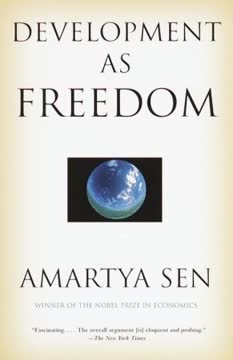
1. Development is the expansion of substantive freedoms.
Development consists of the removal of various types of unfreedoms that leave people with little choice and little opportunity of exercising their reasoned agency.
Beyond narrow metrics. Development is fundamentally about expanding the real freedoms people enjoy, enabling them to live lives they value. This perspective contrasts with narrower views focused solely on GNP growth, industrialization, or technological advance.
Removing unfreedoms. True development requires eliminating major sources of unfreedom: poverty, tyranny, poor economic opportunities, social deprivation, and neglect of public facilities. These "unfreedoms" restrict choices and opportunities, hindering human flourishing.
Intrinsic value. Freedom is both the primary objective and the principal means of development. Its intrinsic importance means it is valuable in itself, not merely as a tool to achieve other economic indicators.
2. Freedom plays both intrinsic and instrumental roles.
Expansion of freedom is viewed, in this approach, both as the primary end and as the principal means of development.
Dual significance. Freedom's intrinsic role lies in enriching human life through basic capabilities like avoiding starvation or participating politically. Its instrumental role highlights how different types of freedom mutually reinforce each other.
Interconnected freedoms. Five instrumental freedoms are emphasized: political freedoms, economic facilities, social opportunities, transparency guarantees, and protective security. These contribute to a person's general capability to live more freely.
Policy implications. Recognizing these interconnections is crucial for effective policy. For example, economic growth can fund social services, while education and healthcare improve economic participation and reduce mortality rates.
3. Poverty is a deprivation of basic capabilities, not just income.
Poverty must be seen as the deprivation of basic capabilities rather than merely as lowness of incomes, which is the standard criterion of identification of poverty.
Beyond income. While low income is a major cause, poverty is more fundamentally a deprivation of basic capabilities—the substantive freedoms to achieve a life one has reason to value. This includes the ability to live long, be healthy, and participate in society.
Diverse influences. Many factors beyond income affect capabilities:
- Personal heterogeneities (disability, age)
- Environmental diversities (climate, disease)
- Social climate (public education, crime)
- Intra-family distribution (gender bias)
Magnified inequality. Income inequality can be exacerbated by unequal abilities to convert income into capabilities. A disabled person, for instance, needs more income to achieve the same functioning as an able-bodied person.
4. Democracy is vital for preventing crises and shaping values.
No substantial famine has ever occurred in any independent country with a democratic form of government and a relatively free press.
Famine prevention. Democracy's protective role is powerfully demonstrated by its ability to prevent famines, even in poor countries. Governments facing elections and a free press have strong political incentives to act against impending crises.
Informational and constructive roles. Political freedoms facilitate open public discussion, which is essential for identifying needs and forming shared values. This constructive role helps conceptualize "economic needs" and drives appropriate policy responses.
Beyond economic growth. While some authoritarian states have achieved rapid economic growth, there is no general evidence that suppressing political freedoms is beneficial. Democracy's intrinsic value, protective function, and role in value formation are indispensable for comprehensive development.
5. Markets are essential but require social and institutional support.
The freedom to exchange words, or goods, or gifts does not need defensive justification in terms of their favorable but distant effects; they are part of the way human beings in society live and interact with each other (unless stopped by regulation or fiat).
Freedom of transaction. Markets are intrinsically valuable, offering the basic freedom to exchange and transact. Denying this freedom, as seen in labor bondage or restrictions on women's employment, is a major societal failing.
Efficiency and limitations. Markets are powerful engines of economic growth and efficiency, but they do not inherently guarantee equity or address public goods. Unconstrained markets can lead to entrenched poverty, environmental damage, and social exclusion.
Complementary institutions. Markets must be supplemented by other institutions like public education, healthcare, and social safety nets. Adam Smith himself supported public education and recognized market failures, advocating for critical scrutiny of market operations.
6. Women's agency drives profound social and economic change.
Nothing, arguably, is as important today in the political economy of development as an adequate recognition of political, economic and social participation and leadership of women.
Beyond well-being. Focusing on women's agency recognizes their active role in shaping society, not just as passive recipients of welfare. Empowering women through education, employment, and property rights enhances their voice and influence.
Impact on family and society. Women's agency significantly reduces child mortality and fertility rates. Educated and employed women can better advocate for their children's welfare and make informed decisions about family size.
Challenging biases. Increased female participation in economic and social life helps correct gender biases in intra-household resource allocation and challenges traditional norms. Examples like the Grameen Bank demonstrate the success of economically empowering women.
7. Population growth is best addressed through freedom, not coercion.
The solution of the population problem calls for more freedom, not less.
Malthus revisited. Fears of food output falling behind population growth are largely unfounded; world food production has consistently outpaced population. Malthus's pessimism about voluntary fertility reduction has been disproven by history.
Voluntary reduction. Fertility rates decline with social and economic development, particularly through women's education and employment. Countries like Kerala and Tamil Nadu achieved low fertility without coercion, unlike China's "one-child policy."
Coercion's costs. Coercive family planning violates reproductive rights and can have severe side effects, such as increased female infant mortality and sex-selective abortions. Freedom-enhancing policies are more effective and ethical.
8. Human rights are universal ethical claims, not exclusive to any culture.
The valuing of freedom is not confined to one culture only, and the Western traditions are not the only ones that prepare us for a freedom-based approach to social understanding.
Ethical claims. Human rights are ethical claims for universal entitlements and freedoms, not merely legal constructs. They represent what people should have, even if not yet legally enforced, and can include "imperfect obligations" on society.
Challenging cultural critiques. The "Asian values" argument for authoritarianism is based on narrow, selective interpretations of diverse Asian traditions. Figures like Confucius, Emperor Ashoka, and Islamic scholars demonstrate rich histories of valuing freedom, tolerance, and dissent in Asia.
Globalization and diversity. While globalization poses cultural threats, it also fosters cross-cultural learning and interchange. Societies can choose to preserve traditions through public discussion and participation, rather than through imposed uniformity or isolation.
9. Effective social choice demands rich information and public deliberation.
The greatest relevance of ideas of justice lies in the identification of patent injustice, on which reasoned agreement is possible, rather than in the derivation of some extant formula for how the world should be precisely run.
Beyond limited information. Kenneth Arrow's impossibility theorem highlights that rational social choice is hindered by limited information (e.g., only individual preference rankings). Real-world social judgments require broader data, including poverty levels, welfare impacts, and earned entitlements.
Value formation. Social decisions are not just about aggregating given preferences but also about shaping them through public discussion and interaction. This process helps forge shared values and commitments, leading to partial accords on basic injustices.
Anticipating consequences. Rational social progress involves anticipating both intended and unintended consequences of policies. Learning from past successes (e.g., China's social reforms aiding later economic growth) and failures (e.g., adverse effects of coercive family planning) is crucial for effective policy.
10. Values and ethics are foundational for successful economic systems.
The success of capitalism in transforming the general level of economic prosperity in the world has drawn on morals and codes of behavior that have made market transactions economical and effective.
Beyond self-interest. While self-interest is a powerful motivator, effective economic systems, including capitalism, rely on broader values like trust, reliability, and honesty. Adam Smith recognized that "humanity, generosity, and public spirit" are crucial for societal well-being.
Combating corruption. Corruption, a major barrier to progress, stems from violating established rules for personal gain. Solutions involve not just penalties and reduced discretionary power, but also fostering ethical norms and a sense of "relative justice" through leadership example.
Environmental ethics. Addressing public goods issues like environmental protection requires not only regulations and incentives but also the development of social values and a sense of responsibility. This reduces reliance on forceful state action and promotes collective well-being.
11. Individual freedom and social responsibility are deeply intertwined.
Responsibility requires freedom.
Dual relationship. Individual responsibility is crucial, but it is profoundly contingent on the substantive freedoms people possess. Without the capability to do something (e.g., basic education, healthcare), a person cannot be held responsible for it.
Social commitment. Social support in expanding freedoms is an argument for individual responsibility, not against it. It's about creating opportunities for choice and decision-making, enabling individuals to act responsibly, rather than fostering a "nanny state."
Integrated approach. This social commitment involves not just the state, but also diverse institutions: markets, political parties, NGOs, media, and community arrangements. These collectively enhance and sustain individual freedoms, allowing people to shape their own destinies.
Review Summary
Reviews of Development as Freedom are mixed, averaging 4.1/5 despite many low ratings. Common criticisms include excessive repetition, dry and overly complex writing, and a failure to engage with modern examples or contemporary scholars. Critics argue Sen ignores geopolitical power structures, colonial history, and class dynamics, while offering only superficial critiques of capitalism. Positive reviewers appreciate his capability approach, reframing development beyond GDP, and his arguments linking political freedom to economic progress, acknowledging the book's significant influence on development theory and institutions like the UN.
People Also Read