Key Takeaways
1. Productivity's Ultimate Purpose: Glorify God by Doing Good
Productivity is effectively stewarding my gifts, talents, time, energy, and enthusiasm for the good of others and the glory of God.
Beyond mere tasks. True productivity, from a Christian perspective, transcends simply "getting more stuff done." It's a profound theological concept rooted in our God-given purpose: to bring glory to Him. Every action, every decision, and every moment of our lives should ultimately serve this higher calling, transforming mundane tasks into acts of worship.
Good works illuminate. We glorify God by doing good works, which Jesus described as a light shining before others, causing them to praise our Father in heaven. These "good works" aren't limited to overtly spiritual activities; they encompass any deed done for the benefit of others and the glory of God. Whether you're a parent comforting a child, a student diligently studying, or an employee serving clients, your actions can reflect God's goodness.
God's design for us. God saved us precisely for good works, preparing them beforehand for us to walk in. This means Christians are uniquely equipped and called to be "good works zealots," passionately committed to serving others. Even our imperfect efforts are pleasing to God, who delights in our desire to honor Him through our service in every area of life.
2. Conquer the Thieves of Productivity: Laziness, Busyness, and Life's Thorns
Whatever the answer is needs to be identified and rooted out. It needs to be destroyed and replaced for the good of others and the glory of God.
Identify the culprits. Our struggle with productivity often stems from three primary "thieves." Laziness, characterized by procrastination and a refusal to start or finish tasks, is a deep-seated character deficiency. Busyness, its apparent opposite, is equally detrimental, leading to scattered attention and a false sense of accomplishment without true fruitfulness.
External challenges. Beyond internal struggles, we face "thorns and thistles"—the inherent difficulties and interruptions of a fallen world. These external obstacles, from traffic jams to unexpected illnesses, constantly threaten to derail our best-laid plans. Recognizing these challenges helps us understand that diminished productivity is often a theological problem, a failure to align with God's truths.
A call to action. Overcoming these thieves requires intentionality and a commitment to character. We must actively identify what hinders our ability to do good for others and systematically root it out. This means structuring our lives to maximize good, cultivating Christian character, and even pursuing other foundational habits like exercise or spiritual disciplines in parallel.
3. Audit Your Life: Define Areas of Responsibility and Roles
Before God, what am I responsible for?
Bring order to chaos. Life's demands are infinite, but our capacity is finite. To achieve peace and productivity, we must first conduct a thorough audit of our responsibilities. This involves looking at our lives through a wide-angle lens, identifying all areas where God has entrusted us with stewardship, much like the parable of the talents.
Categorize your commitments. The goal is to encompass all responsibilities within a manageable number of broad categories, ideally five to nine. These categories act as containers for all your life's commitments. Examples include:
- Personal (spiritual, physical, administrative)
- Family (spouse, children, home, finances)
- Church (ministry, discipleship, community)
- Social (friends, evangelism)
- Work/School/Hobbies
Detail your roles. Once broad categories are established, drill down into specific roles, tasks, or projects within each. This provides greater definition and clarity, outlining the specific ways you fulfill your responsibilities. This living list will evolve, but it provides a crucial framework for organizing your life.
4. Clarify Your Mission: Prioritize with Purpose and Practice Planned Neglect
Only once you give yourself permission to stop trying to do it all, to stop saying yes to everyone, can you make your highest contribution towards the things that really matter.
Mission-driven decisions. With your responsibilities defined, the next step is to articulate your mission within each area. Instead of a single, intimidating life mission statement, create focused mission statements for each area of responsibility. These statements serve as guiding principles for allocating your finite resources—gifts, talents, time, energy, and enthusiasm.
The power of "no." Regularly review your roles and projects against your mission statements. This critical step helps identify commitments that no longer align with your purpose. True productivity isn't about doing more things, but doing more good, which often requires the courage to say "no" to even good opportunities that don't fit your mission.
Planned neglect. Embrace the concept of "planned neglect," consciously choosing what not to do. For off-mission items, you have three options:
- Drop them: Eliminate tasks that serve no clear purpose.
- Delegate them: Assign tasks to others who are better suited or equipped.
- Do them: Acknowledge that some off-mission tasks may still be done out of love for God and others, even if they don't perfectly fit your core mission.
5. Select and Master Your Essential Digital Tools
To a large degree, your productivity depends on identifying and using the best tools for the job and then growing in your skill in deploying them.
Tools for efficiency. Just as early humans relied on tools to exercise dominion, we depend on modern tools to enhance our productivity. These tools compensate for our shortcomings, remembering details, managing tasks, and organizing information, freeing our minds for more important matters. Choosing the right tools and learning to use them skillfully is paramount.
The indispensable trio. An effective productivity system hinges on three essential digital tools, each with a distinct purpose:
- Task Management Tool (e.g., Todoist): Captures and organizes projects, tasks, and actions.
- Scheduling Tool (e.g., Google Calendar): Organizes time, events, meetings, and appointments.
- Information Tool (e.g., Evernote): Collects, archives, and provides access to data, facts, and documents.
"A home for everything." The guiding principle for tool usage is "a home for everything, and like goes with like." This means tasks belong only in your task manager, events only on your calendar, and information only in your information tool. This strict separation prevents clutter and ensures you always know where to find what you need, fostering a calm and orderly life.
6. Establish a Daily Planning Ritual: The Coram Deo Review
To manage your day effectively you need to know what the possible tasks are for that day, what the necessary tasks are for that day, and what time is available to accomplish them.
Habit sustains motivation. Motivation is fleeting, but habits endure. To sustain productivity, embed your tools into a consistent system of habits and routines. This system ensures that even when motivation wanes, you continue to operate smoothly and efficiently, dedicating appropriate time and attention to what matters most.
The daily Coram Deo. Start each workday with a brief, prayerful "coram Deo" (in the presence of God) review. This short planning phase, typically 4-5 minutes, is tactical, setting tasks into time and determining your daily focus. It's a deliberate moment to acknowledge God's sovereignty and seek His wisdom for the day.
The Coram Deo checklist:
- Pray: Admit dependence on God and ask for help.
- Clear Task Inbox: Process all new tasks, assigning them to projects or deleting/doing/deferring/delegating.
- Check Calendar & Alerts: Review today's events and gauge available time.
- Check Waiting For: Follow up on delegated items.
- Check Next 7 Days: Note approaching deadlines.
- Choose Today's Top Tasks: Select priorities and assign due dates.
7. Execute Your Day Strategically: Manage Energy, Tackle Hard Tasks First
Getting things done is not only a matter of managing time, but also a matter of managing energy.
Beyond planning. Once daily planning is complete, the execution phase begins. Your tools now serve as your guides: the task manager shows options, the calendar alerts to events, and the information tool provides necessary data. The key is to work with your system, not against it.
Optimize energy levels. Productivity isn't just about time; it's about energy. Understand your personal energy cycles—when you're at your mental peak and when you're least effective. Schedule high-engagement tasks (creative work, problem-solving) for your high-energy times, and administrative or low-mental-engagement tasks for your low-energy periods.
Strategic execution tips:
- Use all three tools: Ensure tasks, events, and information are in their proper homes.
- Do the hardest tasks first: Tackle daunting tasks when your energy is highest for maximum impact.
- Prioritize your work: Complete your chosen tasks before responding to others' demands.
- Expect failure: Don't be discouraged by undone tasks; simply reschedule them.
- Remember your purpose: Constantly remind yourself that you exist to glorify God by doing good, not just to check off boxes.
8. Maintain Your System with a Consistent Weekly Review
Productivity is not a system you set up and then forget about, but something that demands dedicated attention on a regular basis.
Fight chaos creep. No system maintains order on its own; it requires consistent maintenance. Just as a car needs regular oil changes, your productivity system needs a weekly review to prevent chaos from creeping in. This strategic review widens your scope beyond daily tactics, allowing you to set new plans, restart stalled projects, and course-correct.
The power of checklists. A weekly review, guided by a checklist, is the most effective way to maintain system integrity. It calls you back when you've drifted and ensures all parts are functioning. Block off about 30 minutes, ideally at the end of the week, to plan and organize for the week ahead.
Serve and surprise. Frame your weekly planning around the "serve and surprise" paradigm for each area of responsibility.
- Serve: What must I do this week to be faithful in my roles?
- Surprise: What can I do to excel, delight, and be an unexpected blessing to others?
This paradigm helps generate tasks that reflect both duty and joyful generosity.
9. Tame Your Email: Treat It as Communication, Not a Catch-All
Email is an abysmal task management tool and a woefully poor scheduling tool. It is tolerable only if we make it do what it does passably well: communication.
The email paradox. Email is a vital communication tool, yet it often becomes a source of chaos due to misuse. Many treat their email inbox like a physical mailbox crammed with unread letters, task lists, and forgotten appointments. This chaotic approach hinders productivity and creates unnecessary stress.
Email's proper home. Apply the "home for everything" principle to email: the inbox is only for unprocessed communication. It is not a place for archived messages, tasks, or calendar items. A simple email system needs just four locations:
- Inbox: For new, unprocessed emails.
- Reply Folder/Label: For emails requiring a thoughtful response later.
- Archive Folder/Label: For emails to keep but require no action (or forward to Evernote).
- Trash Bin: For junk or irrelevant messages.
The "Inbox Zero" workflow. When checking email, process each message immediately: trash it, archive it, reply if it takes less than 15 seconds, or move it to your Reply folder. The goal is to empty your inbox every time you check it. Integrate email with your other tools:
- Tasks from email: Create a task in your task manager.
- Information from email: Forward to your information tool (e.g., Evernote).
- Events from email: Add to your calendar.
10. Cultivate Holistic Productivity: Embrace Rest, Accountability, and Continuous Growth
Productivity is about all of life and requires all of your body and mind.
Beyond the grind. True productivity isn't just about relentless work; it's about holistic well-being. Neglecting personal care, rest, or spiritual disciplines ultimately undermines your ability to do good. Prioritize personal devotions, ensuring your soul is nourished, not just your to-do list.
Smart habits for sustained output:
- Break down daunting tasks: Make large projects manageable.
- Use a password manager: Save mental energy and enhance security.
- Create a "not-to-do" list: Identify and break bad habits.
- Set time limits for meetings: Prevent them from expanding unnecessarily.
- Stop multi-tasking: Focus on one task to completion for better results.
- Move around and take breaks: Rejuvenate your mind and body.
- Learn to delegate: Free up your time for higher-priority tasks.
- Track your time occasionally: Audit where your time truly goes.
- Turn off notifications: Minimize distractions from devices.
- Write everything down: Capture ideas and prevent forgetting.
- Plan to rest: Schedule a full day of rest each week.
- Get accountability: Have someone check in on your system's maintenance.
- Exercise: Boost overall energy and mental clarity.
Embrace the journey. Productivity is a continuous process of refinement, not a one-time setup. Hold your plans loosely, trusting in God's sovereignty and embracing interruptions as part of "real life." By consistently maintaining your system, seeking accountability, and prioritizing holistic well-being, you can continually grow in your ability to do more good, better, for the glory of God.
Review Summary
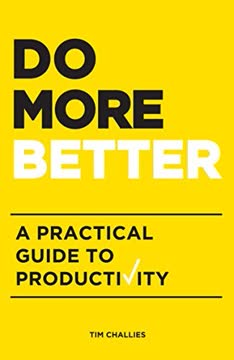
Do More Better is praised by most readers for its practical, God-centered approach to productivity, blending theological grounding with actionable steps. Many appreciate its concise, easy-to-read format and step-by-step guidance on tools like Todoist, Evernote, and Google Calendar. Critics note it can feel overly specific to the author's own system, potentially excluding those without demanding schedules or digital lifestyles. Some found the theological integration forced or legalistic. Overall, readers value its focus on glorifying God through productivity, though several suggest pairing it with deeper works like What's Best Next by Matt Perman.
People Also Read