
Key Takeaways
1. A Radical's Early Path to Justice
Her interest and involvement were based less on theory and ideology than on observation of the world around her and a passionate sense of justice.
Formative experiences. Dorothy Day's early life, though middle-class, was marked by a profound awareness of social injustice, fueled by her father's journalism and her own voracious reading of authors like Upton Sinclair and Dostoievski. This led her to explore Chicago's impoverished South Side and later immerse herself in New York's radical Greenwich Village scene.
Journalism and activism. As a young journalist for socialist papers like The Call, Day actively participated in labor movements and suffragette protests, enduring jail time in Washington D.C. and Chicago. These experiences solidified her commitment to the poor and marginalized, shaping her perspective on societal failings.
Personal reflection. Her early encounters with suffering, particularly during her brief jail stays, deeply impacted her, revealing the degradation faced by the incarcerated and the unexpected kindness among the most vulnerable. She began to question societal norms and the true nature of morality, seeing beyond labels like "prostitute" to the inherent dignity of individuals.
2. Idealism as Innate Curiosity and Drive
Idealism in the young, I guess I'm saying, is curiosity as well as goodness trying to express itself. And it's knowledge of your own pain, which you see in your neighbor.
Beyond circumstances. Day believed youthful idealism stemmed not just from personal unhappiness or family turmoil, but from an innate human drive to question life's fundamental meanings. She saw it as a deep-seated curiosity, pushing individuals to look beyond themselves and their immediate surroundings.
Seeking answers. From a young age, she grappled with existential questions like "why we're here and where we're going," a quest she felt was as fundamental as any other human instinct. This intellectual and spiritual restlessness propelled her through various phases of her life, from literary aspirations to political engagement.
Universal drive. She recognized this drive in others, including her father, who pondered the role of "temperament" in shaping one's life path. Day argued that this inherent questioning, often dismissed as mere "sublimation" by psychologists, was a God-given capacity meant to guide us toward understanding and living well with our neighbors.
3. A Conversion Rooted in Happiness and Struggle
I was happy but my very happiness made me know there was a greater happiness to be obtained from life than any I had ever known.
Paradox of joy. Dorothy Day's conversion to Catholicism, around age 28, was paradoxically triggered by a period of profound natural happiness in her common-law marriage to Forster Batterham. This earthly joy awakened a deeper spiritual yearning, a desire for a "greater happiness" that led her to conscious prayer.
Personal conflict. Her growing faith, particularly her decision to baptize their daughter Tamar and then herself, created an irreconcilable rift with Forster, an ardent atheist and anarchist. This led to their painful separation, as she felt compelled to choose between her love for him and her burgeoning spiritual commitment.
Sacrifice and new path. The conversion was not a sudden, unburdened embrace but a "struggle for my own soul," marked by self-doubt, loneliness, and the difficult choice of celibacy. She saw it as a definitive turning point, a commitment to a life of "poor, chaste, and obedient" service, believing her true life had just begun.
4. Loyalty to a Flawed Church
I loved the Church for Christ made visible... Not for itself, because it was so often a scandal to me.
Unflinching critique. Dorothy Day's deep love for the Catholic Church was always tempered by an unflinching awareness of its historical and contemporary failings. She embraced it with "eyes wide open," recognizing its capacity for sin, hypocrisy, and compromise with worldly power.
Institutional hypocrisy. She was particularly outraged by the Church's wealth, its perceived indifference to the poor during the Depression, and the complacency of many well-to-do parishioners. Day often felt "ashamed of my church" and envied her radical atheist friends who actively fought for social justice while the Church seemed to "hedge its bets."
Internal struggle. Despite her criticisms, she remained fiercely loyal to the Church's core teachings and sacraments, viewing it as her spiritual home. She saw her role not as challenging its doctrine, but as constantly urging it to live up to the radical example of Jesus, even if it meant being a "cross on which Christ was crucified."
5. The Power of Local, Person-to-Person Action
We never expected to solve the nation's problems, but we thought we ought to try to do all that we could do, and we thought that if more and more of us tried harder and harder—well, a step would have been taken, and that's what I think the Lord wants from us, as many steps as we can manage.
Bottom-up approach. The Catholic Worker Movement, founded with Peter Maurin, adopted a profoundly localist and anti-statist political philosophy. They focused on direct, person-to-person acts of charity and community building, believing that true change begins "from the bottom" rather than through large-scale government programs.
Rejection of state solutions. Day and Maurin were skeptical of the modern nation-state's capacity for genuine social justice, viewing its increasing power as "the servile state." They advocated for decentralized communities, worker ownership, and a return to agrarian living, contrasting their vision with both capitalism and state communism.
Everyday impact. This localism meant dedicating daily efforts to feeding the hungry, sheltering the homeless, and clothing the needy in their immediate neighborhoods. While some volunteers found this approach impractical, Day saw it as a direct embodiment of Christ's ministry, focusing on those within reach rather than distant political battles.
6. Christian Pacifism as a Core Stance
We are not living in an ivory tower.
Unwavering commitment. Dorothy Day's pacifism was a cornerstone of her Catholic Worker philosophy, maintained even through the Spanish Civil War and World War II. She believed that war, as a form of mass murder, was fundamentally incompatible with Christ's teachings and the sanctity of human life.
Controversial position. This stance often put her at odds with mainstream Catholic opinion and even many of her radical friends, who supported fighting fascism. She refused to pray for victory for either side in the Spanish Civil War, instead praying for all the Spanish people as "our brothers in Christ."
Spiritual weapons. Day acknowledged the immense challenge of pacifism in the face of tyranny, questioning if she had the "spiritual capacity to use spiritual weapons" against such evil. Yet, she steadfastly believed in the power of "perfect love" to overcome hatred, even if it meant enduring suffering and facing martyrdom.
7. Living the "Works of Mercy" Daily
The real issue is what we are trying to do here. Do we understand our intentions well enough to be able to explain them to others? That is an important question for us. We are all supposed to be teachers to each other.
Daily immersion. Life in a Catholic Worker House of Hospitality was a demanding, immersive experience of constant service, prayer, and self-reflection. Day and her companions cooked, cleaned, wrote, and cared for the urban poor, striving to make helpers and helped indistinguishable.
Challenges and temptations. This daily work was far from serene, often involving rude guests, exhaustion, and internal struggles with irritation, resentment, and anger. Day candidly admitted to moments of impatience and the temptation to "pose" as angelic, recognizing the "devil wins" when she failed to be truly open and honest.
Self-scrutiny and growth. She viewed these challenges as opportunities for spiritual growth, constantly reminding herself and others of the dangers of self-righteousness and pride. The community was a place for mutual teaching and learning, where even a "drunk sailor" could become a deputy of the Lord, offering unexpected lessons in humility and connection.
8. The Bible as a Lifelong Guide
The Bible helps me get through the painful times of this life, reminds me of what I am doing here.
Constant companion. The Bible was Dorothy Day's most cherished book and constant companion throughout her decades in hospitality houses. She read it daily, not merely as a text, but as a living source of comfort, moral guidance, and spiritual energy.
Personal solace. In moments of weariness, doubt, or spiritual weakness, she turned to the Scriptures with a desperate need, finding reassurance in passages like Saint Paul's Epistle to the Romans. She even practiced a form of bibliomancy, opening the book randomly for divine messages.
Foundation for community. Paul's teachings, particularly the twelfth chapter of Romans on "Christian Behavior," provided the philosophical bedrock for the Catholic Worker's communal life. It emphasized humility, mutual affection, and serving each other's interests, guiding their efforts to live out the Gospel literally.
9. Spiritual Kinship Beyond Denomination
I believe God may have helped him speak to us that day. Peter once told me that he expected us all to be together in the next life; he was sure of it. I can't be as sure as he was. But I hope and pray we all stay in this big Catholic Worker family.
Diverse influences. Beyond the saints and biblical figures, Dorothy Day found profound spiritual kinship in a diverse array of writers and activists, regardless of their religious affiliation. She admired George Orwell's compassion for the poor and his ideological struggles, even while critiquing his cynicism.
Shared human struggle. She felt a deep connection to Ignazio Silone, particularly his novel Bread and Wine, which explored the journey from revolutionary politics to profound human and spiritual understanding. Silone's portrayal of the "cafoni" (poor peasants) and the spiritual quest of his characters resonated deeply with her own experiences and values.
Universal longing. Day saw these figures as fellow travelers on a shared path, grappling with life's mysteries and the meaning of human existence. She believed that God's love and presence could be found in unexpected places and people, fostering a sense of "kinfolk" among all who strive for goodness, whether consciously religious or not.
10. The Constant Battle Against Pride
The sin of pride, I keep repeating to myself, is the worst of all sins, and it lurks around every corner.
Ever-present danger. Dorothy Day was acutely aware of the insidious nature of pride, constantly battling it within herself and observing its manifestations in others, even in charitable work. She recognized that the desire to do good could easily morph into self-righteousness or a need for recognition.
Self-correction. She candidly admitted to moments of arrogance, especially in her youth as a "politically-conscious person" with a "swollen head." Throughout her life, she practiced rigorous self-scrutiny, often retreating to prayer or reading to combat feelings of superiority or the temptation to judge others.
Humility in service. Day understood that true service required a profound humility, a willingness to be "fools for Christ" rather than celebrated leaders. She saw the interest of "important people" in the Catholic Worker as a potential "sign of our ruin," a distraction from their core mission of being with the poor.
11. A Life Defined by "Living Mystery"
To be a witness does not consist in engaging in propaganda or even in stirring people up, but in being a living mystery; it means to live in such a way that one's life would not make sense if God did not exist.
Beyond explanation. Ultimately, Dorothy Day's life was a profound testament to her faith, a "living mystery" that defied simple categorization or psychological explanation. She sought to live in a way that made God's presence evident through her actions, rather than through mere words or intellectual arguments.
Integrated existence. Her contemplative and prophetic mind was seamlessly integrated with an active, pastoral life of service, feeding the hungry, housing the needy, and caring for the sick. She embraced the contradictions of her existence, finding God's anchor most firmly when least connected to worldly certainties.
Enduring legacy. Day's journey, from radical journalist to devout Catholic activist, was a continuous search for meaning, purpose, and faith. Her life, marked by both personal struggle and unwavering dedication to the poor, stands as an enduring example of how one can live out Christian principles in the modern world.
Review Summary
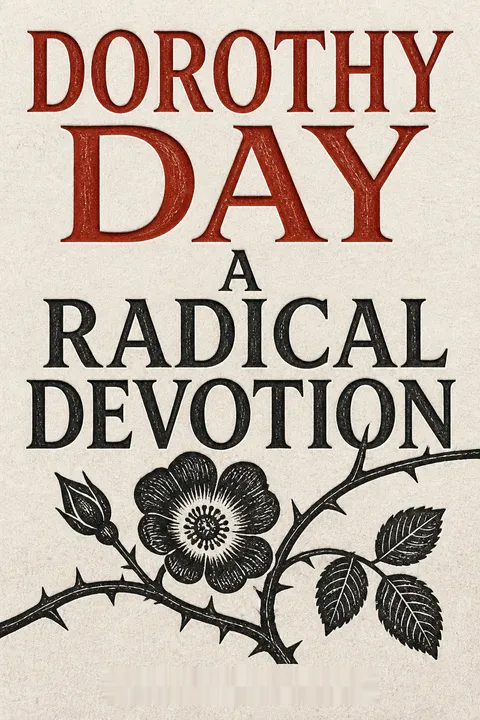
Reviews of Dorothy Day: A Radical Devotion are mostly positive, averaging 4.15 out of 5. Many readers find the book an inspiring introduction to Day's life, praising Coles' use of direct quotes and interviews to paint a vivid, humanizing portrait. Several note it complements Day's autobiography, The Long Loneliness. Critics argue Coles lacks understanding of Catholicism, rambles, and applies an overly psychoanalytical lens. Despite mixed views on his approach, most agree Day herself is a remarkable, inspiring figure whose commitment to social justice resonates deeply.
People Also Read



Download PDF
Download EPUB
.epub digital book format is ideal for reading ebooks on phones, tablets, and e-readers.








































