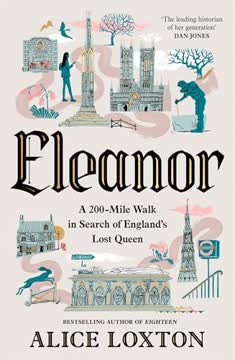
Key Takeaways
1. Eleanor of Castile: A Formidable Queen and Astute Businesswoman
Today, she’d be winning prizes for Women in Business, photographed in a no-nonsense power suit surrounded by her brood of children.
A powerful partnership. Eleanor of Castile, born a Castilian princess, married Prince Edward of England at age twelve in a political arrangement that blossomed into a deep, respectful love. Their thirty-six-year marriage was a true partnership, marked by shared adventures, including Crusades, castle building, and navigating civil war. Eleanor was Edward's trusted confidante and advisor, often discussing affairs of state and policy with him.
Financial independence. Unlike many queens who were financially dependent on their husbands, Eleanor built an impressive property empire of over 200 manors, farms, priories, and ports, generating an income comparable to the realm's greatest lords. This ensured her financial independence and provided a dower assignment for future English queens. Her rigorous, detail-oriented approach to property management, though sometimes criticized as avaricious, showcased her exceptional business acumen.
A complex legacy. While some contemporary chroniclers portrayed Eleanor as greedy, and later ballads fictionalized her as a wicked villainess, evidence suggests a more nuanced character. She was a patron of the arts, introduced forks and gardening innovations to England, and was known for her thoughtful kindness to household staff. Her insistence on an inquest into her estates on her deathbed suggests a desire to right any wrongs committed in her name, highlighting her commitment to justice despite the pressures of her position.
2. Edward I's Unprecedented Grief Forged a Lasting Architectural Tribute
‘who in life we dearly cherished and who in death we cannot cease to love’.
A king's sorrow. When Queen Eleanor unexpectedly died in Harby, Nottinghamshire, in November 1290, King Edward I, a formidable warrior king, was consumed by grief. He withdrew from public life, refusing to deal with daily paperwork, and penned heartfelt words to the Abbot of Cluny, expressing his profound and enduring love for his late wife. This personal sorrow drove an extraordinary public commemoration.
Action-focused grieving. Edward's grief manifested as "action-focused grieving," channeling his immense sorrow into a monumental project. Within months of Eleanor's death, he commissioned the finest masons in England to erect twelve magnificent stone monuments—the Eleanor Crosses—at each overnight stop of her 200-mile funeral procession from Lincoln to London. This was an unprecedented gesture, far grander than any previous royal memorial.
A public declaration. The crosses were not merely private tokens of affection but public declarations of Edward's devotion, designed to inspire prayers for Eleanor's soul and solidify her memory. Each cross, unique in design but consistent in its display of Eleanor's heraldry and statues, served as a visible testament to their enduring love, transforming a journey of sorrow into a lasting architectural ode.
3. The Eleanor Crosses: Medieval Marvels Born of Love and Loss
Never before or since have we seen such an ode to love, marked in stone.
Architectural innovation. The Eleanor Crosses were revolutionary in their scale and design, pioneering the new Gothic style in Britain. Commissioned between 1291 and 1295, these monuments, some reaching 16 meters high, were an explosion of complex geometry, painted inscriptions, heraldic devices, and exquisite full-size sculptures of Eleanor. They pushed the boundaries of what was architecturally possible, blending art, sculpture, and engineering.
A master mason's craft. Building each cross was a colossal undertaking, overseen by master masons—the "superstars of the day"—who were artists, architects, and engineers combined. The process involved:
- Quarrying and scappling stone (e.g., Weldon stone from Corby).
- Detailed drawings on parchment, transferred to wood or canvas patterns.
- Precision carving using dummy hammers and chisels.
- Lifting heavy blocks with rudimentary cranes and winches.
- Binding stones with lime mortar, made on-site.
- Erecting scaffolding (leaving "putlog holes" in walls).
- Adding intricate detailing and vivid coloration.
Waypoints of remembrance. The crosses served as tangible waypoints along Eleanor's final journey, inviting travelers and pilgrims to pause and pray for her soul. While only three original crosses survive today (Geddington, Northampton, and Waltham Cross), their presence continues to evoke the profound love story of Edward and Eleanor, standing as England's answer to the Taj Mahal.
4. History's Erasures: The Destruction and Rediscovery of Medieval Heritage
Estimates put the loss at up to 97 per cent.
Waves of destruction. Much of England's rich medieval heritage, including most of the Eleanor Crosses, was systematically destroyed in two major waves. The first followed the Reformation in the 16th century, when Henry VIII's break from Rome led to the smashing of Catholic shrines and the dissolution of monasteries. The second, a century later during the English Civil War (1640s-1650s), saw Parliamentarian troops target symbols of royalism and Catholicism, leading to the demolition of castles, houses, and monuments like the Cheapside and Charing Crosses.
Lost to time. The Lincoln and Grantham crosses, for instance, were destroyed in the Civil War, their stones repurposed for other buildings. Eleanor's visceral tomb in Lincoln Cathedral and her heart's burial site at Blackfriars Priory also vanished, leaving only Victorian replicas or plaques to mark their former existence. This widespread destruction meant that for centuries, the physical reminders of Eleanor's legacy were largely absent from the landscape.
Fragments and revivals. Despite the extensive loss, fragments and records occasionally resurfaced, sparking renewed interest. The discovery of the Lincoln cross's foundation in 1746, or the Cheapside fragments during sewer works in 1838, provided clues to their original grandeur. These discoveries, coupled with the Victorian Gothic Revival, inspired later generations to rebuild or commemorate the crosses, ensuring Eleanor's story was not entirely lost to oblivion.
5. The Pilgrim's Path: A Modern Journey Through Ancient Landscapes
Walking is for the body; pilgrimage for the soul.
Retracing history. The author embarked on a 200-mile walk, mirroring Eleanor's funeral cortège route from Harby to London, 734 years later. This physical journey was an attempt to connect with Edward's grief, understand Eleanor's legacy, and glimpse the "innermost workings of the medieval mind." The walk transformed from a mere hike into a modern pilgrimage, inviting unexpected encounters and profound reflections.
Connecting across time. The journey revealed how the English landscape is layered with history, from ancient Roman roads like Ermine Street and Watling Street to medieval ridge and furrow fields. The author encountered:
- The site of Sir Richard de Weston's manor in Harby.
- The remains of a Knights Templar preceptory at Temple Bruer.
- Second World War pillboxes near RAF Wellingore.
- Celebration Avenue in Northampton, lined with memorial trees.
- The Grand Union Canal and its 19th-century aqueduct.
The essence of pilgrimage. Guided by the British Pilgrimage Trust, the author learned that pilgrimage is a practice of "good intentions and a heart open for transformation," where the journey itself is as important as the destination. It's about being physically present in "thin spaces"—places of spiritual significance—and allowing the landscape to reveal the stories of generations past, fostering a deep connection to ancestors and the human condition.
6. Medieval Life and Death: A World of Faith, Hardship, and Miracles
It was also an alien, wacky place, where a book was more valuable than a house. Where accidently eating a purple frog, then throwing it up, was considered a miraculous blessing.
A different world. Medieval England was a society profoundly shaped by faith, where death was a familiar presence and life was often arduous. The concept of purgatory meant that the dead remained connected to the living, with prayers, masses, and good deeds performed to hasten souls to heaven. This belief system influenced everything from elaborate royal burials to the construction of chantry chapels.
Daily realities. Life for the average medieval peasant involved relentless toil, with days dictated by the rhythms of the seasons and the demands of the land. Travel was slow and challenging, often on poorly maintained roads, with dangers from wild animals like wolves. Medical practices were rudimentary, based on ancient theories of humours, and dental care was often left to barber surgeons or home remedies like powdered beetles.
Miracles and the mundane. Despite the hardships, the medieval world was also one of wonder and belief in the miraculous. Shrines like St Alban's were sites of healing and divine intervention, where pilgrims sought cures for ailments or gave thanks for unexpected blessings, such as surviving a fall into a river or, in one memorable instance at York Minster, vomiting up a purple frog.
7. Beyond Royalty: The Overlooked Women Shaping History
The life of the dead is placed in the memory of the living.
Eleanor's female contemporaries. While Eleanor of Castile stands out, her story is intertwined with countless other women, many of whom remain largely forgotten. These include:
- Belaset of Wallingford: A wealthy Jewish businesswoman in Lincoln, persecuted and ultimately hanged for coin clipping in 1290, her house now a poignant memorial.
- Theodora (Christina of Markyate): An 11th-century aristocratic woman who escaped an arranged marriage to found Markyate Priory.
- Lady Katherine Ferrers ("The Wicked Lady"): A 17th-century highwaywoman who led a double life, by day a lady, by night a robber.
- Isabella, Matilda, and Ermentrude: Nuns expelled from Delapré Abbey in 1300 for "throwing their modesty to the winds."
- Catherine Eddowes: A victim of Jack the Ripper, whose mutilated body was found in Mitre Square, the same site where Eleanor's body rested.
Women in the author's journey. The pilgrimage itself highlighted the contributions of women across centuries:
- Margaret Thatcher: Grantham's famous daughter, a formidable leader.
- Celia Fiennes: A 17th-century travel writer who documented England on horseback.
- Dora Barrett: The artist who sculpted the Eleanor statue in Dunstable.
- Dorothy Colville: A local historian who championed the overlooked churchyards.
- Sue Gentleman: Who researched and modeled for the Charing Cross murals.
- Sara Cockerill: The historian whose detailed biography brought Eleanor's story to life.
A collective legacy. The Monument to the Women of World War II in Whitehall, and the individual stories encountered, underscore that history is not just about kings and queens but also about the collective endeavors and sufferings of ordinary women. Their resilience, creativity, and quiet contributions form a vital, often unacknowledged, thread in the tapestry of time.
8. Conservation and Creativity: Keeping Eleanor's Legacy Alive Today
What I wish for, therefore, is that an association should be set on foot to keep watch on old monuments, to protest against all ‘restoration’ that means more than keeping out wind and weather.
The conservation movement. The destruction of medieval monuments spurred a shift from heavy-handed "restoration" to careful "conservation." Figures like John Ruskin and William Morris (who founded the "anti-scrape" Society for the Protection of Ancient Buildings) advocated for minimal intervention, preserving the original fabric of historic buildings and making new additions visibly distinct. Modern conservation, exemplified by Skillington Workshop's work on the Northampton Cross, involves meticulous recording, cleaning, and structural reinforcement using traditional materials and techniques.
Modern tributes. Eleanor's legacy is not confined to ancient stones but continues to inspire contemporary creativity:
- Stamford's new Eleanor Cross: A modern, needle-like sculpture by Wolfgang Buttress, echoing the original's rose motif.
- Stony Stratford's mural: Luke McDonnell's 30-foot-high psychedelic depiction of Eleanor, a rock-star muse gazing wistfully at the sky.
- Charing Cross Underground murals: David Gentleman's black and white wood engravings, depicting the cross's construction, seen by thousands daily.
- "Adopt an Organ Pipe" at St Albans: A modern way to support cathedral upkeep, connecting individuals to historic spaces.
An evolving narrative. These modern interpretations, from public art to community initiatives, demonstrate that history is a living, changing entity. They ensure that Eleanor's story, and the broader narrative of England's past, remains engaging and accessible, inviting new generations to connect with and contribute to its ongoing legacy.
9. Westminster Abbey: Eleanor's Final Resting Place and a Tapestry of Time
Here she was. Here we were, meeting at last!
The journey's culmination. After a 200-mile pilgrimage, the author's journey concluded at Westminster Abbey, Eleanor's final resting place. This sacred site, a "royal peculiar" reporting directly to the monarch, has been a continuous place of Christian worship for over a thousand years, witnessing coronations, royal weddings, and burials. It was here that Eleanor's body, after its solemn procession, was laid to rest on December 17, 1290.
A place of power and memory. Westminster Abbey is a repository of history, housing over 3,000 burials, including kings, queens, and national figures. The author walked past:
- King Edward's Chair: The Coronation Chair, still used by monarchs today.
- The Cosmati Pavement: A beautiful 13th-century mosaic floor, commissioned by Henry III, with hidden meanings.
- Edward I's effigy: A pensive figure pointing towards Eleanor's tomb, as if guiding the author.
Eleanor's enduring presence. Eleanor's bronze effigy, crafted by William Torel in 1291, is a masterpiece of medieval art, depicting her in flowing robes, adorned with jewels, and resting on pillows patterned with the symbols of Castile and León. Encased in an intricate iron grille, her tomb, though somewhat hidden, remains a powerful symbol of Edward's devotion and a testament to a queen who, in life and death, refused to be forgotten. The abbey, like the entire journey, reveals how the past is not distant but alive, constantly echoing through the present.








































