

Key Takeaways
OpenAI's founding altruism became a mask for empire-building
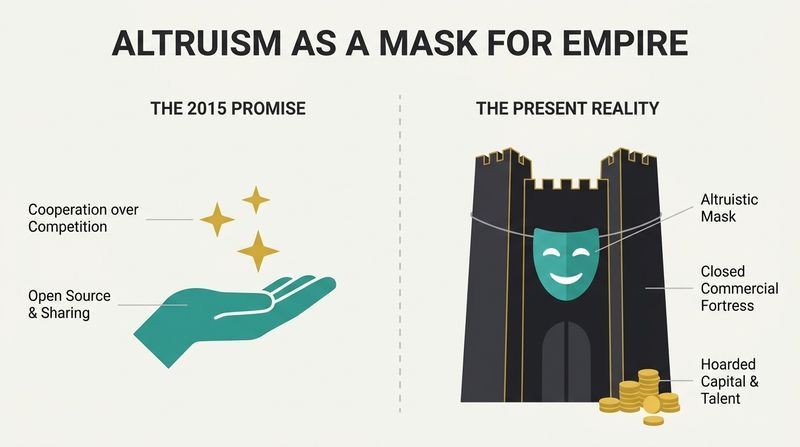
The bait-and-switch is the book's thesis. In 2015, OpenAI launched as a nonprofit pledging $1 billion, promising open research, transparency, and even self-sacrifice: if a rival got closer to beneficial AGI, OpenAI vowed to stop competing and start assisting. Within a few years it became the opposite. It aggressively commercialized ChatGPT, cut off research access, and triggered the very race-to-the-bottom it warned against.
Hao's core argument is that OpenAI's mission (ensure artificial general intelligence benefits humanity) works as a three-part formula for consolidating power: it rallies talent around a quasi-religious cause, it justifies hoarding capital and resources by invoking scary competitors, and it stays vague enough that leadership can reinterpret it however suits their expansion.
What's striking is how Hao frames idealism not as a casualty of greed but as its instrument. The vagueness of "beneficial AGI" functions like the elastic mission statements sociologist Max Weber described in charismatic institutions: unfalsifiable, endlessly renewable. Critics might counter that mission drift afflicts nearly every startup facing capital constraints, and that OpenAI's compute costs genuinely required commercial revenue. But Hao's sharper point holds: no other organization converted an unfalsifiable promise about the future into license for present-day extraction quite so effectively. The empire metaphor risks overreach, yet it usefully names a dynamic that "corporate hypocrisy" undersells.
Scaling is a self-fulfilling prophecy, not a law of nature
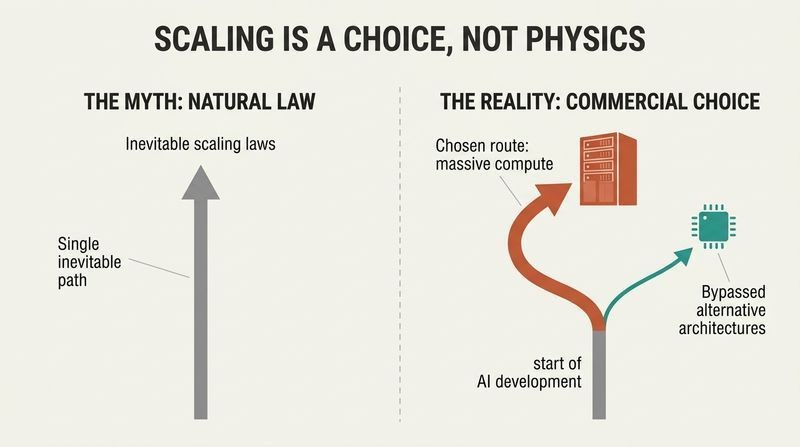
Compute became the religion. Cofounder Ilya Sutskever preached a simple creed: bigger neural networks, fed more data and more computing power, would produce intelligence. OpenAI discovered that AI capability had been doubling every 3.4 months, far outpacing Moore's Law. They branded this "scaling laws" and treated it as destiny.
But Hao insists scale was a choice, not physics. GPT-4 is reportedly over 15,000 times larger than GPT-1 built five years earlier. Alternatives existed: Stable Diffusion needed only 256 chips versus OpenAI's supercomputers, and neurosymbolic approaches or better-quality data could reach similar performance with far less compute. Moore's Law itself was never physics; it was Gordon Moore's business target that the industry chose to chase. Scaling won because it was easiest to commercialize and rewarded whoever had the most data.
The deepest insight here is epistemological: a prediction, once adopted by powerful actors, manufactures the conditions that confirm it. This echoes economist Robert Merton's "self-fulfilling prophecy" and the sociology of expectations in technology studies. By pouring billions into scaling, the industry starved alternative research paths, then pointed at scaling's success as proof it was the only way. The counterargument, voiced by Sutskever and Hinton, is that scaling simply works, and results are results. Yet Hao's structural critique lands: when funding collapses diversity of ideas, "what works" becomes tautological. We cannot know if a cheaper, smaller path existed because nobody was funded to find it.
Modern AI runs on hidden workers earning under $2 an hour
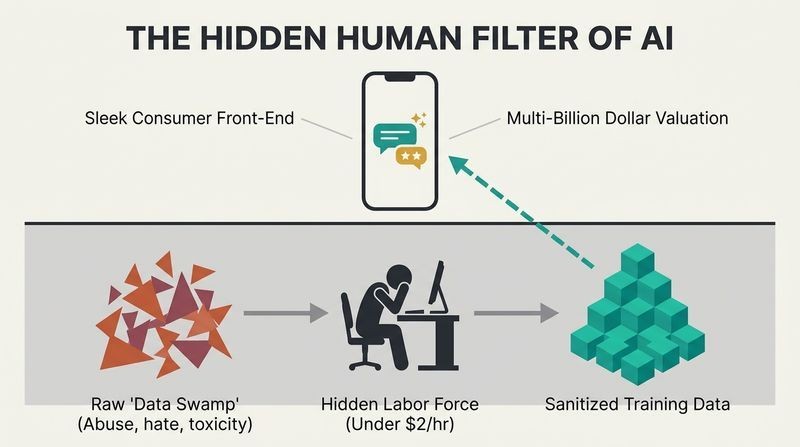
The "data swamp" created traumatic labor. When OpenAI stopped filtering training data and instead scraped the entire internet, it needed humans to clean the toxic outputs. It contracted a firm called Sama to hire Kenyan workers who sorted through descriptions of child abuse, bestiality, and violence for roughly $1.46 to $3.74 an hour.
The pattern follows economic collapse. Data-annotation firms like Scale AI perfected a playbook: enter countries in crisis (Venezuela during hyperinflation of 10 million percent, then Kenya, then North Africa), offer high pay to attract workers, then throttle wages once established. One worker, Mophat Okinyi, reviewed sexual-abuse content until it destroyed his marriage and mental health. When workers used ChatGPT to speed up their own tasks, Scale blacklisted entire countries for "scamming."
Hao's reporting extends Mary Gray and Siddharth Suri's concept of "ghost work": the invisible human labor propping up supposedly automated systems. What's newly damning is the moral inversion she documents. A white-collar worker using ChatGPT to boost productivity is celebrated as the future of work; a Kenyan annotator doing the same is fired for fraud. The colonial parallel is not rhetorical flourish but structural: firms deliberately hunt populations that are educated, online, and desperate. A fair challenge is whether content moderation can ever be humane at scale, but Hao's point stands that current wages and psychological safeguards reflect deliberate cost-cutting, not necessity.
Data centers drain water and power from the world's most vulnerable
AI has a physical body, and it is thirsty. Training GPT-3 reportedly consumed 1,287 megawatt-hours and, during one month in drought-stricken Iowa, Microsoft's data centers drew about 6 percent of a district's water. Each ChatGPT query uses roughly ten times the electricity of a Google search.
The costs land on the marginalized. In Chile's Atacama region, communities already hollowed out by copper and lithium mining now fight data centers for their water. In Uruguay, during a drought so severe the government mixed saltwater into taps, Google planned a center to use two million gallons of drinking water daily. Activists like Daniel Pena and the group MOSACAT forced disclosures and blocked projects. By 2030, data centers may consume 8 percent of US power.
This chapter grounds the abstraction of "the cloud" in mud, drought, and noise pollution, echoing Kate Crawford's "Atlas of AI" and its insistence that computation is extraction. The framing of AI as the latest chapter of resource colonialism is provocative and largely earned: the same regions that supplied colonial empires now supply the compute empire. A nuance worth adding is that some water is recirculated and some regions have surplus renewable power, so the picture is uneven. But Hao's core exposure of corporate secrecy, shell companies, and broken sustainability promises reveals an industry actively obscuring costs it could disclose.
Naming it 'intelligence' was a marketing trick that still fools us
The field's original sin was a rebrand. In 1956, John McCarthy needed a catchier phrase than "automata studies" to attract funding, so he coined "artificial intelligence." The word smuggled in a promise. Yet there is no scientific consensus on what intelligence even is, and every benchmark (chess, Go, the Turing test) gets surpassed and then dismissed as "not real intelligence."
Anthropomorphizing has consequences. In 1966, Joseph Weizenbaum's simple chatbot ELIZA fooled people into believing it understood them, alarming its own creator. ChatGPT shares that humanlike interface by design. When developers say models "learn" or "read" like humans, it inflates perceived capability and doubles as a legal shield: companies argue training on copyrighted work is just "inspiration," like a human reading.
Hao revives Weizenbaum's warning with fresh urgency. The linguist Emily Bender's "stochastic parrot" framing complements this: models generate statistically probable text without meaning or intent, yet our brains cannot stop imagining a mind behind fluent words. The insight cuts against industry rhetoric and consumer intuition alike. One could push further: anthropomorphism is not only marketing but a cognitive default, documented in developmental psychology, that no disclaimer fully overrides. This matters because misplaced trust already caused harm, from a lawyer citing fabricated cases to a Belgian man's suicide after chatbot conversations. The term "hallucination" itself, Hao notes, misleadingly implies a bug rather than the core mechanism.
Two rival AI religions, Boomers and Doomers, worship the same god
Silicon Valley split into camps that mirror each other. The Doomers, steeped in effective altruism, fear rogue superintelligence could exterminate humanity and want to slow or carefully gate AI development. The Boomers, or effective accelerationists, see technological progress as a moral imperative to speed up. Anthropic and OpenAI became figureheads for each side.
Both preach from the same scripture. Hao's crucial observation: both treat AGI as inevitable and imminent, both discuss it with religious fervor, and both claim moral authority to keep AI development in the hands of their adherents. One warns of hellfire, the other promises heaven, but neither questions whether this technology should be built or who gets to decide. Effective altruism's "expected value" math even justified getting rich to give later.
This is one of the book's most clarifying moves: collapsing an apparent debate into a shared theology. Both camps benefit from hype, because existential stakes (whether feared or celebrated) make the technology seem world-historic and justify concentrating control among a tiny elite. The framing recalls religious studies scholarship on millenarian movements that fixate on an approaching end-time. A steelman for the Doomers: some risks may be genuine regardless of who profits from the narrative. But Hao's point about the missing third position (should this be built at all, and by whom) exposes how the debate's very framing serves incumbents by keeping outsiders out of the room.
ChatGPT was a 'low-key research preview' that ambushed its own makers
The most consequential launch in AI was almost an afterthought. Fearing Anthropic would release a chatbot first, OpenAI rushed out a chat interface on the existing GPT-3.5 model in November 2022. Leadership called it a "low-key research preview" and provisioned servers for maybe 100,000 users. Employees bet a few thousand might try it over the weekend.
It became the fastest-growing consumer app in history, hitting one million users in five days and one hundred million in two months. Servers melted. The safety team, numbering barely a dozen, scrambled with broken monitoring. Ironically, GPT-3.5 was barely an improvement over technology already public for two years. The magic was packaging: a conversational, humanlike interface, the same trick that made ELIZA captivating in 1966.
The episode is a case study in how interface, not raw capability, drives adoption, a lesson from product design that the research-obsessed lab underestimated. It also reveals a troubling truth about safety governance: the company could not predict its own flagship product's reception, which undercuts confidence in its ability to forecast far more dangerous future systems. A Safety employee raised exactly this at an all-hands. The counterpoint is that iterative real-world deployment genuinely surfaces problems no lab test would. But when the deploying entity is also racing competitors and monetizing, "learning from users" conveniently aligns with shipping fast, making the safety rationale hard to distinguish from commercial urgency.
Altman's genius is a listening, dealmaking, story-selling talent for power
The through-line of Altman's career is influence, not code. His mentor Paul Graham said you could drop him on an island of cannibals and return to find him king. Called the "Michael Jordan of listening," Altman remembers tiny details about people, offers help and capital generously, then leverages that goodwill. He built financial ties to over 400 companies, making it hard to find anyone in his orbit without a stake in his success.
A darker pattern recurs. Twice at his first startup Loopt, senior staff urged the board to fire him for prioritizing his own gain and distorting truth in small, hard-to-pin-down ways. The same accusations resurfaced at OpenAI: telling people what they want to hear, then undermining dissenters until they yield. Both times, he emerged with the upper hand.
Hao portrays a specific archetype: the network entrepreneur whose product is relationships. This resonates with sociologist Ronald Burt's research on "structural holes," where power accrues to those who broker connections between otherwise separate groups. Altman's genius was making himself the indispensable node of Silicon Valley. The "paper cuts" of small dishonesties, individually trivial but cumulatively corrosive to trust, is a psychologically astute observation that maps onto research on how betrayal erodes teams. A fair caveat: Hao's sources skew toward those who clashed with Altman, and charisma plus ambition describe many effective founders. Still, the pattern's repetition across two decades and two companies is hard to dismiss as coincidence.
The five-day coup proved a handful of insiders control AI's future
In November 2023, OpenAI's board fired Altman for not being "consistently candid," installing CTO Mira Murati as interim CEO. Chief scientist Sutskever had concluded Altman's pattern of manipulation made him unfit to guide AGI. Within days it collapsed: Microsoft offered to hire Altman, over 700 of 770 employees threatened to quit, and Sutskever himself flipped, tweeting regret. Altman returned; the independent directors who challenged him departed.
Hao's takeaway transcends who won. The drama revealed that the fate of a civilization-shaping technology rests on the clashing egos, ideologies, and loyalties of a tiny group of Silicon Valley elites, deciding behind closed doors. Even OpenAI's own employees were left in the dark. The nonprofit board, designed as the ultimate safety check, buckled instantly under moneyed pressure.
The board's implosion is a governance parable. The structure Altman himself designed, granting a nonprofit board authority to fire him for the good of humanity, proved theatrical the moment it was tested against Microsoft's billions and employee equity. Director Helen Toner's chilling line, that destroying the company could be consistent with the mission, exposed how detached the safeguard was from real incentives. Political scientists studying institutional design note that paper checks mean nothing without aligned power to enforce them. What lingers is the democratic deficit: eight billion people affected, roughly ten deciding. Hao's governance question (who shapes AI) becomes concrete and unsettling here.
There's another way: small, consented, community-owned AI already works
Hao's antidote is a Maori radio station in New Zealand. Te Hiku Media wanted to transcribe archival recordings of elders to revive te reo, an endangered language. Instead of scraping data, they built on three principles: consent, reciprocity, and sovereignty. They asked the community's permission, collected data only from willing donors, and kept it under Maori guardianship, licensing it only for approved uses.
The results demolish the scale dogma. In ten days, trusting community members donated 310 hours of transcribed audio, enough to build a speech model with 86 percent accuracy using just two chips. Compare that to the 680,000 hours OpenAI scraped for its Whisper tool. The lesson: task-specific, consensual, energy-efficient AI can uplift marginalized communities rather than extract from them.
Te Hiku reframes the entire debate from "how do we make AI good" to Stanford researcher Pratyusha Kalluri's sharper question: does this technology shift power toward people or away from them? The example is genuinely destabilizing to industry orthodoxy because it succeeds on the industry's own terms (working models) while rejecting its methods. A realistic caveat: language revitalization is narrow and well-bounded, and it is unclear how far the model generalizes to general-purpose systems demanding vast diverse data. But that may be Hao's deeper point: perhaps we do not need general-purpose everything-machines. Smaller, purpose-built, accountable tools might serve most human needs better, without the empire.
Redistribute power along three axes: knowledge, resources, and influence
Hao offers a concrete formula for dissolving empire. The AI giants control three axes of power, each reinforcing the others: knowledge (by eroding open science and hiding models from scrutiny), resources (by hoarding data, compute, land, and labor), and influence (by manufacturing ideologies and dazzling demos that capture imagination).
Counter-moves along each axis:
1. Fund independent research and evaluators so we are not reliant on companies to grade their own homework.
2. Require disclosure of training data and technical specs, the way cars get Energy Star ratings and drugs get FDA review.
3. Strengthen labor protections and unions, following Hollywood writers who won AI safeguards.
4. Invest in broad public education to dissolve the mystique.
5. Support community-driven, decolonial AI like DAIR and Te Hiku.
The prescription's strength is its refusal of both fatalism and techno-optimism, insisting AI is a product of thousands of contestable human choices, not destiny. The Energy Star and FDA analogies are rhetorically effective: we already regulate consumer products more than we regulate data-defined systems affecting billions. A limitation is enforcement. Transparency mandates face fierce lobbying, as California's vetoed SB 1047 showed, and global supply chains outrun national law. Hao's insistence on cross-border solidarity among affected communities, from Kenyan annotators to Chilean activists, echoes labor history: power concentrated globally can only be countered by organizing globally. Whether that coalition can form against trillion-dollar incumbents remains the open question.
Analysis
Karen Hao's "Empire of AI" is best understood as investigative journalism wearing the armature of political theory. Its central conceptual move, casting OpenAI and its peers as modern empires, is not decorative. Empires, Hao argues, seize resources they do not own, exploit distant labor, justify conquest by competition with rival empires, and cloak extraction in narratives of civilizing progress. Each element maps onto AI: scraped data and art, underpaid Global South annotators, the perpetual invocation of China, and the gospel of "beneficial AGI."
The book's structural innovation is its dual lens. Hao braids the boardroom intrigue of Silicon Valley's most secretive lab with ground-level reporting from Kenya, Chile, Uruguay, and Venezuela. This juxtaposition is the argument itself: the same weeks OpenAI reached a $157 billion valuation, Kenyan workers who made ChatGPT safe were being blacklisted and Chilean communities were fighting for drinking water. The wealth flows up; the costs settle on the vulnerable.
What distinguishes the work from adjacent critiques (Zuboff's surveillance capitalism, Crawford's extraction thesis, Bender's stochastic parrots) is Hao's access. Her 2019 profile made her the first journalist embedded inside OpenAI, and her sourcing on the November 2023 board crisis is unmatched, including her surreal accidental infiltration of the anti-Altman letter-writers' shared inbox.
The book's vulnerabilities are worth naming. The empire metaphor occasionally strains, and Hao concedes the AI empires lack the overt violence of colonial predecessors. Her sourcing on Altman leans toward those who clashed with him. And her optimism about small-scale alternatives like Te Hiku may underweight why general-purpose systems attract capital: they promise returns narrow tools cannot.
Yet the achievement is durable. Hao reframes the governing question from the industry's preferred "how do we make AI safe" to the political "who decides, and who pays." By insisting nothing about this technology's shape was inevitable, she reopens a future the incumbents would prefer closed. The book is less a prophecy of doom than a demand for democratic reckoning.
Review Summary
Empire of AI receives mixed reviews, with praise for its investigative reporting on OpenAI and Sam Altman, but criticism for perceived bias and lack of technical depth. Some readers appreciate the expose on AI's environmental and labor impacts, while others find the book overly critical and ideologically driven. The narrative structure and focus on personal details are contentious points. Overall, readers value the insights into OpenAI's evolution and AI industry practices, but opinions vary on the book's perspective and conclusions.
FAQ
What is Empire of AI: Dreams and Nightmares in Sam Altman's OpenAI by Karen Hao about?
- In-depth OpenAI profile: The book offers a comprehensive look at OpenAI’s rise, internal power struggles, and the broader implications of its work on artificial intelligence.
- Focus on power and governance: It examines how a small group of tech elites, led by Sam Altman, shape the future of AI, highlighting the tension between idealistic missions and commercial pressures.
- Societal and global impact: Karen Hao explores AI’s effects on labor, the environment, and the concentration of wealth and influence, framing AI development as a new form of empire-building.
- Insider access: The narrative is based on over 300 interviews and extensive documentation, providing rare behind-the-scenes insights into OpenAI and the global AI industry.
Why should I read Empire of AI by Karen Hao?
- Reveals hidden complexities: The book uncovers the human, ethical, and political struggles behind AI’s development, challenging simplistic narratives of technological progress.
- Societal and ethical context: Readers gain awareness of the real-world costs of AI, including labor exploitation, environmental harm, and the marginalization of vulnerable communities.
- Nuanced leadership portrait: It provides a balanced, detailed view of Sam Altman and OpenAI’s internal politics, showing how personalities and corporate culture shape AI’s trajectory.
- Alternative perspectives: The book introduces community-driven AI projects and movements, offering hope for more ethical and inclusive AI futures.
What are the key takeaways from Empire of AI by Karen Hao?
- AI is political: Progress in AI is driven by the ambitions and conflicts of a few powerful individuals and corporations, not just scientific merit.
- Scaling and its costs: OpenAI’s doctrine of scaling compute and data to achieve AGI fuels a costly, competitive race with significant social and environmental consequences.
- Concentration of benefits and harms: The rewards of AI are concentrated among elites, while workers and marginalized groups bear the burdens.
- Transparency and governance challenges: OpenAI’s shift from openness to secrecy illustrates the difficulties of responsible AI governance in a high-stakes environment.
- Possibility of alternatives: The book argues for diverse AI approaches and stronger policies to democratize AI’s benefits and mitigate its harms.
Who is Sam Altman and how is he portrayed in Empire of AI by Karen Hao?
- Central figure and CEO: Sam Altman is the CEO and cofounder of OpenAI, depicted as a charismatic, ambitious, and sometimes controversial leader.
- Complex personality: The book explores Altman’s background, personal traits, and leadership style, highlighting his ambition, sensitivity, and tendency toward secrecy and manipulation.
- Power struggles: Altman’s decisions, including his brief ouster and reinstatement, exemplify the intense internal conflicts and governance challenges at OpenAI.
- Public image vs. reality: While Altman carefully curates his public persona, the book reveals the anxieties and contradictions beneath his leadership.
What is OpenAI’s mission and how has it evolved according to Empire of AI?
- Original nonprofit mission: OpenAI was founded to develop artificial general intelligence (AGI) for the benefit of all humanity, emphasizing openness and collaboration.
- Shift to for-profit model: Financial pressures led to the creation of a capped-profit partnership, allowing OpenAI to raise billions while still claiming to prioritize its mission.
- Erosion of ideals: Over time, commitments to transparency and altruism gave way to secrecy, commercialization, and competitive urgency.
- Mission as justification: The mission is often invoked to rationalize rapid scaling and secrecy, with the belief that being first is essential to ensuring beneficial AI outcomes.
What is artificial general intelligence (AGI) and how is it portrayed in Empire of AI by Karen Hao?
- Definition of AGI: AGI refers to highly autonomous AI systems that outperform humans at most economically valuable work, representing the theoretical pinnacle of AI research.
- Uncertain and aspirational goal: The book emphasizes that AGI is an amorphous, largely unknowable target, with no clear markers for success or timeline.
- Scaling hypothesis: OpenAI’s leadership, especially Ilya Sutskever, believes AGI will emerge primarily through scaling simple neural networks with massive compute and data.
- Rhetorical tool: AGI serves as a powerful narrative to justify OpenAI’s aggressive resource consumption and secrecy, even as current AI systems fall short of true general intelligence.
What are the “scaling laws” and “OpenAI’s Law” described in Empire of AI by Karen Hao?
- OpenAI’s Law: This term describes the rapid doubling of compute used in AI breakthroughs, far outpacing Moore’s Law and requiring massive computational resources.
- Scaling laws: These are empirical relationships showing how AI model performance improves predictably with increases in training data, compute, and model size.
- Strategic importance: Scaling laws underpin OpenAI’s focus on building ever-larger models like GPT-3 and GPT-4, driving its resource-intensive approach.
- Consequences: The pursuit of scaling leads to enormous financial, environmental, and social costs, and creates a high-stakes race that shapes the entire AI industry.
How does Empire of AI by Karen Hao describe the role of human labor and data annotation in AI development?
- Foundational human labor: The book reveals that AI models rely heavily on low-paid annotators, often in the Global South, who label data and moderate content under harsh conditions.
- Exploitation and precarity: Workers face unstable pay, psychological harm, and limited protections, with companies exploiting crises in countries like Kenya and Venezuela to source cheap labor.
- Invisible but essential: Despite their critical role in AI’s success, these workers remain largely invisible and unsupported, highlighting a hidden supply chain.
- Calls for reform: The book discusses organizing efforts and research initiatives advocating for fair pay and labor rights in the AI industry.
What environmental and resource impacts of AI are highlighted in Empire of AI by Karen Hao?
- Massive energy consumption: Training and running large AI models require enormous computing power, leading to significant carbon emissions and energy use.
- Water and land use: Data centers consume vast amounts of water for cooling and occupy large land areas, often in vulnerable or marginalized communities.
- Extractivism and local harm: Mining for resources like lithium and copper, especially in places like Chile’s Atacama Desert, disrupts ecosystems and displaces Indigenous communities.
- Corporate greenwashing: Tech companies often downplay environmental harms, promoting efficiency narratives while lacking transparency about AI’s true carbon footprint.
What were the key events and lessons from the OpenAI board crisis in Empire of AI by Karen Hao?
- Altman’s firing and reinstatement: In November 2023, OpenAI’s board abruptly fired CEO Sam Altman, citing concerns about his leadership and honesty, but reinstated him after employee and investor backlash.
- Internal divisions: The crisis exposed deep fractures within OpenAI’s leadership, including conflicts among Altman, Greg Brockman, Ilya Sutskever, and Mira Murati.
- Governance failures: The board struggled with oversight, lacked independent legal support, and faced challenges in holding Altman accountable.
- Aftermath: The episode led to resignations, loss of trust, and highlighted the precarious balance of power in governing a powerful AI company.
How does Empire of AI by Karen Hao address AI safety and the ideological divide within OpenAI?
- Safety vs. speed: The book describes a factional split between those prioritizing AI safety (“Doomers”) and those pushing for rapid deployment and commercialization (“Boomers”).
- Superalignment and preparedness: OpenAI launched initiatives like Superalignment and the Preparedness Framework to evaluate and mitigate dangerous AI capabilities, but these were often rushed or deprioritized.
- Internal conflict: Safety advocates clashed with leadership, leading to departures of key researchers and raising concerns about the company’s commitment to responsible AI.
- Broader implications: The book underscores the need for independent oversight, transparency, and whistleblower protections to ensure AI safety.
What is reinforcement learning from human feedback (RLHF) and how is it explained in Empire of AI by Karen Hao?
- Definition and purpose: RLHF is a technique where human contractors provide examples and rank AI outputs to teach models to produce more helpful, truthful, and harmless responses.
- Process details: Workers write ideal answers to prompts and rank multiple AI-generated responses, allowing the model to learn from this feedback and adjust its outputs.
- Impact on AI models: RLHF was central to developing InstructGPT, ChatGPT, and GPT-4’s chat capabilities, improving usability and safety.
- Limitations: Despite its benefits, RLHF cannot fully eliminate errors or hallucinations, as neural networks inherently produce probabilistic outputs.
What are some of the best quotes from Empire of AI by Karen Hao and what do they mean?
- On explaining AI: Joseph Weizenbaum’s quote, “It is said that to explain is to explain away... its magic crumbles away,” highlights the tension between AI’s perceived intelligence and its mechanistic reality.
- On success and vision: Sam Altman’s statement, “Successful people create companies. More successful people create countries. The most successful people create religions,” reflects his view of tech founders as visionaries shaping belief systems.
- On OpenAI’s mission: Altman wrote, “Building AGI that benefits humanity is perhaps the most important project in the world... We must put the mission ahead of any individual preferences,” underscoring the company’s framing of its work as a historic, collective endeavor.
- On AI’s future: Altman predicted,
Download PDF
Download EPUB
.epub digital book format is ideal for reading ebooks on phones, tablets, and e-readers.








































