Key Takeaways
1. U.S. Intervention, Not Freedom, Fuels Anti-American Terrorism
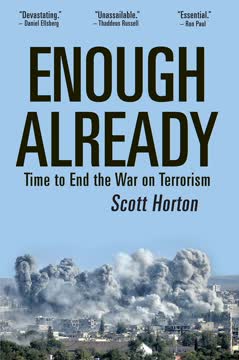
The truth is U.S. intervention in the Middle East long precedes al Qaeda’s war against America and is the primary cause of our terrorism problem.
Misrepresenting causes. The book argues that the U.S. government consistently misrepresents the true causes of anti-American terrorism, falsely claiming that terrorists hate American freedom and values. This narrative exploits public ignorance and fear to advance unrelated political agendas. Osama bin Laden and other terrorist leaders explicitly stated their grievances were rooted in specific U.S. foreign policies, not American liberty.
Bin Laden's grievances. Bin Laden repeatedly cited U.S. military presence in the Arabian Peninsula, the sanctions and bombing of Iraq, and unconditional U.S. support for Israel's occupation of Palestinian lands as primary motivations. He aimed to provoke the U.S. into a costly war of attrition, destabilizing the region and bankrupting America. The 9/11 hijackers themselves were from U.S.-allied countries like Saudi Arabia and Egypt, not designated enemy states, further underscoring the political, rather than religious, nature of their motivations.
Blowback terrorism. This phenomenon, where secret or unknown foreign policies lead to unforeseen consequences, caught the American public off guard after 9/11. The attacks were a desperate measure by a small group of U.S.-backed Arab insurgent fighters, aiming to goad the U.S. into actions that would serve their own goals of destabilization and radicalization. The "War on Terrorism" has, ironically, accomplished more of al Qaeda's agenda than they could have dreamed.
2. 9/11 Exploited for Pre-Existing Geopolitical Agendas
The president and his men had already decided, the very day of the attack, that they would be launching a project far greater than a mere hunt for the leaders of the group that was responsible.
Pretext for expansion. Immediately after 9/11, despite knowing al Qaeda was responsible, the Bush administration broadened the "War on Terror" to include a vast array of targets, notably Iraq. Key figures like Donald Rumsfeld and Paul Wolfowitz pushed for war against Iraq from day one, leveraging the crisis to pursue long-held neoconservative goals of regime change and regional dominance. This was a "bait-and-switch" from targeting those responsible for 9/11 to pursuing unrelated geopolitical objectives.
"Axis of Evil." In 2002, Bush declared an "Axis of Evil" (Iraq, Iran, North Korea), falsely linking them to terrorism and weapons of mass destruction. This was a blatant lie, as these nations were not allied with al Qaeda and posed no imminent threat to the U.S. The real motive was to establish American supremacy in the Middle East, dismantle the Powell-Weinberger doctrine of avoiding wars, and test Rumsfeld's new military doctrines.
Neoconservative influence. A small group of neoconservatives, including Richard Perle, Paul Wolfowitz, and Douglas Feith, had long advocated for regime change in Iraq and Syria, primarily to benefit Israel and reshape the Middle East. They infiltrated key government positions and think tanks, relentlessly pushing for war and shaping the narrative. Their 1996 "Clean Break" strategy explicitly called for removing Saddam Hussein to weaken Syria and Iran, thereby enhancing Israeli security.
3. Deliberate Deception and Propaganda Sold Unnecessary Wars
The administration pushed a hoax that a Kuwaiti nurse witnessed Iraqi soldiers murdering premature babies for their incubators in Kuwaiti hospitals and also claimed the Iraqis were lining up their army on the Saudi border in preparation for an attack on their capital city, Riyadh.
Fabricated pretexts. The U.S. government consistently used deliberate lies and propaganda to garner public support for wars.
- Iraq War I (1990-1991): The "babies thrown from incubators" story was a PR firm fabrication, and claims of 250,000 Iraqi troops on the Saudi border were false.
- Iraq War II (2003): The administration falsely claimed Iraq possessed WMDs (nuclear, chemical, biological) and had ties to al Qaeda.
- Aluminum tubes for centrifuges were for rockets.
- Niger uranium claims were based on forged documents.
- "Mobile biological labs" were weather balloon equipment.
- The "slam dunk" intelligence on WMDs was a lie.
- Claims of an Iraq-al Qaeda alliance were debunked by intelligence agencies, yet pushed by Cheney and others.
Ignoring peace offers. Saddam Hussein repeatedly sought to negotiate his withdrawal from Kuwait and later offered to surrender unconditionally before the 2003 invasion. These offers were consistently rejected by the U.S. administration, which was determined to go to war regardless. The goal was not peace or compliance, but regime change.
Media complicity. Compliant media outlets, like The New York Times, amplified government lies, presenting them as independently verified facts. This created a climate where questioning the war was deemed unpatriotic, effectively silencing dissent and manipulating public opinion. Polls showed that by 2003, two-thirds of Americans believed Iraq was behind 9/11.
4. Iraq War II: A Catastrophic Blunder Empowering Iran and Jihadists
The American people had given the President the writ to get the men responsible for the attack on the U.S., “dead or alive.” Bush had other plans.
Unintended consequences. The 2003 invasion of Iraq, far from securing American interests, became a "strategic disaster."
- Empowering Iran: The U.S. dismantled Saddam Hussein's Sunni-dominated regime, inadvertently installing Iranian-backed Shi'ite parties (SCIRI, Da'wa) in power in Baghdad. This fundamentally shifted the regional balance of power in Iran's favor.
- Igniting civil war: The U.S. disbanded the Iraqi army and outlawed the Ba'ath Party, creating a power vacuum and fueling a Sunni insurgency. The subsequent "Salvador Option," where U.S. forces allied with Shi'ite death squads (like the Badr Brigade) to target Sunnis, exacerbated sectarian violence.
- Rise of ISIS: The sectarian policies of the U.S.-installed Shi'ite government, particularly Prime Minister Nouri al-Maliki, alienated Sunni populations in western Iraq, creating fertile ground for the resurgence of al Qaeda in Iraq (AQI), which later evolved into ISIS.
The "surge" and its failures. The 2007 "surge" in Iraq, led by Gen. David Petraeus, did not achieve political reconciliation. Instead, it completed the sectarian cleansing of Baghdad, consolidating Shi'ite power, and left Sunni insurgents (the "Sons of Iraq") betrayed and disempowered, setting the stage for future conflict.
Betrayal and manipulation. Key figures like Ahmed Chalabi, a convicted embezzler and Iraqi exile, actively fed false intelligence to neoconservatives, later revealed to be working for Iran. The U.S. was manipulated into destroying Iran's greatest enemy, a "gift on a golden platter" as the Saudi King put it.
5. The "Redirection" Fueled Syrian Chaos and ISIS's Rise
To undermine Iran, which is predominantly Shi’ite, the Bush Administration has decided, in effect, to reconfigure its priorities in the Middle East.
Shifting alliances. After the Iraq War empowered Iran, the Bush administration initiated a "redirection" policy in 2006, covertly backing Sunni extremist groups against Shi'ite forces across the region, including in Lebanon and Syria. This policy continued under Obama, who, despite fighting al Qaeda in other theaters, tacitly supported al Qaeda-linked groups in Syria to weaken Iran's ally, Bashar al-Assad.
Arming jihadists. The U.S. and its allies (Saudi Arabia, Qatar, Turkey) poured billions of dollars and weapons into the Syrian insurgency, knowing that al Qaeda affiliates like Jabhat al-Nusra were the dominant fighting force. Obama himself admitted that arming "moderate rebels" was a "fantasy," yet the CIA's "Timber Sycamore" program continued to funnel arms, many of which ended up in the hands of jihadists.
ISIS's Syrian origins. The chaos and foreign intervention in Syria directly led to the rise of ISIS. Al Qaeda in Iraq (ISI), led by Abu Bakr al-Baghdadi, expanded into eastern Syria, eventually splitting from al-Nusra and declaring its "Caliphate" in 2014. This was a direct consequence of the U.S. and its allies' policy of "managing" the rise of terrorists to use them against Assad, a strategy that spectacularly backfired.
6. Libya and Yemen: New Fronts, Same Disastrous Outcomes
The war did not create a new democracy to protect freedom and save Libya from tyranny. Instead, it only sowed chaos and far worse violence than could have possibly occurred if the U.S. and its allies had not intervened.
Libyan intervention. The 2011 intervention in Libya, driven by humanitarian hawks like Samantha Power and Hillary Clinton, was based on false pretexts of an impending genocide. It overthrew Muammar Gaddafi, a former U.S. ally in counter-terrorism, and plunged Libya into endless civil war, empowering al Qaeda-linked groups and leading to the re-establishment of chattel slavery.
Spreading instability. The Libyan war had devastating "backdraft" consequences across Africa. Well-armed Tuareg fighters, returning from Libya, destabilized northern Mali, leading to a military coup and the rise of al Qaeda in the Islamic Maghreb (AQIM). This conflict then spread to Nigeria (Boko Haram), Niger, Chad, and Burkina Faso, creating new battlefields for U.S. special operations forces.
Yemen's humanitarian crisis. The U.S., under Obama, greenlighted and actively supported a Saudi- and UAE-led war in Yemen in 2015, primarily to "placate the Saudis" over the Iran nuclear deal. This war, waged against the Houthi movement (who were initially U.S. allies against al Qaeda), has caused the world's worst humanitarian crisis, with deliberate targeting of civilian infrastructure, widespread famine, and massive civilian deaths. The U.S. has effectively sided with al Qaeda in Yemen, as AQAP has been integrated into the Saudi-UAE coalition.
7. "Forever Wars" Perpetuated by the Military-Industrial Complex
The spirit of this country is totally adverse to a large military force.
Bureaucratic inertia. Despite repeated failures and public desire for withdrawal, the "War on Terrorism" continues indefinitely. Presidents, from Bush to Obama to Trump, have campaigned on ending these "forever wars" but have consistently escalated or maintained them. This is due to the immense power of the military-industrial complex and the national security state, which have a vested interest in perpetuating conflict.
Economic incentives. The wars are incredibly costly, estimated at $6.4 trillion over 19 years, but they generate massive profits for defense contractors like Lockheed Martin and Raytheon. These companies, along with think tanks and lobbyists, exert significant influence on foreign policy, ensuring a continuous demand for military spending and intervention. The "Iron Triangle" of military, industry, and politicians prioritizes profit and power over peace and national interest.
"Great Power Competition." The shift in military strategy from counter-terrorism to "Great Power Competition" with Russia and China provides a new rationale for military expansion, despite the existential risks of nuclear conflict. This serves as a make-work program for the Pentagon, justifying massive budgets and global deployments, even when these "threats" are largely defensive or exaggerated.
8. Erosion of American Liberties Under the Guise of Security
The real assault on our freedom began when Senator Joe Biden’s USA-PATRIOT Act passed right after the September 11th attacks, which included a massive expansion of power for the Department of Justice, its FBI and other agencies.
Domestic police state. The "War on Terrorism" has led to a significant erosion of civil liberties within the United States.
- Mass surveillance: The NSA's warrantless surveillance programs, exposed by Edward Snowden, collected vast amounts of data on American citizens, including phone calls, emails, and internet activity.
- Militarization of police: Federal programs have transferred military surplus equipment (e.g., MRAPs) to local police, leading to an increase in paramilitary SWAT raids on civilian homes.
- Entrapment operations: The FBI has conducted hundreds of "fake" terrorism cases, entrapping individuals through informants and fabricating plots, often preying on vulnerable individuals.
Executive overreach. Presidents have claimed "unitary executive" powers in wartime, attempting to override constitutional constraints. While the Supreme Court has pushed back on some aspects (e.g., indefinite detention), the underlying power remains, threatening fundamental rights like due process and freedom from unwarranted searches.
Undermining trust. The actions of intelligence agencies, such as the CIA and FBI, in subverting political processes (e.g., the Russiagate investigation against Donald Trump) demonstrate a dangerous shift where these unelected bodies act as separate, unaccountable branches of government, eroding public trust and democratic principles.
9. A Call for Non-Interventionism to Restore American Principles
Her glory is not dominion, but liberty. Her march is the march of the mind. She has a spear and a shield: but the motto upon her shield is, Freedom, Independence, Peace.
Rejecting empire. The book argues that America's pursuit of global dominance is a "lost cause" that has betrayed its founding principles. The U.S. should abandon its "crusader state" mentality and return to a foreign policy of restraint, focusing on domestic issues and leading by example, rather than through military force.
The true cost. The wars have killed millions, displaced tens of millions, and destroyed entire nations, creating more enemies and discrediting American ideals globally. The economic burden, coupled with the erosion of civil liberties, represents a "choking life" for Americans, fulfilling Osama bin Laden's goal of bankrupting and undermining the U.S.
Veterans' wisdom. A growing consensus among military veterans, who have directly experienced the futility and cost of these wars, supports withdrawal and a less interventionist foreign policy. Their voices, often ignored by the political establishment, represent a powerful call to end the cycle of violence.
Path to peace. Ending unnecessary interventions, especially in the Middle East, is the crucial first step to deterring terrorism and restoring American freedom and prosperity. The U.S. should prioritize "universal rights, locally enforced" and engage in diplomacy and commerce, rather than perpetual warfare, to secure its future.
People Also Read