


Key Takeaways
"Fuck him" is a mindset, not an act: refuse to shrink
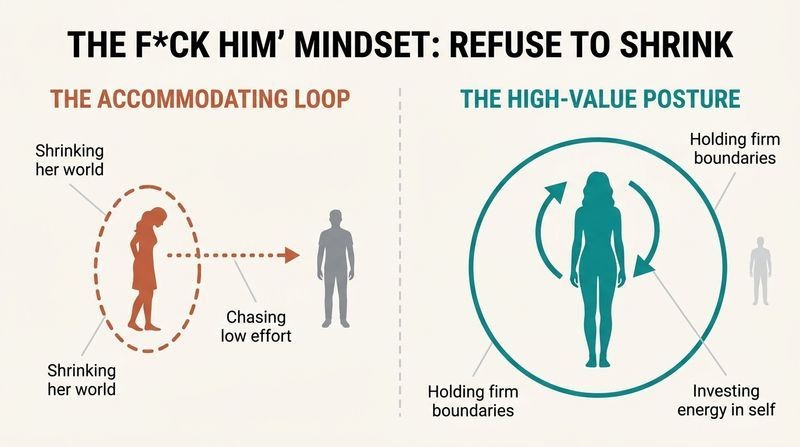
The title is psychological, not sexual. Brian's central provocation is that women lose great relationships by being too accommodating, too available, and too eager to please men who haven't earned it. His prescription is a mental posture: whenever a man behaves badly, mentally shrug and think "well, fuck him," then redirect your energy to your own life.
The high-value woman is the archetype. She treats herself as the prize. She never nags, yells, or pouts because she doesn't need to. She's kind but firm, giving her time and attention only to men who put in real effort. Her looks are almost irrelevant, which is why average-looking women often land devoted, high-quality partners. The book promises to reveal the mindset such women share, drawn from Brian's interviews with roughly a thousand of them.
The framing is deliberately abrasive, but underneath the shock-title sits a familiar and defensible idea: self-abandonment repels intimacy. Attachment researchers would recognize the "high-value woman" as someone with a secure, differentiated sense of self, comfortable with autonomy. What's worth flagging is the heteronormative, essentialist frame throughout: men chase, women are prizes. That model captures real dating dynamics for some, but treats gendered behavior as fixed biology rather than culture. Readers should extract the transferable insight (stop performing for approval) while questioning the rigid script that only women should hold power lightly and men must always pursue.
Never make him the center of your life; he'll feel suffocated
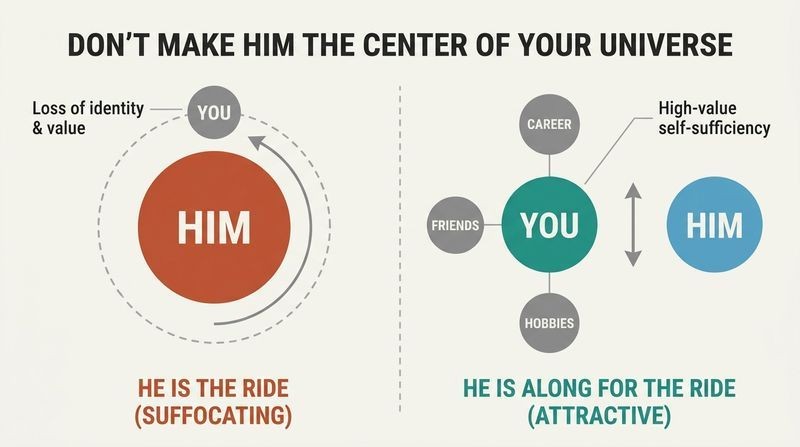
Neediness is the true repellent, not niceness. Brian argues men, especially high-quality ones, run from women who orbit them. He tells of Jamie, 57, courted by a wealthy, respectful man who proposed after three months. She never nagged, never pushed, simply went along for the ride. Four weeks into wedding planning, he called it off and vanished. Her mistake wasn't doing something wrong; it was doing nothing, letting him call every shot until he spooked himself.
Want him, never need him. The distinction is Brian's fulcrum. On a 1-to-10 scale, whoever values the relationship less holds the power. If she's a 10 and he's a 6, he suffocates and flees. Keep your career, hobbies, and friendships intact. He comes along for the ride; he never becomes the ride.
The want-versus-need distinction echoes a robust finding in relationship psychology: perceived partner independence increases desire. Esther Perel builds her entire body of work on this, arguing desire requires distance and mystery, that we're drawn to a partner who remains slightly out of reach. Brian intuits the same mechanic. The weakness is his one-directional framing, as though only women risk over-investing. In reality men smother partners too. The Jamie story also conveniently blames her passivity while excusing the man who proposed impulsively then bolted, a pattern that says more about his avoidance than her compliance.
Reinforce good behavior, withdraw for bad, and never nag
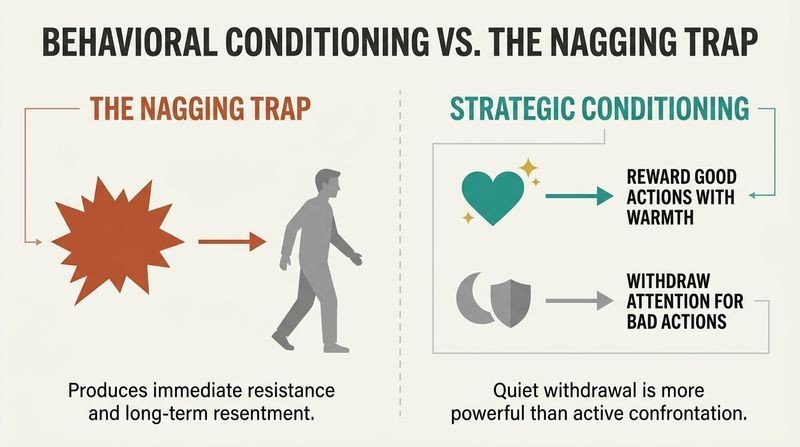
This is the golden rule of the book. Nagging, complaining, and yelling produce short-term compliance and long-term resentment. Instead, reward what you like with warmth and attention, and go quiet, less available, and less catering when he disappoints you. No words required. Brian likens it to operant conditioning: ignoring is the harshest punishment, worse than confrontation.
Dr. Goldstein's experiment anchors the claim. A psychologist studied whether wives could recondition difficult husbands. One woman, Sabrina, was left by her husband for another woman. Rather than pleading, she rewarded every call with warmth and compliments while calmly ignoring his abandonment, always ending calls first. Call frequency climbed, and he eventually left the girlfriend and asked to move back. Brian pairs this with the Gottman finding that stable couples run roughly five positives per negative; divorcing couples invert it.
The behaviorist core is legitimate. Positive reinforcement outperforms punishment across species, and Gottman's magic ratio (about 5:1) is one of the most replicated findings in couples research. Where the advice gets ethically slippery is the framing of a partner as a Labrador to be trained, and the Sabrina anecdote glamorizes winning back a man who abandoned his family. A behavioral scientist would add nuance: reinforcement works best paired with clear, direct communication, not strategic silence. The assertiveness Brian elsewhere praises ("I don't like it when you...") is actually more evidence-based than the passive withdrawal he leads with here.
Men want to earn love the way they earn a hard-won salary
Challenge creates value; ease destroys it. Brian's sharpest analogy: imagine two jobs paying 10,000 dollars monthly. In one, the money arrives no matter what. In the other, you must show up, perform, and improve to get paid. The guaranteed salary feels like a dream, then becomes boring within months precisely because nothing is earned. The second keeps a man motivated and grateful.
Relationships run on the same wiring. If affection, sex, and attention require no effort early, he assigns them no value and looks elsewhere for the chase. This is why Brian insists a woman set the tone in the first weeks: create habits where he works to please you. Ambitious, high-quality men are the most susceptible, because they're programmed to value what they've struggled for.
The salary metaphor is genuinely clarifying and maps onto behavioral economics: humans systematically devalue what arrives without cost, a cousin of the endowment effect and hedonic adaptation. The IKEA effect (we prize what we build ourselves) supports his point that effort breeds attachment. But the model risks pathologizing generosity. Healthy long-term bonds are built on reciprocal giving and safety, not perpetual auditioning. Perpetual scarcity can also breed anxious attachment rather than devotion. The steelman: early-stage calibration matters, and one-sided over-giving does signal low self-regard. The overreach: treating a decades-long marriage as a game a man must never finish winning.
Delay sex to dodge the oxytocin trap and get seen
Two rules govern intimacy. First, don't sleep with him too soon. Brian cites Dr. Breuning's work on oxytocin, the bonding hormone released through intimate touch and sex, which makes a woman evaluate a man far more positively than warranted and whisper "this is the one" before she has any evidence. It's evolution's mechanism to keep a mother and provider bonded, blind to whether he's actually worthy.
Second, "mentally fuck" him immediately. Since men are visual and initially superficial, holding off on your body forces him to engage your personality, the real differentiator. Give visual hints (a shape, not the goods) rather than words, and never lead him to arousal only to slam the brakes, which builds resentment. Waiting also filters out men hunting one-night stands.
The oxytocin science is directionally real but oversimplified. Oxytocin is released in both sexes and its effects are context-dependent, not a female-only love drug. Still, the behavioral counsel (slow down before bonding chemistry overrides judgment) aligns with sound decision-making under emotional arousal, what Dan Ariely calls the "hot state" where we mispredict our own choices. The gendered double standard is the weak seam: framing a woman's body as a scarce commodity that loses value when "given away" recycles a purity-economy logic many readers will reject. The defensible kernel is pacing intimacy until infatuation chemistry stops distorting your read on a person's character.
Give him a challenge and he'll believe it was his idea
Steer with reverse psychology, not requests. Brian compares men to three-year-olds who want the toy the moment you forbid it. Janice wanted more time with her golf-obsessed boyfriend Mark. Nagging pushed him further away. So she did the opposite: she encouraged his golf and filled her freed time with improv class and spinning. Within 26 days Mark proposed skipping golf to spend Sunday together. Crucially, she didn't drop everything; she offered another day, protecting her value.
Rebekah fixed a doorknob without asking. After endless ignored requests, she grabbed the toolbox and started clumsily tinkering herself. Her husband rushed in and took over within a minute. The lesson: a man's ego drives him to provide and protect, so let him feel the decision is his own.
This is applied ego-psychology, and the tactical examples are memorable. The mechanism resembles psychological reactance (Brehm), the well-documented human tendency to resist when freedom feels threatened and to want what's restricted. Framing choices to preserve autonomy is a real influence lever used in negotiation and parenting alike. The ethical tension is manipulation dressed as strategy: Brian insists it isn't a game, yet staging a broken doorknob or performing disinterest is precisely engineered indirection. A relationship built on covert steering can erode the honesty that sustains trust. The healthier extraction: replace nagging with clear autonomy-respecting requests and genuine independent living, not theatrical ruses.
Put every man on probation before you crown him king
Never trust the honeymoon performance. The high-value woman treats early infatuation as "the love radio station" she rarely tunes into, because everyone shows their best game at first. She runs an extended probation: observing, not complaining, how he behaves when life goes wrong, when he's sick, passed over at work, or served the wrong dish. She takes silent notes. If his report card accumulates too many marks, she leaves without asking him to change, because she knows he won't.
Slow the pace even when he sprints. Recall Jamie's vanished fiancé. Because men handle emotion poorly, a woman who lets a man race ahead watches him outrun himself, panic, and flee. So she caps early dating at two or three times a week and guards her existing life fiercely.
The probation concept is sound risk management dressed in dating language. Behavioral consistency over time and across contexts is genuinely more predictive of character than peak behavior, a principle courts, hiring managers, and clinicians all rely on. Observing someone under stress reveals more than their curated best. The caution: silent note-taking without communication can curdle into surveillance and emotional withholding, denying a partner the feedback that lets a relationship grow. There's a difference between wise patience and testing someone who never knows he's being graded. The strongest version pairs this vigilance with the assertive honesty Brian praises elsewhere: watch closely, but also speak plainly.
Your self-respect, not your body, is your magnetic asset
Self-respect cannot be faked or injected. Brian calls it the trait that never ages, and the number-one filter against players, who hunt weak prey they can control with minimal investment. Boundaries repel manipulators and attract high-quality men who respect standards because they hold high standards themselves. Karen, twice divorced and twice cheated on, confessed her pattern stemmed from believing "I don't deserve any better." Men, Brian argues, cannot respect a woman more than she respects herself.
Travel light and keep attention costly. In first impressions, avoid dumping baggage, ex-complaints, and childhood wounds. Spoon-feed your time. Leave a great conversation after a few minutes rather than clinging. Because of first-impression bias, the brain locks onto its initial read and filters out contradicting evidence, so the opening minutes carry disproportionate weight.
This is the book's most durable and least gender-specific insight. "People treat you as you allow" oversimplifies (abuse is never the target's fault), but self-respect as a boundary-setting behavior genuinely shapes relational dynamics. It connects to Nathaniel Branden's work on self-esteem as the immune system of the psyche, and to research showing people with clear boundaries report higher relationship satisfaction. First-impression bias (the halo effect and anchoring) is well established in social cognition. The caveat worth naming: "travel light" can shade into emotional inauthenticity, hiding your real self to seem low-maintenance. Boundaries attract; concealment merely delays the moment two real people actually meet.
When he says "not ready," agree faster than he does
Match his ambivalence, don't fight it. When a good man (no red flags, just commitment fear) says he isn't ready for a relationship, the losing moves are getting mad, selling him on trying, or working harder for his attention. All lower your value. The winning response: agree he should take his time and go have his fun, then add the hook that if you're not with someone else by then, you might reconnect. This triggers his "wait, what if she is?" alarm.
Brian's own girlfriend disarmed his commitment fear. When his alarm fired during their early dating, instead of asking if he still loved her, she calmly offered to go home to her own place. Her non-neediness snapped him out of it and raised her value. The security women crave, he insists, doesn't exist anyway.
The tactic exploits loss aversion and scarcity, both real motivators, and the psychology of reactance again: grant the freedom and the craving to flee weakens. There's wisdom in refusing to argue someone into wanting you, since persuasion rarely generates authentic desire. Yet the scripted counter-move (the strategic "if I'm still available") is a calculated gambit that assumes his hesitation is a test rather than genuine information. Sometimes "I'm not ready" simply means not ready. Brian's own caveat helps: if his actions don't back the words, believe the actions and move on. The healthiest read is emotional non-desperation, not a clever line to reel him back.
Feelings aren't facts; let emotional intelligence outrank oxytocin
Emotional intelligence is the master key. Brian, who battled panic attacks for fourteen years, uses that history to make a point: bodies manufacture emotions that don't match reality, like feeling a tiger is present when none exists. After a perfect first date, the high-value woman feels the same swoon as everyone else but labels it: "These are just feelings, based on hormones, and they may not be real." She gives him the benefit of the doubt while refusing to act on the chemistry.
Self-control is a trainable muscle. Citing Daniel Goleman's Emotional Intelligence, Brian frames managing emotion like weightlifting or the neural pathways a toddler builds learning to walk: effortful at first, automatic with repetition. Never take a man's bad behavior personally; how people treat you reveals them, not you.
This is the book's most psychologically mature note, and it universalizes beyond dating. The "feelings aren't facts" reframe is a cornerstone of cognitive behavioral therapy and Acceptance and Commitment Therapy, which teach cognitive defusion: observing thoughts and emotions without obeying them. Neuroplasticity does support the muscle metaphor; repeated regulation strengthens prefrontal control over limbic impulses. The honest tension in the book is that this chapter's wisdom (feel fully, choose deliberately) sits somewhat at odds with earlier tactical gamesmanship. Read charitably, emotional intelligence is the foundation and the tactics are scaffolding. Read critically, a person this self-regulated may not need the manipulation playbook at all.
Analysis
F ck Him is a blunt, provocative entry in the pickup-adjacent dating-advice genre, aimed at heterosexual women who keep losing men they want. Its structure is loosely thematic rather than systematic: short punchy chapters circling one thesis from many angles. That thesis is coherent and, stripped of its shock-jock packaging, largely defensible: self-abandonment repels intimacy, and non-neediness combined with strong boundaries is magnetic.
The book's intellectual DNA is behaviorism (reward good, ignore bad), evolutionary psychology (men pursue, women select), and pop emotional intelligence (Goleman, Gottman). Its most valuable, transferable insight is the want-versus-need distinction and the primacy of self-respect. These generalize well beyond gender and align with attachment theory, Esther Perel's work on desire and distance, and CBT's "feelings aren't facts."
The book's weaknesses are equally clear. It leans hard on gender essentialism, treating "men are three-year-olds ruled by ego" and "women seek security" as fixed biology rather than culture, which flattens real human variety and excuses immature male behavior it simultaneously condemns. Its ethics wobble: it insists the strategies aren't games while teaching staged doorknobs, performed disinterest, and calculated silence. The science is cited loosely (oxytocin as a female love drug, a single Goldstein anecdote generalized into law). And the recurring metaphor of training a man like a dog reduces partnership to behavior modification.
The most honest tension is internal: the final chapters champion emotional intelligence, authenticity, and boundaries, which arguably make the manipulation tactics redundant. A woman who genuinely values herself, keeps her own life, and reads emotions clearly doesn't need reverse-psychology ruses; she simply becomes someone worth chasing. Read that way, the book's tactical scaffolding is training wheels for the real lesson: stop performing for approval, and build a life so full that no single man becomes its center. That message deserves a less abrasive book, but it's a real message.
People Also Read




Glossary
High-value woman
Self-respecting, non-needy, boundary-strong womanBrian's central archetype: a woman who treats herself as the prize, never nags or plays games, keeps her own full life, and gives her time and attention only to men who earn it. Her power comes from self-respect and non-neediness rather than looks, which is why he claims average-looking women with this mindset attract devoted, high-quality partners.
Mental fucking
Captivating a man psychologicallyBrian's term for engaging and challenging a man mentally rather than physically, forcing him to see and become addicted to a woman's personality instead of just her body. Achieved by being sassy, high-value, non-needy, and unpredictable from the first meeting, creating the mental challenge he says all men crave.
The golden rule
Reward good, withdraw for badBrian's core behavioral prescription: reinforce a man's desirable behavior with warmth and attention, and respond to undesirable behavior by withdrawing, becoming less available, and giving less, all without nagging or explaining. Modeled on operant conditioning and the idea that being ignored is a harsher, more effective consequence than confrontation.
Probation period
Extended vetting before commitmentThe practice of withholding full commitment while quietly observing how a man behaves over time and under stress (illness, setbacks, frustration), rather than trusting his best early-stage performance. The woman takes mental notes without complaining, and exits if his accumulated behavior fails her standards, on the logic that people don't fundamentally change.
Want versus need
Desire without dependenceBrian's key distinction: wanting a relationship is healthy, but needing one hands over power because you have the most to lose. On a 1-to-10 scale, whoever values the relationship less holds the lead. The high-value woman wants her man deeply but never needs him, keeping her independent and attractive.
Download PDF
Download EPUB
.epub digital book format is ideal for reading ebooks on phones, tablets, and e-readers.








































