

Key Takeaways
A screenwriter's letter can shatter the family myth you grew up believing
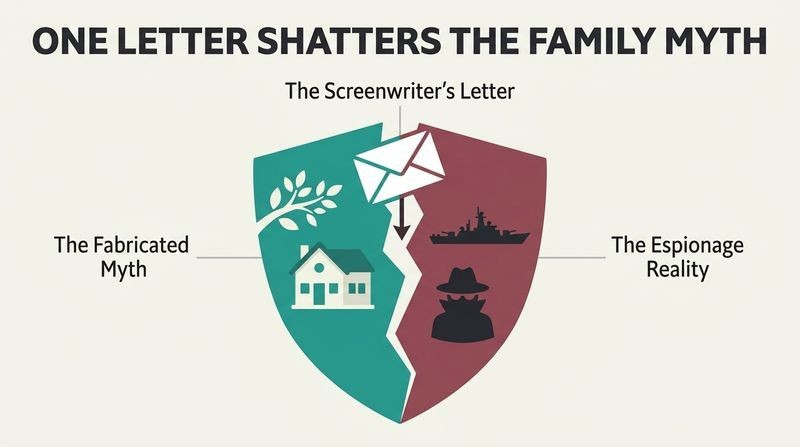
The book opens with a bombshell. In 1994, Christine Kuehn, a suburban Maryland mother of three, opens a letter from a Hollywood screenwriter researching German spies at Pearl Harbor. He wants to reach her grandfather, Otto Kuehn. Her father had always described Otto as an unremarkable naval officer who died in a car crash. The letter says otherwise. A trip to Borders bookstore confirms the nightmare: in book after book on the 1941 attack, she finds the entry "Kuehn, Bernard Julius Otto," a paid Nazi and Japanese spy.
The discovery detonates decades of careful silence. Her father, Eberhard, had buried his past so thoroughly that his own daughter grew up believing invented tales about rescued highway toddlers instead of the truth about Berlin, Hitler, and betrayal.
What's striking is how ordinary the trigger was: junk mail on pizza night. Family historians know this pattern well. The "discovery narrative" often begins with an outside intrusion rather than internal curiosity, because families protect their myths fiercely. Psychologists studying intergenerational trauma call this "the conspiracy of silence," a term coined for Holocaust survivor families where the unspeakable becomes structurally invisible. Kuehn's memoir inverts the usual perpetrator-descendant story: instead of Nazi guilt inherited quietly, she stumbles into it accidentally, which makes the reader complicit in her dawning horror. The bookstore scene works because research, not confession, becomes the vehicle of truth.
Chronic gamblers who lose everything become perfect recruits for extremism
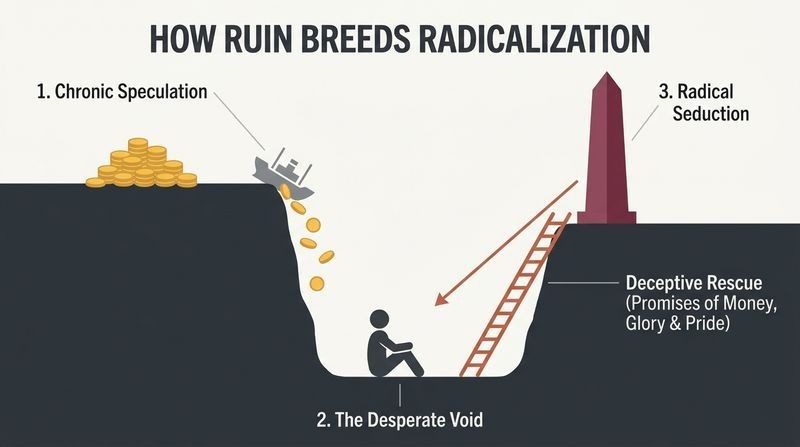
Otto Kuehn was a serial failure before he was a spy. Born into Berlin wealth in 1895, he inherited roughly 800,000 dollars in today's money from an estranged aunt. He blew it on ventures he knew nothing about: a freighter that ran aground weeks after purchase, a sparkling water company that folded, a coffee import business, all gambled away within a few years. Impulsive, easily bored, and allergic to perseverance, he drifted from scheme to scheme.
When the 1929 crash devastated Germany, the rudderless Otto attended a Hitler rally in Kiel in 1930 and was electrified. He joined the Nazi Party the next day. His wife Friedel, son Leopold, and daughter Ruth all followed. An ordinary middle-class family transformed into committed Nazis, seduced by promises of money, glory, and restored national pride.
The portrait of Otto as a compulsive gambler reframes his radicalization as psychological rather than ideological. This aligns with research on extremist recruitment: movements disproportionately attract the humiliated, the downwardly mobile, and those seeking significance after personal collapse. Political scientist Eric Hoffer argued in The True Believer that mass movements recruit not the successful but the frustrated, people desperate to lose themselves in a cause. Otto fits precisely. His story complicates the comforting notion that only monsters become Nazis. Sometimes it is simply a man who cannot stop betting, looking for one final jackpot to redeem a lifetime of losses.
History pivots on tiny mercies: Otto's loan put Heydrich on the train
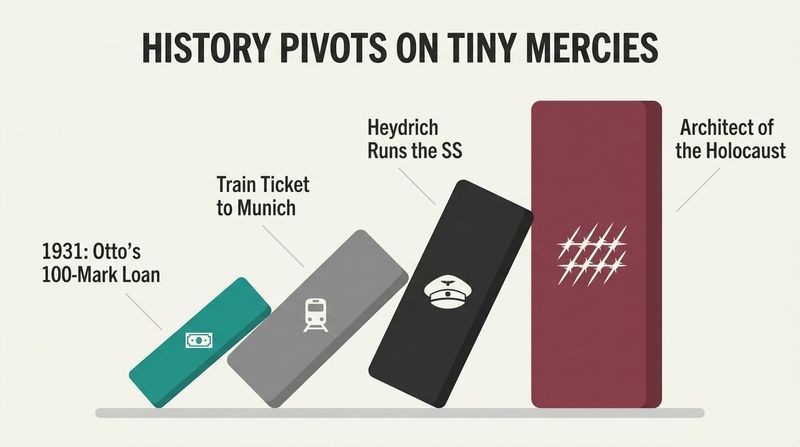
One small gesture may have shaped the Holocaust. In 1931, Otto and a down-on-his-luck aristocrat named Reinhard Heydrich both competed for a job running SS counterintelligence under Himmler. Heydrich could not afford the train ticket to Munich. Otto, seeing a fellow gentleman in need, loaned him 100 marks. Heydrich made the trip, charmed Himmler for hours, and got the job. Otto was passed over.
Heydrich became the "Butcher of Prague," ordered the first concentration camp at Dachau, ran the Gestapo, and chaired the 1942 conference that engineered the "Final Solution." Kuehn wrestles with the vertigo of it: her grandfather's rare act of kindness helped launch one of history's greatest killers. She concedes Otto's appointment would have changed nothing, since only a fanatic could fill that role, but the moment haunts her.
This is counterfactual history at its most seductive and most treacherous. The "for want of a nail" instinct tempts us to locate world-historical evil in single contingent moments. Kuehn wisely resists, recognizing that the SS role demanded a Heydrich-type regardless of who boarded the train. Historians call this the tension between contingency and structure. Individual choices matter, but vast machinery of genocide required thousands of willing hands, not one. Still, the anecdote illuminates a moral truth: perpetrators are enmeshed in ordinary social courtesies. Evil travels on trains bought with a colleague's spare change, which is precisely what makes it so unsettling.
A discarded mistress became Japan's white face at Pearl Harbor
The Hawaii mission was born from a coverup. Ruth Kuehn, Otto's stepdaughter, had an affair with propaganda minister Joseph Goebbels after he spotted her at a lavish 1935 gala. The problem: Ruth was secretly half Jewish, her biological father a Berlin architect named Martin Punitzer who fled to Chile. With the Nuremberg Laws about to criminalize German-Jewish relations, Goebbels needed his liability gone.
His solution was elegant and cruel. Japan wanted Caucasian spies in Hawaii who would not arouse suspicion once war began. Goebbels shipped the entire Kuehn family to Oahu. Otto signed a contract worth roughly 680,000 dollars a year in today's money. A family fled Nazi persecution of their own daughter by going to work for the Axis, spying on the nation that would eventually take them in.
The layered ironies here border on the novelistic. A Jewish woman becomes a Nazi asset; a family escapes antisemitic danger by serving the regime that created it; the "racially pure" cover depends on hiding Jewish blood. This exposes the incoherence at fascism's core, where ideology bends instantly to expediency and personal scandal. Goebbels, architect of racial purity propaganda, sleeps with a half-Jewish woman and then weaponizes her. The episode also illustrates how espionage networks exploit the compromised and the desperate. Ruth was not a mastermind but a woman trapped by her own secret, coerced into a role that would define and eventually destroy her.
The best spies stay invisible; the Kuehns threw parties instead
Otto and Friedel violated the first rule of espionage. Told to stay under the radar, they did the opposite. They bought three properties, hired Japanese maids, filled rooms with Persian rugs and antique Chinese screens, and hosted galas so lavish they made the Honolulu society pages. Otto courted young Navy officers freely, took photo-taking jaunts near airfields, and clipped newspaper articles about fleet movements. A German sailor warned the local consul: "He is a dangerous man." Berlin confirmed bluntly: "Otto Kuehn is a spy."
Their spending drew FBI attention within months. J. Edgar Hoover noted they "entertain lavishly, particularly Army officers, with no known means of income." Only daughter Ruth, who folded intelligence-gathering seamlessly into dating naval officers, operated with genuine professional discretion.
The Kuehns embody a paradox in tradecraft: narcissism and espionage are fundamentally incompatible. Effective agents cultivate grayness, the forgettable presence intelligence services prize. Otto craved exactly the recognition his mission required him to avoid. This maps onto research on why some spies get caught: not clever counterintelligence but the operative's own need for status, money, or attention. Aldrich Ames and Robert Hanssen were undone partly by unexplained wealth. The Kuehns' story suggests the same lesson decades earlier. Ruth's contrasting competence is telling. She hid in plain sight through the socially expected role of a pretty young woman dating officers, the perfect camouflage.
Compartmentalization lets ordinary people hold monstrous contradictions
The Kuehns were masters of not-seeing. Leopold beat Jews in Berlin streets while his own sister carried Jewish blood, either ignorant of her lineage or willfully blind. Otto and Friedel spied to help destroy America while savoring every pleasure American Hawaii offered. They cheered Leopold's Nazi career and Hitler's conquests while shielding their Jewish daughter from the same regime's violence. Kuehn argues all good spies must possess this trait, or they would go mad.
Her father Eberhard inherited the family gift and turned it toward survival. He locked his childhood away so completely that he told his children invented stories rather than face Berlin's bloodshed or Pearl Harbor's shame. The telegram-style clipped answers he gave about his past were the verbal architecture of a man burying himself to stay sane.
Psychology calls this dissociation or motivated reasoning, and it is not exotic. Ordinary humans routinely hold contradictory commitments, funding causes while violating them, professing values they betray. What the Kuehns demonstrate at extreme scale is the mind's capacity to wall off incompatible truths. Robert Jay Lifton's study of Nazi doctors coined "doubling," the formation of a second self that commits atrocities while the original self remains intact. The Kuehns doubled across the whole family. Eberhard's version is more sympathetic: compartmentalization as trauma management rather than moral evasion. The same cognitive machinery that enables perpetrators also lets victims endure the unendurable.
Both nations punished the innocent while the guilty family paid unevenly
Justice in wartime was arbitrary and racialized. After Pearl Harbor, the FBI arrested the whole Kuehn family, including fifteen-year-old Eberhard, who knew nothing, and labeled him a national security threat so his father could not destroy evidence. Otto confessed after being denied food and water through marathon interrogations, and was sentenced to death by firing squad. Meanwhile 120,000 Japanese Americans on the mainland, almost none guilty of anything, were interned for the entire war.
Special Agent Robert Shivers, who built the case against the Kuehns, risked his career fighting mass internment of Hawaii's Japanese population. He had informally adopted a Japanese American student he called Sue. The spy Yoshikawa himself noted the bitter irony of being jailed alongside loyal Japanese Americans who had done nothing.
The moral asymmetry is stark. The genuinely guilty Kuehns received individualized due process, however flawed, while the presumptively innocent were punished collectively on the basis of ancestry. Shivers emerges as the book's quiet hero, a conservative Southerner whose personal relationship with one Japanese American woman inoculated him against the racial panic gripping Washington. This echoes the "contact hypothesis" in social psychology: prejudice erodes through genuine interpersonal contact. Hawaii's relative restraint versus the mainland's mass internment partly reflects such contact in a diverse society. The chapter is a reminder that wartime justice tracks fear and race more than actual guilt.
Otto escaped a firing squad on a technicality of peacetime law
A legal quirk saved the condemned spy. Otto was convicted by a military tribunal and sentenced to be shot. But his spying and arrest occurred before war was declared and before martial law existed in Hawaii. When the Supreme Court reviewed the case of eight German saboteurs who landed by submarine in 1942 (six were executed), it upheld their deaths because they acted during wartime. Otto's crimes had happened in peacetime, when a military court lacked authority to impose death.
His sentence was commuted to fifty years hard labor at Fort Leavenworth. After the war, a 1946 ruling on martial law in Hawaii reopened his case. He was ordered deported, held two years on Ellis Island, then simply paroled. An FBI memo about losing track of this dangerous enemy read: "This is astounding."
The saboteur case, Ex parte Quirin, remains a touchstone in debates over military tribunals, cited after 9/11 to justify Guantanamo commissions. Otto's fate hinged entirely on jurisdictional timing, a reminder that legal outcomes often turn on procedural technicalities rather than moral desert. The bureaucratic bumbling that followed, holding him two years past a deportation order then releasing him untracked, exposes how administrative chaos can undercut both justice and security. The man once sentenced to die for enabling the deadliest attack on American soil to that point wandered off to work odd jobs in New York, an anticlimax that says much about institutional capacity in the postwar scramble.
At sixteen, choose the person you'll be regardless of your bloodline
Eberhard's defiance is the book's moral center. Pressured relentlessly to return to Germany, teenage Eberhard refused. In a letter to his sister Ruth he wrote that his siblings would always be German but he never again would be, that he believed the Nazis were wrong. Friedel even begged Leopold to have the Nazi regime forcibly extract him. Instead Eberhard became a U.S. citizen, enlisted, and fought at the Battle of Okinawa, one of the war's bloodiest, losing twelve thousand comrades.
He chose the country that had branded him an enemy alien and jailed him. His parents wanted him defending Berlin alongside Leopold, who died in the city's final days. Eberhard broke the family pattern deliberately, paying for it with a lifetime of buried grief and invented stories.
This is the memoir's thesis in miniature and the source of its dedication: you cannot choose your family, but you can choose who you become. Developmental psychology emphasizes adolescence as the crucible of identity formation, and Eberhard's case is extreme. At sixteen, orphaned by circumstance, he rejected inherited ideology through sheer moral clarity. The tragedy is the cost. His agency required amputating his entire past, which produced the haunted, secretive father his daughter struggled to know. The book quietly argues that moral courage and psychological wholeness do not always coexist. Sometimes doing right demands a self-erasure that leaves permanent scars.
Burning the records never sets you free; secrets corrode from within
The family tried to erase itself, and failed. The book opens and closes with fire. In 1964 Ruth and Hans burned the family's papers, photos, and letters in a Bavarian field, hoping to escape the tragedy. Ruth thought, "We are all finally free." She was wrong. She spent her final decades convinced the FBI still watched her, ripped the K section from her own address book, and hid the torn pages taped under a nightstand so no one could find surviving relatives.
Friedel died terrified of a knock on the door. Hans, falsely mythologized as history's only child spy, battled alcoholism and took his own life in 1974. Kuehn's father buried everything until dementia erased even the memory. Yet the secret survived every fire, surfacing through FBI files, a screenwriter's letter, and a cousin's message.
The recurring bonfire is a haunting structural device, bookending a story about the futility of destroying the past. Trauma research supports Kuehn's conclusion: suppression tends to intensify rather than resolve psychological wounds, and unspoken family secrets often transmit across generations as anxiety, addiction, and paranoia, exactly the pattern in Hans, Ruth, and Friedel. The German concept Vergangenheitsbewaltigung, coming to terms with a difficult past, names what the Kuehns refused and what Christine finally attempts. Her closing insight, that secrets eat love like acid but love regenerates, reframes the whole project. Telling the story, not burning it, becomes the only genuine liberation, especially as she watches swastikas reappear in her own neighborhood.
Analysis
Family of Spies belongs to a distinctive subgenre: the perpetrator-descendant memoir, where an ordinary person discovers monstrous ancestry and must metabolize it. What separates Kuehn's book from confessional Nazi-grandchild literature is the accidental, investigative structure. She learns her history the way a journalist would, through FBI files, archives, and long-lost cousins, and this reportorial spine lends the personal material documentary weight. The book braids three timelines: the Kuehns' 1915-1945 rise and ruin, the author's decades-long investigation from 1994 onward, and her father's slow surrender to dementia. That triple structure is the book's chief technical achievement, letting historical narrative and emotional discovery illuminate each other.
The deeper intellectual contribution is its meditation on inheritance and agency. Kuehn keeps circling a genuinely unsettling question: what does it mean to share blood with people who enabled atrocity? Her honesty about recognizing herself in Otto, and her relatives noting she resembles Friedel, refuses the easy comfort of disavowal. Yet the book's answer, embodied in her father's choice at sixteen, insists that character is chosen, not transmitted. This is a hopeful thesis, though the memoir undercuts it with the price Eberhard paid: a lifetime of dissociation and invented stories. The book is thus more psychologically complex than its uplifting dedication suggests.
Historically, the Kuehn case is minor, a footnote in Pearl Harbor scholarship, and readers seeking military history will find the espionage almost comically amateurish. The value lies elsewhere: in the anatomy of how a normal family radicalizes, how spies self-destruct through vanity, and how silence propagates trauma. Its weakness is occasional over-dramatization and reliance on imagined scenes. Its timeliness, punctuated by the author witnessing resurgent antisemitism outside her own window, gives the familiar warning that fascism creeps slowly then arrives fast a fresh, personal urgency.
Review Summary
Family of Spies by Christine Kuehn reveals the shocking true story of her grandparents' role as Nazi and Japanese spies in Hawaii before the Pearl Harbor attack. Readers praise this debut memoir for its meticulous research, compelling narrative that reads like fiction, and the author's courage in exposing her family's devastating secrets. The book seamlessly weaves between historical events and Kuehn's thirty-year investigation. Reviewers found it educational, jaw-dropping, and timely, with many calling it essential reading for WWII history enthusiasts and praising narrator Erin Bennett's outstanding audiobook performance.
People Also Read







Glossary
Bushido
Japanese warrior honor codeThe samurai code of discipline, honor, and absolute loyalty, dating to the seventeenth century, that shaped Japanese military training before World War II. It demanded obedience without question and held that capture by the enemy was a profound dishonor, better remedied by ritual suicide. Spy Takeo Yoshikawa and millions of Japanese soldiers were forged in this ethos.
Haole
Caucasian person in HawaiiA Hawaiian term for white residents and visitors, from ha (breath of life) and ole (without), reportedly because natives thought pale newcomers did not breathe. Often derogatory, it marked Otto Kuehn as an outsider whose frequent visits to the Japanese consulate stood out, since he was one of only two haoles granted private access.
X-Day
Japanese code for attack dateThe internal Japanese designation for the planned Pearl Harbor assault. Once the signal 'Climb Mount Niitaka' was sent on December 2, 1941, X-Day was fixed for December 8 Tokyo time, meaning December 7 in Hawaii. Otto Kuehn's signaling system was built to relay ship movements right up to this date and no further.
The dormer window
Kuehn spy signaling deviceA small attic window Otto built into his Kalama home overlooking the Pacific. His signaling plan used lights shown from it at specific hours to communicate American ship movements to Japanese submarines waiting offshore. Because it was mentioned in an intercepted Japanese telegram, it became the linchpin of evidence connecting the Kuehns to the attack.
Compartmentalization
Mentally walling off contradictionsAs the author uses it, the family trait of holding irreconcilable realities simultaneously without psychological collapse: spying against America while enjoying its paradise, persecuting Jews while protecting a Jewish daughter. She argues all effective spies need it, and her father used the same mechanism to bury his traumatic past in order to survive.
Download PDF
Download EPUB
.epub digital book format is ideal for reading ebooks on phones, tablets, and e-readers.








































