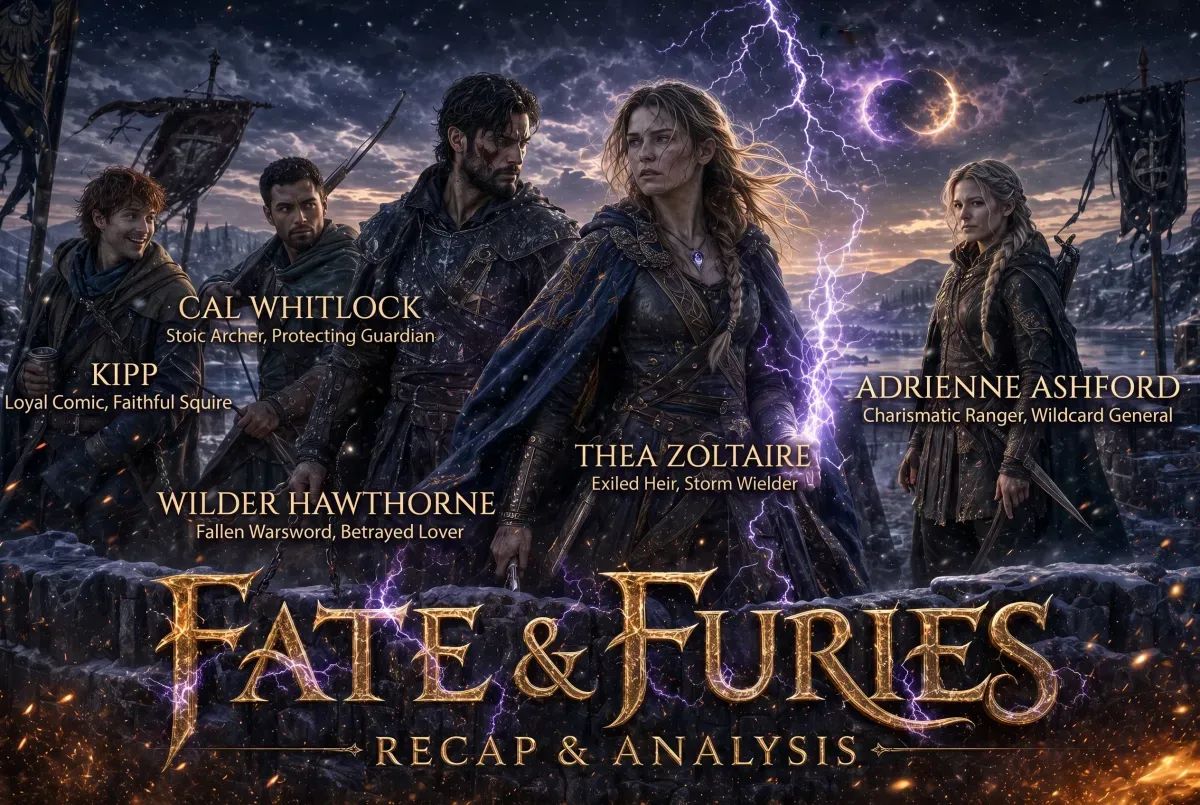


Plot Summary
Prologue
An ancient prophecy shadows the midrealms: in the ruins of a fallen kingdom, a daughter of darkness3 will wield a blade in one hand and command death with the other. When the skies blacken at the end of days, the Veil between worlds will fall, the tide will turn the instant her blade is drawn, and a dawn of fire and blood will follow.
The rulers have weaponized this verse to rally their frightened people toward the Moonfire Eclipse, a once-in-a-century celestial event they swear will see light conquer the spreading dark. But prophecies, like the fate stones that count down a life, rarely mean what those who recite them believe.
The prophecy functions as both prophecy and propaganda, a text whose ambiguity invites exploitation. By foregrounding it, the book signals that interpretation, not destiny, will drive the plot. Who gets to name the daughter of darkness becomes the central political question. The verse also encodes the novel's gender argument: a woman's power is feared, mythologized, and blamed before it is ever understood. The fate stone parallel introduces mortality as a ticking clock that pressures every choice. Crucially, the rulers' confident reading foreshadows their hubris, while the closing caution that prophecies deceive primes the reader to distrust official narratives and watch for the truth buried beneath sanctioned fear.
Hunting the Fallen Warsword
For twelve months Thea,1 the warrior called the Shadow of Death, has chased Wilder Hawthorne2 across frozen Aveum, blaming the fallen Warsword2 for loosing wraiths upon the world when he freed half-wraiths at Notos and shattered her heart. Her storm magic has gone silent since that battle, and the fate stone at her throat still counts toward her death at twenty-seven.
With friends Cal5 and Kipp,4 she slays howlers outside a village on her name day, then wakes to find Wilder2 slipped past her watch to leave a small box marked with a lightning bolt. Reading only a taunt, she flings it into a frozen river. She clips Wren8's unbreakable manacles to her belt, swearing to drag him before the rulers in chains.
The opening establishes vengeance as Thea's organizing principle, a grief disguised as duty. Her lost magic literalizes her fractured interior: betrayal severed something essential. The name day gift, instantly destroyed, dramatizes how rage forecloses understanding, a pattern the whole novel will dismantle. Scheuerer frames hunting as both mission and avoidance; pursuit lets Thea outrun mourning. The fate stone injects mortality urgency, making her single-mindedness feel desperate rather than heroic. Crucially, the reader sees only her interpretation of events, an unreliable lens that the dual narration will soon complicate, inviting us to question whether the traitor she chases is the villain she insists upon.
The Heart on the Snow
Tracking Wilder2 to a fishing village, Thea1 finds corpses burning and learns a lone warrior2 repelled the howlers before a lake creature dragged him under. She battles cursed reef dwellers, poison-dripping krakens menacing the survivors, until Wilder2 bursts from the shattered ice clutching the monster's torn heart and drops it at her feet.
He reaches for her, hoarse with longing, pleading to explain everything. Thea1 lets him believe she might kiss him, then snaps the alchemy-treated manacles around his wrists. With Cal5 and Kipp,4 she decides to deliver him to the rulers gathering at Vios for the Moonfire Eclipse. Secretly relieved to be near her, Wilder2 lets himself be chained, desperate to learn why her magic has fallen silent.
The capture inverts the rescue trope: he saves the village, she imprisons the savior. That dissonance plants the novel's central doubt, since traitors do not usually die defending strangers. Thea's feigned tenderness weaponizes intimacy, revealing how thoroughly she has armored desire into strategy. Wilder's willing surrender reframes captivity as proximity, his only route back to her. The exchanged glances over a still-beating heart fuse romance and violence, the book's signature register. His preoccupation with her vanished power signals stakes larger than personal reconciliation, hinting that her magic matters to forces neither of them fully controls, and that this hunt was never only hers.
Buried Together in Ice
To make Thea1 listen, Wilder2 smashes a cave entrance shut, sealing them alone in the tunnels beneath the mountains. He lays out the truth he has assembled: the shadow-touched are humans who resisted a reaper's curse, not monsters, and his mentor Talemir Starling12 is one of them. He insists King Artos,10 not Anya the feared Daughter of Darkness,3 is poisoning the realms through the Veil.
Thea1 dismisses it as a traitor's lie. When her soaked clothing nearly freezes her to death, Wilder2 strips her and shares his body heat, confessing he once healed her with Aveum springwater because he loved her. They surface to meet Cal,5 Kipp,4 and Adrienne, his former lover,6 whose easy familiarity needles Thea1's pride.
Enclosure becomes a confessional device: stripped of escape, Thea must finally hear. The hypothermia rescue physicalizes their bond, intimacy framed as survival rather than seduction, and reintroduces consent as a recurring ethical motif. Wilder's springwater confession reveals love as the hidden engine behind events Thea misread as manipulation. The shadow-touched lore reframes the entire war as a problem of misrecognition, of calling victims monsters. Adrienne's arrival weaponizes jealousy, exposing how Thea's wounded heart still claims him even as her mind condemns him. The scene's tension between fact and feeling models the novel's thesis that truth requires both evidence and the willingness to be vulnerable.
The Carriage Under Siege
A red royal flare sends them charging to the Wesford Road, where shadow wraiths swarm a carriage carrying Princess Jasira of Harenth.13 Thea1 fights with Wilder2's twin Naarvian steel swords, but the wraiths overpower her, and her absent magic leaves her badly outmatched. Kipp4 unlocks Wilder2's manacles so he can join the fight; together they carve out the wraiths' hearts and free the sobbing princess.
Then, rather than flee, Wilder2 retrieves the irons and offers Thea1 his wrists, proving he will not abandon her quest even when unbound. They escort Jasira13 toward Vios, Thea1 forced to share his saddle, her resolve crumbling with each press of his body and every truth she can no longer pretend she did not hear.
Wilder's voluntary re-chaining is the chapter's moral hinge, an act of loyalty that contradicts everything Thea has told herself about him. Heroism without freedom dismantles her binary of traitor versus ally. The battle exposes her vulnerability without magic, foreshadowing the cost of her severed power and the trials ahead. Jasira's introduction seeds a personal stake in Harenth's court, complicating Thea's later understanding of Artos. The shared saddle stages reconciliation as bodily proximity overriding ideology; desire becomes the slow solvent of resentment. Scheuerer keeps converting combat into courtship, insisting that trust, like steel, is forged under pressure rather than declared.
Children in the Ice Cells
Amid the floating glass domes of Vios, the rulers honor Thea1 for capturing the traitor2 and saving Jasira,13 but King Artos10's touch makes her skin crawl, and she recognizes empath magic fogging the hall. Wilder2 is hauled to the ice dungeons, his trial postponed until after the eclipse. Defying Artos10's pointed warning to stay away, Thea1 descends and finds Wilder2 beaten and chained in the freezing dark.
He directs her to the end of the cell row, where she discovers winged shadow-touched children, huddled, starved, guilty of nothing. He reminds her she should have kept his gift. Rattled to her core, she retreats, the certainty that fueled a year of hatred finally beginning to fracture.
The juxtaposition of a gilded honoring above and tortured children below crystallizes the novel's critique of sanctioned cruelty: the state rewards the wrong people for the wrong reasons. Artos's empath fog makes manipulation literal, suggesting that consent and clarity themselves are under assault. Thea's instinct to disobey authority becomes her first reclaimed virtue, intuition over institution. The children weaponize empathy against ideology more effectively than any argument Wilder made, because seeing undoes what telling could not. This is the midpoint pivot where Thea's epistemology shifts from believing the powerful to trusting evidence, a reorientation that will eventually cost her everything she once wanted.
What the Silver Orb Holds
Cal5 sheepishly admits he secretly fished Wilder2's box from the bushes and kept it. Inside lies a memory orb, a rare artifact from beyond the Veil. When Thea1 presses it, golden light floods the room with the recorded Great Rites of Warswords past, every blizzard, beast, and trial.
Then she watches Wilder2 cross the realms, bartering for those memories so he could recreate each challenge in her path across the very year she hunted him. The howlers, the brutal terrain, the reef dwellers were all his doing. He never abandoned her; he was keeping his vow to prepare her for the Rite. Weeping, Thea1 grasps that her vengeance rested on a lie, and resolves to break him out of the ice.
The orb is the novel's master reveal, retroactively rewriting the entire plot from persecution into pedagogy. What Thea read as cruelty was care disguised by necessity, the cruelest of misreadings. The device interrogates how narrative framing manufactures villains; the same events mean opposite things depending on who narrates intent. Cal's quiet preservation of the gift dramatizes how loved ones sometimes hold the truth we throw away. Emotionally, this is Thea's collapse and rebirth, guilt converted into purpose. Thematically, it argues that mentorship and love can look identical, and that the deepest devotion often hides inside what feels like betrayal, demanding humility rather than certainty.
Masquerade Beneath a Blood Moon
Disguised in a mask and freed by the Warsword Torj9 and the wine merchant Marise, Wilder2 sweeps Thea1 into a dance at the masked ball as her rescue plan quietly unfolds. When the Moonfire Eclipse arrives, the promised return of light never comes; darkness floods the glass dome. A monstrous arachne, half spider and half man, shatters the walls.
Then Anya, the winged Daughter of Darkness,3 storms in with a scythe, cutting straight toward the rulers, and Artos10 in particular. Thea1 instinctively throws herself between her sister3 and the royals before Anya3 sweeps her and Wilder2 away in a tide of shadow, hurling them far past the city into the frozen woods to witness something she was never meant to see.
The failed eclipse devastates the rulers' propaganda: the salvation they sold does not arrive, exposing prophecy as a tool rather than a promise. The masquerade literalizes the book's obsession with masks and hidden identities, fitting that truth erupts when everyone is concealed. Anya's targeted assault on Artos quietly reverses the prophecy's accusation, showing the supposed villain hunting the supposed savior. Thea's reflex to protect the rulers marks how deeply old loyalties persist even after the dungeon revelation, dramatizing that knowledge changes belief faster than instinct. Anya's abduction is paradoxically protective, removing Thea from a stage of lies toward unfiltered proof.
The Camp in the Woods
Anya3 sets them above a hidden enemy encampment. There Thea1 sees Artos10's bejeweled dungeon master overseeing the work, winged sigils on every banner, and feels the unmistakable warmth of Artos10's empath magic threading the air. A rheguld reaper drives its talons into a chained villager, twisting an innocent into a mindless howler.
Wilder2 explains these creatures are not shadow-touched but tortured experiments bound to their master's will, and that Artos10 has framed Anya3 while ruling the realms behind a mask of generosity toward grieving Tver. Thea,1 who saved the king10's life twice, presses Wilder2's twin swords back into his hands but keeps her own vow, refusing to carry his blades when she means to earn her own.
Witnessing replaces argument as the engine of conviction; the camp gives Thea the empirical proof her warrior's mind demanded. The reveal that Artos manufactures monsters reframes the war as state terror disguised as benevolence, a sharp political allegory about leaders who profit from the fears they secretly create. Thea's guilt at twice saving Artos converts naivety into resolve. Returning the swords while refusing to keep them is a quiet declaration of autonomy: she will not be defined by his legend, even reconciled. The scene completes her ideological defection, transferring loyalty from crown to truth, and positions her self-determination as the spine of the coming arc.
A Sister Made in Shadow
In the warm underground camp of the shadow-touched, Anya3 enfolds Thea1 in shadow and replays her past. As a small girl during the attack on Thezmarr, Artos10 and Guild Master Osiris17 forced a shadow scythe into her hands, branded her the prophesied Daughter of Darkness before the crowd, then cast her into a pit to be cursed by a chained wraith.
She survived alone, fought back the dark, and became shadow-touched. Thea1 accepts that her eldest sister3 is innocent, and family. Reconciling with Wilder,2 she begs forgiveness for chaining him; he refuses to bed her until she is truly certain of their future, then later brings her to a shattering climax in his tent.
Anya's vision exposes the prophecy as an engineered frame-up, a child scapegoated to launder a tyrant's crimes, indicting the very mythology the rulers exploit. Sisterhood becomes restorative justice: Thea inherits not a monster but a survivor. The scene reframes monstrousness as something done to people, not innate, deepening the book's victim-versus-villain inquiry. Wilder's refusal to sleep with Thea until she is sure reclaims consent as emotional rather than merely physical, insisting intimacy follow conviction. The pairing of trauma testimony and tender reconciliation argues that healing requires both witnessing another's wound and tending one's own, knitting the political and the personal into a single act of repair.
The Storm Wakes Again
Anya3 sends Thea1 and Wilder2 ahead to secure a meeting place, guiding them through the tunnels to the Singing Hare, a rebel-friendly tavern saved by Kipp4's improbably vast connections as the Son of the Fox. After a year of buried desire and corroded trust, they finally come together fully, and as they do, lightning sparks from Thea1's fingertips.
The storm magic that vanished after Notos blooms back to life, dancing harmlessly across Wilder2's skin. He had told her grief tore her apart; now love has reforged her. The rebels had pinned hopes on gaining a storm wielder, and Thea1 has become one anew, whole at last, her power deeper and fiercer than it ever was before her loss.
The return of magic through union completes the novel's psychological equation: power was never lost to spite but to grief, and intimacy is the antidote. That the lightning does not harm Wilder externalizes recognition, her truest self meeting its match without destruction. Scheuerer ties female power to emotional wholeness rather than suppression, rejecting the trope that love weakens a heroine. The tavern's outlaw network reframes resistance as a web of small loyalties rather than grand armies, with Kipp's reputation suggesting that overlooked people often hold the keys. Thea's renewed, amplified power signals that integration, not denial, is the source of her strength.
Enemies Around One Table
An improbable war council gathers at the Singing Hare: Wilder2's silent brother Malik,11 the sharp librarian Audra14 who summoned them, the alchemists Wren8 and Farissa, the Warsword Torj,9 shadow-touched rangers Dratos7 and Gus,15 and the guerrilla general Adrienne.6 Wren,8 whom Anya3 once took hostage, seethes at her eldest sister3 before agreeing to hear her out.
Audra14 declares the prophecy binds them all and that the time for fighting one another has ended. They map the campaign against Artos:10 Wren8 will investigate the poison gifted to Harenth's Warswords, the group learns the sacred Pools of Purity were attacked as a diversion, and Wren8 agrees to travel to Naarva. Old foes become allies as Thea1 watches a fairer world take shape.
The council dramatizes coalition as messy, grudging labor rather than tidy unity; reconciliation between Wren and Anya shows trust as a process, not a switch. Audra's summons reveals that resistance was incubating within the corrupt institution itself, complicating any pure opposition of guild versus rebels. The poison subplot turns alchemy and knowledge, traditionally dismissed as women's work, into decisive weapons, extending the book's gender argument. The diverse table, monsters and Warswords and merchants together, embodies the thesis that survival demands abandoning inherited categories of enemy. Thea's role as witness underscores her transformation from lone avenger into a node in a collective, larger than any single vendetta.
The Furies Call Her Name
Mid-council, a relentless restlessness seizes Thea,1 a pull dragging her toward the door that she mistakes for her newly unruly magic. Wilder2 recognizes it at once: it is the call to the Great Rite, the Furies16 summoning her to face their deadly trials. After a lifetime of yearning to become a Warsword and outrun her fated death at twenty-seven, the moment arrives at the worst conceivable time, on the eve of war.
Wilder,2 terrified but holding himself steady, vows to escort her to the mountain just as his own mentor12 once escorted him. The rebels press three fingers to their shoulders in salute. Thea1 warns them not to begin the war without her, then rides toward fate itself.
The mistaken interpretation of the call as malfunctioning magic neatly echoes the novel's pattern of misreading inner signals, but now the misreading is benign, a sign of her growth toward trusting Wilder's knowledge. The Rite's terrible timing fuses personal ambition with collective stakes, refusing the fantasy that destiny waits for convenience. Wilder's fear, voiced privately, humanizes the warrior and raises the emotional cost: the closer he gets to happiness, the more he has to lose. The salute marks Thea's communal recognition before any formal title. Departure becomes the threshold ritual of myth, the hero crossing alone into ordeal while love waits, powerless, at the gate.
Three Trials of the Furies
Wilder2 leaves her at the misted mountain, unable to follow. Within, a maze of mirrors batters Thea1's mind with her ugliest reflections and forces a choice: storm wielder or Warsword. She chooses the blade, and her magic is torn screaming from her body. Next, the Glacier's Embrace tests her endurance as she scales a sheer ice wall and slays an ice basilisk with its own ripped fang.
Finally, on a frozen lake, reapers hold her loved ones hostage; she fights a wraith, an imposter wearing Wilder2's face, and a poisonous vine blight, severing her own hand to escape its grip. Refusing to choose any longer, she reclaims her storm. The Furies, naming themselves Iseldra, Morwynn, and Valdara,16 crown her Warsword and restore her hand.
The trials externalize the book's tripartite mantra, strong of mind, body, and heart, into a psychomachia where Thea must literally face herself. The mirror maze stages self-acceptance as the hardest combat, integrating her darkness rather than denying it. The forced sacrifice and ultimate refusal to choose dramatize her rejection of false binaries, the same imposed limits that have caged women warriors and shadow-touched alike. Cutting off her own hand is agency at its most brutal, choosing mutilation over surrender. Demanding the Furies' forgotten names reframes the climax as feminist reclamation: power lies in being remembered. Restoration with a permanent scar insists triumph leaves marks; wholeness is hard-won, not pristine.
Taken to the Scarlet Tower
While Thea1 endured the Rite, arachne venom from an earlier scratch felled Wilder,2 and Artos10's army arrived. Knowing he could not fight, Wilder2 chained himself to a tree to make it look as if Thea1 had captured him, shielding the rebellion, and carved a lightning bolt for her before Artos10 dragged him to the dreaded Scarlet Tower without trial.
Emerging at last a Warsword bearing both Naarvian steel and her returned storm, Thea1 swallows her fury, plays the loyal hero for Artos,10 and learns where Wilder2 has been sent. At the crossroads she spurns the road to claim a warhorse and rides west. There Talemir Starling, the winged Shadow Prince12 and Wilder2's own mentor, appears to help her storm the tower.
The resolution withholds the reunion it earns, converting victory into fresh peril, a sequel hook that nonetheless completes Thea's transformation. Wilder's self-sacrifice mirrors his earlier voluntary chaining, his love always expressed as protective surrender, now nearly fatal. Thea's performance of loyalty before Artos demonstrates strategic patience, the patient Delmirian fury the prologue invoked, replacing reckless rage with calculated resolve. Choosing rescue over the prestigious stallion confirms love has overtaken ambition as her compass. Talemir's arrival closes a loop opened mid-book and reframes the lone hero as part of a lineage of the betrayed and reborn. The ending crowns her and immediately tasks her, fusing fulfillment with relentless forward motion.
Analysis
Fate and Furies converts a revenge plot into a meditation on misrecognition, asking how readily the powerful manufacture villains and how grief masquerades as righteous fury. Thea1 spends a year hunting a man she has fundamentally misread, and the novel's structure, dual narration plus the memory orb reveal, repeatedly shows that the same events mean opposite things depending on who narrates intent. The prophecy of the Daughter of Darkness3 operates as state propaganda, a frame-up that scapegoats a child to launder a tyrant's crimes, while the kindly King Artos,10 an empath who fabricates the fears he promises to cure, dramatizes a chillingly contemporary politics of weaponized benevolence. The shadow-touched, victims relabeled as monsters, sharpen this critique of how language and authority decide who counts as human.
At its core the book is a feminist reforging. Thea1's lost magic literalizes grief's power to fracture the self, and its return through love rather than suppression rejects the trope that intimacy weakens a heroine. The Great Rite stages self-acceptance as the hardest combat, and Thea's refusal to accept the false binary of storm wielder or Warsword, paired with her demand that the Furies16 speak their forgotten names, insists that women's might deserves to be remembered, not reduced to anonymous rage. The recurring motif of consent, Wilder2 withholding intimacy until certainty, reframes romance around emotional clarity rather than conquest. The novel also argues for coalition over purity. Old enemies share one table, and survival requires abandoning inherited categories. Knowledge, alchemy, and overlooked people like Kipp4 prove as decisive as steel. Its lesson lands in Thea's evolution from solitary avenger into a node within a collective, and in the patient fury the prologue promised: vengeance matured into strategy, certainty humbled into trust, and love chosen, repeatedly, over both ambition and immortality.
Review Summary
Fate & Furies receives high praise from readers, with many considering it the best in the series so far. Reviewers applaud the intense emotions, character development, and expertly woven plot. The book's tension and angst captivate readers, while the relationship between Thea and Wilder continues to evolve. Some criticize pacing issues and repetitive elements, but overall, fans eagerly anticipate the final installment. The found family dynamics and side characters receive particular appreciation. Many readers describe the book as an emotional rollercoaster that leaves them craving more.
People Also Read
Characters
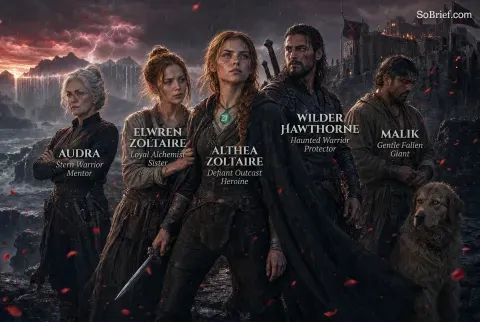
Thea
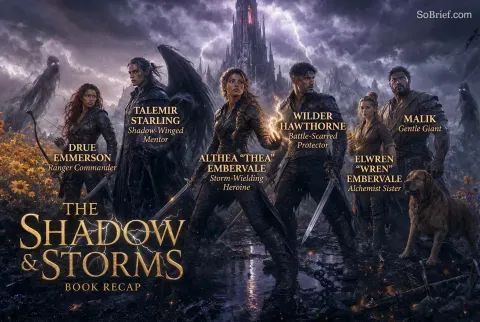
Vengeful warrior heirAlthea, called the Shadow of Death, is a relentless would-be Warsword and secret heir of fallen Delmira whose storm magic vanished after a devastating betrayal at Notos. Driven by grief disguised as fury, she channels heartbreak into a year-long manhunt, mistaking single-minded vengeance for duty. A fate stone marks her for death at twenty-seven, lending desperation to her ambition. Fiercely loyal to friends Cal5 and Kipp4, stubborn to a fault, and incapable of masking her feelings, she chants a mantra about strength of mind, body, and heart to hold her fracturing self together. Her arc traces the painful journey from certainty to humility, from solitary rage toward trust, sisterhood, and a love she once condemned2. Beneath armor and blades beats an aching, unhealed heart.
Wilder Hawthorne
Fallen Warsword loverWilder, the Hand of Death and now a hunted fallen Warsword, is a brooding, scarred swordsman who once mentored and loved Thea1 before vanishing at Notos. Outwardly arrogant and gruff, smelling perpetually of rosewood and leather, he hides a self-sacrificing tenderness and a bottomless capacity for guilt. He chose mortality over immortality long ago, unwilling to outlive everyone he loves, a decision that shapes his fatalism. Caught between loyalty to a corrupt guild and a dangerous truth he has slowly uncovered, he carries secrets to protect Thea1's future, even at the cost of her trust. His devotion expresses itself through protection and patience rather than possession. He fears happiness precisely because he finally has something to lose.
Anya
Feared Daughter of DarknessAnya Embervale is Thea1 and Wren8's long-lost eldest sister, a shaved-headed, scarred storm wielder with membranous wings, branded by the realms as the prophesied Daughter of Darkness. Hardened by a childhood stolen in shadow and a life spent rallying the persecuted shadow-touched, she is guarded, blunt, and slow to trust, having learned that trust costs survival. Beneath her granite exterior lies enormous grief for the family she lost and the years that were taken. She leads a rebellion with fierce pragmatism and dry humor, fury personified yet patient, embodying the prologue's warning. Reuniting with her sisters forces her to risk the tenderness she long buried, revealing a woman who fought monstrousness without becoming a monster.
Kipp
Witty loyal strategistKristopher, the Son of the Fox, is Thea1's auburn-haired companion, a self-described clever charmer with a sharp mind, a bottomless appetite, and an astonishing web of tavern connections across the realms. Beneath the jokes and incessant chatter lies fierce loyalty and quiet wisdom; he repeatedly nudges Thea1 toward truths she avoids. He values people over institutions and follows her, not the guild.
Cal
Steadfast flaming archerCallahan, the Flaming Arrow, is Thea1's grounded, dependable friend, a skilled archer with a soft heart and a dry, grumbling humor. Practical where Thea1 is reckless, he quietly preserves the discarded gift that changes everything, knowing her better than she knows herself. His loyalty is to Thea1 personally rather than to Thezmarr's antiquated laws.
Adrienne
Naarvian rebel generalAdrienne Ashford is the beautiful, blunt general of Naarva's guerrilla forces and Wilder2's former lover, now firm friend. Relentless, perceptive, and unbothered by his moods, she serves the Shadow Prince12 and the shadow-touched cause. Her generosity toward Thea1, sharing hard-won wisdom about loving a difficult man, dissolves jealousy into alliance.
Dratos
Roguish winged rangerDratos the Dawnless is a shadow-touched Naarvian ranger with red-and-black wings, bottle-green eyes, and a fondness for pipe smoke and provocation. Brash and theatrical, he masks deep loyalty to his cousin Gus15 and to Anya3's rebellion. He refuses to hide his nature for anyone's comfort, embodying defiant self-acceptance.
Wren
Brilliant alchemist sisterElwren is Thea1's younger sister, a gifted alchemist whose potions, poisons, and unbreakable manacles prove decisive. Intelligent and proud, she carries trauma from being held hostage by Anya3, making her slow to forgive. Increasingly respected and even feared, she represents knowledge as power, a counterweight to brute force.
Torj
Honorable Bear SlayerTorj Elderbrock, the Bear Slayer, is a golden-haired Warsword wielding a war hammer, loyal to friends above the corrupt guild. Wry and warm beneath his stoicism, he risks much to aid Wilder2 and counsels both lovers through fear. He becomes a crucial inside ally close to the enemy.
King Artos
Benevolent-seeming tyrantArtos Fairmoore, King of Harenth, presents himself as the realms' generous savior, funding Tver's rebuilding and championing Thea1's heroics. Charming, emerald-eyed, and effusive, he wields the most powerful empath magic in history, a gift that makes his warmth feel like an oily intrusion. His benevolence is performance; his patience is predatory. He embodies the terror of a ruler who manufactures the very fears he promises to vanquish, turning prophecy and propaganda into instruments of control while the realms thank him for it.
Malik
Wilder's wounded brotherMalik the Shieldbreaker, Wilder2's older brother, was once Thezmarr's strongest warrior before a reaper attack left him diminished, largely silent, and tremoring. Still an immovable, gentle presence accompanied by his dog Dax, he anchors Wilder2's deepest guilt and love. His mere arrival speaks volumes of devotion words cannot.
Talemir Starling
Legendary Prince of HeartsTalemir Starling, dual-wielding champion called the Prince of Hearts, is Wilder2's revered former mentor, spoken of throughout as legend. Charismatic and formidable, his fate is bound to the shadow-touched cause in ways that reframe the entire conflict. He arrives to change everything, a warrior whose history mirrors the betrayed and reborn.
Princess Jasira
Kind Harenth princessJasira of Harenth is a warm, open-hearted princess rescued by Thea1, who becomes an unexpected friend. Having loved and lost, she counsels Thea1 on guarded hearts. Her trusting tenderness and her bond to Artos10 create poignant tension once darker truths surface around her father10's court.
Audra
Sharp-tongued librarian keeperAudra, librarian of Thezmarr and Thea1's former warden, is a stern, knowing woman who carries dangerous secrets and ceremonial daggers she insists are merely decorative. She believes knowledge wielded well is the greatest power. Tougher than any interrogation, she quietly orchestrates alliances and guards the truth of the past.
Gus
Young shadow-touched rebelAngus Castemont, Dratos7's teenage cousin, is a knitting-obsessed shadow-touched youth with a quick temper and old wounds. His grief over how his kind were once treated voices the cost of the realms' cruelty.
The Furies
Immortal trial-keepersIseldra, Morwynn, and Valdara are the three original Warswords, goddesses who govern the Great Rite and the fate of warriors. Radiant, ancient, and rarely surprised, they test mind, body, and heart, and grant or withhold immortality according to the love within a candidate's heart.
Osiris
Corrupt guild masterOsiris, Guild Master of Thezmarr, dispatched Thea1 to bring Wilder2 to justice. A figure of authority whose complicity in old crimes runs deeper than anyone suspects, he represents the institutional rot the rebellion must cut out.
Plot Devices
The fate stone
Mortality countdown talismanA piece of jade Thea1 wears at her throat, the fate stone marks her destined death at twenty-seven and cannot be discarded; cast into the sea or a river, it always returns. It physicalizes the novel's tension between destiny and choice, lending urgency to Thea1's hunger to become a Warsword and perhaps cheat fate. It binds her timeline to a ticking clock that pressures every decision and saturates her romance with the ache of borrowed time. Wilder2 guards its secret as fiercely as she does, and the lovers come to call their fates entwined. Its meaning, and what the Furies16 reveal about why it cannot be escaped, deepens as the story closes.
The memory orb
Truth-revealing artifactA rare silver sphere from beyond the Veil, the memory orb stores the recorded experiences of past Warswords' Great Rites. Wilder2 leaves it as Thea1's name day gift, which she throws away in rage before Cal5 secretly recovers it. When she finally presses it, golden light unspools decades of trials and, devastatingly, footage of Wilder2 bartering across realms to recreate every challenge in her path. The device functions as the novel's great reframe, converting a year of apparent persecution into hidden mentorship and love. It dramatizes how the same events change meaning entirely depending on intent, dismantling Thea1's certainty and redirecting the plot from vengeance toward rescue.
Alchemy-treated manacles
Power-suppressing restraintsForged by Wren8 and treated with arachne venom alchemy, these unbreakable irons can hold even a Warsword by dampening Furies16-given strength. Thea1 uses them to capture Wilder2, and their repeated locking and unlocking choreographs the shifting power between captor and captive. Crucially, Wilder2 voluntarily re-chains himself more than once, transforming the restraints from a symbol of his subjugation into proof of his loyalty and choice. The same suppressive venom later resurfaces in a far more dangerous form, tying a small alchemical detail to a major plot consequence. The manacles thus track the relationship's evolving balance, from enmity to trust, while seeding the science behind a later crisis.
The Moonfire Eclipse
Prophecy-driven false hopeA once-in-a-century celestial event the rulers promote as the moment light will triumph over darkness, the Moonfire Eclipse draws the kingdoms to Vios in desperate hope. Tied to the prologue's prophecy, it functions as state propaganda, a manufactured salvation that rallies frightened people behind their leaders. The masquerade ball staged in its honor becomes the setpiece where masks, lies, and hidden agendas collide. When the eclipse arrives and the promised light never returns, the failure shatters official narratives and exposes the rulers' impotence, triggering the chaos that scatters the protagonists toward the truth. It embodies the book's interrogation of how prophecy is weaponized to control belief.
The Great Rite
Identity-forging trial gauntletThe sacred ordeal that transforms a Guardian into a Warsword, summoned by the Furies16 as an irresistible call. Its three trials test mind, body, and heart through a maze of mirrors, a lethal ice climb, and a frozen lake where loved ones are held hostage, time itself bending within. It demands brutal sacrifices and forces impossible choices, externalizing Thea1's deepest fears and her struggle to integrate her fractured selves. The reward is a blade of Naarvian steel, a Warsword totem, and an audience with the Furies16. Long foreshadowed by Thea1's lifelong ambition, the memory orb, and her mantra, the Rite serves as the novel's climactic crucible of self-acceptance.
FAQ
Synopsis & Basic Details
What is Fate & Furies about?
- A Quest for Vengeance: The story follows Althea Zoltaire, known as the Shadow of Death, as she relentlessly hunts Wilder Hawthorne, a fallen Warsword, for his betrayal.
- A World in Peril: The midrealms are plagued by a growing darkness, with monsters and wraiths emerging through tears in the Veil, threatening the fragile peace.
- A Battle of Identities: Thea grapples with her own identity, her lost magic, and her connection to a prophecy that casts her as a bringer of destruction.
Why should I read Fate & Furies?
- Complex Characters: The novel features morally grey characters with deep emotional conflicts, making their choices and motivations compelling.
- Intricate Plot: The story weaves together elements of political intrigue, personal betrayal, and supernatural threats, creating a rich and engaging narrative.
- High-Stakes Action: The book is filled with intense battles, dangerous quests, and high-stakes decisions that keep the reader on the edge of their seat.
What is the background of Fate & Furies?
- Fantasy Setting: The story is set in a world of three kingdoms, Thezmarr, Aveum, and Harenth, each with its own unique culture and history, all threatened by a growing darkness.
- Magical Elements: The midrealms are infused with magic, including storm magic, shadow magic, and alchemy, which play a significant role in the plot and character development.
- Prophecy and Fate: The narrative is driven by a prophecy that foretells the rise of a "Daughter of Darkness," adding a layer of destiny and inevitability to the characters' actions.
What are the most memorable quotes in Fate & Furies?
- "Beware the fury of a patient Delmirian woman.": This quote foreshadows the power and determination of the Delmirian women, particularly Anya and Thea, and their role in the unfolding events.
- "This thing between us is endless. Nothing will stop me loving you.": This quote highlights the intense and complex relationship between Thea and Wilder, a bond that transcends betrayal and separation.
- "I am the storm.": This quote encapsulates Thea's identity as a powerful storm wielder, a force of nature capable of both destruction and protection.
What writing style, narrative choices, and literary techniques does Helen Scheuerer use?
- Dual Perspectives: The narrative shifts between Thea's and Wilder's perspectives, providing insight into their conflicting motivations and emotional states.
- Foreshadowing and Symbolism: Scheuerer uses subtle foreshadowing and recurring symbols, such as the fate stone and the color black, to create a sense of impending doom and thematic depth.
- Action-Oriented Prose: The writing style is fast-paced and action-oriented, with vivid descriptions of battles and magical encounters, keeping the reader engaged.
Hidden Details & Subtle Connections
What are some minor details that add significant meaning?
- The Peppermint Tea: Wilder's tin of peppermint tea in Thea's saddlebag serves as a constant reminder of their past relationship, highlighting the lingering emotions beneath her anger.
- The Sapphire: The sapphire Thea takes from Hawthorne's effects, belonging to a former lover, foreshadows the complex relationships and betrayals that will unfold.
- The Meditation Cards: Audra's meditation cards, particularly the one that reads "strong of mind, strong of body, strong of heart," reveal Thea's internal struggle and her attempts to regain her lost magic.
What are some subtle foreshadowing and callbacks?
- The Seer's Words: The seer's words, "Remember me," and the jade stone she gives Thea, foreshadow the importance of memory and identity in the story, and the connection to the past.
- The Thundersnow: The mention of a thundersnow, a rare weather event, foreshadows the return of Thea's magic and her role as a powerful storm wielder.
- The Manacles: The manacles Wren creates for Thea, treated with alchemy to suppress a Warsword's power, foreshadow the suppression of Thea's own magic and the lengths she will go to capture Wilder.
What are some unexpected character connections?
- Kipp and Wren: The subtle hints of a connection between Kipp and Wren, Thea's sister, add a layer of complexity to the relationships and suggest a potential future alliance.
- Adrienne and Wilder: The reveal of Adrienne as Wilder's former lover adds a layer of complexity to his character and his past, and highlights the shared history between the two.
- Audra and Anya: The connection between Audra and Anya, revealed through their shared history and knowledge of the past, adds depth to the characters and their motivations.
Who are the most significant supporting characters?
- Torj Elderbrock: As a fellow Warsword, Torj's presence highlights the complexities of loyalty and duty, and his interactions with Wilder and Thea reveal the internal conflicts within the guild.
- Adrienne Ashford: As a general of the Naarvian guerrilla forces, Adrienne's role in the rebellion and her connection to Wilder add a layer of political intrigue and strategic planning to the story.
- Malik Hawthorne: Wilder's brother, though injured, serves as a reminder of the personal stakes involved in the conflict and the impact of the darkness on those closest to the main characters.
Psychological, Emotional, & Relational Analysis
What are some unspoken motivations of the characters?
- Wilder's Self-Sacrifice: Wilder's actions are driven by a desire to protect Thea and the midrealms, even if it means sacrificing his own reputation and freedom.
- Thea's Fear of Loss: Thea's relentless pursuit of Wilder is fueled by a fear of losing control and a deep-seated sorrow over the betrayal of someone she loved.
- Anya's Desire for Acceptance: Anya's actions are driven by a desire to be accepted and understood, to prove that she is not the monster she is perceived to be.
What psychological complexities do the characters exhibit?
- Thea's Internal Conflict: Thea struggles with her identity, torn between her duty as a Guardian and her desire for vengeance, and her love for Wilder.
- Wilder's Guilt and Redemption: Wilder grapples with the guilt of his past actions and seeks redemption through his efforts to protect the midrealms and Thea.
- Anya's Trauma and Isolation: Anya's past trauma and isolation have shaped her into a complex and guarded character, struggling to trust and connect with others.
What are the major emotional turning points?
- The Discovery of the Gift: Thea's discovery of Wilder's name day gift, a taunt disguised as a present, intensifies her anger and fuels her determination to capture him.
- The Loss of Magic: Thea's realization that her magic is gone creates a sense of vulnerability and loss, forcing her to rely on her physical strength and skill.
- The Reunion with Wilder: Thea's reunion with Wilder at the fishing village, and the subsequent battle, forces her to confront her feelings for him and the complexities of their relationship.
How do relationship dynamics evolve?
- Thea and Wilder's Shifting Power: The power dynamic between Thea and Wilder shifts throughout the story, as they grapple with their past and their present roles.
- Thea and Anya's Sisterhood: The relationship between Thea and Anya evolves from one of suspicion and animosity to one of understanding and acceptance, as they discover their shared history and destiny.
- Thea, Cal, and Kipp's Loyalty: The bond between Thea, Cal, and Kipp is tested by the challenges they face, but their loyalty to one another remains unwavering, a source of strength amid the chaos.
Interpretation & Debate
Which parts of the story remain ambiguous or open-ended?
- The True Nature of the Furies: The Furies' motivations and their role in the events of the story remain ambiguous, leaving the reader to question their true intentions.
- The Extent of Artos' Power: The full extent of King Artos' power and influence is not fully revealed, leaving the reader to wonder about the true scope of his control over the midrealms.
- The Fate of the Midrealms: The ending leaves the fate of the midrealms uncertain, with the war against the darkness still looming, and the future of the kingdoms hanging in the balance.
What are some debatable, controversial scenes or moments in Fate & Furies?
- Wilder's Betrayal: Wilder's actions at Notos, freeing the half-wraiths and aligning with the Daughter of Darkness, are open to interpretation, with readers debating his true motives and whether his actions were justified.
- Thea's Treatment of Wilder: Thea's harsh treatment of Wilder, despite her lingering feelings for him, raises questions about the nature of forgiveness and the complexities of love and betrayal.
- The Morality of the Shadow-Touched: The portrayal of the shadow-touched as both victims and potential threats raises questions about the nature of good and evil, and the complexities of prejudice and acceptance.
Fate & Furies Ending Explained: How It Ends & What It Means
- Thea's Choice: Thea's choice to embrace both her storm magic and her Warsword identity signifies a rejection of the limitations imposed upon her by fate and a reclamation of her own power.
- The Great Rite's True Purpose: The Great Rite is revealed to be a test of self-acceptance and the ability to embrace one's true nature, rather than a rigid set of rules and traditions.
- The Unfolding War: The ending sets the stage for a larger conflict, with the midrealms facing a greater threat than ever before, and the characters' fates intertwined in the battle against darkness.
The Legends of Thezmarr Series
About the Author
Other books by Helen Scheuerer

Download PDF
Download EPUB
.epub digital book format is ideal for reading ebooks on phones, tablets, and e-readers.








































