

Key Takeaways
Chasing the orgasm is exactly what prevents it
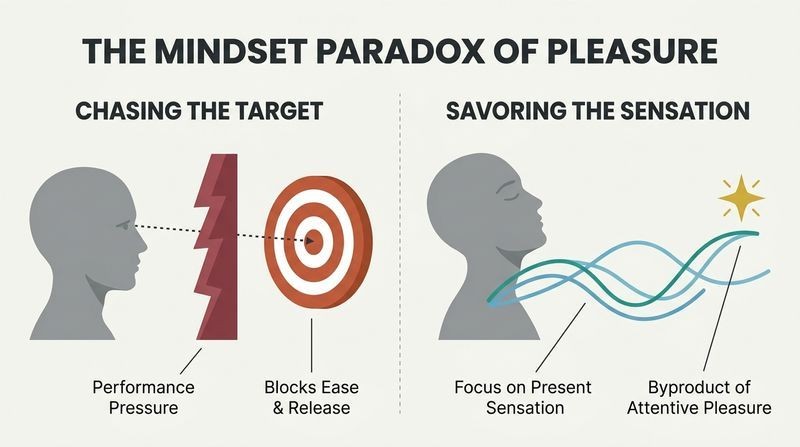
The mindset paradox sits at the core. Jenkins argues that walking into the bedroom determined to "give" an orgasm loads both partners with performance pressure, and that pressure breeds the anxiety that blocks release. He compares it to an athlete choking under a roaring crowd: too much conscious striving diverts focus from the act itself and produces failure.
The fix is a deliberate reframe. Stop treating orgasm as a target to hit and treat it as a byproduct of sustained, attentive pleasure. Focus on how she feels moment to moment, and the release arrives on its own. Repeated failed attempts, he warns, anchor disappointment to intimacy itself, compounding "performance anxiety" into future encounters and turning sex into a dreaded chore rather than a pleasure.
What's striking is how neatly this mirrors modern clinical sex therapy. Masters and Johnson pioneered "sensate focus," an exercise banning intercourse and orgasm precisely so couples rediscover touch without goal-anxiety. The mechanism is real: the sympathetic nervous system's fight-or-flight arousal (from pressure) directly antagonizes the parasympathetic state required for genital engorgement and release. Psychologists call this "spectatoring," monitoring your own performance instead of inhabiting the experience. The paradox generalizes far beyond sex: sleep, creativity, and flow states all collapse under forced effort. Jenkins arrives at a genuinely sound principle, even if his framing as a bedroom "strategy" ironically risks reintroducing the very goal-orientation he warns against.
Men sprint, women climb; pace to her arousal curve
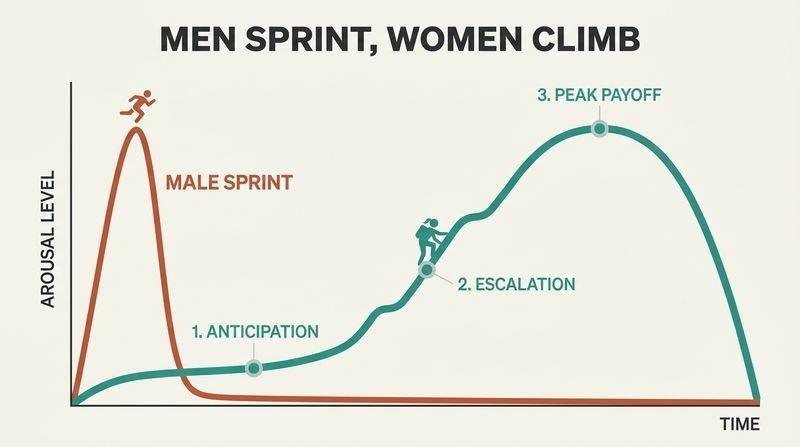
Escalation is a female requirement, not a preference. Jenkins stresses that men typically need only arousal and stimulation to finish quickly, while women require a gradual ramp through distinct stages of intensity. Rushing straight to genital contact, which works fine for men, leaves a woman physically unready and short-circuits the whole process.
Anticipation multiplies everything. He frames teasing as a tension-building tool: rub the inner thighs, hips, and buttocks before ever touching the genitals, so desire and sexual tension accumulate until they demand release. The catch is self-control. As you build her anticipation you build your own, and the man's job is to hold pace rather than jump ahead. Slower approach, bigger payoff.
The physiology backs the timing gap. Studies of arousal consistently show women take roughly 10 to 20 minutes of stimulation to reach the arousal plateau men can hit in a couple of minutes, which is why foreplay is not optional garnish but the main structural event. Anthropologist Helen Fisher and others note this asymmetry likely reflects different evolutionary reproductive stakes. One caveat: framing all women as slow-burning and all men as instant is a statistical average, not a law. Individual variation is enormous, and some women arouse faster than their partners. The actionable core, match her curve rather than yours, remains excellent advice precisely because most men default to their own tempo.
A tense woman cannot climax, so eliminate stress first
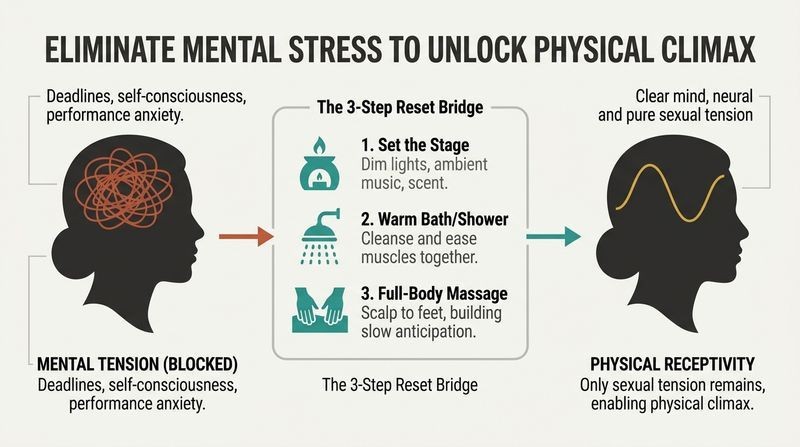
Relaxation is a physiological precondition. Jenkins insists that a mind occupied by work deadlines, body self-consciousness, or the pressure to perform keeps the body too tense to release. The only tension that should remain is sexual tension. His three-step relaxation formula:
1. Set the stage (dim lighting, ambient music, a signature scent).
2. Shower or bath together, both to relax and to ensure cleanliness.
3. A full-body massage, working from scalp to feet, teasing near the genitals without touching them.
Scent becomes a trained trigger. He suggests using one fragrance exclusively during sex so it builds a "scent memory," eventually firing arousal on its own. Massage doubles as both relaxation and slow-burn anticipation, blurring the line between calming her down and turning her on.
The scent-conditioning idea is textbook Pavlovian association, and olfaction is uniquely suited to it: smell is the only sense wired directly into the limbic system, bypassing the thalamus, which is why odors trigger emotion and memory faster than any other cue. The relaxation emphasis aligns with research showing that parasympathetic dominance enables clitoral and vaginal engorgement. Emily Nagoski's "dual control model" reframes this precisely: arousal depends as much on removing brakes (stress, distraction, self-judgment) as on hitting accelerators. Jenkins intuits the brakes concept without the vocabulary. The massage sequence is also smart applied psychology, converting abstract "relax" instructions into concrete, sequential actions a nervous partner can actually follow.
The clitoris and G-spot are one connected organ
Most of the clitoris is hidden inside. Jenkins explains that the visible glans is a fraction of the structure. The clitoral shaft extends internally and splits into two legs (the crura) that straddle the vaginal opening, and crucially the internal clitoris wraps around the urethra. The organ carries over 8,000 nerve endings and exists solely for pleasure, with no reproductive function.
This anatomy explains "vaginal" orgasms. Because the G-spot (a spongy patch about one and a half to two inches up the front vaginal wall) sits against the internal clitoris, stimulating it is really stimulating clitoral tissue from inside. He also notes the vagina's nerves cluster in the outer third near the entrance, meaning the deep two-thirds feel mostly pressure. Practical upshot: penis length matters far less than men fear.
The unified-clitoris model is genuinely accurate and remarkably ahead of popular understanding for a 2011 guide. Urologist Helen O'Connell's MRI studies in the late 1990s and 2000s revealed the clitoris as a large internal structure, dissolving the old Freudian war between "clitoral" and "vaginal" orgasms as separate, hierarchically ranked events. Jenkins correctly reframes them as different access points to the same nerve network. The 8,000-nerve-ending figure is widely cited though its original measurement was in cattle, not humans, and recent 2022 research revised the human count upward to roughly 10,000. The reassurance about size is well-founded and echoes decades of survey data.
Give three orgasms before you take one: the "3 Before Me" rule
Generosity is strategic, not just kind. Jenkins' "3 Before Me" rule says the man should deliver three orgasms before receiving any pleasure himself, sequenced deliberately:
1. Clitoral (via oral) first, because the clitoris is most responsive and "primes" the G-spot.
2. G-spot (via fingers) second, felt as deeper with more involuntary contractions.
3. Blended third, combining tongue on clitoris and fingers on G-spot for the most intense release.
He grounds it in reciprocity. Because women lack the male refractory period (the mandatory cooldown after male orgasm), they can chain orgasms back-to-back. He argues that a satisfied partner reciprocates far more enthusiastically, and that once she has climaxed repeatedly, the man's own staying power becomes almost irrelevant. The number three is a guideline, not gospel; the principle is her satisfaction precedes his.
The refractory-period asymmetry is real and understudied; prolactin release after male orgasm suppresses further arousal, while women lack that hard reset, making multiple orgasms physiologically available to many. The reciprocity logic borrows loosely from Cialdini's norm of reciprocity, though framing pleasure as a transactional "deposit" you expect returned sits uneasily with the book's own earlier plea to abandon goal-chasing. A subtler risk: the rigid three-orgasm quota can itself become a performance metric that pressures a partner who does not orgasm easily or does not want multiples. The durable insight is the sequencing and the ethic of prioritizing her arousal, not the arithmetic.
At the brink, freeze your technique; do not improvise
The most common failure is changing what works. Jenkins identifies the "pre-orgasm" as the moment most couples blow it. As she nears climax, partners instinctively speed up, slow down, switch positions, or stop, and the fragile buildup collapses. His rule is blunt: whatever rhythm, pressure, and location are working, maintain them exactly, even if she squirms or asks you to move.
Use her body as feedback. His "Secret Twitch Method" has the man keep fingers resting on the G-spot to feel for involuntary vaginal contractions, using them as a live gauge to calibrate the ideal tongue spot, pressure, and speed. Once the contractions intensify and grip harder, hold steady through the squirming. He also checks that she keeps breathing, since holding her breath inadvertently traps the orgasm.
The "don't change what works" principle reflects a real feature of orgasmic response: the climb requires consistent, rhythmic, escalating stimulation, and novelty at the threshold resets the nervous system's accumulation toward the reflex. The Secret Twitch idea is essentially biofeedback, treating involuntary muscle contraction as an honest signal that verbal cues may not provide, especially with partners who go quiet or inhibited. The breathing note is underrated: breath-holding activates the Valsalva response and muscular bracing that can suppress release, which is why many sex educators coach rhythmic breathing. The one tension is autonomy: "don't let her move" language should mean maintaining stimulation, never overriding genuine withdrawal of consent.
Female ejaculation is real, and the fear of peeing blocks it
The urge to urinate is a false alarm. Jenkins explains that G-spot stimulation activates the Skene's glands (the "female prostate" or para-urethral glands), which can release a clear fluid chemically distinct from urine. The problem is that swelling near the urethra makes many women feel they need to pee, and terror of wetting the bed pulls them out of arousal and into anxiety, killing the orgasm.
Solve it through preparation and permission. Have her urinate beforehand so the bladder worry is gone, lay down towels, and reassure her that letting go is safe. He offers a conditioning trick: building comfort so she can relax and "let go" in the partner's presence, pairing reassurance with the sensation until inhibition dissolves. The recurring theme: she cannot release what she is clenching to hold back.
The science here is partly settled, partly contested. Skene's glands do produce a PSA-containing fluid analogous to prostatic secretion, confirmed in lab analysis. However, research (notably Salama et al., 2015) found that large-volume "squirting" is mostly dilute urine expelled from the bladder, while true female ejaculate is a smaller milky secretion. So Jenkins overstates the "definitely not urine" claim; the reality is a mix. His psychological point stands firmly, though: sphincter clenching driven by shame is a documented orgasm inhibitor, and normalizing the sensation removes the brake. The conditioning language edges toward the paternalistic, but the underlying safety-and-permission dynamic is sound therapeutic ground.
What you do after sex determines whether there's a next time
The Reflection phase is core curriculum, not optional. Jenkins argues that many men obsess over the performance scorecard and then roll over to sleep or hop up to "seize the day," which he ranks as the two worst post-sex moves. To a woman, the minutes after orgasm reveal whether you are considerate or just a self-interested "booty call."
After-play compounds desire. He frames roughly fifteen minutes of cuddling, kissing, and talking as deposits into a "Desire account." Because the satisfaction of one encounter feeds directly into the seduction phase of the next, warm aftercare makes her more attracted, more likely to initiate, and eager for a repeat. Oxytocin, the "cuddling hormone" released during intimacy, drives bonding and connection, so the afterglow is where emotional attachment gets cemented.
The oxytocin claim is well-supported: the hormone surges during orgasm and physical closeness, promoting pair-bonding, trust, and stress reduction, and post-coital affection predicts relationship and sexual satisfaction in longitudinal studies (for example, Muise et al., 2014, found afterglow lingers for days and forecasts relationship quality). Framing aftercare as an investment with compounding returns is behaviorally astute, since intimate memory shapes future desire. The mild irony is the transactional "deposit" metaphor again; the most bonded couples cuddle because they want to, not to bank credit. Still, for men who treat sex as a discrete event that ends at climax, reframing it as a cycle that loops through connection is genuinely useful.
Master the strategy first, then swap techniques like Lego bricks
Strategy beats tactics. Jenkins separates the whole experience into strategy (the mindset and overall framework) and tactics (specific how-to techniques), insisting the strategy unlocks the techniques rather than the reverse. His "Female Orgasm Blueprint," adapted from Whipple and Brash-McGreer's circular model of female sexual response, maps four phases: Seduction, Sensations, Surrender, and Reflection, spanning five stages from Desire through Resolution.
The framework is modular. He compares it to a workout with a fixed warm-up, main set, and cooldown structure where only the specific exercises change. Once you internalize the sequence (create desire, relax and arouse, escalate to plateau, trigger orgasm, then reinforce), you can "plug and play" any technique into each slot, keeping every encounter fresh while the underlying architecture stays constant.
Elevating strategy over technique is the book's most transferable idea, applicable to cooking, negotiation, or teaching: memorize a robust structure and improvise the details. Basing the model on Beverly Whipple's peer-reviewed circular model lends real credibility, and Jenkins' honest admission that he borrowed the outline is refreshing in a genre thick with invented pseudoscience. The circular framing (satisfaction feeds the next encounter's desire) captures something linear models like Masters and Johnson's original miss. The limitation is that any rigid blueprint risks mechanizing intimacy into a checklist, which can reintroduce the spectatoring the book warns against. Frameworks are scaffolding, best discarded once fluency arrives, like training wheels.
Spot a faked orgasm by the body, not the soundtrack
Volume is the tell of the fake. Jenkins claims that women who fake tend to be loud and theatrical, echoing porn, producing crisp, clearly enunciated exclamations rather than the broken, trembling, involuntary sounds of genuine release. He argues that vocal performance is the easiest part to counterfeit and therefore the least reliable signal.
The body is nearly impossible to fake. Authentic orgasm produces a cluster of involuntary signs:
1. Rhythmic vaginal contractions roughly every 0.8 seconds.
2. Anal contractions.
3. The reddish "sex flush" across skin.
4. Pupil dilation.
5. Full-body muscle spasms, sweating, and a genuinely shaking voice.
He contends that while any single sign can be mimicked, faking the entire physiological cascade simultaneously is essentially impossible.
The 0.8-second contraction interval traces directly to Masters and Johnson's lab measurements, so the anatomy is sound. The behavioral inference is shakier. Research suggests faking is common (surveys put it well above half of women at some point) and often motivated by kindness or wanting to end sex, not deception for its own sake. Treating orgasm as something to forensically verify sits in tension with the book's own relaxation-and-trust ethos; surveillance breeds exactly the anxiety that suppresses genuine response. The physiological literacy is valuable for attunement, reading a partner's real state, but weaponized as a lie-detector it corrodes the safety that authentic pleasure requires. Attunement, not interrogation, is the useful frame.
Analysis
This is a 2011 direct-to-consumer instructional manual, part sex-education primer and part affiliate-marketing funnel (note the repeated product links to dating programs, condoms, and desensitizing sprays). Its structure is framework-based: a six-key strategy section, an anatomy lesson, a four-phase blueprint, and step-by-step technique routines graded beginner to advanced. The audience is explicitly heterosexual men in relationships. What makes it hard to summarize is separating the durable, evidence-consistent physiology from the dated marketing hype, folk statistics, and heteronormative framing.
Judged charitably, the book's spine is more legitimate than its packaging suggests. Its best ideas, that goal-chasing sabotages arousal, that relaxation is a physiological gate, that the clitoris is a large internal organ unifying so-called clitoral and vaginal orgasms, and that aftercare feeds future desire, align with mainstream sexology from Masters and Johnson through Beverly Whipple to Emily Nagoski. Jenkins deserves credit for building on a peer-reviewed model (Whipple and Brash-McGreer) and for anatomical accuracy unusual in popular guides of its era.
The weaknesses are equally clear. Fabricated-sounding statistics (70% of women have never climaxed with a man, fewer than 1% of men can find a G-spot) are presented without sourcing. The squirting-is-not-urine claim overreaches the science. The transactional metaphors (a "Desire account," reciprocity quotas) sit awkwardly against the book's own anti-pressure philosophy, and the highly scripted routines risk mechanizing intimacy into the spectatoring it warns against. The framing treats female pleasure as a technical problem for a male operator to solve, which underplays mutuality, communication, and the woman's own agency and self-knowledge.
The honest verdict: strip away the salesmanship and the swagger, and a reader is left with a functional, physiologically literate scaffold for attentive, patient, communication-driven sex. The strategy-over-tactics principle, the relaxation emphasis, and the reframe of orgasm as byproduct rather than target are the lasting value; the checklists and folk numbers are disposable.
Review Summary
Female Orgasm Black Book receives generally positive reviews, with an overall rating of 3.90 out of 5 based on 121 reviews. Many readers find it to be an excellent and helpful resource, praising its straightforward explanations and numerous drawings. Some reviewers describe it as one of the best books on the topic, appreciating its concise approach without unnecessary embellishments. The book is particularly valued for its visual aids, which some readers prefer over photographs. While most reviews are highly positive, there are a few brief, less enthusiastic responses as well.
People Also Read

Glossary
Female Orgasm Blueprint
Four-phase sexual response frameworkJenkins' adaptation of Whipple and Brash-McGreer's circular model of female sexual response into a practical map with four phases (Seduction, Sensations, Surrender, Reflection) and five stages (Desire, Excitement, Plateau, Orgasm, Resolution). It functions as a fixed strategic structure into which specific techniques can be substituted, with each encounter's satisfaction feeding desire for the next.
3 Before Me Rule
Give three orgasms before receivingThe guideline that the man should bring his partner to three orgasms (clitoral, then G-spot, then blended) before receiving any sexual pleasure himself. Rationale: it primes her body, exploits women's lack of a refractory period, invokes reciprocity, and makes the man's own staying power largely irrelevant. The number is flexible; the principle is her satisfaction first.
Secret Twitch Method
Using vaginal contractions as feedbackA calibration technique where the man rests fingers on the G-spot to feel involuntary vaginal contractions, using them as a live signal to identify the optimal clitoral spot, tongue pressure, and licking speed. Once the effective combination is found, he holds it exactly constant through the approach to orgasm rather than changing anything.
Blended Orgasm
Simultaneous clitoral and G-spot climaxThe third and most intense orgasm in Jenkins' sequence, produced by combining oral stimulation of the clitoris with finger stimulation of the G-spot at the same time. Because the partner has already climaxed twice, it typically arrives quickly and is the orgasm most likely to trigger female ejaculation.
The Oxytocin Factor
Bonding hormone driving desireJenkins' term for oxytocin's role in female sexual response. Secreted by the pituitary gland, it drives the muscle contractions of orgasm, intensifies pleasure, and (as the "cuddling hormone") generates emotional bonding and intimacy. He argues cultivating its release through aftercare deepens attachment and increases a partner's future desire.
Reflection Phase
Post-orgasm bonding that fuels desireThe final phase of the Blueprint, covering the roughly fifteen minutes after sex. Jenkins frames attentive after-play (cuddling, talking, kissing) as deposits into a "Desire account" because the emotional satisfaction of one encounter loops back to become the seduction phase of the next, making the partner more attracted and eager to repeat.
FAQ
What’s "Female Orgasm Black Book" by Lee Jenkins about?
- Comprehensive Orgasm Guide: The book is a practical, step-by-step manual focused on helping men (and couples) understand and reliably give women orgasms.
- Strategy and Tactics: It covers both the mindset (strategy) and specific sexual techniques (tactics) necessary for female sexual satisfaction.
- Blueprint for Success: Jenkins introduces a four-phase "Female Orgasm Blueprint" that guides readers from seduction to aftercare.
- Educational and Actionable: The book is designed to fill the gaps left by poor sex education, offering checklists, routines, and detailed anatomical explanations.
Why should I read "Female Orgasm Black Book" by Lee Jenkins?
- Addressing Common Frustrations: The book tackles the widespread issue of women not experiencing orgasms during sex, which often leads to dissatisfaction in relationships.
- Practical, No-Nonsense Advice: Jenkins provides clear, actionable steps rather than vague or theoretical advice, making it easy to implement.
- Improved Relationships: By following the advice, readers can expect more fulfilling sex lives, increased intimacy, and happier partners.
- Unique Focus: Unlike many sex guides, it emphasizes both emotional and physical aspects, including communication, relaxation, and aftercare.
What are the key takeaways from "Female Orgasm Black Book" by Lee Jenkins?
- Mindset Matters Most: Focusing on pleasure and process, not just the goal of orgasm, is crucial for success.
- Communication is Essential: Open, honest communication—both verbal and non-verbal—is necessary to discover what works for each woman.
- Step-by-Step Blueprint: The four-phase system (Seduction, Sensation, Surrender, Reflection) provides a repeatable structure for sexual encounters.
- Techniques and Routines: The book offers beginner to advanced routines, including specific massage, oral, and fingering techniques for different types of orgasms.
What are the most surprising statistics or facts in "Female Orgasm Black Book" by Lee Jenkins?
- Orgasm Gap: 70% of women have never had an orgasm with a man, highlighting a major issue in sexual satisfaction.
- Faking Orgasms: 92% of women have faked orgasms to "get it over with," indicating a lack of genuine pleasure.
- Sexual Disinterest: Nearly 50% of men have partners who never ask for sex, often because sex isn’t pleasurable for them.
- Education Deficit: Most men’s sex education comes from unreliable sources like friends, porn, or inadequate school programs.
What is the "Female Orgasm Blueprint" in "Female Orgasm Black Book" by Lee Jenkins?
- Four Phases: The blueprint consists of Seduction (Desire), Sensation (Excitement & Plateau), Surrender (Orgasm), and Reflection (Resolution).
- Circular Model: Inspired by Dr. Beverly Whipple’s circular model, it emphasizes that satisfaction in one encounter leads to desire in the next.
- Step-by-Step Progression: Each phase has specific goals and techniques, from building anticipation to aftercare.
- Multiple Orgasms: The system is designed to facilitate not just one, but multiple orgasms for women.
What are the most important mindset shifts recommended in "Female Orgasm Black Book" by Lee Jenkins?
- Focus on Pleasure, Not Orgasm: Shifting from a goal-oriented approach to enjoying the process reduces pressure and increases success.
- Give Before You Receive: Prioritizing your partner’s pleasure first leads to better reciprocation and satisfaction.
- Relaxation is Key: Helping your partner relax—physically and mentally—is essential for her to experience orgasm.
- Letting Go of Performance Anxiety: Both partners should release expectations and focus on connection and enjoyment.
How does "Female Orgasm Black Book" by Lee Jenkins explain female sexual anatomy and erogenous zones?
- Detailed Anatomy Lessons: The book covers both external (clitoris, labia, mons pubis) and internal (vagina, G-spot, A-spot, urethral sponge) anatomy.
- Clitoris as Central: Emphasizes the clitoris as the primary organ for female pleasure, with over 8,000 nerve endings.
- G-Spot and Beyond: Explains how to locate and stimulate the G-spot and A-spot for deeper orgasms and even female ejaculation.
- Other Erogenous Zones: Highlights the importance of stimulating areas like the neck, ears, breasts, scalp, and more for full-body arousal.
What are the main techniques and routines for giving orgasms in "Female Orgasm Black Book" by Lee Jenkins?
- Beginner to Advanced Routines: The book provides structured routines, each with specific steps for massage, oral sex, fingering, and blended techniques.
- Clitoral, G-Spot, and Blended Orgasms: Techniques are tailored to achieve different types of orgasms, starting with clitoral, then G-spot, and finally blended (simultaneous) orgasms.
- Stepwise Escalation: Each routine follows the blueprint’s phases, ensuring proper buildup, stimulation, and aftercare.
- Customizable Templates: Readers are encouraged to mix and match techniques to suit their partner’s preferences.
How does "Female Orgasm Black Book" by Lee Jenkins address communication and feedback during sex?
- Open Dialogue: Encourages both partners to discuss likes, dislikes, and fantasies openly before and during sex.
- Verbal and Non-Verbal Cues: Suggests using hand squeezes, body language, and moans as feedback if verbal communication is difficult.
- Continuous Feedback Loop: Stresses the importance of checking in and adjusting techniques based on real-time responses.
- Teamwork Approach: Recommends involving your partner in the learning process for mutual growth and satisfaction.
What advice does "Female Orgasm Black Book" by Lee Jenkins give for overcoming common obstacles to female orgasm?
- Relaxation Techniques: Recommends massages, baths, and creating a sensual environment to reduce stress and anxiety.
- Addressing Inhibitions: Offers tips for women to let go of shame, body image issues, and fear of "letting go."
- Handling Performance Pressure: Advises against focusing on orgasm as a goal, which can create anxiety and inhibit pleasure.
- Female Ejaculation Concerns: Provides reassurance and practical steps for women worried about urination during G-spot stimulation.
How can you tell if a woman is faking an orgasm, according to "Female Orgasm Black Book" by Lee Jenkins?
- Physical Signs: Real orgasms involve involuntary vaginal and anal contractions, a "sex flush," dilated pupils, and sometimes sweating.
- Vocal Cues: Faked orgasms often sound theatrical and lack the shaky, uncontrolled voice typical of real climax.
- Body Language: During a real orgasm, a woman may lose control, arch her back, and display full-body spasms.
- Consistency of Signs: The combination of all physical and vocal indicators is hard to fake simultaneously.
What are the best quotes from "Female Orgasm Black Book" by Lee Jenkins and what do they mean?
- "If you want to give an orgasm, you have to NOT focus on the orgasm!" – Emphasizes the importance of enjoying the process rather than obsessing over the end goal.
- "The female sexual organs comprise one of the most intricate and sensitive nerve networks in the universe, and it’s yours for the discovering." – Highlights the complexity and potential of female pleasure.
- "Make a solid commitment to not only read this book, but to put the principles I share with you into practice in your every day sex life." – Stresses that knowledge alone isn’t enough; action is required for results.
- "The better she feels about her sexual experience with you this time, will create more desire to be with you next time." – Underlines the cyclical nature of sexual satisfaction and desire in relationships.
Download PDF
Download EPUB
.epub digital book format is ideal for reading ebooks on phones, tablets, and e-readers.








































