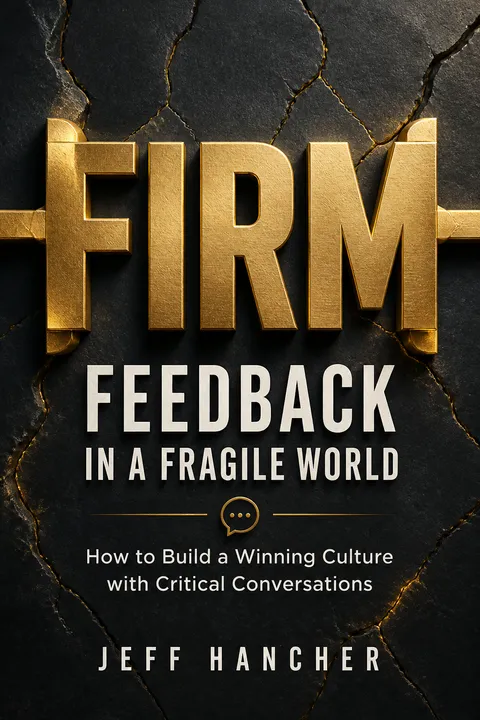
Key Takeaways
1. Feedback is neutral data, not a personal attack
To put it simply, feedback is the process where information (data) is given and received with the intent of modifying or reinforcing the next action.
Feedback is morally neutral. It is merely information returned to guide future behavior, yet leaders and employees often wrap it in intense emotional anxiety. When delivered objectively, it acts as a diagnostic tool rather than a personal judgment, allowing teams to pivot without feeling defensive.
Avoid emotional labeling. Emotional leaders often default to extreme generalizations like "you always" or "you never," which immediately trigger the brain's evolutionary fight-or-flight response. Instead, leaders must separate the person from the performance by focusing strictly on objective facts.
Ditch the feedback sandwich. This common management tactic—sandwiching a correction between two compliments—is manipulative and conditions employees to dread praise. To build a healthy culture, keep positive feedback purely reinforcing and negative feedback clearly redirecting:
- Let your positives stand alone to build genuine confidence.
- Deliver redirecting feedback directly to maintain clarity.
- Avoid conditioning your team to brace for the "other shoe to drop."
2. Leaders must earn the right to give feedback by making relational deposits
You have to make deposits in order to make withdrawals.
The relational bank account. Leaders cannot expect employees to accept tough, redirecting feedback if they only interact during moments of failure. Every supportive conversation, expression of gratitude, and inquiry into an employee's well-being acts as a deposit that builds trust.
Catch people doing right. Leaders are naturally hardwired to spot and fix problems, which often causes them to ignore daily successes. To combat this bias, use the "three coins" exercise to build a daily habit of positive reinforcement:
- Place three coins in your right pocket every morning.
- Move one coin to your left pocket each time you praise an employee's good work.
- Do not end your day until all three coins have been moved.
Invest in personal goals. True leadership extends beyond professional output to understanding what motivates your employees in their personal lives. By aligning their daily work with personal dreams—like saving for a family trip to Disney World—you transform feedback from a corporate demand into a tool for personal fulfillment.
3. Assertive feedback balances high standards with deep personal care
That’s how leaders offer feedback: velvet on the outside (grace, warmth, and belief), brick on the inside (candor, principled, and truthful).
The velvet-covered brick. Effective feedback requires a delicate balance of emotional security and structural backbone. Leaders must avoid the extremes of passivity, which sacrifices standards for artificial harmony, and aggression, which destroys morale for short-term compliance.
The four feedback styles. Understanding your inherited feedback style is crucial for adapting your approach to different individuals:
- Passive: Avoids conflict, walks on eggshells, and blindsides employees during annual reviews.
- Aggressive: Relies on title authority, micromanages, and eventually drives top talent away.
- Passive-Aggressive: Uses sarcasm or exclusion to signal displeasure without holding direct conversations.
- Assertive: Sets clear expectations, builds deep relationships, and holds people accountable with empathy.
Strive for relational integrity. Assertive leaders do not walk a tightrope between results and relationships; they use relationships to drive results. By combining technical competence with emotional intelligence, they earn the right to lead people who want to follow them, not just those who have to.
4. Clear, reasonable expectations are the prerequisite for fair accountability
Setting clear expectations is the only way you can have a right to give feedback and hold people accountable.
The speed limit analogy. Holding an employee accountable without setting clear expectations is like a police officer ticketing a driver on a highway with no speed limit signs. Without explicit, visible standards, feedback feels unjust, arbitrary, and emotionally damaging to the employee.
Collaborative goal setting. Leaders must work alongside their teams to establish SMART goals that are Specific, Measurable, Attainable, Relevant, and Time-bound. When employees have a voice in defining their targets, they are 3.6 times more engaged and view the subsequent feedback as fair:
- Specific & Measurable: Define exactly what success looks like with clear metrics.
- Attainable & Relevant: Ensure the goal is realistic for their tenure and directly impacts their role.
- Time-bound: Establish clear deadlines to create a natural urgency for regular check-ins.
Move from compliance to commitment. Compliance occurs when employees follow rules only when the boss is watching, whereas commitment happens when they understand why the expectation benefits them. Connect corporate policies, such as safety protocols, to personal well-being to inspire self-motivated excellence.
5. Overcome the FEAR of feedback to prevent cultural decay
Avoiding feedback and accountability does not protect your reputation—it will destroy it.
The cost of silence. Nearly 70% of managers feel uncomfortable delivering feedback, yet withholding correction allows underperformance to fester. When leaders avoid tough conversations, they shift the workload to high performers, breeding resentment and destroying team morale.
Deconstruct the FEAR acronym. Leaders must identify and dismantle the four primary psychological barriers that prevent them from speaking up:
- Fallout: The fear that an employee will quit, leaving a gap in productivity.
- Emotion: The fear of tears, anger, or defensive outbursts during the meeting.
- Amateur: Feeling unequipped or untrained to handle difficult conversations.
- Retaliation: The fear of HR complaints, social media backlash, or damage to one's reputation.
Choose your pain. Leaders cannot escape discomfort; they can only choose between the short-term pain of a difficult conversation or the long-term pain of a toxic, unproductive culture. By accepting that they cannot control an employee's emotional response, leaders free themselves to deliver necessary truths with composure.
6. Match your feedback style—Directive, Collaborative, or Supportive—to the employee's situation
The best leaders don’t just choose one and hope it works—they learn how to balance each type for each person.
Situational feedback application. Feedback is not a one-size-fits-all tool; it must be tailored to the employee's tenure, competence, and emotional state. Leaders must diagnose the situation before speaking, ensuring they do not micromanage experts or abandon novices.
The three core approaches. Mastering the three primary feedback styles allows leaders to navigate any workplace scenario effectively:
- Directive: One-way communication used for safety issues, time-sensitive crises, or onboarding new hires.
- Collaborative: Two-way dialogue that uses open-ended questions to guide tenured, high-performing employees to their own solutions.
- Supportive: Empathetic listening and encouragement used for peak performers facing personal crises or disillusioned learners.
Avoid style overuse. Overusing directive feedback kills innovation and breeds quiet quitting, while overusing supportive feedback can lead to a lack of accountability. Balance these styles to build a resilient team that knows when to execute orders and when to innovate.
7. Use the Five Questions Technique to transition from compliance to self-ownership
Telling an employee why they should meet your expectation will only get you compliance.
The power of inquiry. When holding an employee accountable for a "won't do" behavior, lecturing them only breeds defensiveness. Instead, use a structured, question-based approach to guide the employee to take personal ownership of their performance and future actions.
The Five Questions framework. Walk the employee through these five specific questions in a private setting to establish mutual understanding and commitment:
- Do you know what the expectation is? (Identifies a "can't do" vs. a "won't do" problem).
- Can you tell me what the expectation is? (Validates that you are both on the same page).
- Can you tell me why meeting the expectation is good for you? (Creates personal buy-in).
- What behaviors will you change to meet it? (Forces the employee to design the solution).
- If this behavior continues, what should we do? (Establishes pre-agreed consequences).
Promote self-accountability. By allowing the employee to articulate the "why" and the "how" of their correction, you shift the burden of monitoring from your shoulders to theirs. The next time they face a choice, they will be guided by their own words rather than fear of your policing.
8. Address disruptive behavior objectively using the Situation-Behavior-Impact-Intent (SBII) framework
The listener is more likely to absorb what you’re saying when you focus on the facts.
De-escalate workplace drama. When an employee exhibits disruptive or disrespectful behavior, reacting with immediate anger destroys your leadership credibility. The Situation-Behavior-Impact-Intent (SBII) framework allows you to address the issue calmly, privately, and constructively.
The SBII breakdown. This structured method strips emotion from the conversation and focuses entirely on objective data and relational restoration:
- Situation: Define the exact time and place of the event (e.g., "During this morning's team meeting...").
- Behavior: Describe the observable action without using emotional labels (e.g., "You interrupted me and called my idea stupid...").
- Impact: Explain how the behavior affected you, the team, or the project (e.g., "The team became uncomfortable, and we missed our objectives...").
- Intent: Ask the employee what they were hoping to accomplish, opening the door for collaborative problem-solving.
Protect the relationship. By focusing on the objective impact of the behavior rather than attacking the employee's character, you keep their defenses low. This approach allows you to transition smoothly into coaching, support, or formal disciplinary action based on their response.
9. Eliminate leadership blind spots by actively soliciting feedback and joining peer communities
The more feedback you receive, the better feedback you will give.
The danger of isolation. Leaders are highly vulnerable to blind spots because employees naturally hesitate to give honest feedback to those who control their raises and promotions. To avoid the "silo effect," leaders must actively build safe pathways for upward feedback.
Cultivate self-reflection. Growth begins with personal reflective practices and the humility to admit when your delivery falls short of your intentions. Ask your team specific, actionable questions during one-on-ones to prove you are open to correction:
- "What is something I should stop doing as a leader?"
- "Where did I drop the ball on this project?"
- "How can I better support you next week?"
Leverage peer masterminds. Joining a mastermind group of fellow executives provides an invaluable, unbiased sounding board outside your organizational hierarchy. Sharing challenges with peers who have navigated similar crises helps you see your decisions from fresh perspectives and prevents self-destructive isolation.
I confirm that I have written detailed takeaways for ALL 9 key takeaways in the format requested.
Download PDF
Download EPUB
.epub digital book format is ideal for reading ebooks on phones, tablets, and e-readers.








































