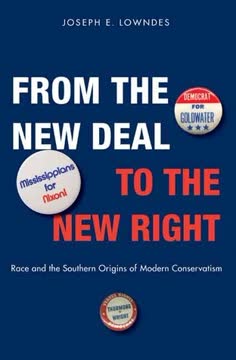
Key Takeaways
1. The "Backlash" Narrative Masks the Deep Origins of Modern Conservatism.
Instead of accepting the premise that white voters were pushed too far in the 1960s, we might ask: Why should white voters necessarily have seen increasing claims for black equality as detrimental to their own interests?
Challenging assumptions. The common "backlash" theory, which attributes the rise of the modern Right to a white reaction against the 1960s civil rights movement, oversimplifies a complex historical process. This narrative often implies that white voters were simply "pushed too far," overlooking the active construction of political identities and grievances. It fails to explain why racial issues automatically linked to conservative positions or Republican affiliation.
Beyond reaction. The emergence of modern conservatism was not a spontaneous reaction but a deliberate, long-term process of political actors forging new collective identities. This involved linking racism, antigovernment populism, and economic conservatism into a coherent discourse and institutional strategy. The "backlash" thesis, often used as a justification for modern conservatism, obscures the contingent, mobile, and highly adaptive nature of the Right's development.
Southern centrality. The South played a far more critical and proactive role than merely reacting to federal desegregation efforts. Southern segregationist intellectuals and politicians actively sought to nationalize their struggle, aligning with forces outside the South from the New Deal era onward. This strategic engagement, rather than a simple regional "backlash," laid the groundwork for the eventual transformation of national politics.
2. Dixiecrats Forged the Initial Link Between White Supremacy and Economic Conservatism.
"White supremacy is a political doctrine," not a biological fact.
A new blueprint. Joseph E. Lowndes argues that Charles Wallace Collins's 1947 book, Whither Solid South?, served as both a manifesto and blueprint for the Dixiecrat Revolt of 1948. Collins, an Alabama attorney with a background in government and banking, articulated a vision for a national political realignment that would unite southern Democrats and conservative Republicans. His work was crucial in theorizing the marriage of economic conservatism with white supremacy.
Modernizing arguments. Collins understood that New Deal liberalism was redefining political terms like "democracy" to include racial equality, which he saw as a threat to southern traditions and American identity. He countered this by asserting that "white supremacy is a political doctrine," not a scientific one, thereby shifting the debate from biology to political power and state sovereignty. This move allowed him to argue that racial hierarchy was a matter of practical politics and constitutional principle, not mere prejudice.
Strategic realignment. The Dixiecrats, led by figures like Strom Thurmond, aimed to break the South's century-long allegiance to the Democratic Party. Their strategy, heavily influenced by Collins, involved using the Electoral College to gain leverage and eventually form a new conservative party. While the 1948 revolt failed electorally, it established a "core of southern resistance" and began the crucial process of linking states' rights and opposition to civil rights with a broader conservative economic and political agenda.
3. National Review Bridged Northern Conservatism with Southern States' Rights.
"Those who oppose the South’s resistance tend to rest their case, simply, on the fact that they disapprove of racial discrimination of any kind. It has been surprisingly difficult to fix their attention on the fact that, as far as the South and its sympathies are concerned, something else is at stake."
Seeking common ground. In the decade following the Dixiecrat Revolt, National Review (NR), founded by William F. Buckley, Jr., became instrumental in connecting northern conservatives with southern segregationists. NR's editors saw the conflict over states' rights and federal power in the South as an opportunity to expand the conservative movement, despite initial skepticism about the Republican Party's conservative credentials. They aimed to support states' rights without openly embracing racism.
"Fusionism" and racial coding. NR sought to integrate southern opposition to desegregation into its "fusionist" worldview, which combined economic antistatism with social traditionalism and anticommunism. They argued that southern resistance was primarily about decentralized political authority and the Tenth Amendment, not racial discrimination. This approach allowed northern conservatives to express solidarity with the South on "principle," while subtly accommodating racial anxieties.
Building the Southern GOP. NR's intellectual efforts laid the groundwork for strategic political organizing. Figures like L. Brent Bozell, who ghostwrote Barry Goldwater's Conscience of a Conservative, crafted a language that separated states' rights from explicit white supremacy, while still appealing to southern voters. This discursive bridge, combined with the "Operation Dixie" initiative, helped transform the Republican Party in the South from a patronage organization into a viable conservative force, culminating in Goldwater's 1964 presidential nomination.
4. George Wallace's Populism Nationalized Racial Resentment and Antigovernment Sentiment.
"I am an Alabama segregationist . . . not a Wisconsin segregationist. If Wisconsin believes in integration, that is Wisconsin’s business, not mine."
The "Fighting Judge." Alabama Governor George Wallace emerged as a contradictory but potent populist figure in the 1960s, capitalizing on growing racial and social anxieties. His 1963 inaugural address, promising "segregation now, segregation tomorrow, segregation forever," and his "stand in the schoolhouse door" at the University of Alabama, propelled him onto the national stage. He skillfully framed southern resistance not as racism, but as a defense against an "omnipotent march of centralized government."
Nationalizing resentment. Wallace's campaigns transcended regional boundaries by linking segregation to broader antigovernment themes like anticommunism, property rights, and job security. He warned northern blue-collar workers that federal civil rights legislation threatened their seniority and neighborhoods, using coded language about "Japanese-Lutherans" and "Chinese-Baptists" to evoke racial fears without explicit racist appeals. He also embraced white ethnic groups, positioning himself as a defender of their status against both liberal elites and perceived black encroachments.
Violence and "Law and Order." Wallace's rallies were often marked by tension and violence, which he and his campaign staff strategically leveraged. He cultivated an image as a "law and order" champion while simultaneously inciting clashes and condemning "permissive" government. This paradoxical stance allowed him to appear as a strong leader protecting "average citizens" from urban unrest, student protests, and rising crime rates, further solidifying a new "Middle American" identity rooted in racial and antigovernment populism.
5. Nixon's "New Majority" Consolidated Diverse White Voters Through Coded Appeals.
"They’re not sick or racists. They’re not guilty of the crime that plagues the land; they are black, they are white; they’re native born and foreign born, they’re young and they’re old."
A calculated centrism. Richard Nixon's path to the presidency involved carefully navigating the political landscape shaped by Goldwater's conservative movement and Wallace's populist appeal. He aimed to attract both conservatives and southern segregationists without appearing extreme to the broader electorate. Nixon presented himself as a unifier, promising to "bring us together" while subtly marginalizing liberalism and the Left.
The "Southern Strategy" refined. Nixon's campaign, heavily influenced by strategists like Kevin Phillips and Harry Dent, targeted white voters in the South, West, and suburbs. While publicly disavowing overt racism, Nixon used coded language and policies to appeal to racial anxieties. He promised to appoint "strict constructionists" to the Supreme Court, opposed busing, and adopted a "go slow" approach to desegregation, earning the loyalty of white southerners who felt betrayed by the Democratic Party.
"Forgotten Americans" and "Silent Majority." Nixon skillfully crafted a majoritarian identity of "forgotten Americans" – "the non-shouters, the non-demonstrators" – who were patriotic, self-supporting, and law-abiding. This group, he implied, was under attack by liberal elites, protesters, and welfare recipients. This rhetoric allowed Nixon to consolidate a diverse coalition of white working-class ethnics, suburbanites, and southerners, effectively redefining the political center and driving wedges into the New Deal coalition.
6. Nixon Mastered a "Tory Liberal" Strategy to Reshape the Political Center.
"Tory men and liberal policies are what have changed the world."
Governing paradox. Nixon's presidency was marked by a "Tory liberal" approach, where he adopted certain liberal policies while advancing a conservative agenda. He understood that winning elections and governing effectively required accommodating some New Deal commitments. This strategy allowed him to expand federal spending on domestic programs, sign environmental bills, and even impose wage and price controls, while simultaneously appealing to conservative voters.
Strategic federal action. Nixon's administration expanded and redirected federal power in ways that deflected liberal criticism and satisfied other groups. For example, the Family Assistance Plan (FAP) aimed to "clean up the welfare mess" with work requirements, appealing to conservatives, while also expanding federal aid eligibility. The "Philadelphia Plan" mandated minority representation in federally contracted businesses, a move that, while controversial, allowed Nixon to appear to advance civil rights without alienating his white working-class base.
Undermining from within. By expanding federal programs but shifting control (e.g., from specific housing projects to state block grants, or redirecting arts funding), Nixon subtly undercut liberal influence. This approach allowed him to claim majoritarian backing and gain cooperation from other branches of government, even as he moved the political center rightward. His ability to enforce desegregation quietly, while publicly opposing busing, further solidified his image as a pragmatic leader who could deliver for white voters without appearing overtly racist.
7. Cultural Narratives, Like Josey Wales, Normalized Antigovernment Racial Conservatism.
"Guv’mints lie . . . promise . . . back-stab . . . eat in yore lodge and rape yore women and kill when ye sleep on their promises. Guv’mints don’t live together . . . men live together."
Beyond politics. The political divisions of the 1960s and the disillusionment following Watergate and Vietnam fostered a widespread antigovernment sentiment. This sentiment, while rooted in conservative antistatism, also drew from left-leaning social movements. Cultural narratives played a crucial role in linking these disparate strands into a coherent political identity, often by selectively appropriating antiracist and countercultural themes.
Asa Carter's transformation. Asa Earl Carter, a former Klan leader and George Wallace's speechwriter, later reinvented himself as Forrest Carter, a Native American novelist. His 1973 novel Gone to Texas, adapted into Clint Eastwood's The Outlaw Josey Wales, exemplifies this cultural shift. The story portrays a white Confederate outlaw seeking vengeance against an authoritarian federal government, a narrative that resonated with the emergent Right's valorization of the victimized white American.
Racial coding in culture. The Outlaw Josey Wales skillfully uses racial coding by making African Americans completely absent from its Reconstruction-era narrative. This absence allows the film to depict the federal government as the sole villain, thereby masking the protagonist's fight for a slave-holding society. By identifying with indigenous peoples who also suffered at the hands of the U.S. government, Carter's work creates a cross-racial political commitment that, paradoxically, upholds his old white supremacist politics by uniting whites and Indians against a common (federal) enemy, while implicitly excluding blacks.
8. The Rise of the Right Was a Contingent Process of Identity-Building, Not Inevitable.
Political interests are an artifact of political identity. Who we are determines what we want.
Beyond realignment. The shift from the New Deal to the modern Right was not a simple electoral realignment but a "durable shift in governing authority" achieved through a long, contingent process of political identity-building. The Dixiecrat Revolt, Goldwater's candidacy, Wallace's campaigns, and Nixon's "New Majority" were, in isolation, institutional defeats, but collectively, they were decisive in producing conservative triumph. This transformation occurred at the "micropolitics" level, where language and culture reshaped political realities.
Forging new identities. Regime builders of the modern Right successfully crafted a coherent political identity by disassembling old political associations and forging new ones. They linked disparate themes—states' rights, punitive sentencing, opposition to welfare, neoliberal economics, and "family values"—into an "associative chain" that defined a new political center. This new identity, often embodied by abstractions like "Forgotten Americans" or "Silent Majority," united diverse groups against a perceived "liberal state" and its "special rights" claimants.
The power of forgetting. Ronald Reagan's "Great Rediscovery" narrative, which framed the rise of the Right as an inevitable return to American "common sense," underscores the political necessity of forgetting the bitter conflicts and "founding violence" involved in this transformation. The success of modern conservatism was not a predetermined outcome but a contingent phenomenon, continually shaped by older political identifications and new political events. This demonstrates that political identities are not fixed, offering a reminder that alternative futures are always possible through deliberate political action.








































