Key Takeaways
1. Ancient Myths Foreshadow Modern AI and Robotics
Ideas about creating artificial life were thinkable long before technology made such enterprises possible.
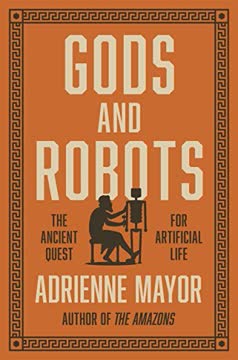
Imagination precedes invention. Long before the clockwork contraptions of the Middle Ages or modern technological innovations, ancient Greek myths explored concepts remarkably similar to today's robots, automata, human enhancements, and Artificial Intelligence. These stories served as "ancient science fictions" or "cultural dreams," demonstrating that the human imagination could conceive of artificial life far in advance of the technological means to create it. This highlights the enduring link between myth and scientific inquiry.
Timeless themes. The narratives in "Gods and Robots" reveal that the fundamental questions surrounding artificial life are not new. From Homer to Aristotle, people pondered how replicas of nature might be crafted, how they would function, and what their existence would mean for humanity. Many of the automata and mechanical devices actually designed in Greco-Roman antiquity even recapitulated these myths, illustrating and alluding to gods and heroes.
A continuous dialogue. The book argues that these ancient tales offer a priceless resource for understanding the fundamental challenges of biotechnology and synthetic life today. By revisiting these stories, we can enrich contemporary discussions about robotics, AI, and other innovations, recognizing that the "great river network of mythic narratives" continues to flow, crisscrossing and circling back to familiar characters and accumulating new insights.
2. Biotechne: Life Through Craft, Not Just Magic
The common denominator of mythic automata that took the forms of animals or androids like Talos and Pandora is that they were "made, not born."
Fabricated, not born. A central concept in ancient Greek thought about artificial life was "biotechne," meaning "life through craft or science." This distinguished beings like the bronze robot Talos or the artificial woman Pandora, who were "made, not born," from naturally occurring life forms or those simply enlivened by divine command or magic. These creations were envisioned as manufactured products, meticulously designed and constructed from scratch using the same materials and methods as human artisans, albeit with superhuman ingenuity.
Beyond mere magic. While tales of inert matter brought to life by a god's spell exist (like Pygmalion's statue), many ancient automata were described as technological productions. Their creators—divine figures like Hephaestus or legendary inventors like Daedalus—possessed extraordinary creativity and technical virtuosity. They employed tools, arts, crafts, and methods that paralleled real-life practices, but achieved spectacular results that exaggerated and surpassed mortal abilities.
Mechanistic concepts. Even without explicit descriptions of internal mechanisms, the very idea of "biotechne" implied a form of engineering. For instance, Talos's internal ichor system, sealed by a bolt, was described in mechanistic and biological terms, suggesting a sophisticated, if mythical, understanding of internal workings. This focus on craft and construction, rather than pure magic, marks a crucial distinction in the ancient imagination of artificial life.
3. The Uncanny Valley: Ancient Reactions to Artificial Life
Unprecedented innovations and brilliant techniques in Greek art and in mechanical technology, evoked sebas, thauma, and thambos—awe, wonder, and astonishment—in antiquity.
Shock of the new. The ancient Greeks experienced profound and often conflicting emotions when confronted with hyperrealistic artworks or mechanical devices that mimicked life. This "shock of the new" included awe and wonder, but also disorientation, alarm, and even terror, a psychological response akin to the modern "Uncanny Valley" phenomenon. This anxiety arose when the line between the inanimate and the animate blurred, especially with anthropomorphic entities.
Disquieting realism. Artists and sculptors achieved extraordinary levels of verisimilitude, creating figures that seemed to breathe, move, or even express emotion. Examples of this unsettling realism include:
- Odysseus's fear of hyperrealistic images of predators and murderers in the Underworld.
- Satyrs in Aeschylus's play alarmed by effigies of their own heads, fearing they lacked only voices to come alive.
- The "archaic smile" on statues like Pandora, which could convey mindlessness or a disconcerting, unnatural cheerfulness.
Such artistic illusions and animated sculptures intensified negative emotions, suggesting that the human psyche has long grappled with the eerie "in-betweenness" of artificial life.
Statue lust and its implications. The phenomenon of "agalmatophilia," or sexual attraction to statues, further illustrates the powerful, unsettling impact of lifelike art. Stories of men falling in love with or attempting intercourse with statues, like Praxiteles's Aphrodite of Knidos or Pygmalion's Galatea, highlight how realistic creations could evoke intense, even pathological, emotional responses. These tales serve as "parables about the power of mimetic creation" and the confusion between artificial and natural, foreshadowing modern debates about sex robots.
4. The Perils of Seeking Immortality and Eternal Youth
But if turning back old age and postponing natural death were unreasonable and forbidden, as Medea cautioned Jason (chapter 2), then could mortals at least hope to somehow enhance their physical capabilities—which are so paltry compared to those of the gods?
A double-edged gift. The ancient Greeks were deeply preoccupied with eternal youth and everlasting life, but their myths often served as cautionary tales about the unforeseen and tragic consequences of such desires. While gods were ageless and immortal, human attempts to achieve this state frequently led to suffering worse than death. The "Tithonus dilemma" is a prime example, where Eos's mortal lover is granted immortality but not eternal youth, condemning him to endless, decrepit old age, devoid of memory or strength.
Mortality and human dignity. Many myths emphasized that human dignity, love, and heroic striving were intrinsically linked to a finite lifespan. Heroes like Achilles chose a short, glorious life over a long, comfortable one, valuing "imperishable glory" (kleos aphthiton) over physical immortality. The story of Odysseus refusing Calypso's offer of eternal life to return to his mortal wife, Penelope, underscores the intensity of human ties that are made stronger precisely because they cannot last.
Unintended consequences. Even when immortality was granted, it often came with unforeseen drawbacks. The centaur Chiron, suffering from an incurable wound, begged for death despite his immortality. Sisyphus's eternal punishment for binding Thanatos (Death) led to chaos, as no living thing could die, condemning the sick and wounded to interminable suffering. These narratives highlight the profound philosophical questions about the meaning of life, memory, and suffering when death is removed from the equation, echoing modern debates about limitless rejuvenation and "overliving."
5. Human Enhancement: Borrowing Powers from Gods and Animals
The gifts bestowed by Prometheus represent the first 'human enhancements,' defined as 'attempts to temporarily or permanently overcome limitations of the human body by natural or artificial means.'
Overcoming frailty. Greek myths frequently explored the human desire to transcend natural limitations and augment physical capabilities, often by mimicking the powers of gods or animals. Prometheus's initial gifts of fire and technical skills to defenseless humans were the foundational "human enhancements," enabling them to create tools and compensate for their inherent weaknesses. This ancient impulse to "upgrade" nature foreshadows modern transhumanism and military human enhancement technologies.
Biomimetic designs. Legendary inventors like Daedalus were masters of biomimicry. His most famous invention, the wings for human flight, directly imitated the pinions of birds, allowing him and Icarus to soar. Similarly, Medea's Promethean ichor drug, derived from the immortal Titan's blood, temporarily imbued Jason with superhuman strength and courage, deflecting fire and resisting spears, much like modern psychoactive stimulants designed to supercharge soldiers.
Artificial animal aids. The creation of artificial animals also served to enhance human endeavors or desires. Daedalus constructed a realistic, hide-covered wooden cow for Queen Pasiphae to mate with a bull, enabling an unnatural act. Alexander the Great's legends include a diving bell for undersea exploration and a flying machine powered by harnessed birds, demonstrating a desire to conquer both the heavens and the oceans. These tales illustrate the ancient fascination with harnessing or replicating animal abilities to expand human potential.
6. Automata as Instruments of Power and Control
It is a striking fact that the autocratic fascination with animated statues designed to inflict torture and death was not confined to ancient myth.
Tyrants' tools. Both mythical and historical accounts reveal a recurring pattern: despotic rulers commissioned and deployed artificial beings and clever contraptions as instruments of power, control, and often, torture or death. These malevolent machines served to humiliate subjects, eliminate enemies, and display the absolute, arbitrary authority of the monarch. This dark side of technological ambition was a consistent theme from ancient myths to historical records.
Mythical enforcers. In mythology, figures like Zeus, King Minos, and King Aeetes utilized technologically advanced automata for cruel purposes:
- Talos: The bronze giant, created by Hephaestus for King Minos, guarded Crete by hurling boulders and roasting invaders alive with his heated body.
- Fire-breathing bronze bulls: Forged by Hephaestus for King Aeetes, these beasts were meant to incinerate Jason.
- Zeus's Eagle: A mechanical drone-eagle, also made by Hephaestus, was sent to perpetually torture Prometheus.
These creations highlight the ancient imagination of robots as formidable, often lethal, enforcers of tyrannical will.
Historical horrors. Real-life tyrants also employed ingenious, often gruesome, artifices:
- Phalaris's Brazen Bull: A hollow bronze bull statue, designed by Perilaus, was used by the tyrant of Acragas to roast victims alive, with internal pipes amplifying their screams into bull-like bellows.
- Nabis's mechanical Apega: The Spartan dictator Nabis created a spiked robot resembling his wife, Apega, to torture wealthy citizens who refused his demands, impaling them in a deadly embrace.
- Emperor Gao Yang's killer kites: In ancient China, this emperor executed prisoners by harnessing them to large, bird-shaped kites and forcing them to "fly" from a high tower for his amusement.
These historical examples underscore the chilling reality of how technology, when combined with absolute power, could be perverted for sadistic ends, blurring the lines between myth and historical atrocity.
7. Ethical Dilemmas: Agency, Slavery, and Unintended Consequences
The Talos myth embodies age-old questions about what it is to be human and free.
Questions of autonomy. Ancient narratives about artificial life consistently raised profound ethical and philosophical questions that remain relevant today. These included the nature of consciousness, the capacity for free will in manufactured beings, and the moral responsibilities of creators. The very idea of automata often intertwined with the concept of slavery, prompting discussions about control and the potential for rebellion.
The problem of control. The myths frequently explored the dangers of creating beings that could not be fully controlled or whose programming led to unforeseen, destructive outcomes:
- Talos's vulnerability: Medea's trickery exploited Talos's "almost human" susceptibility to persuasion, revealing that even powerful automata could be outsmarted.
- The sown dragon-teeth army: Jason's automaton soldiers, programmed only to attack, turned on each other when a random impact triggered their aggression, highlighting the risks of mindless, uncontrollable force.
- Socrates on Daedalus's statues: He compared fleeting opinions to Daedalus's animated statues that needed to be "tethered" lest they escape, implying that creations require moral and intellectual anchors.
These stories foreshadow modern concerns about AI ethics, the "black box" problem of deep learning, and the imperative to ensure that artificial intelligence benefits humanity.
The human-machine boundary. The ancient world grappled with what it meant to be human in the face of increasingly lifelike creations. The Buddhist tale of robot assassins pursuing their creator, or the idea of humans as "puppets of the gods" (Plato), explored the unsettling possibility that our own agency might be an illusion. These narratives compel us to consider the moral implications of creating beings that mimic life, and the potential for such creations to challenge our understanding of selfhood and freedom.
8. Hephaestus: The Divine Engineer of Intelligent Automata
Hephaestus’s Golden Maidens set the standard for artificial life.
Master of biotechne. Hephaestus, the lame smith god, was the ultimate divine engineer in Greek mythology, renowned for his unparalleled skill in metalworking, craftsmanship, and invention. His creations were not merely magical but involved sophisticated technological prowess, anticipating modern concepts of robotics and Artificial Intelligence. Hephaestus's forge was a mythical laboratory where "made, not born" beings came to life.
A pantheon of automata. Hephaestus's résumé included a wide array of self-moving and intelligent creations:
- Talos: The bronze giant of Crete, an android with an internal ichor system, designed for defense.
- Fire-breathing bronze bulls: Forged for King Aeetes, these mechanical beasts were a formidable challenge for Jason.
- Self-moving tripods: These wheeled cauldrons automatically delivered nectar and ambrosia to the gods' banquets, responding to commands and returning on their own, representing early "driverless" machines.
- Automatic gates of Olympus: Swiveling on their own accord, these gates anticipated automatic doors.
- Self-adjusting bellows: Twenty bellows in his forge operated and adjusted themselves to his needs, demonstrating automated labor.
These devices, though mythical, illustrate the ancient imagination of machines performing complex tasks autonomously.
The Golden Maidens: Proto-AI. Hephaestus's most remarkable creations were his life-size golden female robots. These assistants were not only spontaneously mobile and indistinguishable from real women but were also endowed with "mind, wits, voice, and vigor," along with the knowledge of all the immortal gods. They anticipated and responded to his needs, representing an ancient vision of augmented intelligence and setting a high standard for artificial life with human-like consciousness and capabilities.
9. Pandora: The "Beautiful Evil" of Artificial Creation
A crucial difference between Eve and Pandora is that Pandora was not summoned into existence but constructed, by the god of craftsmanship—the same god, Hephaestus, who built other ingenious automata, such as the bronze robot Talos, the self-moving tripods, and a staff of female helpers made of gold.
Zeus's malicious design. Pandora was not a naturally born woman but a deliberate "snare" (dolos) created by Zeus and Hephaestus to punish humanity for accepting Prometheus's stolen fire. She was a "kalon kakon," a "beautiful evil," an artificial female designed to be irresistibly seductive yet bring ruin. Her manufactured nature is central to her myth, highlighting themes of divine malice and the dangers of unchecked technological power.
A composite being. Hephaestus molded Pandora from clay, giving her human-like strength and voice. Other Olympian gods contributed to her composition, bestowing unique gifts and personality traits:
- Athena: Dressed her in dazzling clothing and taught her crafts.
- Graces and Peitho: Gave her charm and powers of persuasion.
- Aphrodite: Filled her with irresistible sex appeal, arousing "painful desire."
- Hermes: Gave her a shameless, devious nature and deceitful words, naming her "Pandora" (All Gifts) for the ruination of mankind.
This collaborative creation underscores her artificiality and her role as a programmed agent of divine retribution, a replicant with no past or true self-identity.
The jar of misfortunes. Pandora's mission was to open a sealed pithos (jar), releasing disease, pestilence, labor, poverty, and other torments upon humanity. The only thing left trapped inside was Elpis, "Hope." The meaning of Hope's confinement is ambiguous, debated since antiquity: is it a blessing or another form of torment, like "blind hope" or "false hope"? Pandora's "uncanny smile" in ancient art, reminiscent of the robot Maria in "Metropolis," reinforces her manufactured, deceptive nature and the unsettling ambiguity of her purpose, making her a proto-robot who violates Asimov's Zeroth Law by harming all humanity.
10. Daedalus: The Archetypal Human Inventor and His Creations
Daedalus was a craftsman and inventor, not a magician. Using familiar tools, methods, techniques, and materials, Daedalus deployed creative expertise and technology to achieve wonderful results.
Ingenuity without magic. Daedalus stands as the archetypal human inventor in Greek mythology, renowned for his extraordinary craftsmanship and technological innovations. Unlike the gods, his creations were achieved through skill, tools, and materials, not divine magic, pushing the boundaries of what mortals could achieve in art and engineering. His works often blurred the line between art and life, evoking awe and sometimes fear.
Life-mimicking art. Daedalus's specialty was creating "living statues" (daedala) so realistic they were believed to move on their own or needed to be tethered to prevent their escape. This concept was a popular joke in ancient Athens and reflected the "Uncanny Valley" effect of hyperrealistic art. His creations included:
- Hyperrealistic sculptures: Statues that seemed to breathe, move their eyes, or make sounds.
- The Labyrinth: A bewildering, covered maze designed for King Minos.
- Artificial cow for Pasiphae: A hollow, hide-covered wooden replica that fooled a real bull, enabling an unnatural act.
- Golden ram: A gilded ram so perfect it was mistaken for a real animal.
These creations showcased his ability to replicate nature with astonishing verisimilitude, often with unsettling implications.
Human-powered flight. Daedalus is most famous for inventing wings made of feathers and wax, enabling human-powered flight for himself and his son, Icarus. This biomimetic design, though tragic for Icarus, represented a bold attempt to overcome human limitations and achieve freedom through technology. Daedalus's story, with its blend of optimism and despair, serves as a timeless allegory for the hubris and unanticipated consequences of technological overreaching, yet his survival and continued inventiveness underscore the enduring human drive for innovation.
11. Prometheus: The Artisan Creator of Humanity and Technology
The artistic decision to show Prometheus constructing the first human starting with the bone structure likens the Titan to a sculptor who constructs a statue upon a model skeleton.
The Titan as craftsman. Prometheus, the maverick Titan, is central to the myth of human creation and the bestowal of technology. While some myths describe humans being magically formed, a fascinating tradition, particularly in Etruscan art, depicts Prometheus as an artisan meticulously crafting the first humans. These images show him using tools and assembling bodies piece by piece, or even starting with an internal skeleton (kanabos), emphasizing a "biotechne" approach to life's creation.
From inside out. Unlike the "magic-wand" scenarios, these artistic representations portray Prometheus as a sculptor or engineer, building the human form from the inside out. He is shown:
- Molding clay: Mixing earth and water (or tears) to shape the first men and women.
- Using tools: Employing hammers, scrapers, scalpels, and plumb lines, like real craftsmen.
- Assembling on a framework: Constructing bodies in sections on poles or, remarkably, starting with a human skeleton (kanabos) as an armature.
This vision suggests that ancient artists and viewers understood his creation as a form of sophisticated craft, analogous to a sculptor making automata, rather than a simple act of divine will.
Gifts and consequences. Prometheus's ultimate gift to humanity was the theft of fire and the arts of civilization (techne), including speech, writing, mathematics, and medicine. This act, which enabled humans to survive and thrive, earned him eternal torment from Zeus. The myth explores the profound ethical questions of creation, free will, and the responsibilities of a creator. It also touches on the unsettling idea that humans might be the "automata or playthings of an imperfect and/or evil demiurge," raising timeless questions about autonomy and the origins of evil, themes powerfully revived in modern science fiction like "Frankenstein" and "Blade Runner."
People Also Read