
Key Takeaways
1. The extreme heatwave of 1976 acted as a literal and metaphorical pressure cooker for British society.
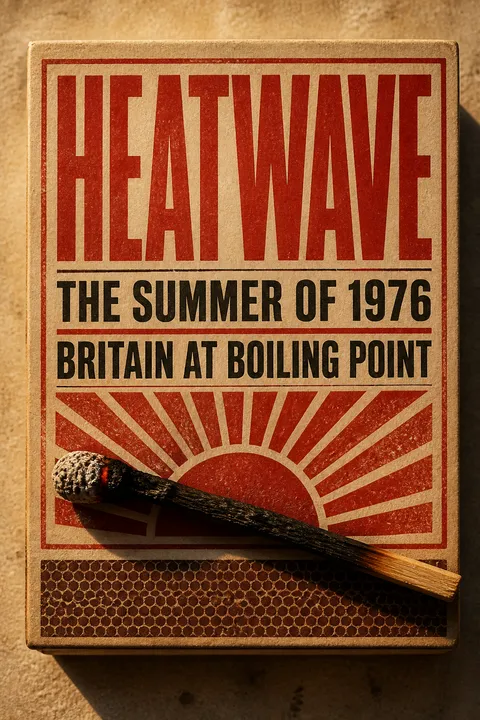
Britain in the summer of 1976 was all dry kindling, just waiting for a match.
The boiling point. The summer of 1976 was the driest and hottest Britain had experienced since records began 250 years prior. As temperatures soared past 30 degrees Celsius, the physical infrastructure of the country began to melt, and water reserves dwindled to a mere 90-day supply in London. This environmental crisis was not merely an inconvenience; it acted as a psychological pressure cooker that frayed tempers, spiked domestic violence, and set the stage for widespread social rebellion.
Drought and desperation. The government was forced to implement drastic measures to manage the dwindling water supply.
- Water was strictly rationed, and municipal standpipes became a common sight on suburban streets.
- The public was bombarded with slogans like "Save Water – Bath with a Friend" to encourage conservation.
- A bizarre plague of 24 billion starving ladybirds swarmed the southern coasts, biting sweat-drenched citizens.
- Forest fires raged across the parched countryside, while roads melted and trains caught fire.
A metaphorical catalyst. Ultimately, the relentless heat served as a catalyst for a country already on the brink of economic and social collapse. With inflation running at 15 percent and the pound sterling in freefall, the British public was deeply frustrated. The heatwave stripped away the polite veneer of post-war British deference, igniting a series of strikes, racial confrontations, and cultural revolutions that would permanently reshape the nation's identity.
2. The Trico strike proved that grassroots solidarity could successfully enforce the newly minted Equal Pay Act.
The establishment and the media do not like that combination.
A landmark struggle. When the American-owned Trico-Folberth factory in Brentford phased out its night shift, five male workers were transferred to the daytime assembly line. The female workers quickly discovered that these men were being paid £6.50 more per week for performing the exact same tasks. Armed with the newly enacted Equal Pay Act of 1975, 400 women walked out on strike on May 24, embarking on a historic 21-week battle for basic workplace equality.
The Costa del Trico. The striking women transformed the pavement outside the factory into a vibrant, sun-drenched community hub.
- They set up deckchairs, sofas, and Primus stoves, earning the nickname "Costa del Trico."
- The strikers successfully turned back delivery lorries, severely disrupting Trico's windscreen wiper production.
- When the company used police escorts to run midnight convoys, the women formed human blockades.
- They boycotted biased Industrial Tribunals, choosing to rely on direct action and union solidarity instead.
A triumphant victory. Despite facing police hostility, media trivialization, and financial hardship, the women refused to back down. They raised over £30,000 in strike funds from supportive trade unions and ordinary citizens across the country. On October 14, the management finally capitulated, granting the women their hard-won equal pay and proving that organized, multicultural female solidarity could defeat multinational corporate power.
3. The tragic murder of Gurdip Singh Chaggar catalyzed a militant, self-defending generation of British Asian youth.
The elders wanted jaw jaw, we wanted war war.
A community pushed too far. For years, Asian immigrants in suburbs like Southall endured relentless racial violence, commonly referred to by the derogatory term "Paki-bashing." The older generation of immigrants, represented by the Indian Workers’ Association, consistently preached patience, integration, and turning the other cheek. However, the brutal stabbing of 18-year-old Gurdip Singh Chaggar by a gang of white youths on June 4 shattered this passive consensus and ignited a fierce youth rebellion.
The Southall uprising. The youth of Southall refused to let Chaggar's death go unavenged or ignored by the authorities.
- Angered by congealed blood left on the pavement, hundreds of youths rioted, stoning cars and confronting the police.
- A crowd of 300 besieged the local police station for three hours to demand the release of arrested Asian teenagers.
- Young militants openly rejected the cautious, conciliatory advice of their community elders.
- They formed the Southall Youth Movement (SYM) to actively patrol the streets and physically defend their neighborhood.
A generational shift. The creation of the SYM marked a seminal moment in British race relations. It signaled the rise of a new, British-born generation of Asians who refused to behave like grateful, submissive guests. This militant stance quickly spread to other immigrant communities across the UK, establishing a network of youth movements dedicated to self-defense and anti-racist activism.
4. Systemic police prejudice and incompetence led to horrific miscarriages of justice and allowed serial killers to roam free.
Stefan Kiszko would have made a better detective than the late Dick Holland ever was.
A broken justice system. The mid-1970s exposed a deeply corrupt and prejudiced police culture, particularly within the West Yorkshire police force. Detectives routinely relied on coerced confessions, ignored vital forensic evidence, and allowed personal biases to dictate their investigations. This systemic failure was epitomized by Detective Superintendent Dick Holland, whose ineptitude ruined innocent lives while allowing dangerous predators to remain at large.
Double failures of justice. Holland's career was defined by two parallel, catastrophic investigations in Yorkshire.
- He coerced a false confession from Stefan Kiszko, a mentally vulnerable clerk, for the murder of 11-year-old Lesley Molseed.
- Kiszko was wrongfully imprisoned for 16 years, despite medical proof that he could not produce the sperm found on the victim.
- The actual killer, taxi driver Ronald Castree, was arrested for another child assault during Kiszko's trial but ignored by police.
- He simultaneously botched the hunt for the Yorkshire Ripper, Peter Sutcliffe, by dismissing survivors like Marcella Claxton.
Prejudice over professionalism. The police's failure to catch Sutcliffe earlier stemmed from their dismissive attitude toward his victims, many of whom were written off as prostitutes. Meanwhile, Kiszko was railroaded simply because his physical oddness made him an easy target for a force desperate for a quick conviction. This dark chapter severely eroded public trust in the police and highlighted the lethal consequences of institutional bigotry.
5. The rise of the "Soul Boy" subculture created a rare, vibrant space for multiculturalism and fashion-forward escapism.
Unlike northern soul, with its dervish spins and flailing kicks, its wild amphetamine abandon, the southern style was tight and precise: feet made rapid tap movements, knees were bent, hips sashayed, shoulders rolled, heads bobbed.
A stylish sanctuary. While mainstream teenage fashion was dominated by shapeless flared jeans and rock T-shirts, a highly sophisticated subculture was quietly flourishing in the discotheques of London and the South East. The "Soul Boys" and "Soul Girls" rejected the aggressive, beer-fueled atmosphere of traditional pubs in favor of a world centered entirely on sharp dressing, precise dancing, and cutting-edge Black American music.
The soul boy aesthetic. This subculture was defined by its meticulous attention to detail and its unique musical tastes.
- Followers frequented West End clubs like Crackers, dancing to imported jazz-funk, fusion, and Philadelphia soul.
- The fashion featured asymmetric "wedge" haircuts, peg trousers, bowling shirts, and plastic jelly sandals.
- Boutiques like Acme Attractions in the King's Road became essential hubs for sourcing dead-stock vintage clothing.
- Unlike other scenes, soul clubs were genuinely multicultural, welcoming both Black and white youth, as well as gay dancers.
An inclusive revolution. The soul boy scene was a rare oasis of tolerance in a deeply divided Britain. It allowed working-class youth to escape the grim economic realities of the decade through a shared obsession with style and rhythm. This vibrant, fluid subculture laid the aesthetic groundwork for the New Romantic movement of the 1980s and proved that music could successfully bridge racial and social divides.
6. Punk rock emerged as a raw, chaotic rejection of the bloated, idealistic rock establishment.
We’re not into music, we’re into chaos.
The death of rock idealism. By 1976, the rock music establishment had become bloated, self-indulgent, and entirely disconnected from its working-class roots. Stadium gigs by aging superstars like the Rolling Stones and the Who were expensive, over-produced, and increasingly plagued by crowd violence. In response, a raw, aggressive new youth culture began to coalesce in the sweaty, claustrophobic cellars of London and Manchester.
The rise of the Sex Pistols. Managed by the entrepreneurial provocateur Malcolm McLaren, the Sex Pistols became the vanguard of this musical revolution.
- They stripped rock'n'roll back to its basic, high-energy elements, inspired by the breakneck speed of the Ramones.
- Their singer, Johnny Rotten, captivated audiences with his intense, hostile stare and anti-establishment lyrics.
- The band's early gigs, like the legendary Manchester Free Trade Hall shows, inspired attendees to form their own bands.
- A dedicated, outrageously dressed entourage, the Bromley Contingent, followed them, wearing fetish gear from McLaren's shop.
A cultural watershed. Punk was more than just a new musical genre; it was a wholesale rejection of the status quo. It democratized music-making, proving that anyone could form a band or publish a fanzine without needing technical expertise or industry permission. By the end of the hot summer, punk had shattered the big sleep of sixties political idealism, replacing it with a potent, DIY energy that would define the decade.
7. Eric Clapton’s infamous racist rant inadvertently birthed the powerful "Rock Against Racism" movement.
We want to organise a rank-and-file movement against the racist poison in rock music.
The catalyst of hypocrisy. On August 5, 1976, a heavily intoxicated Eric Clapton took the stage at the Birmingham Odeon and launched into a shocking, pro-Enoch Powell tirade. He urged his audience to vote for Powell to prevent Britain from becoming a "black colony" and repeatedly used racist slogans. The irony was staggering: Clapton, a man who had built his entire career, fame, and fortune on copying Black American blues music, was now advocating for the repatriation of Black immigrants.
The birth of Rock Against Racism. Clapton's drunken outburst provoked immediate outrage among music fans and activists.
- Photographer Red Saunders wrote an impassioned letter of protest to the music press, calling out Clapton's hypocrisy.
- The letter struck a chord, prompting hundreds of readers to write in and offer their support.
- This groundswell of anger led to the formation of Rock Against Racism (RAR), a grassroots political movement.
- RAR organized gigs featuring a mix of black reggae acts and white punk bands, promoting racial unity.
A cultural shield. Rock Against Racism became one of the most successful cultural movements in British history. It successfully mobilized the energy of the punk and reggae scenes to combat the rising influence of the far-right National Front. By creating a shared space where black and white youth could party together, RAR helped ensure that the next generation of Britons would reject the racist poison of the past.
8. The tragic deaths of three children in Belfast sparked a massive, cross-sectarian women's peace movement.
Please stop the violence, people can’t take any more, it’s just too much...
A breaking point in the Troubles. The sectarian conflict in Northern Ireland had reached a horrific peak in the summer of 1976, with Loyalist and Republican paramilitaries engaged in a brutal cycle of tit-for-tat killings. The violence seemed endless and indiscriminate, terrorizing ordinary citizens on both sides of the religious divide. The breaking point came on August 10, when an out-of-control IRA getaway car struck and killed three young children in Belfast.
The Peace Women. Witnessing this tragedy, two ordinary women, Betty Williams and Mairead Corrigan (the children's aunt), decided to take a stand.
- They launched a petition demanding an end to the violence, which quickly gathered thousands of signatures.
- They organized a series of massive, cross-sectarian peace marches through both Catholic and Protestant neighborhoods.
- Over 35,000 people joined their march on the Protestant Shankill Road, defying threats from paramilitaries.
- The movement, known as the Peace People, united women across the sectarian divide in a shared demand for peace.
A legacy of hope. Although the Peace People eventually fractured, their impact was profound and lasting. They proved that the vast majority of the population in Northern Ireland, both Catholic and Protestant, desperately wanted an end to the armed conflict. Their courageous, female-led activism severely undermined the moral authority of the paramilitaries, paving the long, difficult road toward the eventual peace agreement.
9. Pop culture and television reflected a nation caught in a deep identity crisis, torn between nostalgia and liberation.
I wish people would just listen to the songs and leave me alone!
A divided cultural landscape. In 1976, British television and pop music were caught in a fascinating transition between the conservative, music-hall traditions of the past and the progressive, liberating forces of the future. The media landscape was incredibly simple, with just three TV channels and a handful of radio stations, meaning that the entire country watched the same shows and listened to the same records, whether they liked them or not.
Nostalgia versus reality. This cultural tension was reflected in the popularity of various shows and artists.
- The hit TV drama Rock Follies laid bare the exploitation and sexism faced by female performers in the music industry.
- Sitcoms like The Fosters introduced the first all-Black British cast to prime-time television, albeit with white writers.
- Joan Armatrading emerged as a major star, a fiercely independent Black female artist who refused to conform to sexist industry standards.
- Meanwhile, the charts were dominated by safe, nostalgic acts like Abba, the Beach Boys, and the novelty sounds of the Wurzels.
The dawn of a new era. This cultural push-and-pull reflected a nation struggling to define its post-imperial identity. While older audiences retreated into the comforting nostalgia of wartime singalongs, the young were embracing the raw, authentic voices of artists like Armatrading and the Sex Pistols. The summer of '76 was the moment when the old, deferential Britain of the post-war era began its final, chaotic transition into a modern, multicultural society.
10. The 1976 Notting Hill Carnival riots marked a definitive turning point in Black British resistance against police oppression.
One quarter of a million black people on the streets of Britain in 1976 is a political event.
The battle of Notting Hill. The 1976 Notting Hill Carnival was supposed to be a celebration of Caribbean culture, but it quickly turned into a full-scale battleground. The Metropolitan Police, determined to crack down on alleged pickpocketing, deployed over 1,500 officers in heavy, militaristic formations. This aggressive, over-policed presence was seen as a direct provocation by the young Black Londoners who had endured years of systemic harassment under the hated "Sus" laws.
Anatomy of a riot. The confrontation erupted on Monday afternoon under the Westway flyover and quickly spread.
- Youth fought back against police charges, using bricks, bottles, and stones as weapons.
- The police, completely unprepared for the level of resistance, were forced to use dustbin lids as makeshift shields.
- Over 325 police officers were injured, and several police vehicles were damaged or destroyed.
- The rioters successfully forced the police into a retreat, reclaiming the streets of Notting Hill for the community.
A political awakening. The Notting Hill riots were not a mindless outbreak of criminality, but a politically charged rebellion against state oppression. It proved that the young Black British generation was no longer prepared to accept police brutality and second-class citizenship. The image of Black youth fighting the police became an iconic symbol of resistance, immortalized on the cover of the Clash's debut album, and signaling the birth of a fiercely defiant, multicultural Britain.
Download PDF
Download EPUB
.epub digital book format is ideal for reading ebooks on phones, tablets, and e-readers.








































