Key Takeaways
1. Sleep is a Friend, Not an Engineering Problem
You’ve lost a friend and gained an engineering problem.
Reframe your relationship. Many people approach sleep as a broken machine that needs fixing, meticulously tracking data and trying to "hack" their way to better rest. This mindset, fueled by the booming sleep industrial complex, turns a natural, complex, and beautiful biological process into a stressful engineering challenge. The author argues that sleep cannot be controlled or forced; it's an involuntary state that thrives on a healthy, trusting relationship.
Societal shift. Historically, sleep was a fluid, social experience, adapting to natural rhythms and community needs. However, industrialization and capitalism transformed sleep into a private, scheduled necessity, often viewed as a barrier to productivity. This shift has eroded our innate understanding of how and when to sleep, leading to widespread struggles and the belief that sleep is something to be conquered.
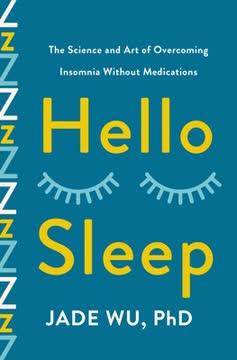
Rebuild the friendship. To overcome insomnia, the goal is not to master sleep through rigid rules or expensive gadgets, but to rebuild a friendly relationship with it. This involves understanding sleep's true nature, setting meaningful boundaries, and appreciating what sleep needs from you, rather than solely focusing on what you demand from it. The "Hello Sleep" program guides readers through this transformative journey, emphasizing scientific insights and behavioral changes.
2. Insomnia is a 24-Hour Disorder, Not Just a Nighttime Problem
Insomnia is a twenty-four-hour disorder.
Beyond nighttime struggles. Insomnia is more than just difficulty falling or staying asleep; it's a pervasive condition that impacts your mood, energy, and overall well-being throughout the entire day. The constant worry, frustration, and mental burden associated with sleepless nights contribute significantly to daytime fatigue and impaired functioning, creating a vicious cycle that perpetuates the problem.
Common misconceptions. Many believe insomnia is simply a symptom of stress, a chemical imbalance, or chronic sleep deprivation. However, chronic insomnia is distinct from these. If you have insomnia, you are likely not sleep-deprived in the clinical sense, because true sleep deprivation would make you irresistibly sleepy. Instead, insomnia is often maintained by hyperarousal—a state where your brain is too revved up, even when your body is exhausted.
The 3 Ps. Chronic insomnia develops through a combination of predisposing factors (e.g., being a light sleeper), precipitating factors (e.g., a stressful life event), and crucially, perpetuating factors. These perpetuating factors are the unhelpful thoughts and behaviors adopted in an attempt to "fix" sleep, such as going to bed too early or lingering in bed, which inadvertently keep insomnia alive. Addressing these perpetuating factors is key to recovery.
3. The "Big Reset" Starts with Sleep Consolidation
For most adults, it takes about sixteen to eighteen hours of being awake to save enough in the piggy bank for a good quality sleep.
Fuel your sleep drive. Sleep drive is your body's "hunger" for sleep, accumulating like coins in a piggy bank the longer you stay awake and active. A sufficient sleep drive is essential for initiating and maintaining quality sleep. Many insomniacs sabotage this drive by going to bed too early, lingering in bed, taking naps, or being inactive, leading to a perpetually low "piggy bank" balance.
Distinguish tired from sleepy. It's crucial to differentiate between feeling "tired" (worn out, low energy) and genuinely "sleepy" (on the verge of falling asleep). Going to bed when merely tired, but not sleepy, means you haven't accumulated enough sleep drive, resulting in tossing, turning, and frustration. This reinforces the negative association with your bed.
Implement sleep consolidation. The most effective way to increase sleep drive is through sleep consolidation, which involves spending less time in bed. This means:
- Calculating a personalized "time-in-bed window" (average total sleep time + 30 minutes, minimum 5 hours).
- Establishing a consistent daily rise time, even on weekends.
- Only going to bed at your earliest allowed bedtime, or when genuinely sleepy, whichever is later.
- Temporarily avoiding naps and sleeping in. This temporary, mild sleep deprivation is intentional, designed to jump-start your sleep system and teach your brain to fill your limited time in bed with quality sleep.
4. Unlearn Conditioned Arousal: Your Bed is for Sleep, Not Struggle
In other words, all the hours you’ve spent tossing and turning have actually conditioned your brain to be awake and unhappy … in bed.
Pavlov's dogs and your bed. Just as Pavlov's dogs learned to salivate at the sound of a bell, your brain can become "conditioned" to associate your bed with wakefulness, frustration, and anxiety. This conditioned arousal explains why you might feel sleepy on the couch but wide awake the moment you get into bed. It's a powerful perpetuating factor for insomnia, turning your sanctuary into a battleground.
Stimulus control: drop the rope. To reverse this conditioning, you must break the association between your bed and wakefulness. This means using your bed exclusively for sleeping (and sex, with brief reading for pleasure being an exception). The most critical rule is: if you can't fall asleep or fall back to sleep, get out of bed. Staying in bed and "trying" to sleep only reinforces the negative conditioning and fuels hyperarousal.
Engage in enjoyable activities. When you get out of bed, do something genuinely enjoyable and non-stimulating, rather than trying to bore yourself back to sleep. This could be reading a captivating book, listening to a podcast, or engaging in a hobby. The goal is not to make yourself sleepy, but to prevent your brain from associating wakefulness with the bed, and to make your awake time more pleasant. Remember to dim screens or use blue light-blocking glasses to minimize light's impact on your circadian rhythm.
5. Combat Fatigue by Boosting Your Circadian Rhythms
When your SCN is confused by these circumstances, it has a hard time making you sleepy at night, and it has a hard time making you alert and energetic during the day.
Fatigue's true roots. While often blamed on "lack of sleep," daytime fatigue in insomniacs is more closely linked to hyperarousal, sleep misperception, inconsistent sleep patterns, and unhelpful thoughts about sleep. Objective sleep measures often don't correlate with perceived fatigue. One major, often overlooked, contributor to this exhaustion is circadian dysregulation—when your body's internal clock is out of sync with the external world.
The maestro's confusion. Your brain's master clock, the suprachiasmatic nucleus (SCN), orchestrates your body's daily rhythms, including sleep and wakefulness. When the SCN is confused by inconsistent schedules, irregular meals, or insufficient daytime light exposure, it struggles to make you alert during the day and sleepy at night. This "clock confusion" significantly contributes to the tired-but-wired feeling.
Light and movement are key. To reset your circadian system and alleviate fatigue, prioritize:
- Bright daytime light: Get ample exposure to natural sunlight, especially in the morning. This signals "daytime" to your SCN, strengthening your rhythms.
- Dim evenings: Minimize bright light exposure in the hours before bed, mimicking natural darkness. Use dim, warm-colored lights and blue light-blocking glasses if using screens.
- Consistent rhythms: Maintain a regular wake-up time every day and eat meals at consistent times.
- Physical activity: Regular, low-to-moderate intensity exercise (ideally outdoors) boosts energy, reduces fatigue, and improves mood, further supporting a robust circadian rhythm.
6. Quiet Your Racing Mind with Daytime Rest and Thought Processing
If you give yourself a proper chance to process thoughts during the day or evening, they won’t be bouncing around your head at night with so much energy.
Daytime habits, nighttime chaos. The "racing mind" at night is often a consequence of how we manage our thoughts and rest during the day. A constant "get-it-done" mentality, driven by modern productivity culture, signals perpetual danger to your brain, making it difficult to switch into "let-it-go" mode at bedtime. Unprocessed thoughts accumulate, only to erupt when the quiet of night offers no distractions.
Prioritize true rest. True rest is not passive media consumption or mindless distraction; it's rejuvenating, non-goal-oriented activity that nourishes your body and soul. This could include walking, daydreaming, reading for pleasure, listening to music, or engaging in hobbies. Deliberately schedule and protect these periods of rest to signal safety to your brain and prevent mental overload.
Create a mental litter box. To prevent thoughts from overwhelming you at night, dedicate specific time during the day for "thought processing." This can involve journaling, solo prayer, or long walks. A powerful technique is the "mental litter box":
- Designate a 30-minute "worry time" each day.
- During this time, actively indulge in worries or ruminations without judgment.
- Outside this time, defer any emerging worries to your next scheduled session.
This teaches your mind to contain its "business" to a specific period, preventing it from spilling over into your sleep.
7. Break the Self-Fulfilling Prophecy of Negative Sleep Thoughts
In this cruel, Greek tragedy–style twist, the way we think about insomnia turns out to be one of the best fuels for keeping insomnia going.
Thoughts fuel arousal. Your automatic thoughts about sleep—such as "I won't be able to function tomorrow" or "Insomnia is ruining my life"—are not neutral. They trigger powerful emotions like frustration, anxiety, and resentment, which in turn increase hyperarousal. This creates a self-fulfilling prophecy, where negative expectations about sleep actively make it harder to sleep, perpetuating the cycle of insomnia.
Become a "Pocket Socrates." To dismantle this prophecy, you must first become aware of these automatic thoughts. Use a thought record to identify the situation, the automatic thought, and its emotional/behavioral consequences. Then, challenge these thoughts using a "Pocket Socrates" approach:
- Fact vs. fear: Is the thought based on evidence or anxiety?
- Counterexamples: Have there been times when your prediction didn't come true?
- Worst-case scenario: What's the absolute worst outcome, and can you cope?
- Unfair pressure: Are you blaming sleep unfairly or expecting too much?
- Balanced perspective: What's a more accurate, fair, or helpful way to think about the situation?
Shift your perspective. The goal is not to force positive thoughts, but to cultivate a more realistic and flexible perspective. By examining unhelpful thoughts, you reduce their power to generate anxiety and frustration, thereby decreasing arousal. This practice, over time, helps you develop a healthier, more trusting relationship with sleep, allowing you to respond to sleeplessness with acceptance rather than struggle.
8. Let Go of Sleep Effort: Stop Trying So Hard to Sleep
But when it comes to sleep, hard work often backfires.
The quicksand of effort. Sleep is an involuntary process; you cannot force it. Any intentional action or thought aimed at inducing sleep—such as trying to clear your mind, researching the "perfect" mattress, or strategizing medication dosages—constitutes "sleep effort." This effort, however well-intentioned, paradoxically increases hyperarousal, making it even harder to fall asleep. It's like struggling in quicksand: the more you fight, the deeper you sink.
Embrace psychological flexibility. To escape this trap, you must "drop the rope" and let go of the struggle. This involves:
- Accepting reality: Acknowledge your wakefulness without judgment or attempts to change it. Simply state, "I'm awake right now, and that's okay."
- Acting like a good sleeper: Ask yourself, "What would someone who sleeps effortlessly do in this situation?" This shifts your behavior away from anxiety-driven actions and signals to your body that sleep is resilient, not fragile.
- Getting out of your head and into your body: Practice mindfulness exercises like the 5-4-3-2-1 technique, mindful breathing, or body scans. These practices ground you in the present moment, diverting attention from anxious thoughts and reducing mental chatter.
Cover the clock. A simple yet powerful step is to remove or cover all clocks and electronic devices from your view at night. Knowing the time when you're awake only fuels anxiety and frustration, warping your perception of how long you've been awake. By eliminating this source of information, you reduce sleep effort and allow your mind to disengage from the "sleep math" that perpetuates insomnia.
9. Reclaim Trust in Your Sleep: A Strategic Approach to Medications
If you want to get off your sleep medication for good, you have to stop playing tug-of-war with it.
The psychological burden of pills. Sleep medications, whether prescription or over-the-counter, often come with a psychological cost. The "PRN paradox"—taking pills "as needed"—forces constant decision-making, bargaining, and guilt, all of which increase arousal and psychological dependence. Furthermore, when you successfully sleep after taking a pill, you may misattribute the sleep to the medication rather than your body's natural sleep drive, reinforcing the belief that you cannot sleep without it.
Modest efficacy, significant risks. While FDA-approved sleep medications can offer modest improvements (e.g., reducing sleep onset by 5-12 minutes), their long-term efficacy is often underwhelming, and they carry risks like cognitive impairment, falls, and withdrawal symptoms. Over-the-counter aids like melatonin are often misunderstood (it's a hormone, not a sedative) and unregulated, with little evidence for treating chronic insomnia.
A structured taper plan. If you choose to discontinue sleep medications, do so strategically and with medical supervision. The process involves:
- Consulting your prescriber: Never make changes without your doctor's approval, especially for benzodiazepines, which require very gradual tapering to avoid dangerous withdrawal.
- Completing the Hello Sleep program: Building foundational sleep skills first significantly increases your chances of success.
- Gradual, predetermined tapering: Create a fixed schedule for reducing dosage or frequency, removing on-the-fly decisions. This minimizes rebound insomnia (a temporary worsening of sleep during withdrawal) and prevents misattribution.
10. Optimize Your Sleep Environment and Habits (But Don't Obsess)
The reason I wrote off sleep hygiene with Keisha, but ultimately spent multiple sessions emphasizing it with Wei, is because substances and screens played very different roles in their relationships with sleep.
Context is everything. Sleep hygiene advice—like avoiding caffeine or screens before bed—is often generic and can be counterproductive if it leads to excessive "sleep effort." For some, strict adherence to these rules creates more anxiety than the habits themselves. For others, poor habits genuinely interfere with sleep. The key is to understand your personal sensitivity and the role these factors play in your unique relationship with sleep.
Debunked and nuanced advice:
- Evening exercise: Perfectly fine and even beneficial for sleep. Don't restrict it if it's your only opportunity.
- Bedroom environment: Excessive light and noise are disruptive. Use earplugs, eye masks, and dim lighting. However, if watching TV in bed is non-negotiable, dim the screen and use a sleep timer.
- Caffeine: Blocks sleep drive. Sensitivity varies, but generally, less and earlier is better. Gradually reduce intake if it's impacting your sleep or causing "tired but wired" feelings.
- Nicotine, alcohol, cannabis: All are detrimental to sleep in excess, causing fragmentation and withdrawal symptoms. While complete abstinence isn't always necessary for moderate users, reducing or quitting can significantly improve sleep quality.
- Bed partners: Human and animal partners can disrupt sleep through noise, movement, or differing chronotypes. Consider separate sleeping arrangements, earplugs, or improved ventilation if disturbances are significant.
Intentional media consumption. Evening screen use can interfere with sleep by suppressing melatonin, especially if daytime light exposure is low. Mitigate this by:
- Maximizing bright light exposure during the day.
- Dimming screens or using blue light-blocking glasses in the evening.
- Being mindful of content: prioritize enjoyable, non-stimulating activities over passive scrolling or anxiety-inducing media.
11. Adapt to Life's Changes: Sleep During Hormonal Shifts and Aging
Good relationships can withstand change, and better yet, welcome them.
Women's unique challenges. Women are 1.5 times more likely to experience insomnia, with reproductive milestones like pregnancy, postpartum, and menopause significantly impacting sleep. Hormonal fluctuations, physical discomfort, and psychological changes during these periods can lead to increased sleepiness, fragmented sleep, and higher risk for sleep disorders.
Navigating hormonal shifts:
- Pregnancy: Expect increased sleepiness and fragmentation. Be lenient with sleep consolidation, plan naps, maintain consistent wake times, and prioritize daytime light. Address snoring/sleep apnea promptly.
- Postpartum: The first 1-3 months are tough due to interruptions and circadian disruption. Maximize daytime light and activity, minimize nighttime stimulation, and establish consistent rhythms for both parent and baby.
- Menopause: Increased risk for insomnia (often due to hot flashes) and obstructive sleep apnea. Manage vasomotor symptoms, embrace age-related sleep changes, and stay physically/mentally active.
Aging sleep is not "failing." Sleep patterns naturally evolve with age. While deep sleep may decrease and awakenings may increase, this is often an adaptation to changing bodily needs, not a sign of failure. Older adults may nap more and experience earlier sleep-wake phases. The key is to adapt your behaviors and expectations:
- Don't force sleep: Accept natural changes in sleep duration and timing.
- Prioritize circadian health: Emphasize daytime light exposure and consistent rhythms, as the SCN weakens with age.
- Stay active: Physical, mental, and social engagement are crucial for both sleep and cognitive health.
12. Address Other Sleep Disorders for Holistic Health
Knowing about them will help you understand your sleep needs, seek appropriate treatment, and modify what you do about insomnia.
Beyond insomnia. Insomnia often co-occurs with or is exacerbated by other sleep disorders, making comprehensive assessment crucial. Addressing these underlying conditions can significantly improve insomnia symptoms and overall health.
Key co-occurring disorders:
- Obstructive Sleep Apnea (OSA): Frequent breathing interruptions during sleep, leading to fragmented sleep, daytime sleepiness, and increased risk for heart disease, diabetes, and cognitive impairment. Snoring, gasping, and daytime sleepiness are red flags. Treatment (e.g., CPAP) is vital and can dramatically improve quality of life.
- Restless Legs Syndrome (RLS) & Periodic Limb Movement Disorder (PLMD): Irresistible urges to move legs or involuntary limb movements, primarily at night. Often linked to iron deficiency. Can severely disrupt sleep.
- Circadian Rhythm Sleep-Wake Disorders: Mismatches between internal clocks and external schedules (e.g., shift work, jet lag, delayed/advanced sleep phases). These cause insomnia, fatigue, and broader health issues. Strategic light exposure and consistent rhythms are key.
- Parasomnias: Unusual sleep behaviors like nightmares, sleepwalking, or sleep paralysis. Often linked to sleep deprivation, trauma, or other conditions. Nightmares can be treated with specific therapies.
- Hypersomnias: Excessive daytime sleepiness (e.g., narcolepsy, idiopathic hypersomnia, insufficient sleep syndrome). Requires medical diagnosis to differentiate from simple sleep deprivation.
Consult a specialist. If you suspect another sleep disorder, consult a sleep specialist for proper diagnosis and tailored treatment. While the Hello Sleep program provides powerful tools for insomnia, some conditions require specific medical interventions. Remember, sleep is resilient, and by understanding and supporting its needs, you can cultivate a lifelong, healthy relationship.
Review Summary
Hello Sleep receives praise for its evidence-based approach to overcoming insomnia without medication. Readers appreciate Dr. Wu's empathetic tone, clear explanations, and practical strategies. The book debunks sleep myths and offers a fresh perspective on developing a healthy relationship with sleep. Many find the "Big Reset" program helpful, though some note it requires significant effort. Reviewers highlight the book's focus on women's sleep issues and its comprehensive coverage of various sleep-related topics. While some readers find certain insights obvious, most recommend it as a valuable resource for those struggling with insomnia.
People Also Read