
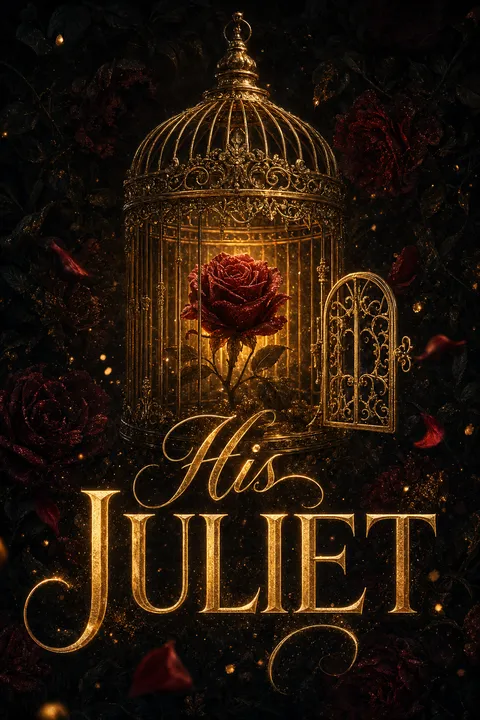


Plot Summary
Hostage Among the Bookshelves
Chased through rainy Manhattan by an Albanian assassin, a charismatic mafia underboss1 ducks into an unlocked bookstore after hours and finds its manager2 frozen mid-bite over her dinner. He confiscates her phone, shields her when someone rattles the door, and calms her panic attack by eating her pizza and holding her hands. To pass the hours they play truth or dare.
When they trade names, the cosmic joke lands: he is Romeo,1 she is Juliet.2 She draws a childish heart on his chest with her name inside; he keeps it like a brand. Each confesses a private guilt, his for failing to save his father, hers for a lost friend, and the stranger who terrified her1 becomes, impossibly, the safest person she has met in years.
The opening weaponizes coincidence (the Shakespearean names) to signal the book's self-aware romance-fable mode. Danger functions paradoxically as comfort for Juliet, whose trauma has inverted her threat response: chaos steadies her while ordinary life suffocates. Romeo's compulsive feeding and hand-holding introduce his caretaking as both tenderness and control. The temporary tattoo becomes a covenant, foreshadowing permanent ink. By staging intimacy inside a locked, dark bookstore, the narrative establishes enclosure as safety, a motif that will later curdle when enclosure becomes captivity. Two grief-shaped people recognize each other across a counter.
The Monster in the Basement
Away from Juliet,2 Romeo's1 real life sharpens into focus. Working as second-in-command to Matteo,3 the New York Don, he leads a raid on an Albanian-linked Midtown club and discovers six emaciated women chained in a hidden cellar, plus one dying girl locked in a closet whom his soldier Angelo7 carries out.
Afterward Romeo1 interrogates the captured men, learning the Butcher,4 boss of Europe's largest Albanian clan, has stepped into the leadership vacuum to import sex slaves.
Romeo1 tortures and kills, feeding an inner violence he calls his monster, yet vengeance leaves him hollow. The brokenness in the rescued girls' eyes mirrors his mother's14 after his father's murder, and only the memory of green eyes and pink-tipped hair2 quiets the storm inside him.
This section fractures the playboy mask, revealing the trauma engine beneath Romeo's charm. The trafficking horror grounds the mafia fantasy in genuine moral stakes, giving his brutality an ethical alibi while refusing to sanitize it. His dissociative monster is framed psychologically, a survival adaptation forged the day he found his tortured mother, rehearsing the book's central wound: powerlessness to protect. Crucially, revenge fails to satisfy, establishing that violence cannot metabolize grief. Only Juliet can. The parallel between captive women and his damaged mother threads shame through his heroism, complicating the reader's easy consumption of his lethality.
An Impossible Friendship Proposal
Unable to shake her, Romeo1 returns to the bookstore under the pretense of needing a book recommendation, glaring at any customer who eyes her and refusing to leave when the store closes. He orders takeout so they can eat on the floor again, and while cleaning up he spots the Empire Properties rent-increase letter, secretly resolving to fix it since he is the company's CFO.
Torn between desire and the certainty that his world would endanger her, he texts a compromise at one in the morning: they should be friends. She accepts, admitting she has few friends left. He walks her to her rundown apartment, warns off the drug dealers loitering outside, and drives home wanting far more than friendship.
The friendship offer is self-deception dressed as restraint, a man negotiating with his own obsession. Romeo's territorial displays over harmless customers expose possessiveness as his love language, while his covert intervention in her rent reveals control masquerading as generosity, a pattern that will dominate their courtship. The chapter dramatizes the fantasy of being seen and provided for, catnip to an orphan who has learned to expect nothing. Juliet's frank admission of loneliness raises the emotional stakes: this is not casual for her. The gap between their worlds is stated plainly, planting the tension that eventually detonates.
One Block Off the Map
Arriving one morning with breakfast, Romeo1 walks Juliet2 toward the shop until construction forces them off her single memorized route. She freezes, dizzy and hyperventilating, and finally confesses the secret she has hidden from everyone: agoraphobia has shrunk her world to a bagel shop, a bodega, and one path to work.
Instead of pity, Romeo1 offers a choice and a promise to turn back the instant she panics. Talking her through the unfamiliar block, distracting her with questions about her books, he keeps his body between her and the crowd until they reach the store. She weeps at how significant this small crossing is, and he treats her bravery as monumental, learning the exact shape of her fear.
Disclosure is the true intimacy here, more exposing than any physical act. Juliet's agoraphobia is rendered with clinical precision, panic as a body hijacked, and the narrative resists cure-by-love fantasy: Romeo does not fix her, he accompanies her. His refusal to shame her rewrites her expectation that vulnerability invites abandonment. The single safe route becomes a poignant emblem of trauma's economy, survival purchased by radical shrinkage. That he grasps the magnitude of one deviated block signals emotional attunement rare in the genre's alpha archetype, distinguishing devotion from mere domination and deepening the reader's investment in his tenderness.
Gifts From a Secret Benefactor
Romeo1 escalates his covert caretaking. He has Sienna5 reverse Juliet's2 rent hike through Empire Properties, breaks into her apartment to photograph clothing tags, and sends a wardrobe of luxurious winter clothes plus lingerie he chose himself. He installs surveillance cameras outside her building to watch her come and go, tells the stoop dealers his name to keep them away, and sends pizza to make up for the slice he once stole.
Late-night phone calls become ritual, confessions traded in the dark about insomnia, nightmares, and his crocheting hobby. During a slow day, women named Sienna5 and Sofiya6 visit the shop on false pretenses, sizing up the girl who has captured him, and promise to attend her first author signing.
This montage of provision reveals the seductive danger at the book's heart: surveillance framed as love. Cameras and break-ins would read as violation in another story, but the narrative recodes them as protection, inviting the reader to enjoy the fantasy while quietly flagging its ethics. Romeo's anonymous generosity satisfies Juliet's starvation for care without forcing her to feel indebted, a psychology of a giver who fears rejection more than exposure. The women's reconnaissance visit stitches Juliet toward found family. The tension between his secrecy and her ignorance accumulates like debt, guaranteeing a reckoning once she learns who her guardian really is.
Chicago and the Bratva Bargain
Because Matteo3 will not leave his heavily pregnant wife Sofiya,6 he sends Romeo1 to Chicago to broker help against the Albanians from Dimitri Ivanov,10 the new Russian Pakhan and Sofiya's brother.
Romeo1 trades New York trade-route access for Bratva soldiers, endures Dimitri's10 underground fight club and sex club, and hides that he is aching for Juliet.2 Matteo,3 who has already deduced the secret girlfriend, extracts a confession and punishes Romeo's1 earlier abandonment of a post.
Mid-negotiation, catastrophe: the Butcher4 has placed a hit on Sofiya6 and Sienna.5 Romeo1 rushes home with Bratva reinforcements, only for a subsequent apartment raid to eliminate most Albanian soldiers while the Butcher4 himself vanishes, then reportedly flees to Albania entirely.
The geopolitical machinery of alliances externalizes the couple's core problem: can Romeo integrate love with a life built on threat. Dimitri's decadent clubs mirror what Romeo used to want and no longer does, charting his transformation through contrast rather than declaration. Matteo's discovery collapses Romeo's compartmentalization, forcing the personal into the professional. The hit on the women weaponizes the reader's affection for the found family and manufactures the excuse Romeo will use to push Juliet away. The Butcher's ghostlike evasions build him into an almost supernatural antagonist, seeding the later revelation that explains his impossible ubiquity across two continents.
Christmas, and Everything Confessed
Learning the Butcher4 was spotted in Albania and believing the threat gone, Romeo1 shows up at Juliet's2 door on Christmas in an ugly sweater, refusing to let her spend it alone. He installs a TV and gaming system, teaches her Mario Kart, and they finally sleep together, her first willing intimacy in years.
Afterward she does yoga to manage the overwhelm and tells him the truth: two years earlier a man named Chase drugged and raped her, and that same night her best friend Breanna died by suicide after Juliet2 missed her call. The guilt fused her agoraphobia and self-harm. Romeo1 insists none of it was her fault, quietly files away the rapist's name, and holds her through the confession.
The physical union is deliberately entangled with disclosure, sex as the doorway to buried grief rather than its escape. Juliet's story reframes her symptoms as consequences, not defects, and the narrative's careful consent choreography (lights off, her control over pace) becomes therapeutic reparenting. Her survivor's guilt over Breanna operates by the same false logic as Romeo's guilt over his father, positioning the couple as mirror wounds who can only heal reciprocally. Romeo's silent cataloguing of Chase converts his monster into an instrument of her justice, aligning his violence with love. Christmas, the archetypal family holiday, underscores what the orphan has never had.
Blood on the Forest Trail
Driving upstate with Sienna5 to fetch a nursery rocking chair, Romeo1 is ambushed by Albanian gunmen who shoot out the tires and demand the pair be taken alive. He crashes the SUV, drags a glass-cut Sienna5 into the woods, and defends her while she shoots one attacker dead.
Then Romeo1 comes face to face with the Butcher4 himself, who is supposed to be in Albania, smiling and refusing to shoot, clearly wanting hostages rather than corpses. Romeo1 wounds his hand but the Butcher4 escapes into the trees. Back home, Matteo,3 convinced there is a traitor, strips his loyal hacker Franco12 of duties and puts him under house arrest, then orders Romeo1 to either commit fully to Juliet2 or cut her loose for her safety.
The ambush proves the danger is not theoretical and the Butcher's impossible presence deepens the mystery of his omnipresence, teasing a hidden mechanism. His insistence on capture rather than killing signals leverage-seeking, quietly foreshadowing that Juliet, not Romeo, is the prize. Sienna's kill complicates the found-family women as capable rather than ornamental. Matteo's paranoia about Franco introduces the possibility of betrayal from within, echoing past treachery and generating dramatic irony, since the true manipulator is elsewhere. The ultimatum crystallizes Romeo's dilemma into a binary he cannot dodge, propelling the tragic misjudgment that follows.
Cruelty at the Bakery
Trying to protect Juliet2 by distance, Romeo1 lies that he is back in Chicago. Meanwhile Juliet,2 chasing his earlier encouragement, bravely walks two blocks off her route to the Italian bakery he once mentioned, her first new place in two years. She finds him there mid-meeting with Serbian mobsters and rushes over glowing.
To keep the dangerous men from marking her as leverage, Romeo1 pretends not to know her and coldly dismisses her while the Serbians mock her weight. Devastated, she flees, gets lost, and suffers a brutal panic attack at home. Believing everything he offered was pretense, she relapses into cutting. Alerted by Sienna5 that Albanians are circling her building, Romeo1 races over and finds her bleeding on the bathroom floor.
This is the book's emotional nadir and its most honest reckoning with the cost of protective deception. Romeo's public denial, however strategically motivated, replicates precisely the abandonment Juliet's history has taught her to expect, proving that intention cannot neutralize impact. Her triumphant act of courage curdling into self-harm dramatizes how fragile hard-won progress is when trust is withdrawn. The Serbians' fatphobia externalizes her internalized worthlessness. The scene interrogates the alpha-protector fantasy itself: shielding someone by wounding them is still wounding them. Finding her bleeding forces Romeo to confront that his secrecy, not his enemies, delivered the blow.
The Truth and the Move
In the aftermath, Romeo1 bathes her, tends the cuts, and reveals everything: he is the underboss of the Italian mafia and sex traffickers are watching her apartment.
He offers his own chest to her razor rather than let her cut herself, then moves her into his guarded building despite her terror of elevators, easing it with Sofiya's6 golden retriever Noodle. He prints her a coping-skills list, buys period supplies and heating pads, and reveals the punishment beating Matteo3 gave him for abandoning his post to protect her.
Learning why he was bruised undoes her, but he insists he would choose her every time. Surrounded by Sofiya,6 Sienna,5 and Angelo,7 Juliet2 slowly gains a found family, and the couple exchange their first spoken declarations of love.
Confession dissolves the deception that nearly destroyed them, replacing curated safety with radical honesty. The razor exchange is a startling gesture, Romeo literalizing his willingness to absorb her pain, a dark inversion of caretaking that the narrative frames as devotion rather than pathology. Relocation trades her fragile autonomy for protected dependence, an ethically knotty bargain the book stages as rescue. The coping list signals that he wants to support her recovery, not simply contain her. Discovering the punishment reframes his bruises as proof of prioritization, and the mutual declaration marks her arrival into belonging, the orphan finally chosen and kept.
Justice for Chase, Jealousy Over Leona
Romeo1 tracks down Chase, the man who drugged and raped Juliet,2 and kills him slowly, carving RAPIST into his chest as his monster feeds. He hides the deed from her, fearing she would see the darkness his mother14 once recoiled from. Then Matteo3 dispatches him to Boston to recruit Leona Byrne,11 the Irish mob's top assassin, to hunt the elusive Butcher,4 the price being Romeo's1 help stealing a piece of art.
Days apart stretch into silence, and Juliet2 stumbles on a tabloid photo of Romeo1 dancing with the stunning redheaded Leona,11 reigniting every insecurity that she cannot belong in his glamorous world. Sienna5 reassures her nothing is happening, but old abandonment wiring makes the comfort bounce off.
Chase's execution completes Romeo's transformation of violence into service, delivering the vigilante justice the legal system denied a frightened survivor, a wish-fulfillment the genre thrives on while raising uneasy questions about who deserves to die. His concealment reveals the shame anchoring his monster: he equates his capacity for brutality with unlovability, rooted in his mother's remembered horror. Leona introduces a jealousy subplot that tests Juliet's fragile self-worth rather than the relationship's fidelity, keeping the true threat internal. The tabloid misreading demonstrates how trauma corrupts interpretation, turning innocent images into evidence of inevitable loss.
Taken From the Fire Escape
With Romeo1 delayed in Boston completing Leona's11 heist, Albanians cut power to the entire building, disabling every alarm. Men wake Juliet2 with handcuffs, gag and hood her, and drag her down the fire escape past a downed guard, threatening to kill Sienna5 next door if she resists. They haul her through abandoned subway tunnels beneath the city, zip her into a duffel bag, and load her onto a private plane.
Romeo1 arrives to a dark apartment and Matteo's3 grim confirmation that she is gone, a copy of Romeo and Juliet left open on the bed to a passage about death. Franco,12 aided by Sienna,5 traces a plane bound for Tirana, and Romeo's1 world collapses into the same helplessness he felt the day his father died.
The abduction realizes the dread that has shadowed every safe room and camera: enclosure offers no true immunity. The underground tunnels retroactively explain the Butcher's ghostly mobility, a satisfying mechanical payoff to a long-teased mystery. Juliet's hooded transit through darkness resurrects her childhood closet trauma, collapsing past and present into one continuous terror. The planted play text is the antagonist's literary sadism, taunting the couple with their tragic namesakes and daring fate to fulfill the original ending. For Romeo, her disappearance reactivates his foundational wound, and the narrative positions the rescue as his chance to rewrite history rather than repeat it.
The Mafia Princess Revealed
On the plane, the Butcher4 unmasks the truth: Juliet2 is not Juliet Smith but Juliet Leka, daughter of the rightful Albanian Krye whom he murdered when she was two, hidden in a closet during the killing. He is her uncle, one of secret triplets, and she is the clan's princess, the answer to his war. He claims Romeo1 delivered her to him, poisoning her faith.
In captivity a stray kitten she names Queenie13 keeps her tethered to sanity. A woman named Elira8 slips in warning her not to drink the wedding raki because it is poison. Dressed in a blood-red gown, Juliet2 is forced through a marriage to the Butcher's4 brutal new second, Spiro Abazi,15 then poisoned at the reception when Spiro15 pours the raki down her throat.
The parentage twist retrofits Juliet's entire life, recasting random orphanhood as targeted erasure and elevating her from rescued object to political prize. The Butcher's lie about Romeo's betrayal is psychological warfare, aiming to sever her only anchor of trust precisely when she most needs it. The triplet reveal ingeniously resolves the two-continent impossibility. Queenie functions as a fragile lifeline, externalizing Juliet's will to survive. Elira's cryptic warning introduces a hidden female counter-conspiracy, hinting that the wedding is theater. The forced marriage and poisoning weaponize the Romeo and Juliet parallel, steering toward apparent tragedy so the subversion can land.
The Women's Coup in Albania
Romeo,1 Matteo,3 and Leona11 storm the castle to find Juliet2 seemingly dead beside a slaughtered Spiro,15 and Romeo,1 gutted, mutilates the corpse before Leona11 pulls him toward the great hall. There they discover over a hundred women standing calmly among hundreds of dead men.
Elira Leka,8 Juliet's2 aunt, reveals herself as architect of the entire coup: she engineered the unencrypted call, leaked the wedding, planted the hacker Arta who fooled everyone, and mass-poisoned the clan's men to seize power.
She holds the only antidote, using it as leverage for an alliance made not with Matteo3 but with Juliet,2 the true princess. Romeo1 administers it and Juliet2 revives, Queenie13 curled on her chest. He then hunts down and butchers both surviving Butcher triplets.4
The reveal flips the entire abduction arc into a liberation narrative authored by women, subverting the damsel structure by making Juliet's female relatives the true power brokers who despise dealing with men. Elira's ruthlessness, poisoning her own husband to prove a point, marks her as morally ambiguous rather than heroic, complicating any tidy triumph. Romeo's premature grief and desecration of Spiro's body dramatize love as annihilating rage, his monster fully unleashed by loss. The antidote-as-leverage forces the alliance the plot has been building toward. Juliet's resurrection literalizes the anti-tragedy thesis: these star-crossed lovers refuse the ending their names promise.
Marked, Chosen, and Wed
Home in a new apartment cleared of bad memories, Juliet2 recovers with Romeo,1 Queenie,13 and their found family. They negotiate an alliance with Elira's8 coalition to free the remaining trafficked women, with Sienna5 apprenticing under the hacker Arta.
Romeo1 proposes with a starburst ring, injects a GPS tracker into her arm and shows her his matching one, and tattoos her name over his heart along with angel across his knuckles. On a flower-covered rooftop, with Matteo3 walking her down the aisle, his mother Allegra14 and her partner Francesca present, and Arturo9 officiating, they marry.
Romeo1 reconciles with his mother,14 who reveals she was never horrified by him, only afraid for him. Juliet2 claims her family at last and calls their happy ending only the beginning.
The resolution converts every earlier motif into affirmation: the tattoo that began as washable ink becomes permanent, surveillance becomes consensual mutual tracking, and enclosure becomes chosen sanctuary. The maternal reconciliation dissolves Romeo's founding shame, revealing his self-hatred was projection all along, love mistaken for revulsion. Juliet's agoraphobia is not cured but held, honoring realistic recovery over magical fix. The women-led alliance and the rescue of trafficked survivors give the romance a communal ethic beyond the couple. Marrying a Romeo and Juliet explicitly named against their doomed template, the book insists that trauma need not dictate destiny when someone stays.
Analysis
His Juliet reworks the star-crossed lovers legend into a trauma-recovery fantasy where the tragedy is refused rather than fulfilled. The novel's animating question is whether a person shaped by violence and abandonment can integrate love without destroying the beloved, and it answers through two mirror-wounded people whose parallel survivor guilt, Romeo1 over his murdered father, Juliet2 over her friend Breanna, can only be metabolized reciprocally. The book's most interesting tension is ethical: it presents surveillance, break-ins, covert financial control, and even a subcutaneous tracker as expressions of devotion, inviting the reader to enjoy possessive protection while the narrative quietly acknowledges its coercive edges. This is the dark-romance bargain, and the text negotiates it by insisting on consent within intimacy even as it romanticizes control outside it. Mental illness is treated with unusual seriousness for the genre; agoraphobia and self-harm are neither cured by love nor used as decoration but held as ongoing conditions requiring accompaniment, and the epilogue's refusal to magically fix Juliet2 honors that realism. The Butcher's4 trafficking operation supplies genuine moral stakes that launder the heroes' brutality, while the late-breaking revelation of Juliet's2 hidden lineage converts random orphanhood into targeted erasure, granting her retroactive significance and agency. The women-led coup subverts the damsel structure, relocating power to a coalition of women who disdain negotiating with men, though Elira's8 willingness to poison her own husband keeps triumph morally ambiguous. Ultimately the book argues that found family, chosen and fought for, can overwrite biological catastrophe, and that being truly seen, darkness and all, is the only antidote to shame. Its recurring images, the washable tattoo made permanent, enclosure transformed from cage to sanctuary, dramatize the thesis that trauma need not dictate destiny when someone refuses to leave.
Review Summary
His Juliet is the second book in the Empire of Royals mafia romance series, receiving mixed reviews. Many readers loved the mental health representation, particularly Juliet's agoraphobia and trauma, and praised Romeo's devoted, caretaking nature. Fans of the series enjoyed the found family elements and connections to the first book. Critics felt the story was repetitive, relied too heavily on insta-love, and that Juliet lacked development beyond her trauma, with some finding her too dependent on Romeo for her healing journey.
Characters
Romeo De Luca
Charming mafia underbossSecond-in-command to the New York Don3 and CFO of a legitimate front company, Romeo is a thirty-eight-year-old playboy whose jokester charm is deliberate camouflage for a violent inner self he calls his monster, forged the day he found his tortured mother14 and murdered father. Loyal to the point of self-sacrifice, he cultivates being underestimated. His obsessive, possessive devotion to Juliet2 manifests as relentless caretaking, surveillance, and gift-giving, expressions of a man who fears his darkness makes him unlovable. Beneath the swagger lie insomnia, nightmares, and a tender streak that crochets to soothe himself. He is driven by a need to protect what he loves and by guilt over those he could not save.
Juliet
Agoraphobic booksellerA woman in her mid-twenties who manages the Olive Branch Bookshop, Juliet has survived foster care, the murder of her parents, a drugging and rape, and the suicide of her best friend Breanna. These compounding traumas have collapsed her world into a handful of safe places and a single walking route, her agoraphobia policing every step. She copes through self-harm, reading, and dyeing pink into her hair, one of the few things that makes her feel pretty. Sharp-tongued and secretly funny beneath crippling insecurity, she experiences danger as strangely calming and stability as threatening. Starved for love and convinced she is unworthy of it, she is braver than she believes, inching toward the self she was before fear swallowed her.
Matteo Rossi
The reigning DonHead of the New York Italian mafia and Romeo's1 brother in all but blood, Matteo is the feared Angel of Death who won his empire after his uncle murdered his father. Stern, controlling, and pathologically protective of his pregnant wife Sofiya6 and sister Sienna5, he softens only for family. His new fatherhood chafes against his need for control, and his loyalty to Romeo1 runs deeper than his authority, though he enforces discipline without exception.
The Butcher
Ruthless Albanian bossKrye of Europe's largest Albanian clan, the Butcher earned his name skinning prey as a boy and later his enemies. Attempting to seize New York for sex trafficking, he proves an uncatchable ghost who taunts his rivals. Cold, theatrical, and sadistic, he treats human beings as instruments and family as a tree to be pruned, hiding secrets that reshape the entire conflict.
Sienna
Hacker little sisterMatteo's3 younger sister and a brilliant hacker kept out of Family business by her overprotective brother, Sienna is warm, mischievous, and design-obsessed. She becomes Romeo's1 co-conspirator in his covert gifts to Juliet2 and one of the first to welcome her into the fold, hungry to prove her worth and to gain a sister and friend.
Sofiya
The Don's baker wifeMatteo's3 pregnant wife and Dimitri Ivanov's10 sister, Sofiya is a nurturing baker who runs safe houses for trafficked women and teaches at the gun range. Living with hypermobile Ehlers-Danlos, she uses a wheelchair and rollator. Kind and disarmingly funny, she anchors the found family and gently draws Juliet2 into belonging.
Angelo
Gentle bodyguard soldierSofiya's6 devoted bodyguard, raised in a loving Family household, Angelo rose through the ranks despite Romeo's1 early doubts about his softness. Perceptive and quietly kind, he carried a dying girl named Anya from the trafficking cellar and harbors his own guarded feelings, offering Romeo1 steady loyalty and uncomfortably accurate observations.
Elira Leka
Juliet's mysterious auntA commanding woman with green eyes like Juliet's2, Elira leads a hidden coalition of Albanian women who despise dealing with men. Calculating, patient, and willing to sacrifice pieces for the larger board, she orchestrates events with chilling precision, insisting alliances flow only through her niece2, the rightful princess by blood.
Arturo
Fatherly bookstore ownerThe retired owner of the Olive Branch Bookshop, tied to the Family through his smuggler ancestors, Arturo treats Juliet2 like a granddaughter, feeding her tupperware meals and giving her purpose. Mild-mannered but fiercely loving, he offers protection and a rare paternal warmth.
Dimitri Ivanov
New Russian PakhanSofiya's6 estranged brother and head of the Bratva, Dimitri is a scarred, brass-knuckled powerhouse who negotiates a hard bargain for trade routes and soldiers. Mysterious about his lost decade, he cares for his sister while ruling with intimidating force.
Leona Byrne
Irish assassin heiressThe Irish mob's top assassin, spy, and thief with fiery red hair, Leona is glamorous, wild, and lethally competent. Owing the Don3 a favor, she helps hunt the Butcher4 and pulls Romeo1 into an art heist, unimpressed by his brooding and amused by his lovesickness.
Franco
Reclusive Family hackerMatteo's3 longtime top hacker, quiet and cave-dwelling, whose loyalty stretches back to the old Don's era. Repeatedly bested by the Albanians, he falls under suspicion of betrayal despite having saved Romeo's1 life more than once.
Queenie
Loyal captive kittenA tiny black kitten with four white socks who appears in Juliet's2 Albanian cell, becoming her lifeline to sanity and later her spoiled, tiara-wearing companion, a small warm proof that tenderness survives even in cruel places.
Allegra De Luca
Romeo's estranged motherRomeo's1 Italian mother, widowed when his father was murdered and tortured herself, now living in Italy with her partner Francesca. Warm and grieving, she has long believed her son1 pulled away because of something she did wrong.
Spiro Abazi
The forced groomThe Butcher's4 brutal new second-in-command, chosen to marry Juliet2 and cement the clan's claim. Leering and violent, he views his bride2 as property to be taken.
Plot Devices
The Shakespearean names
Ironic tragic templateThe lovers literally share the names Romeo1 and Juliet2, a coincidence played first for banter and flirtation, then weaponized by the antagonist4 who leaves a copy of the play open to a death passage after the abduction. The device sets up an expectation of tragedy that the narrative deliberately subverts, with Juliet's2 apparent poisoning death echoing the original before her revival rewrites the ending. It functions as both a running joke and a structural promise, letting the book flirt with doom while ultimately insisting these star-crossed lovers refuse their namesakes' fate, converting a byword for tragedy into a declaration of survival and chosen happiness.
The subway map book
Hidden mobility explainedEarly on, a huge scarred stranger4 buys a book on New York's historic subway tunnels from Juliet's2 shop. This seemingly throwaway sale later proves to be the mechanism behind the Butcher's4 ghostly ability to traverse the city undetected, moving men and victims through forgotten underground passages beneath all surveillance. The device rewards attentive readers, retroactively charging an innocent transaction with menace, and it also delivers the gut-punch that Juliet2 unknowingly aided her own future captor4. It exemplifies the book's setup-and-payoff craftsmanship, transforming a minor character beat into the logistical spine of the antagonist's4 impossible omnipresence and tightening the thematic knot between her ordinary life and the criminal world.
The temporary tattoo
Escalating covenant motifOn their first night, Juliet2 draws a childish heart with her name inside on Romeo's1 chest using a Sharpie, and he treasures the mark as though it belongs there. This casual gesture becomes a recurring emblem of belonging that pays off spectacularly when Romeo1 permanently tattoos her name over his heart, adds angel across his knuckles, and inks a rose. The device tracks the relationship's arc from playful improvisation to permanent commitment, externalizing Romeo's1 need to be visibly and irreversibly claimed by the woman who quiets his darkness2. It also inverts the surveillance motif into consent, culminating alongside mutual GPS trackers as chosen, reciprocal marking rather than control.
Self-harm and coping list
Trauma made concreteJuliet's2 cutting, panic attacks, and agoraphobia are rendered as literal physical events rather than abstractions, and Romeo's1 response, a printed coping-mechanisms list annotated with orgasms, cuddles, and stolen baked goods, plus offering his own chest to her razor, dramatizes love as trauma-informed accompaniment rather than cure. The device grounds the fantasy in genuine mental-health representation, letting the reader feel both the seduction of being cared for and the reality that recovery is halting and lifelong. It also links the two leads, whose parallel guilt over people they could not save operates by identical false logic, making healing something they can only accomplish by absorbing and witnessing each other's pain.
The wedding poison
Staged death reversalAt the forced Albanian wedding, men drink shots of raki that Elira8 secretly warns Juliet2 not to touch, and Spiro15 forces some down Juliet's2 throat. The poison collapses heart rates to imperceptible faintness, producing apparent mass death, including Juliet2, whom Romeo1 believes dead. The antidote, held only by Elira8, becomes the leverage that forces an alliance and resurrects Juliet2 at the last moment. The device engineers the book's central subversion of its tragic template, letting grief and rage crest before relief, while revealing the women's coup as the true engine of events. It fuses the Romeo and Juliet death-and-waking motif with mafia power politics into one climactic reversal.
Download PDF
Download EPUB
.epub digital book format is ideal for reading ebooks on phones, tablets, and e-readers.








































