Key Takeaways
1. Our Innate Capacity for Compassion is Undermined by Four Barriers
Now that view is challenged by a growing recognition that innate capacities for care, empathy, nurturing, and compassion are part of our human nature and have been crucial for the evolutionary survival of our species.
Innate goodness. Humans possess an inherent capacity for care, empathy, and compassion, deeply ingrained through evolution and vital for our survival. This challenges older views of human nature as solely selfish, highlighting our spontaneous inclination to help and connect, evident even in infants. However, this innate capacity is often obscured by psychological barriers that prevent its full, sustainable, and inclusive manifestation.
Four key barriers. These internal obstacles limit our ability to consistently access and extend compassion:
- Lack of a secure base: An absence of inner safety and self-worth makes it difficult to be present to others lovingly.
- Reductive thoughts: Mistaking our limited impressions of others for their true selves, fostering bias and hindering genuine concern.
- Aversion to suffering: Experiencing suffering (in self or others) as a source of fear or anxiety, rather than a call for compassion.
- Feeling alone in suffering: Believing our pain isolates us, disconnecting us from universal loving-kindness.
Impact on well-being. These barriers contribute to stress, anxiety, hostility, loneliness, and self-loathing, leading to depletion and burnout in caring roles. Overcoming them is crucial for personal healing, fostering deeper relationships, and empowering sustainable compassionate action in the world.
2. Cultivating a Secure Base is Essential for Sustainable Compassion
To experience themselves and their world as wholly encompassed in love, compassion, and wisdom has empowered practitioners of these traditions to connect with the source of those qualities in the ground of their being and to extend the same power of love and compassion to others.
Foundational security. A secure base, whether external or internal, is paramount for developing sustainable and inclusive compassion. It provides the inner safety, self-worth, and well-being necessary to engage with the world and others without being overwhelmed by fear or neediness. This concept, rooted in attachment theory, highlights how consistent, responsive care fosters the capacity to care for others.
Three levels of secure base. Sustainable Compassion Training (SCT) identifies three interconnected levels:
- Outer secure base (outer refuge): The experience of being held in unconditional love, compassion, and wisdom by a "field of care" (e.g., caring figures, spiritual mentors, or a divine presence).
- Inner secure base (inner refuge): The qualities and loving energies evoked from our own awareness by the outer refuge, increasingly recognized as inherent powers within us.
- Ultimate secure base (ultimate refuge): The deepest nature of mind (buddha nature)—an unconditioned dimension of infinite openness, clarity, and vast capacity—as the ultimate, inexhaustible source of love and wisdom.
Empowering transformation. This deepening sense of security allows us to relax our self-protective grip, heal emotional wounds, and trust the boundless source of compassion within. It enables us to extend care to others from a place of replenishment, rather than depletion, fostering resilience against empathic distress and burnout.
3. The Receptive Mode: Accessing Innate Love Through a Field of Care
By reinhabiting any such time of caring connection repeatedly and experiencing its loving energies and qualities again and again, the practitioner strengthens their secure base.
Reconnecting with care. The receptive mode is the initial step in SCT, designed to access our innate capacities for love and compassion by recalling and reinhabiting experiences of being held in unconditional care. This isn't merely a memory; it's a deeply embodied reliving that activates neural patterns associated with warmth, acceptance, and inner safety.
Diverse access points. A "field of care" can be invoked through various means, catering to individual backgrounds:
- Caring moments: Reliving a time someone lovingly saw, supported, or took joy in you (e.g., a parent, friend, or even a pet).
- Benefactors: Bringing to mind someone who has inspired or blessed your life through their presence, wisdom, or work.
- Spiritual field: Invoking a divine presence, spiritual ancestors, saints, or a sacred aspect of the natural world that embodies unconditional love.
- Being a loving presence: Recalling a moment when you were a source of loving care for another, activating those qualities within yourself.
Healing and unblending. This practice helps us "unblend" from narrow, self-limiting identities and attachment scripts that dismiss or distrust care. By accepting the loving energies into our whole being, we create a healing environment where difficult thoughts and feelings can relax, metabolize, and release, revealing the unconditional capacity for love inherent in our basic awareness.
4. The Deepening Mode: Unifying with Our Buddha Nature for Inner Freedom
This depth of our mind, often referred to in Buddhist traditions as our buddha nature, is our ultimate secure base.
Beyond the surface. The deepening mode builds on the receptive mode, guiding us to settle more fully into the expansive, nondual awareness that is the source of all loving qualities—our "buddha nature." This is our most natural state of being, prior to social conditioning, characterized by openness, clarity, simplicity, and vast compassionate capacity. It's the inner expanse evoked by moments of awe in nature.
Compassionate Presence to Feelings. A key practice in this mode is learning to welcome all feelings (pleasant, unpleasant, neutral) into a compassionate space, without judgment or agenda. This "third way" of relating to emotions—neither suppressing nor acting out—allows them to naturally relax, settle, and heal, revealing the underlying warmth and peace within their essence. This practice transforms our relationship with our inner world, making us safer with our own emotions.
Letting Be of Body, Breath, and Mind. This meditation cultivates tranquil abiding by allowing the body, breath, and mind to settle naturally into their inherent openness and clarity. It involves:
- Relaxing goals: Releasing the mind's habitual striving and conceptualization.
- Panoramic awareness: Opening senses to the pervasive background of awareness, like the sky.
- Non-dual recognition: Moving beyond subtle subject-object duality to glimpse the unconditioned, empty, and lucid nature of mind.
Ultimate secure base. This deepening process reveals buddha nature as the ultimate secure base, an inexhaustible source of replenishment and inner freedom. It allows us to hold any identity lightly, responding to others with greater flexibility, discernment, and compassion from this profound depth.
5. Compassionate Presence to Feelings: A Healing Path for Our Emotions
The Compassionate Presence to Feelings Meditation offers a third way for relating to our feelings that is new to many of us—neither to suppress nor act out painful emotions but to become more fully aware of them in a kindhearted way that provides the welcoming space they need to feel safe, relax, settle, and metabolize themselves in their own way—ultimately a space of deep healing and releasing that opens our perspective on self and others.
A new way to relate. This meditation teaches us to approach all our feelings—physical and emotional, subtle or strong—with unconditional acceptance and warmth. Instead of the common reactions of suppressing, ignoring, or acting out emotions, we learn to create a spacious, compassionate holding environment for them. This allows feelings to naturally relax, settle, and heal without being fueled by our reactions.
Four principles for practice:
- Notice: Identify the predominant feeling in your body or mind.
- Allow: Give the feeling all the space it needs to be, without trying to change it.
- Rest: Abide with or within the feeling spaciously.
- Let be: Release all agendas, allowing everything to settle naturally.
Transformative effects. This practice has profound benefits:
- Healing: It transforms us into an unconditional holding environment, allowing deep relaxation and healing.
- Essence love: It uncovers the inherent warmth, peace, and spaciousness (essence love) hidden within our feelings.
- Inner steadiness: It cultivates equanimity, reducing fear of our own emotions and those triggered by others.
- Compassionate presence to others: Our ability to be present to our own feelings with openness directly enhances our capacity to be present to others' feelings.
Reappraising suffering. This meditation helps us reappraise difficult feelings not as obstacles, but as opportunities for awakening. By becoming compassionately present to them, we transform them into resources for inner healing and deeper connection.
6. The Inclusive Mode: Extending Unconditional Love to All Beings
The inclusive meditation always begins with reconnecting to our field of care, to reestablish our secure base of unconditional love and compassion.
Expanding the circle of care. The inclusive mode extends the healing and deepening experienced in prior modes to encompass all beings. It begins by re-establishing our secure base through the field of care, then allows that loving environment to expand outward, embracing others as if they were parts of our greater self. This cultivates a vast, unconditional love that transcends superficial judgments and in-group boundaries.
Communing with depth. This practice encourages us to:
- Sense others' buddha nature: Perceive others in their profound dignity, worth, and vast underlying potential, beyond reductive labels.
- Resonate with suffering: Acknowledge and empathize with their hidden layers of struggle, fear, and pain, recognizing our shared humanity.
- Wish deepest well-being: Extend a heartfelt desire for their complete freedom from suffering and the actualization of their positive capacities.
Overcoming bias. The meditation specifically addresses the challenge of extending love to strangers and those we dislike. By noticing our limiting images and the self-centered goals that create them, we can "unblend" from these narrow perspectives. This opens our perception to the "three samenesses" we share with all beings: the wish for happiness, the capacity for goodness, and the experience of suffering.
Thorough and vast love. The practice cultivates a love that is both thorough (permeating their whole being) and vast (encompassing all creatures). This boundless love harmonizes us with the infinite openness and limitless capacity of our mind's deep nature, making us an extension of a universal field of care.
7. Four Factors of Compassion: Love, Empathy, Will, and Wisdom
Compassion, as defined here, has four aspects: (1) deep loving care for beings, (2) empathic concern for them in their suffering, (3) a strong wish that wills their freedom from the causes of the suffering as a basis for action, and (4) wisdom.
Holistic compassion. True compassion is a multifaceted force, not merely a fleeting feeling. It integrates four essential factors that, when cultivated together, create a powerful, sustainable, and inclusive orientation towards alleviating suffering. These factors are mutually reinforcing, each strengthening the others.
The four factors:
- Loving care: A fundamental sense that all persons are dear and worthy of unconditional care, wishing them profound well-being.
- Empathic concern: Resonating with others in their suffering, sensing and imagining their experience, extending beyond obvious pain to hidden struggles.
- Compassionate will: A strong, active wish for others to be free from suffering and its causes, motivating responsive action.
- Wisdom: The discerning insight that undercuts the three restrictive tendencies of compassion:
- Seeing beyond limiting labels to recognize everyone's full personhood.
- Awareness of universal, hidden layers of suffering in all beings.
- Knowing that suffering is not the ultimate reality, but can heal within unconditional awareness.
Beyond depletion. This integrated approach to compassion guards against empathic distress and burnout. By grounding our care in wisdom and an expansive sense of self, we transform the pain of empathy into a powerful, outward-directed energy for action, rather than internalizing it as personal suffering.
8. Transforming Suffering into Compassion Through Tong-len Practice
Tong-len expresses a profound form of reappraisal at the heart of Tibetan Buddhism. It involves reevaluating our ordinary, day-to-day experience as an opportunity for awakening and reengaging it in ways designed to bring out powers of love, compassion, and wisdom from our buddha nature in an increasingly sustainable and unconditional way.
Suffering as a gateway. Tong-len, a core Tibetan Buddhist practice, offers a radical reappraisal of suffering, transforming it from an isolating burden into a profound gateway for universal compassion. Instead of avoiding or being overwhelmed by pain, we actively engage with it as a means to awaken our innate capacities for love and wisdom. This practice involves "exchanging" self-concern for other-concern.
Two forms of Tong-len:
- Tong-len Meditation 1 (Taking Our Own Pain): We consciously experience our own feelings of distress (e.g., fear, anxiety, grief) within a loving, healing environment (supported by a field of care or compassionate presence). Recognizing these feelings as shared human experiences, we then extend this healing environment to all others who suffer similarly, wishing them freedom and well-being. This transforms personal suffering into a bridge of empathetic connection.
- Tong-len Meditation 2 (Deepening and Expanding Compassion): We focus on the suffering of others that deeply touches our heart. Imagining their suffering as a cloud, we absorb it into our heart, which "breaks open a shell of self-clinging," releasing radiant compassion. This radiance is then offered to them and all who suffer, wishing them freedom and taking joy in their relief.
Breaking self-clinging. Tong-len actively cuts through self-grasping patterns of mind, which impede our buddha nature. By willingly taking on others' suffering and offering our well-being, we dismantle the ego's protective shell, allowing boundless love and compassion to spontaneously emerge. This imaginative act harnesses subtle energy channels, fostering greater openness and unconditional presence.
9. The Synergy of Compassion and Wisdom Cultivates Equanimity
In this way, all-inclusive compassion and the all-pervasive openness and lucidity of innate wisdom increasingly empower each other as we familiarize ourselves with these meditation practices.
Mutual empowerment. Compassion and wisdom are not separate but synergistically empower each other. As love and compassion expand to include all beings, they help the mind release its narrow, self-clinging constructs, allowing it to settle more deeply into its innate wisdom—the infinite openness and lucidity of buddha nature. Conversely, as wisdom deepens, it frees up our innate capacities for love and compassion to manifest more spontaneously and unreservedly.
Three kinds of equanimity. This synergy cultivates a stable, grounded presence in the world:
- Impartial inclusiveness: A deep care for all beings, transcending superficial appearances and social biases, recognizing their shared dignity and suffering. This cuts through in-group/out-group distinctions.
- Freedom from expectations: Releasing egoistic attachment to specific outcomes or goals. Our compassionate will remains steadfast, unperturbed by obstacles, allowing for perseverance and creative adaptation in action.
- Embracing suffering: Experiencing suffering not as the sole reality, but as encompassed within a larger reality of unconditional compassion and openness. This provides inner safety and calm, protecting against empathic distress without leading to apathy.
Joy in the process. This deepening equanimity brings a profound joy, knowing that compassion and wisdom ultimately prevail over suffering. It allows us to engage with the world's challenges from a place of inner stability, radiating care regardless of external circumstances.
10. Compassion as a Force for Social Change: Confirming Dignity, Confronting Harm
Authentic love confronts what needs to be confronted in others as a way to confirm what is good in them—upholding their capacity to be more than any potentially harmful part of themselves.
Beyond fighting evil. Compassion, informed by wisdom, transforms our approach to social and ecological action. Instead of merely "fighting evil" or opposing individuals, it empowers us to confront harmful behaviors and systems while simultaneously upholding the inherent dignity and positive potential of all involved, including opponents. This is a shift from reactive anger to fierce, discerning compassion.
King's wisdom. As exemplified by Martin Luther King Jr., genuine compassion:
- Distinguishes person from action: It rejects harmful behaviors without hating the person.
- Upholds fuller humanity: It challenges what obstructs a person's positive potential, even for those who cause harm.
- Seeks universal well-being: It works for change not just for the oppressed, but also for the oppressors, recognizing their shared humanity and suffering.
Empowering effective action. This approach fosters:
- Discernment: A clearer understanding of the conditioned layers of suffering that drive harmful behaviors in ourselves and others.
- Resilience: Protection from burnout and anger, as motivation stems from an unconditional source of care.
- Attraction: A grounded, sane approach to change that can attract broader support.
Social action as bringing goodness. The ultimate aim is not merely to defeat perceived enemies, but to evoke and reinforce the capacity for goodness in everyone. This requires us to become more present to our own destructive tendencies and positive capacities, mirroring this awareness in our engagement with the world.
11. Integrating Practice into Daily Life Requires Repetition and Community
Long daily meditation sessions are not necessary if that doesn’t fit into your life. We need one morning meditation session each day as an anchor, which we can then touch in on briefly, repeatedly, throughout the day.
Consistency over length. The transformative power of SCT lies in consistent, repeated practice, not necessarily long sessions. A daily morning meditation, even brief, serves as an anchor, allowing us to reconnect with awakening qualities throughout the day. This frequent re-engagement gradually rewires our minds and bodies for greater awareness, care, and discernment.
Seamless integration. Meditation is not confined to a cushion; it permeates all aspects of life:
- Healing environment: Taking daily feelings of anxiety, anger, or loneliness into field of care or compassionate presence practice on the spot.
- Blessing the day: Consciously including all people and places encountered in the day within the morning's loving intention.
- Reconnecting with openness: Utilizing wide-open vistas or moments of calm to settle into natural, non-dual awareness.
- Transforming perceptions: Using reductive labels (e.g., "stranger," "annoying") as entry points for inclusive meditation, opening to others' deeper humanity.
The indispensable role of community. Sustaining and deepening practice is challenging alone. Spiritual community and mentors provide:
- Support and guidance: Addressing questions, overcoming obstacles, and offering encouragement.
- Shared vision: Reinforcing a worldview of all-inclusive compassion that is often counter-cultural.
- Transmission: Experienced teachers embody and transmit the qualities of love and wisdom, inspiring similar awakening in students.
Relational ending point. The journey of compassion training is deeply relational, starting with receiving care and culminating in becoming an extension of that care for all. This empowers us to respond to the world's problems from an ultimate secure base, fostering profound transformation in ourselves and society.
Review Summary
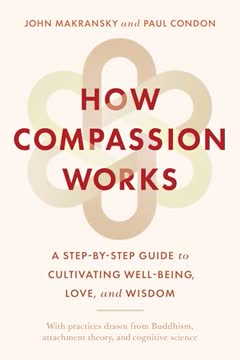
Readers of How Compassion Works largely praise its structured, accessible meditations and its blend of Buddhist-derived contemplative practice with neuroscientific and psychological research. A human services professional found the guided meditations particularly effective, while a sociologist appreciated the book's interdisciplinary rigor but criticized its lack of structural and systemic analysis. One reader initially struggled with the scientific writing style yet found the content highly practical, noting measurable improvements in their meditation practice. Overall, reviewers recommend it as a valuable personal and professional resource, averaging 4.08 out of 5 stars.