

Key Takeaways
You get conned when you think you're the one doing the cheating
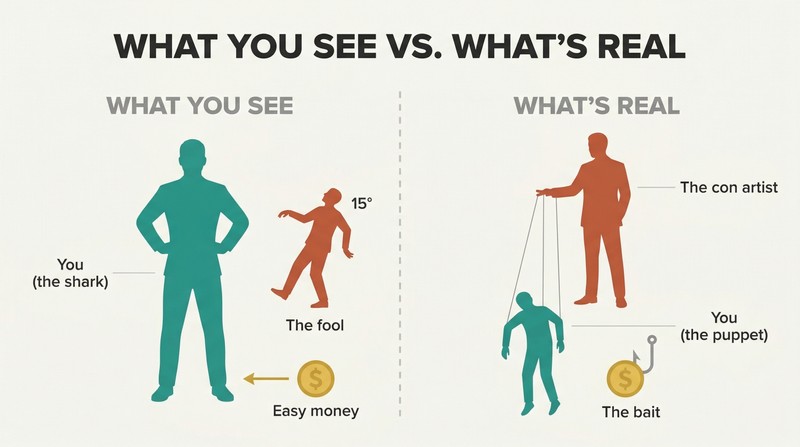
The victim's greed is the weapon. In the Drunken Paw, a loud drunk challenges you to poker and "accidentally" flashes both hands — his shows three jacks, yours shows four kings. You bet everything. He draws two cards and makes a Straight Flush, which crushes kings. The drunk was never drunk. His mistakes were choreographed to make you think you had the unfair edge.
The same principle drives nearly every con in this book. In the Watch Fob Off, you buy a "found" $2,000 watch for $125 because you think you're cheating the owner. In the Crossed Deck, you're recruited as a cheating partner and lose your life savings. The moment you believe you're exploiting someone else's misfortune, you're the one being played.
Every hustle follows the same three-act script: Hook, Line, Sinker
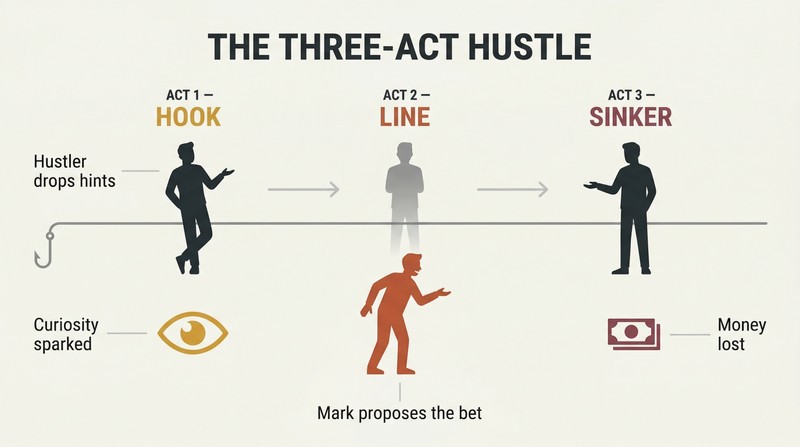
The framework is universal. Freddy quietly studies a cigarette, creating curiosity (the Hook). He muses about tying it into a knot without tearing the paper. You mentally prove it's impossible and eagerly offer a bet (the Line). He wraps the cigarette tightly in cellophane, ties a knot, unwraps it — perfectly intact. He takes your money (the Sinker).
The best hustlers never directly propose a bet. They drop hints and let the mark talk themselves into wagering. Whether it's a $5 bar bet, a street hustle, or a six-figure con, this three-act seduction repeats: create curiosity, build false confidence, then execute the sting. Recognizing the buildup is your best defense.
When someone explains odds while offering a bet, those odds are wrong
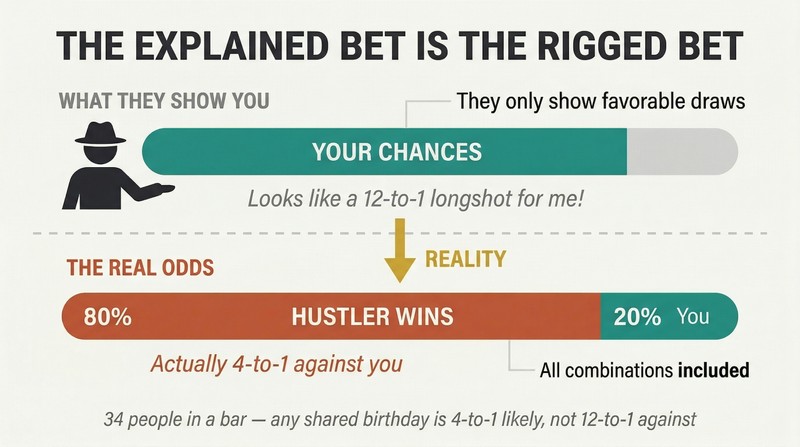
Hustlers weaponize math illiteracy. Freddy once bet the author $50 that two people in a bar of 34 would share a birthday. It seemed like a 12-to-1 longshot. The real odds? 4-to-1 in Freddy's favor. With just 22 people, it's already 50-50 — because you're betting on any shared birthday, not a specific one.
The Seven Card Hustle works similarly. Freddy lets you pick 3 red cards from 5 red and 2 black. He walks you through only the favorable odds on each individual draw while omitting all losing combinations. Real odds: 5-to-2 against you. Chance is what the mug believes in; odds are the exact probability. There is only a theory of probability but a definite law of averages.
In Three Card Monte, every winner you see is on the payroll
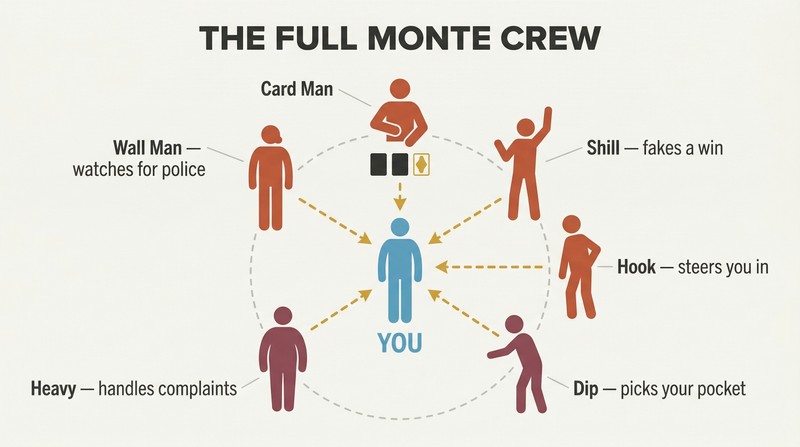
Monte is not a game — it's a theatrical production. The card man uses a move called the Hype to secretly switch which card he throws first, meaning the queen was never where you tracked it. But sleight-of-hand is just one layer. The full team includes:
1. Wall men watching for police
2. Shills who pretend to win, building your confidence
3. A Hook (often a woman) to steer you in
4. A Dip (pickpocket) who robs you even if you don't bet
5. A Heavy who handles anyone who complains
The bent corner "tells"? Planted by shills and switched by the card man in milliseconds. Despite being exposed on television repeatedly, people still lose money on this hustle daily.
The sneakiest cons cheat in your favor to keep you spending
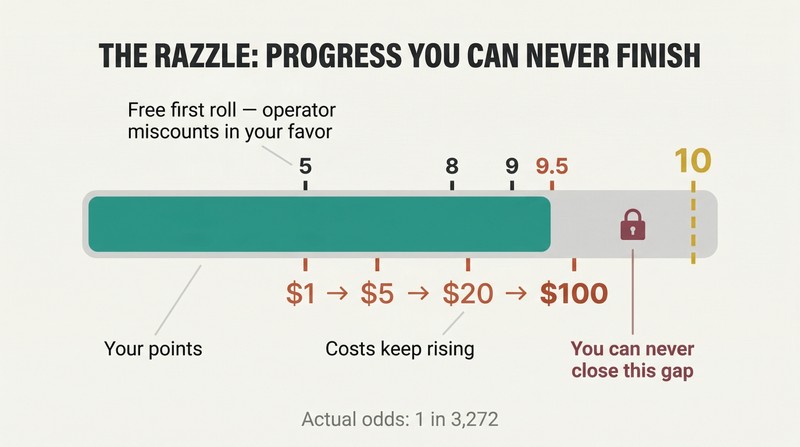
Razzle is a carnival game where you roll marbles into numbered holes, total the score, and convert it on a chart to "points." Reach ten points and win a big prize. Your free opening roll scores five points — halfway there! Each subsequent roll costs a dollar, with prices escalating as you invest more to protect your running score.
Here's the devastating twist: you can't actually score those points. The odds against a winning total are over 3,272-to-1. That opening five-pointer? The operator miscounted in your favor to hook you. He'll keep giving you 8, 9, even 9.5 points — but never ten. One American industrialist reportedly lost $95,000 in a single Razzle session.
Never play a game where you pay more to keep your score
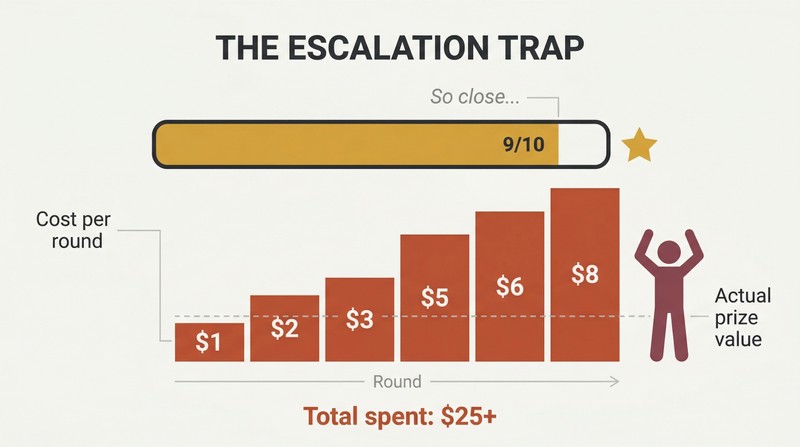
The Flat Count is an escalation trap. You try a carnival game for a dollar and score a few points toward a prize. Then you miss. The operator offers to let you continue — but it costs a dollar to keep your earned points plus a dollar for the next attempt. Soon it's $3, then $5, then $6 per try. At nine out of ten points, quitting feels insane.
This structure appears everywhere: Razzle uses a version called the Ten Count or Add-On, where new prizes are stacked onto your potential winnings, each one increasing the per-play cost. The golden rule is absolute: if continuing requires paying to preserve what you've already "earned," you're inside a machine designed to extract every dollar you have.
If a stranger recruits you as their cheating partner, you're the mark
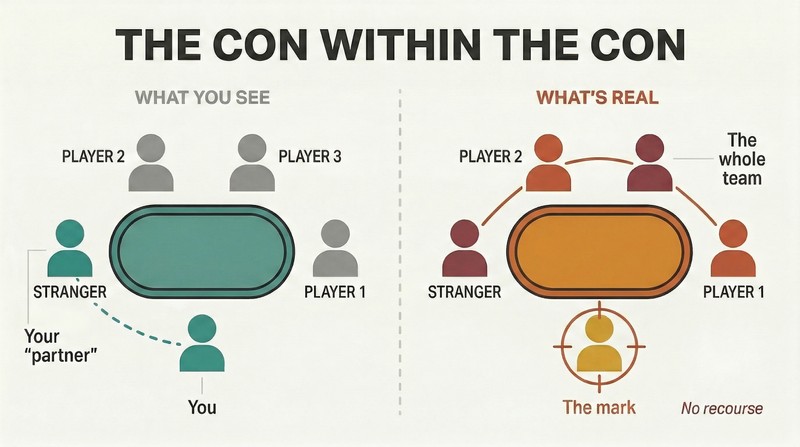
The Crossed Deck is a con within a con. A charming stranger reveals he's a card cheat and recruits you as his partner. He teaches you signals, bankrolls your first game with his money, and you "win" $200. Then comes the big game — a $5,000 buy-in you fund yourself. Every player at the table is part of the team. The deck is switched, you're dealt a losing hand, and your money vanishes.
You have zero recourse. You can't report it — you'd confess to attempted cheating. The first night's winnings were counterfeit. The stranger's fury afterward is scripted to make you blame yourself. This con has been pulled for hundreds of thousands of dollars, targeting anyone who fantasizes about a sure-fire gambling edge.
Watch the shuffle and cut — that's where invisible theft happens
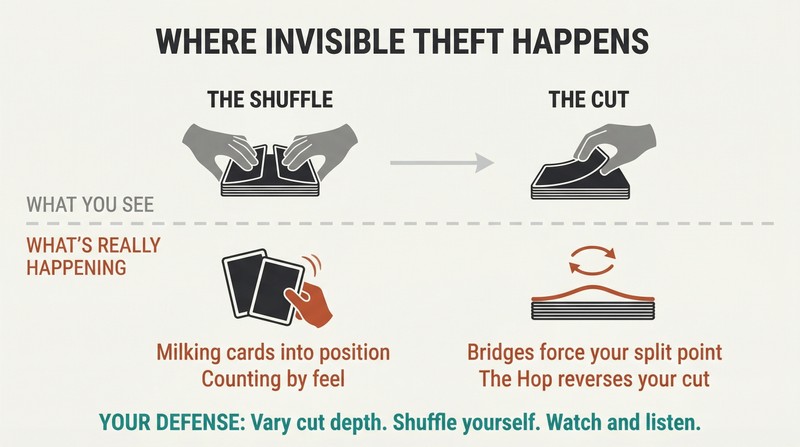
Card cheats don't need Royal Flushes. A professional mechanic controls just two or three cards per deal — enough to twist the odds decisively. During an Overhand Shuffle, a cheat milks desired cards into position with imperceptible finger movements. During a Riffle Shuffle, an expert counts cards by feel alone, interlacing them into exact dealing positions.
The cut is the most critical moment. Cheats defeat it using bridges (tiny bends that force you to split where they want), shills who tap the deck to "let it ride," or the Hop — a two-handed move that reverses the cut in a tenth of a second. Your defense: vary your cut depth randomly, insist on shuffling yourself, and never let the deck leave your sight. A false shuffle may also produce an unnatural clicking rhythm — listen carefully.
Hustlers fake drunkenness; real drinkers make the easiest targets
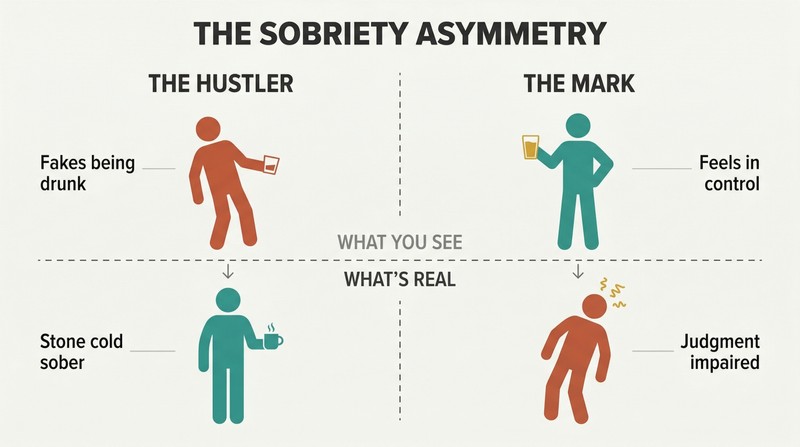
Alcohol is the con man's best friend — yours, not his. The Drunken Paw features a "drunk" who can barely stand, drops cards, and slurs his words. He's stone sober. His bumbling act makes you underestimate him and bet aggressively. The Tat hustle unfolds at hotel bars where business colleagues drink freely — the perfect setting for a rigged dice game nobody will scrutinize.
The upside-down gin and tonic works by dipping the glass rim in gin for the smell, then filling it with plain tonic. The cheat smells like he's drinking but stays razor sharp. Meanwhile, every major hustle in the book — from the Drunken Paw to corporate convention dice scams — begins when drinks are flowing and the victim's judgment is impaired.
Suspect cheating? Leave silently — never confront, never accuse
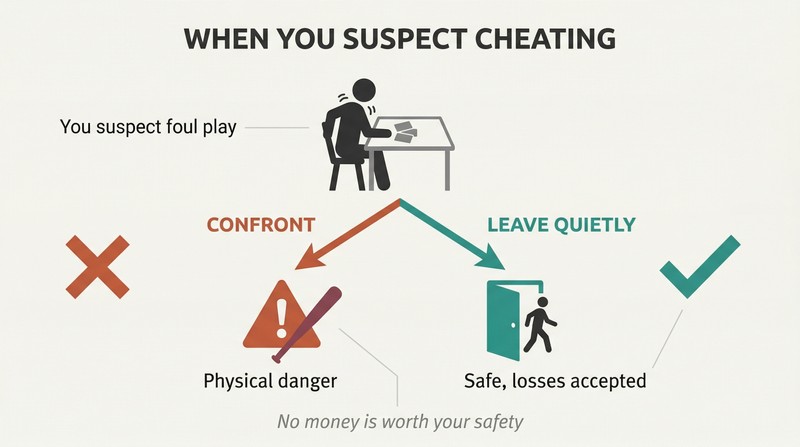
Confronting a cheat is more dangerous than losing the money. A petty cheat called Paw-Paw was caught palming chips in a poker game. His hands were smashed so badly he never used them again — not by police, but by a fellow player. At carnivals, persistent complaints are settled near noisy generators with steel tent pegs.
Freddy's advice is blunt: if you suspect anything, make a polite excuse and walk away. Don't explain your suspicions. Don't try to recover losses. Don't heroically expose the cheat to save other players. If a cheat is caught red-handed, they become a dangerous person. The money you've lost isn't worth your safety. And remember — you'll struggle to describe the cheater accurately even two weeks later.
Analysis
Lovell's book occupies a fascinating position at the intersection of criminal sociology, applied psychology, and practical self-defense. His innovation lies in the composite character 'Freddy the Fox,' which transforms what could be a dry encyclopedia of cons into something approaching gonzo journalism from the cheating underworld — making dangerous knowledge not just palatable but genuinely entertaining.
The most important insight, distributed across hundreds of pages of specific techniques, is that deception is fundamentally a psychological operation, not a technical one. The sleight-of-hand, loaded dice, and marked cards are tools, not weapons. The weapon is always the victim's own cognitive biases: the sunk cost fallacy (Razzle's escalating payments), confirmation bias (reading favorable odds into rigged propositions), and above all the moral licensing that occurs when victims believe they're taking advantage of someone else's misfortune. Lovell's work predates the behavioral economics revolution that would later give academic names to these phenomena, yet describes them with far greater operational precision than most textbooks.
What elevates the book beyond true-crime entertainment is its meta-lesson about information asymmetry. The safest poker games, Lovell notes, are the highest-stakes professional ones — precisely because every player knows how cheating works and watches for it constantly. The dangerous games are the friendly Friday-night ones, where trust substitutes for vigilance. This is a transferable principle: in any transaction, the party with less information about how exploitation works is the party most likely to be exploited. The book's ethical tension — ostensibly protective while providing a complete cheating manual — mirrors debates now common in cybersecurity. Lovell resolves it pragmatically: these techniques require years of practice to execute but only minutes to recognize, making the book asymmetrically useful for defense over offense.
Review Summary
How to Cheat at Everything receives mixed reviews. Readers find it informative about various cons and scams, particularly in gambling and carnival games. Many appreciate the insights into cheating techniques and how to avoid being conned. However, some criticize the dated content, poor editing, and unclear writing. The book is seen as more useful for understanding scams than as a how-to guide. Opinions vary on its entertainment value, with some finding it fascinating and others tedious, especially in sections on card and dice manipulation.
People Also Read




Glossary
NAP Bet
Bet victim cannot winStands for 'Not A Prayer.' A category of bar hustle where the victim has absolutely zero chance of winning, either through the hustler's superior mathematical knowledge (as in the game of NIM or 31) or through outright trickery. Distinguished from Odds Bets where the hustler merely has a statistical advantage.
Hook, Line and Sinker
Three-stage hustle structureThe universal framework for setting up a con or proposition bet. The Hook creates interest or curiosity before any bet is suggested. The Line builds false confidence and lures the victim into wagering, often by letting them convince themselves the bet is favorable. The Sinker is the execution—the moment the money is taken.
Razzle
Points-based carnival escalation scamA carnival game where players roll marbles or dice into numbered holes, convert the total to points on a chart, and must reach a target score (often ten points) to win prizes. The operator miscounts totals in the player's favor to create the illusion of progress while escalating per-play costs. Considered one of the most profitable carnival scams ever devised. Also called Razzle Dazzle.
Flat Count
Escalating payment to preserve scoreA carnival technique where the player accumulates points toward a prize but must pay increasing amounts to preserve their running score with each new attempt. Also called the Ten Count or Add-On when used in Razzle. The costs compound as the player approaches the winning threshold, exploiting sunk cost psychology.
The Crossed Deck
Partner-recruitment con gameA sophisticated confidence game where the victim is befriended by a cheat, recruited as a cheating partner for a card game, given fake winnings to build trust, then invited to a high-stakes game where every other player is part of the team. The victim loses their own bankroll and cannot report the crime without confessing to attempted cheating.
Iron Man
Pre-stacked deck switched inAlso called a Cooler. A pre-arranged deck of cards secretly switched into a live game, replacing the cards in play. The switch takes seconds using methods like the Coat, Lap, Waiter, or Drop techniques. Often also introduces marked cards for continued advantage beyond the stacked hand. Named because it is impossible to beat.
Mechanic
Expert sleight-of-hand card cheatA professional cheat who has mastered the full range of card or dice manipulation techniques including false shuffles, second deals, bottom deals, stacking, mucking, and switching. Mechanics spend years perfecting their moves and typically specialize in one or two core techniques while being proficient at many others.
Two-Way Joint
Game settable fair or riggedA carnival or fairground game that can be adjusted by the operator to be either winnable or unwinnable, often through subtle equipment changes. Used to demonstrate that the game can be beaten during the sales pitch while making it impossible during actual paid play. Examples include weighted bottles, adjustable skittles, and ball games with hard and soft balls.
The Tear Up
Fake check destruction trickA technique where a hustler pretends to tear up a victim's check as a generous gesture, actually destroying a similar-looking substitute check from a collection kept in the wallet. The real check is cashed before the victim realizes they should cancel it. Sometimes performed over the side of a cruise ship for added convincingness.
Shill
Planted fake player or bystanderA member of a cheating team who poses as an ordinary player, bystander, or customer. Shills win games to build victims' confidence, create misdirection during critical moves, steer victims into making larger bets, and validate the appearance of a fair game. In Three Card Monte, shills are the only people who ever win money.
The Hype
Monte's secret card switchThe key sleight-of-hand move in Three Card Monte, also called the Slide. The card tosser holds two cards in one hand and one in the other. On a straight toss, the bottom card of the pair is thrown first. On the Hype, the top card is thrown instead, looking identical to a straight toss. The switch happens before cards hit the surface.
FAQ
1. What is "How to Cheat at Everything" by Simon Lovell about?
- Comprehensive cheating exposé: The book is a detailed guide to the world of cheating, scams, and hustles, especially in gambling, fairs, carnivals, and everyday life.
- Insider knowledge revealed: Simon Lovell, a professional con man, exposes real techniques used by cheats, from sleight-of-hand in card and dice games to street and internet scams.
- Educational and protective aim: The book’s primary goal is to educate readers so they can recognize, avoid, and protect themselves from being conned, rather than to teach them how to cheat.
- Narrative through Freddy the Fox: The character Freddy, a composite of real-life cheats, guides readers through stories, techniques, and the psychology behind hustling.
2. Why should I read "How to Cheat at Everything" by Simon Lovell?
- Protection from scams: The book equips readers with practical knowledge to spot and avoid a wide range of cons, from bar bets to sophisticated gambling cheats and internet fraud.
- Insight into cheat psychology: Lovell explains how cheats manipulate human nature, greed, and trust, helping readers understand why people fall for scams.
- Entertaining and educational: Real-life anecdotes, humor, and the colorful character of Freddy make the book engaging while delivering serious lessons.
- Practical rules and advice: Readers gain actionable tips for everyday situations, such as always counting change and avoiding games with running totals.
3. What are the key takeaways from "How to Cheat at Everything" by Simon Lovell?
- Awareness is protection: Knowledge of how scams and cheats work is the best defense against losing money or being manipulated.
- Cheats exploit psychology: Most cons succeed by controlling victims’ thoughts and actions, not just through technical skill.
- Never trust favorable odds: If someone is explaining odds or offering a deal that seems too good, it’s likely a setup.
- Vigilance in everyday life: The book’s lessons apply beyond gambling, warning readers to be cautious in all transactions and interactions.
4. Who is Freddy the Fox in "How to Cheat at Everything" and what role does he play?
- Master cheat and guide: Freddy the Fox is the book’s protagonist, a professional hustler who never loses because he cheats.
- Source of real-life examples: Freddy shares stories and demonstrates hundreds of cheating techniques, illustrating both mechanics and psychology.
- Teacher and protector: He aims to arm readers with knowledge, turning them from “wimps into Rambos” against hustlers.
- Lovable rogue persona: Freddy is depicted as a charming, witty character who enjoys high-stakes games, whiskey, and cats.
5. What are the main types of scams, hustles, and cons explained in "How to Cheat at Everything" by Simon Lovell?
- Bar and prop bets: Includes seemingly impossible feats and bets with hidden setups, such as tying a cigarette in a knot or match tossing.
- Card and dice cheating: Covers marked cards, false shuffles, stacking, loaded dice, controlled rolls, and signaling systems.
- Carnival and fairground scams: Explains games like Razzle and Flat Count, which use psychological tricks and miscounting to fleece players.
- Street and internet scams: Details cons like the Pigeon Drop, Jam Auction, fake repairmen, chain letters, and online pyramid schemes.
6. How does Simon Lovell explain the psychology and mindset of professional cheats in "How to Cheat at Everything"?
- Ice-cold nerve and patience: Cheats practice for years and wait for the perfect moment to strike, combining skill with boldness.
- Sloppy appearance as cover: Many professionals appear clumsy or amateurish to lower suspicion, masking their true abilities.
- Misdirection and teamwork: Cheats rely on distractions, shills, and signaling to manipulate games and victims.
- Exploiting human nature: They take advantage of greed, trust, and distraction, making victims complicit in their own downfall.
7. What are the key card cheating techniques described in "How to Cheat at Everything" by Simon Lovell?
- Marked cards: Methods include blockouts, line work, daubing, and tactile marks, allowing cheats to identify cards during play.
- False shuffles and cuts: Techniques like overhand false shuffles, riffle stacks, and crimped cuts keep the deck order intact while appearing fair.
- False dealing and palming: Moves such as second deals, bottom deals, and palming let cheats control which cards are dealt or hidden.
- Stacking and mucking: Stacking arranges cards for desired outcomes, while mucking involves switching cards in and out of play.
8. How are dice cheating and controlled rolls performed according to "How to Cheat at Everything" by Simon Lovell?
- Loaded and gaffed dice: Cheats use weighted, shaped, or magnetically controlled dice to alter outcomes in their favor.
- Switching techniques: Sleight-of-hand moves like the Change Over and Thumb Switch allow cheats to swap fair dice for loaded ones.
- Controlled rolls: Techniques such as the slide, drop, and whip shot enable cheats to influence dice results, often aided by special cups.
- Dice cup manipulation: Devices like the Butterfly Cup help conceal dice switching or control during play.
9. What is the "hook, line, and sinker" method in prop bets as described in "How to Cheat at Everything" by Simon Lovell?
- The Hook: The cheat creates curiosity or interest, drawing the victim in with a subtle action or statement.
- The Line: The cheat plants the idea of a bet, making the victim believe the feat is impossible or highly unlikely.
- The Sinker: The cheat performs the “impossible” feat, winning the bet and leaving the victim amazed and out of money.
- Psychological manipulation: This method relies on the victim’s overconfidence and desire for easy wins.
10. How do marked cards, stripper decks, and twinkles work in card cheating according to "How to Cheat at Everything" by Simon Lovell?
- Marked cards: Cards are subtly altered with marks, shading, or tactile bumps to reveal their identity to the cheat.
- Stripper decks: Cards are shaved or shaped so specific cards can be easily located or extracted during play.
- Twinkles and mirrors: Tiny reflective surfaces hidden in jewelry or objects allow cheats to glimpse card faces during dealing.
- Detection and prevention: The book offers tips for spotting these methods, such as the riffle test and checking for uneven cards.
11. What are the most common street, carnival, and internet scams exposed in "How to Cheat at Everything" by Simon Lovell?
- Carnival games: Scams like Razzle and Flat Count use miscounting and psychological tricks to keep players hooked and losing.
- Street cons: Includes the Pigeon Drop, Jam Auction, fake repairmen, and buying a brick (selling a worthless box).
- Internet frauds: Chain letters, work-at-home schemes, credit repair scams, and pyramid schemes are detailed as modern versions of old cons.
- Prevention advice: Lovell stresses skepticism, never paying money to get money, and reporting suspected scams to authorities.
12. What are the best safety tips and rules for avoiding scams and hustles in "How to Cheat at Everything" by Simon Lovell?
- Always count your change: Many cheats rely on short-changing distracted victims; always verify your money before leaving.
- Avoid suspicious games and bets: Never play games requiring running totals, pay-to-keep points, or bets that seem impossible to win.
- Don’t trust explained odds: If someone is explaining odds or offering advice, assume the odds are stacked against you.
- Be cautious with confrontations: Avoid exposing cheats in public; instead, quietly walk away or report to law enforcement for your safety.
Download PDF
Download EPUB
.epub digital book format is ideal for reading ebooks on phones, tablets, and e-readers.








































