


Key Takeaways
You are the world's number-one product, and you sell it daily
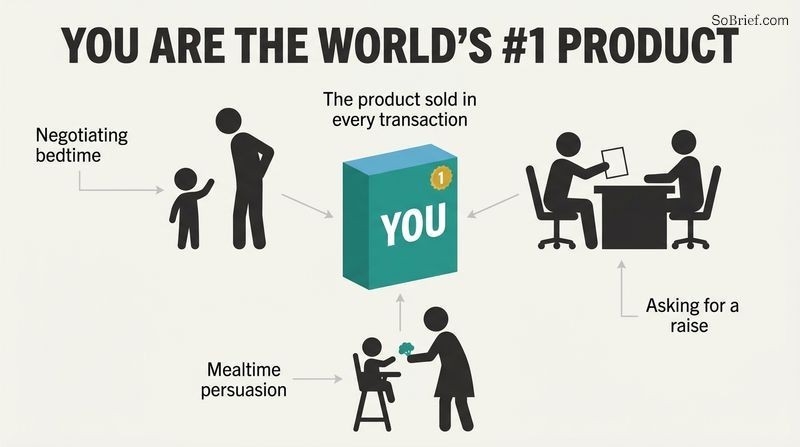
Selling is universal, not a job. Girard holds the Guinness record for retail car sales, 1,425 in a single year, audited by Deloitte. Yet he insists the cars were never his real product. The product was Joe Girard. His core claim: from the moment we can reason, every human being is a salesperson. A child bargaining for a later bedtime, an employee asking for a raise, a teenager talking his way into the family car, a parent selling broccoli to a toddler. All of it is persuasion.
The most valuable inventory is you. Because you are always influencing someone toward your view, your wishes, or your worth, the asset you market most often is yourself. And no one can sell that product better than you, once you know how.
What's striking is how far Girard universalizes selling, three decades before Daniel Pink's "To Sell Is Human" quantified that people spend roughly 40% of work time in non-sales persuasion. The framing echoes Erving Goffman's dramaturgy, where social life is continuous impression management. The danger is instrumentalization: treating every relationship as a transaction can hollow out intimacy. The steelman is that persuasion is morally neutral. Whether you are pitching a product or asking a friend for help, clarity about what you are conveying and to whom is simply competence. Girard's move is to dignify ordinary influence as a learnable craft.
Nobody buys you until you are completely sold on yourself
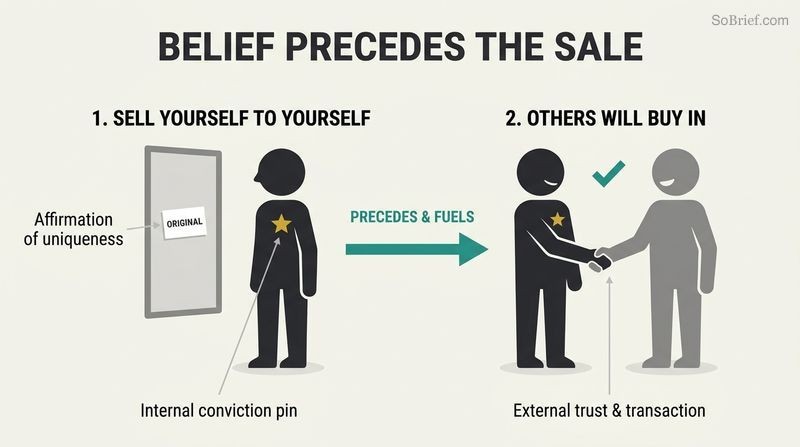
Belief precedes the sale. Girard grew up hearing from his father that he would never amount to anything, and from his mother that he was unrepeatable. He chose his mother's verdict. He wears a gold number-one lapel pin and tapes index cards reading affirmations to his bathroom mirror, repeating them morning and night. The point is not vanity but fuel.
Psyching up is real. His example is Muhammad Ali, who told everyone within earshot that he was the greatest, calling rounds in rhyme. The one fight Ali skipped his ritual self-hype, against Leon Spinks, he lost; he reclaimed the title once he resumed it. Girard's biological flourish: no two people share fingerprints, voiceprints, or personalities, so each person is literally an original with no competitor.
This maps cleanly onto Albert Bandura's self-efficacy research, which shows belief in one's capability predicts performance across domains. But the science adds a caveat Girard misses. A 2009 study by Joanne Wood found that repeating positive affirmations like "I am a lovable person" actually worsened mood in people with low self-esteem, because the statement clashes with their self-concept. Affirmations work best as reinforcement for those already on solid footing, not as a cure for genuine self-doubt. The Ali example is sharper than the mirror cards: pre-performance ritual and arousal regulation are well documented in sports psychology.
Treat every boo as a compliment and run from the chronic gripers
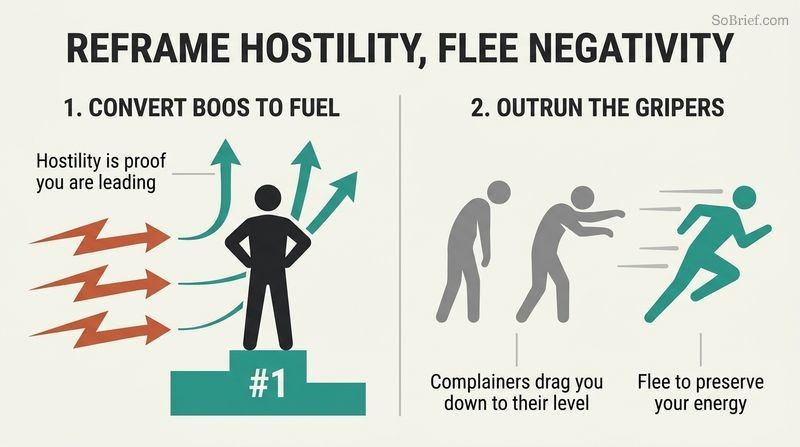
Three kinds of people. Girard sorts everyone into number ones, who achieve, stay enthusiastic, and recharge others; number twos, the gripers always hunting a shoulder to cry on; and number threes, the cop-outs who shrug "what's the use." His instruction is blunt: emulate the ones, flee the twos and threes, because losers work to drag winners down to their level.
Reframing hostility. When Girard became top salesman, his peers booed him at industry banquets, year after year, eventually on national TV. He drew on Ted Williams, whose batting average reportedly climbed whenever the stadium jeered. Girard stood up, thanked the hecklers, and told them the day they stopped booing was the day he stopped being number one. He converted contempt into evidence of his standing.
This is folk sociology that modern network science partly vindicates. Christakis and Fowler's work shows emotions and behaviors spread through social ties, so curating your reference group genuinely shapes outcomes. The booing dynamic resembles tall-poppy syndrome and crab-bucket mentality, both documented across cultures. The constructive challenge: Girard's framework can become a defense mechanism. If every critic is dismissed as a jealous "two," you lose the signal in legitimate feedback. The wiser version distinguishes envy-driven attacks, which deserve indifference, from substantive criticism, which deserves a hearing even when it stings.
Let faith outshout fear by making your mind command your body
Confidence is rebuilt brick by brick. Girard's life cratered before it soared. His construction business collapsed, leaving him sneaking into his own home through a back window to dodge repossession, with no food in the house. His wife June's unwavering faith pulled him back. He talked his way into a car-sales job, promised to beat the dealership's best salesman within two months, and did.
Five rules to banish fear. Believe in yourself, associate with confident people, keep your confidence machine fueled with faith, be master of your ship, and stay busy. He cites a surgeon's claim that only about 5% of people let their minds rule their bodies while 95% are ruled by impulse. George Eastman, near ruin when his photographic plates failed, rebuilt his confidence and invented roll film and the Kodak.
The mechanism resembles Julian Rotter's internal locus of control, the belief that you, not circumstance, steer outcomes, which correlates with resilience. "Keep busy" is more than a platitude: behavioral activation, deliberately scheduling action despite low mood, is a frontline, evidence-based treatment for depression. The 5%/95% figure is rhetorical rather than empirical. The deepest insight is relational: Girard rebuilt on borrowed faith from June before he could generate his own. Research on social support buffering confirms that others' belief in us measurably lowers stress and raises performance, especially during collapse.
Listen with all five senses or watch the sale walk out
The cost of not listening. Two ears, one mouth, Girard notes. His most painful lesson came when a wealthy contractor was minutes from buying, then started talking about his son at the University of Michigan studying to be a doctor. Girard, certain the sale was sealed, half-listened while straining to catch a joke outside his door. The man walked. That night Girard phoned him at eleven to ask what went wrong and learned he had failed to honor the customer's pride in his boy.
Listening is active. We absorb only about half of what is said. Girard's model is financier Bernard Baruch, who advised presidents from a park bench mostly by listening. Mirror expressions, never interrupt, and hear between the lines.
This anticipates Carl Rogers's active, empathetic listening and is confirmed by modern sales analytics. Conversation-intelligence firms like Gong have found top reps listen far more than they talk, with talk-to-listen ratios skewed toward the customer. The contractor story reveals something deeper than technique: people often buy emotional recognition, not just a product. The man needed his fatherly pride witnessed. The lesson cuts directly against the cultural caricature of the motor-mouthed salesman, which is precisely why Girard, the record holder, makes it the heart of his method.
Speak the other person's language: trade every I for a you
Become bilingual in your own tongue. Girard divides words into move-forward words that pull people toward you (you, yours, we, please, thank you, sorry, promise) and hold-back words that push them away (I, me, my, later, maybe). One firm banned the word "I" from all outgoing letters. IBM's star Buck Rodgers sold not transistorized circuitry but what the machine did for the buyer: easier work, lower cost, better service.
Keep it simple and safe. Girard prizes Churchill's preference for short words, the ones that move people, as in "blood, toil, tears and sweat." He warns against red-flag topics (religion, politics, race), against slang that dates fast, and against profanity, which offends half your audience and embarrasses the other half.
This is Dale Carnegie refined into linguistics. The pronoun insight has a surprising empirical twist: James Pennebaker's text analysis found that higher-status people actually use "I" less and "you" more, so Girard's rule doubles as a status signal. Benefit-selling, framing features as outcomes for the buyer, remains the spine of modern marketing copy. The caution is sincerity. When pronoun-swapping becomes a conscious manipulation rather than genuine other-orientation, listeners sense the performance. The technique works because, done right, it forces you to actually adopt the other person's vantage point, not merely mimic its vocabulary.
Truth is simply easier to remember than a lie
The practical case for honesty. Beyond morality, Girard argues lying is bad memory management: a single falsehood demands more falsehoods to cover it, while the truth never needs maintenance. His moral anchor was Father Solanus Casey, a Detroit Capuchin monk, now on the path to sainthood, who told the neighborhood boys they could fool people but never God.
Truth that costs money. Drafted into the army, Girard injured his back falling off a truck. Asked if he had ever hurt his back before, he could have stayed silent and likely collected a lifelong disability pension. Instead he disclosed an old diving-board injury and forfeited the money, unwilling to let a monthly check call him a liar forever. He also cites General Billy Mitchell, court-martialed for truthfully warning about air power, vindicated only after death.
Deception carries a measurable cognitive tax. Reaction-time and neuroimaging studies show lying is slower and more effortful than telling the truth, because the brain must suppress the true answer before fabricating an alternative. Girard intuited this decades early. The pension anecdote functions as a costly signal in the economic sense: integrity proven precisely because it hurt. Stephen Covey would later monetize the idea as "the speed of trust." Girard's own nuance keeps it humane: he pairs truth-telling with kindness, recognizing that unvarnished honesty deployed cruelly is its own failure of salesmanship.
A promise is a contract, so think hard before you make one
Words with backbone. Girard treats "I promise" as binding as a signed contract, not a casual IOU. Judge Myron Wahls put it plainly: if you doubt you can keep it, do not make it. The cautionary tale is Alex, a service write-up man habitually promising cars ready by four o'clock and callbacks he forgot, until he was nearly fired.
Two rules rescued him. First, force yourself, at any cost, to keep every promise already made. Second, think before making any new one, asking honestly whether you can deliver. Within a month customers were calling Alex sincere, service sales rose, and his job was safe. When circumstances genuinely shift, Girard says, phone ahead and renegotiate rather than break the promise in silence.
This dovetails with Robert Cialdini's commitment-and-consistency principle and with expectation-violation theory: a broken promise damages trust more than a promise never made, because it betrays a stated standard. "Underpromise and overdeliver" became service-industry gospel decades after Girard's lunch with Alex. The proactive renegotiation point is underrated. Most trust is destroyed not by failure itself but by the silence around it. In flaky cultures where follow-through is rare, simple reliability has become a sharper competitive differentiator than raw talent, which makes Girard's contract framing more relevant now, not less.
A genuine smile can close a twenty-million-dollar sale
Warmth read first. Girard's signature story: an oil-rich sheikh at a Detroit boat show told one salesman he wanted to buy twenty million dollars of boats. The salesman, unsmiling, looked at him as if he were crazy and a time-waster. The sheikh walked to the next booth, was greeted with a radiant, welcoming smile, repeated his request, and returned the next day with a certified check. The smiling salesman reportedly made 20% and was set for life.
Cheap to give, costly to withhold. A frown uses more muscles than a smile, Girard notes, and smiles are contagious. He coaches putting a smile into your voice so phone listeners can hear it, and replacing the photographer's "cheese" with the warmer thought "I like you."
Psychology backs the priority of warmth. Susan Fiske's stereotype-content model shows humans judge warmth before competence and faster, because warmth historically signaled friend or foe. A welcoming face is processed almost instantly. The facial-feedback hypothesis suggests smiling can even nudge your own mood upward, though replications are mixed. One refinement Girard lacks: authenticity is detectable. A genuine Duchenne smile engages the eyes, while a forced one does not, and people sense the difference. The sheikh tale is surely embellished, but as a parable of warmth-before-substance it is psychologically sound.
The real sale begins the moment you close it
Stand in front of the product. Most salespeople treat the signature as the finish line. Girard treats it as the starting gun. He refused the common phrase "I stand behind what I sell," because no one can see you there. He stood in front of the product, positioning himself between customer and purchase so he could never be dodged when something broke.
The second-miler. When unhappy buyers stormed in, lesser salesmen hid in the washroom; Girard handled the complaint personally, sometimes spending his own money, like gifting a free wheel-alignment certificate that cost him a few dollars. The payoff was a 65% repeat-business rate, which built his record. Going the extra mile, whether asked or not, compounds into loyalty.
This is relationship marketing articulated two decades before academics named it, supplanting the transactional model in the 1990s. The economics are well established: retaining an existing customer costs roughly a fifth of acquiring a new one, and small loyalty gains can swing profitability dramatically. The reciprocity norm explains why the unprompted alignment certificate works so well; unearned generosity creates a felt obligation to return. The "stand in front of the product" image is more than rhetoric. It is a posture of radical accountability, deliberately removing your own escape routes so the customer knows exactly who owns the outcome.
Every person you meet is a gateway to 250 more
The Law of 250. Girard calls his chain reaction principle the Law of 250. A funeral director told him he always orders 250 memorial cards because the average funeral draws about 250 mourners; a printer reported wedding invitations average 250; auditoriums and lounges often cap at 250. So each individual sits at the hub of roughly 250 relationships.
Dominoes, good or bad. Treat one person well and praise ripples outward through their 250, each of whom has 250 more. Treat one badly and you have poisoned 250 prospects at once. Girard reframes it as a chain miracle: influence two people well per week and the math compounds into tens of thousands a year. He points to McDonald's, built on the rule that not one customer leaves dissatisfied.
Girard's folk number sits remarkably close to Robin Dunbar's later research, which pegs stable human relationships at around 150. The figure is impressionistic, not rigorous, but the structural insight is durable: reputation is networked, and every interaction is leveraged. In the social-media era the multiplier dwarfs 250. A single viral review or post can reach hundreds of thousands, which makes the downside risk Girard warns about far more acute today than in 1980. The compounding arithmetic, individual times 250 times 250, is essentially an early intuition of network effects and word-of-mouth virality.
Persistence reframed: no means maybe, and maybe means yes
Rejection as a not-yet. Girard learned his mantra from a fellow salesman: treat "no" as "maybe" and "maybe" as "yes," and you keep hanging in. His proof is Roy, a young man with no experience who wanted a sheet-metal job. Told repeatedly there were no openings, he returned every Monday at eight sharp for weeks until the company hired him partly just to end the suspense.
One step at a time. Girard invokes Edison's endless filament trials, Eastman's roll film, and a marathon runner who pushes through "the wall." The elevator to success is out of order, he says, so take the stairs one step at a time. Life is a race mainly against yourself, and finishing, not placing first, is the win.
This prefigures Angela Duckworth's grit research, which finds sustained perseverance predicts achievement beyond raw talent. The passage Girard quotes on persistence is widely attributed to Calvin Coolidge. But the takeaway needs a guardrail Girard himself supplies: he concedes that Harold Stassen ran for president for decades and never won. Persistence without feedback curdles into stubbornness. The genuine skill, which neither Coolidge nor Girard fully names, is discrimination: telling a soft "maybe" worth pursuing from a hard dead end. Roy's success worked because the door was real but closed, not because doors open to anyone who knocks forever.
Analysis
"How to Sell Yourself" (1980) sits in the lineage of Norman Vincent Peale's positive thinking and Dale Carnegie's relational pragmatism, but Girard's distinctive move is to collapse the boundary between selling a product and constructing a self. His thesis, that you are your own number-one product and are marketing it in nearly every interaction, transforms a sales manual into a philosophy of identity and reputation. That reframing was prescient. Decades later it reappears as "personal branding" and as Daniel Pink's data-backed argument that most modern work is persuasion in disguise.
The book's most durable contributions are relational and long-game rather than tactical. The Law of 250 anticipates network thinking and word-of-mouth virality; the second-miler ethic and the 65% repeat-business figure prefigure relationship marketing and customer-lifetime-value economics that academics would formalize only in the 1990s. Girard's insistence on listening over talking, honesty as memory management, and reliability as a contract all hold up against contemporary behavioral science. His genius was practitioner intuition: he ran the experiment on a showroom floor before anyone wrote the theory.
The weaknesses are real and worth flagging. The relentless self-as-product metaphor risks commodifying personhood, turning friendship and family into pipelines. The affirmation advice oversimplifies what psychology now knows about self-esteem. The chapters on appearance and on women in the workplace are dated artifacts of 1980, heavy on grooming prescriptions and gender essentialism. And the book is anecdote-driven, with vivid stories (the twenty-million-dollar sheikh) that strain credulity as literal events even as they land as parables.
What remains, stripped of its era, is a coherent and humane operating system: believe in your worth, listen hard, speak the other person's language, tell the truth, keep your word, smile, serve beyond the close, and persist. Unfashionably simple, and largely correct.
Review Summary
How to Sell Yourself receives mostly positive reviews, with readers praising its life-changing impact and practical advice. Many appreciate Girard's straightforward writing style and real-world examples. Reviewers credit the book for improving their sales skills, personal growth, and confidence. Some consider it essential reading for students and professionals alike. However, a few critics find the content repetitive or outdated. Overall, readers value the book's insights on self-promotion and communication, with many reporting significant personal and professional benefits from applying its principles.
People Also Read








FAQ
What's How to Sell Yourself about?
- Self-Promotion Focus: The book emphasizes the importance of effectively selling oneself in both personal and professional contexts. Joe Girard shares his experiences as the world’s number-one car salesman to illustrate this point.
- Practical Techniques: Girard provides practical steps to enhance self-confidence, build positive attitudes, and communicate effectively, serving as a guide for improving self-presentation.
- Universal Application: The principles are applicable across various fields, helping individuals stand out in interviews, social situations, and everyday interactions.
Why should I read How to Sell Yourself by Joe Girard?
- Proven Success: Joe Girard is recognized as the world’s greatest salesman, and his methods are based on real-life experiences that led to his success.
- Motivational Content: The book is filled with motivational advice that encourages readers to believe in themselves and their potential.
- Practical Advice: It offers actionable steps that readers can implement immediately to enhance their self-presentation and communication skills.
What are the key takeaways of How to Sell Yourself?
- Self-Confidence is Crucial: Believing in your own worth is the foundation for effective self-promotion.
- Listening is Essential: Active listening is highlighted as a key skill in selling oneself, enhancing communication and relationships.
- The Power of Enthusiasm: Enthusiasm is vital for engaging others, and Girard provides exercises to help develop and express it effectively.
What are the best quotes from How to Sell Yourself and what do they mean?
- “You are what you believe, you are what you think you are.”: This underscores the importance of self-perception in achieving success.
- “Selling yourself actually is a process of persuasion.”: Highlights that self-promotion involves convincing others of your value with trust and authenticity.
- “If you don’t believe you’re number one, no one else will.”: Stresses the necessity of self-belief and how confidence can influence others' perceptions.
How does Joe Girard suggest building self-confidence in How to Sell Yourself?
- Self-Affirmation: Daily affirmations can reinforce self-belief and build confidence over time.
- Surround Yourself with Winners: Associating with positive, successful individuals can boost your own confidence.
- Set Achievable Goals: Establishing and achieving small goals can help build a sense of accomplishment and overall self-confidence.
What techniques does How to Sell Yourself offer for effective communication?
- Active Listening: Emphasizes listening more than speaking to build rapport and understanding.
- Use Simple Language: Advises using clear and straightforward language to ensure understanding.
- Speak the Other Person’s Language: Adapting to others' communication styles can enhance interactions.
How can I apply the principles from How to Sell Yourself in my daily life?
- Daily Affirmations: Start each day with positive affirmations to reinforce self-belief.
- Practice Active Listening: Make a conscious effort to listen attentively in conversations to improve relationships.
- Set Personal Goals: Identify short-term and long-term goals for personal and professional growth.
What is the significance of enthusiasm in How to Sell Yourself?
- Engagement: Enthusiasm is key in engaging others and making a positive impression.
- Motivation: It can motivate both oneself and others, inspiring action and collaboration.
- Cultivation: Girard provides exercises to help develop and express enthusiasm regularly.
How does Joe Girard suggest managing memory in How to Sell Yourself?
- Memory Bank Concept: The mind is likened to a bank where managing what you remember is crucial for effective communication.
- Avoid Clutter: Advises against filling your memory with trivial information to maintain focus on important details.
- Use Word Association: Associating names and concepts with familiar words or images can enhance memory retention.
How does the concept of the Law of 250 work in How to Sell Yourself?
- Ripple Effect of Influence: Each person you interact with can influence approximately 250 others, emphasizing the far-reaching effects of your actions.
- Building a Network: Encourages cultivating relationships thoughtfully to expand your network significantly over time.
- Positive Word of Mouth: Maintaining a good reputation can create a chain reaction of referrals and recommendations.
What is the significance of promises in How to Sell Yourself?
- Building Trust: Keeping promises is fundamental to establishing trust and enhancing your ability to sell yourself.
- Personal Accountability: Being accountable for your commitments is crucial, as failing to keep promises can damage relationships.
- Long-term Relationships: Keeping promises leads to stronger connections and future opportunities.
What role does a smile play in selling myself according to How to Sell Yourself?
- Creates Positive Impressions: A smile can significantly enhance interactions and make you more approachable.
- Builds Rapport: A genuine smile fosters connection and warmth, making it easier to establish relationships.
- Enhances Communication: Smiling while speaking can convey enthusiasm and positivity, making your message more engaging.
Download PDF
Download EPUB
.epub digital book format is ideal for reading ebooks on phones, tablets, and e-readers.








































